Skip to content

You have 15 days after a DWI arrest to request the ALR hearing that fights an automatic license suspension. If you just got home from jail or picked someone up after a late-night stop in Humble, the first call should be to a Humble-area DWI lawyer.
That deadline is the part most families miss because they're focused on bond, work, school, and the embarrassment of the arrest. In Harris County, the criminal case and the license case move on separate tracks, and both can start hurting you before you ever see a courtroom. A calm, local defense strategy right away is the difference between staying organized and letting the case run you.
What to Do Right After a DWI Arrest in Humble
You're probably tired, angry, and trying to figure out what to tell your spouse, employer, or parents. Don't try to solve the whole case tonight. Handle the first quiet decisions first, because those choices shape the next 72 hours more than people realize.
Start with silence and paperwork
Don't post about the arrest, don't explain it on social media, and don't give a long play-by-play to friends who mean well. The state doesn't need your version to build a case, and careless comments only give prosecutors more to work with. Keep your bond paperwork, release forms, and any court notices together in one folder.
Practical rule: If you're unsure whether something helps your case, assume it doesn't and wait to talk to counsel.
A local lawyer can use the bond paperwork to see what the court has already ordered and what deadlines are already moving. If you want a plain-English overview of the release side of the case, find a DUI bail guide can help you understand the general bond process. For a Humble resident, the faster priority is still the same, call a defense lawyer who knows Harris County practice before the license clock runs out.
Make the first legal call before the case starts hardening
A DWI arrest creates two problems at once, the criminal charge and the license issue. A lawyer can start protecting both tracks immediately, and that matters because the ALR deadline moves fast. If you wait until the first court date, you may already have lost your position on the driving side of the case.
If you want to see how bond hearings are handled locally, review what happens at a bond hearing. That's useful because many Humble families don't realize the bond hearing can shape work travel, childcare runs, and routine driving before the case is even set for trial. A lawyer who acts early can also help you avoid accidental bond violations that make an already bad week worse.
Use the first 72 hours to get organized
Before the first court appearance, gather these basics:
- Arrest details: Write down where the stop happened, who was with you, and whether there were passengers or witnesses.
- Medical or work issues: Save anything that shows you need to drive for your job, school, or family obligations.
- Vehicle and license info: Keep your license, registration, insurance, and any tow or impound documents together.
That early organization helps a lawyer move faster when the Harris County timeline starts. It also makes it easier to decide whether the case needs an urgent motion, a bond modification request, or a hard push on the ALR hearing. The first 72 hours are not about panic, they're about preserving options.
How Texas Defines DWI and What Officers Are Looking For
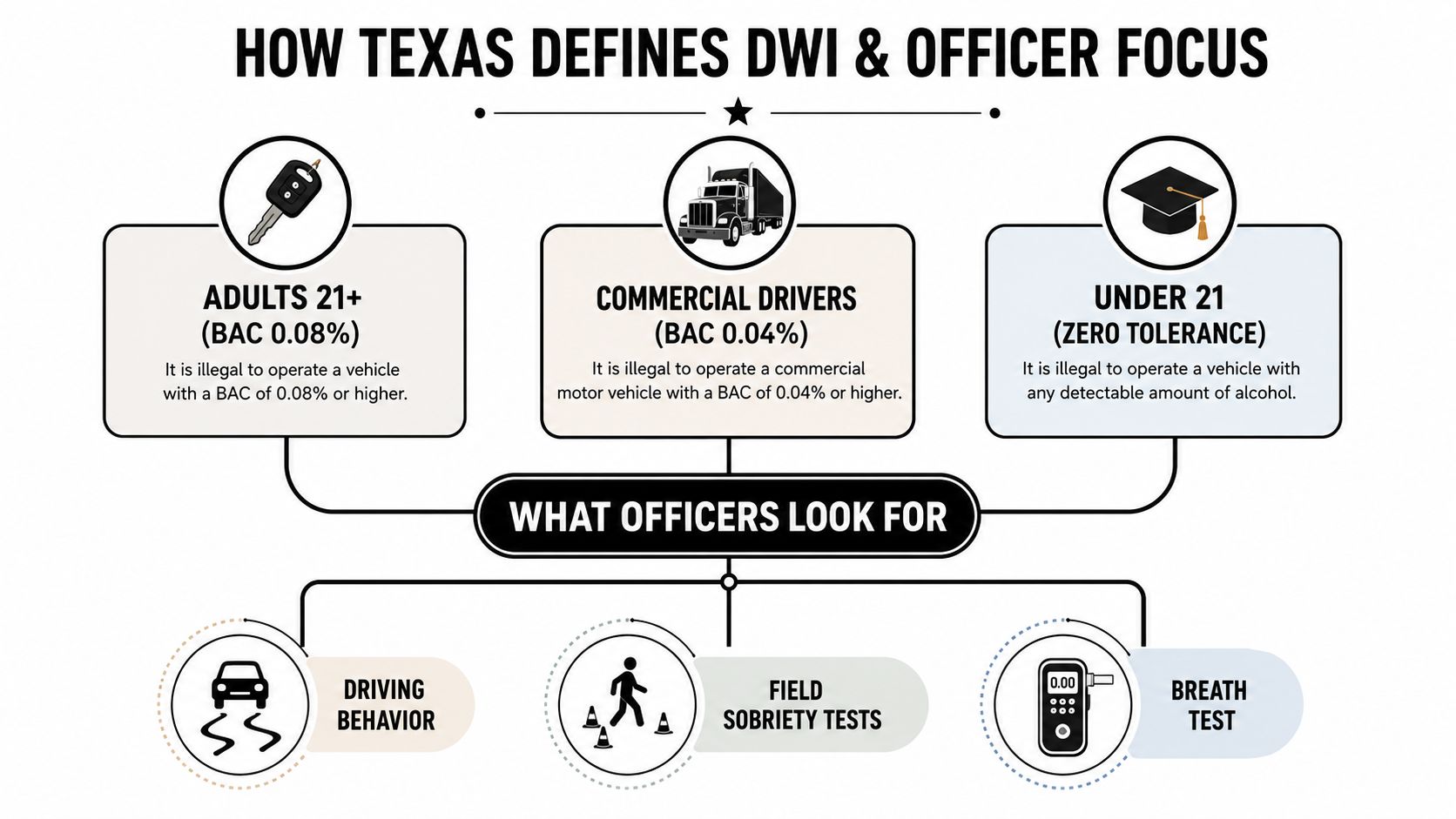
Texas doesn't treat DWI as a narrow, technical label. For adults 21 and over, the legal limit is 0.08% BAC, but the law also covers impairment even when a person is below that number. Commercial drivers face a 0.04 BAC standard, and the state also recognizes a broader impairment rule for safe operation (Texas DWI and DUI laws).
The stop usually matters as much as the test
Most DWI cases don't begin with a dramatic crash. They start with a lane drift, speeding, a broken taillight, or another roadside cue that gives an officer a reason to investigate. Once that stop happens, the officer starts building a chain of observations, driving behavior, field sobriety tests, and then a breath or blood test if things move that far.
The important point is simple. The state has to prove more than “the driver had a drink.” It has to prove lawful stop, proper arrest, and reliable evidence of intoxication or impairment. That's why a Humble-area dwi lawyer humble tx search should lead you to someone who knows how to read the case from the first traffic stop forward, not just the lab result at the end.
What officers focus on in the field
Officers are looking for clues they can later describe in reports and testimony. That usually means they'll pay close attention to balance, coordination, speech, odor, eye movement, and how a person follows instructions. If the officer thinks the driver is impaired, the next layer is usually roadside testing and a probable-cause decision.
The roadside conversation matters because that's where the record starts.
That's also why legal advice is useful even when the facts feel minor. A small traffic issue can turn into a DWI investigation quickly, and once the officer has tied the stop to impairment, the defense has to work backward through each step. If one part of that chain is weak, the entire case can lose force.
Why the legal definition affects your choices
A lot of people assume that if they weren't “drunk drunk,” the case should go away. That's not how Texas law works. Prosecutors can still pursue a DWI if they believe alcohol or drugs impaired normal faculties, and that makes early review essential.
The practical takeaway is this. Don't argue the whole case in your head based on one number or one memory. Get the stop, the testing, and the officer's observations reviewed together.
Texas DWI Penalties and License Consequences Explained
A first DWI in Texas is usually a Class B misdemeanor, and the standard state penalty range includes a jail term of 72 hours to 180 days plus a fine of up to $2,000. Texas also treats the license side as a separate problem, and a first offense can bring a suspension of up to one year (TxDOT impaired driving penalties). Those penalties are the starting point, not the whole picture.
A Humble family usually feels the license problem first. The criminal case moves through court, but the driver still has to get to work, handle school runs, and keep daily life moving while the case is pending.
Criminal court and license court are different fights
People hear “DWI” and assume one judge handles everything. That is not how it works in Texas. The criminal case and the license case move on different tracks, and the license fight can start running before the criminal case is anywhere near a finish. A conviction can also bring collateral problems like license loss, record consequences, and treatment requirements, which is why a lawyer has to look at the whole case, not just the arrest paperwork (Kevin Bennett Law DWI and DUI overview).
| First-Offense DWI Consequences in Texas | Criminal Court | ALR / License Track |
|---|---|---|
| Basic charge | Class B misdemeanor | Administrative suspension issue |
| Jail exposure | 72 hours to 180 days | Not a jail punishment |
| Fine exposure | Up to $2,000 | Not a fine issue |
| Driving impact | Criminal conviction can affect driving privileges | License loss can happen separately |
| Key timing issue | Case moves through court settings | 15-day hearing deadline controls the license fight |
That split matters because a suspended license can disrupt work, family obligations, and daily routines long before the criminal case is finished. In many homes around Humble, Atascocita, and Kingwood, the immediate problem is keeping a spouse working and kids moving while the case works its way through Harris County.
Refusal creates its own risk
Texas implied-consent rules mean refusing a chemical test can still hurt you. A first refusal can mean a 180-day suspension, and a second refusal can mean a 2-year suspension (Jason English Law DWI penalties). That is separate from whatever happens in criminal court.
A refused test does not make the case disappear. It can create a license fight right away, and the arrest still has to be handled in court, on the bond conditions, and on the ALR deadline. If you are in Harris County, the lawyer you want is the one who treats the license deadline and the criminal case with the same urgency. For a plain explanation of the first court appearance, see what happens at an arraignment hearing in a Texas DWI case.
The Harris County DWI Process and Court Timeline
A Humble arrest does not jump straight to trial. The case starts with release, bond conditions, and the first court appearance, where the judge and prosecutor set the pace for everything that follows. From there, the case usually moves through arraignment, pretrial settings, and either a negotiated result or a trial.
The first 30 days are the most important
The first few days decide whether you stay ahead of the case or spend the rest of it catching up. The 15-day ALR deadline is already running, so your lawyer has to deal with the license fight while also getting ready for bond conditions and the first court date. If you miss the hearing request, you can lose a major procedural fight before the criminal case really gets going (Texas DWI arrest guide).
Once you get out, bond conditions can shape daily life fast. Some cases bring ignition interlock requirements, insurance problems, or travel limits that affect getting to work, handling school pick-up, or keeping the household running. Those terms may look small on paper, but they control real life in a hurry.
Practical rule: Bond conditions are part of the defense strategy, not an afterthought.
The first court appearance is where the charge gets formalized and the court starts managing the case. If you want the plain version of that step, review what happens at an arraignment hearing so you understand how the case is officially put on the record.
What the court path usually looks like
The early settings are about process, not theater. Your lawyer uses arraignment to address the charge, preserve objections, and get ready for motion practice. Later settings are where the defense pushes on evidence, testing, and weak points in the State's case before anyone seriously talks about a plea or a trial date.
Harris County courts move in their own rhythm, and that matters for people in Humble. A lawyer who appears in these courtrooms all the time knows the docket, the prosecutors, and the way DWI cases are usually handled in that county. That familiarity can change the tone of negotiation more than families expect.
For a related example of how Harris County court systems affect local families in another area of law, Harris County Family Courts: A Humble Resident's Guide explains how family law cases move through the same court system serving Humble. The point is the same across practice areas, local procedure matters.
A practical timeline families can use
- First 72 hours: keep the paperwork, stay quiet, and call counsel.
- First 15 days: protect the ALR hearing deadline.
- First court setting: address bond conditions and case status.
- Next settings: review discovery, challenge evidence, and decide whether negotiation or trial makes sense.
This process moves slower than people expect, but the deadlines inside it move fast. The early choices do not promise a result, yet they can keep the case from becoming harder than it needs to be.
How a Humble DWI Lawyer Builds Your Defense
A serious DWI defense is not built on slogans. It's built on pressure points, stop the parts of the case that are weak, and force the state to prove the rest. In Texas, the work usually happens before trial, because that's where the defense challenges the stop, the arrest, and the evidence.

The stop and arrest have to hold up
The first question is whether the officer had a lawful reason to stop the car. If that reason falls apart, the rest of the case can weaken with it. The second question is whether the officer had probable cause to arrest, and that's a separate decision point the defense should test carefully.
Field sobriety tests also matter, but they're not magic. They depend on how the officer gave instructions, whether the driver was physically able to perform them, and whether road conditions made the tests less reliable. A lawyer who knows DWI litigation will examine the instructions, the video, and the reports side by side.
Breath and blood evidence need a close look
Chemical testing is often the prosecution's strongest-looking evidence, so it deserves the hardest scrutiny. Defense counsel should examine how the sample was collected, who handled it, and whether the state can connect the evidence cleanly from start to finish. If the chain of custody is sloppy, the defense has room to move.
That's why a lawyer with both pre-trial negotiated resolution experience and jury trial experience matters. Some cases resolve through motion practice or negotiation, but others need to be tried because the state won't back off. The lawyer has to be comfortable doing both.
Good DWI defense is technical work, not guesswork.
Local courtroom experience changes leverage
In Harris County, familiarity with the local judges, prosecutors, and DWI procedures can shape the conversation. A lawyer who regularly handles these matters knows which issues are worth pushing hard and which ones are better used as bargaining chips in negotiation. That can affect whether the state offers a better resolution or digs in.
If you want a direct overview of defense strategy, review how to fight a DWI charge. For families dealing with CPS issues at the same time as criminal allegations, CPS Defense Attorney in Humble is a separate local resource that addresses defense against CPS investigations for Humble families. Legal problems often overlap, and the defense strategy has to account for that reality.
The point of hiring local counsel is simple. You're paying for someone who can find the weak links quickly and use them before the case hardens.
DWI Attorney Fees and How Humble Firms Structure Costs
A DWI case can create legal costs, court costs, and real-life costs at the same time, so the fee structure needs to be clear before anyone signs anything. If a firm can't explain its pricing in plain English, that's a problem.
Ask what the flat fee actually covers
Many misdemeanor DWI firms use a flat-fee structure for the core criminal case. That sounds simple, but the key question is what's included. Ask whether the fee covers pretrial hearings, discovery review, plea negotiations, and trial preparation, or whether any of those are extra.
ALR work may be billed separately. That's not unusual because the license hearing is its own process with its own deadlines and effort. You should know up front whether that hearing is part of the criminal retainer or a separate service.
Trial work and add-ons need clarity
If your case is headed toward trial, ask whether the fee changes once the lawyer starts preparing for jury selection and courtroom presentation. Trial preparation is a different level of work than early negotiation, and most firms price that accordingly. You should also ask who handles the case day to day, the lawyer you hired or staff.
For a practical way to compare professional service pricing in another niche, browse our local SEO cost guide shows why scope and service breakdown matter when you're comparing options. The same logic applies here. Don't compare DWI lawyers by headline price alone, compare what each fee buys.
The right questions beat awkward guessing
Use a simple checklist at the consultation:
- What is included in the quoted fee?
- Is the ALR hearing separate?
- What changes if the case goes to trial?
- Who appears in court for me?
- What costs are outside the fee?
That's the cleanest way to compare firms in Humble, Atascocita, Kingwood, and Northeast Houston without getting lost in sales talk. One more practical note, if a family is juggling a DWI case and child support issues, Child Support Attorney in Humble is a local resource for establishing, modifying, and enforcing child support in Harris County. Legal problems often hit at the same time, and families need clear separation between each issue.
The goal is not to find the cheapest lawyer on the phone. It's to find the lawyer whose fee matches the work your case needs.
Humble-Specific Questions About DWI Cases
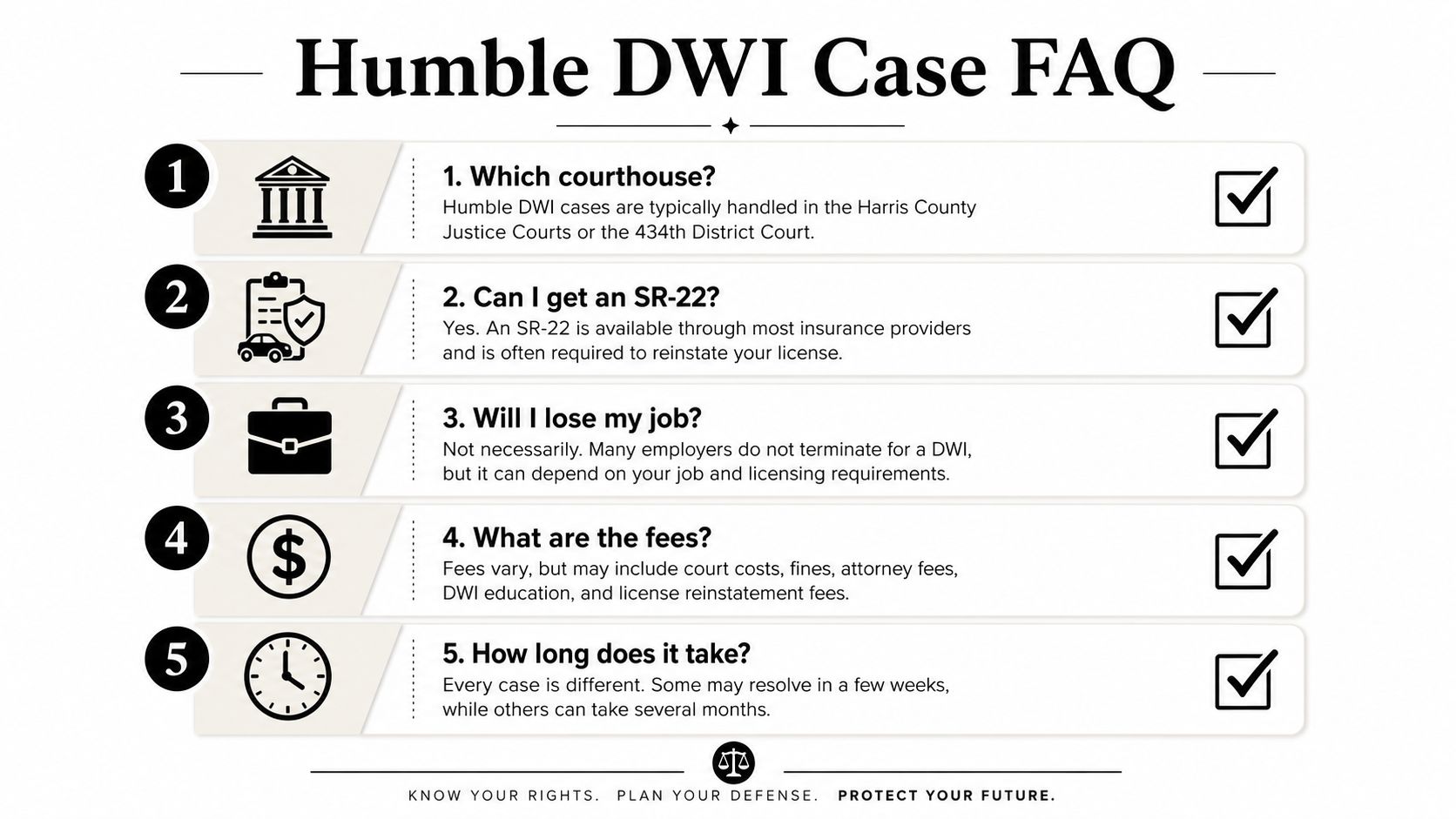
Humble families usually ask the same questions first, only with local details attached. Which Harris County court gets the case? What happens if I still need to drive for work? What should I bring to the consultation? Those are the questions that matter when a late-night arrest has already thrown off the whole week.
Which court handles a Humble case
Humble cases move through the Harris County system, so the courthouse depends on the charge and the docket the case is assigned to. A lawyer who works these cases in Harris County knows the local routine, and that matters because the process is not the same from one county to the next. Court location affects calendar calls, plea talks, and how quickly the case moves.
Can a commercial driver fight the license issue
Yes, and the clock matters even more. Commercial drivers face a lower 0.04 BAC limit, and the ALR hearing still matters because license trouble can get in the way of work fast (TxDOT impaired driving laws). If you drive commercially, tell your lawyer that on day one.
Can a first DWI be dismissed
Sometimes, yes. It never happens by accident. Dismissal usually turns on the stop, how the tests were handled, and whether the state can prove its case cleanly. The defense has to earn that result by attacking weak spots in the evidence, not by waiting for the charge to vanish.
What should you bring to the consultation
Bring the arrest paperwork, bond conditions, your driver's license information, and any notes you wrote down after release. If you are using ignition interlock or you need to drive for work, say that right away. That gives the lawyer a better shot at shaping the early strategy around real life, not just the file.
Schedule a Free Consultation with a Humble DWI Lawyer
A DWI arrest doesn't have to turn into a long, unmanaged mess. The sooner a lawyer starts working the ALR deadline, the bond conditions, and the Harris County court track, the more options you keep open for yourself and your family. That's especially true for people in Humble, Atascocita, Kingwood, and Northeast Houston who can't afford a license problem to spill into work and home life.
The right move is a direct conversation with someone who handles these cases in the same community where you live. You want plain answers, a clear plan, and a lawyer who will tell you what can be fixed now and what has to be fought later.
The Law Office of Bryan Fagan helps Humble-area families handle DWI cases with practical guidance on the license deadline, the court process, and the defense choices that matter most. Visit Law Office of Bryan Fagan to schedule a free consultation with the Humble office and get a real plan for what to do next.