Skip to content

Texas generally gives a family 4 years from the date of death to file an application to probate a will in Texas, and the clock starts on the day of death, not when anyone finds the will. Even so, the work usually starts much sooner, because probate after a death in Humble, Atascocita, Kingwood, or Northeast Houston can move quickly from a single filing deadline into several shorter deadlines that affect what an executor can legally do next.
A grieving family often sits at the kitchen table with the death certificate, an old will, and a stack of mail, trying to figure out which papers matter first. That's the moment when probate stops being an abstract legal word and becomes a calendar problem, a court problem, and a family responsibility. If you understand the timeline early, you preserve more options, reduce mistakes, and avoid the kind of delay that can make a simple estate harder than it needs to be.
The First Days After a Loss in Texas
The first few days after a death are rarely calm. One person is looking for the will, another is calling the bank, and someone else is asking whether the house can be sold or the utilities can be changed. In a Houston-area family, those questions usually surface before anyone has had time to process the loss itself.
Probate timing matters because Texas law ties legal authority to deadlines, not feelings. Until a court opens the estate and issues the proper papers, nobody should assume they can freely sign for the estate, move funds, or transfer title. That's why the question how long do you have to file probate after death in Texas is really the doorway to a larger set of duties, not just one date on a calendar.
Families in Humble often discover that some assets may never need probate, while others absolutely will. That distinction can change the first move you make, which is why it helps to sort through the property before assuming everything belongs in court. A helpful starting point is to review what tends to pass through probate and what may not, and this guide on what assets go through probate is a practical place to begin.
Practical rule: the sooner you identify the will, the death date, and the estate assets, the more control you keep over the timeline.
The safest early step is simple. Gather the original will if you can find it, protect financial records, and write down who has been living in the home or using estate property. That basic organization makes the later court filing much easier, especially when family members live in different parts of Humble, Atascocita, Kingwood, or Northeast Houston.
The Four-Year Deadline to File a Texas Will
Texas Estates Code § 256.003 sets the core rule. A will generally must be filed for probate within 4 years of the decedent's date of death, and the clock starts on the date of death, not when the family discovers the document or finally decides to move forward. Texas probate deadline guidance and Texas Law Help's probate basics both reflect that same basic rule.
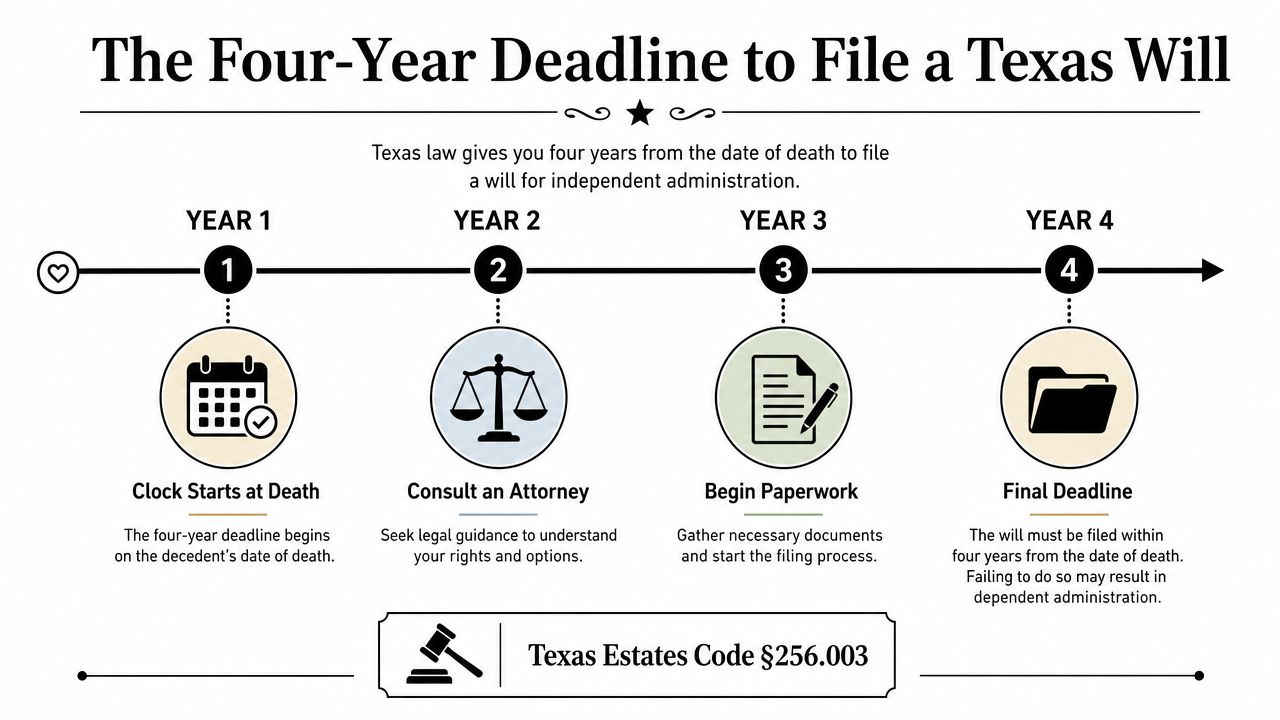
A simple way to think about it is this. If the person died on June 1, the legal clock begins on June 1. It does not stop because the executor was out of town, the family was grieving, or the original will was tucked inside a file cabinet. The law looks to the death date first.
If the filing happens after four years, the court may still consider the will only in narrow situations. Texas law allows a late filing if the applicant proves they were not in default for missing the deadline, and a late filing may still be admitted as a muniment of title in some circumstances. That late path is limited, and it can affect whether independent administration is still available, which matters because independent administration usually reduces court involvement.
The legal deadline is not the same thing as the time it takes to finish the estate. A timely Texas probate often still takes 6 to 12 months, and more complex estates can last 18 months or longer. The Probate Lawyer in Humble, TX service snapshot describes probate administration and estate settlement in Harris County, which is exactly the kind of work many local families need once they're inside that filing window.
The practical lesson is straightforward. Filing on time preserves options. Waiting too long can shrink those options even when the will is valid and the family agrees on what it says.
Deadlines That Start After You File
Once the court opens the estate, the calendar gets tighter. The filing deadline is only the first gate, and executors are the people who feel the next set of deadlines most sharply. Even a family that filed the will on time can run into trouble if no one tracks what happens after letters testamentary are issued.
The post filing dates that matter
Texas probate practice commonly requires the executor to move quickly after appointment. One probate timeline source says an executor generally has 90 days to file the Inventory, Appraisement, and List of Claims after receiving letters testamentary, and secured creditors must be notified within 2 months. The same probate timeline source also notes a creditor-claim period of about 4 months from first publication in probate administration. Texas probate timeline guidance explains these duties in the broader administration process.
Once letters are issued, the estate is no longer just a family matter. It becomes a compliance file.
These dates matter because they control the pace of administration even when the will was filed well within the four-year limit. An executor who misses them can create unnecessary delay, extra court involvement, and complications in closing the estate. That's one reason families in Harris County should treat probate as a sequence of tasks, not a single court visit.
Texas probate deadlines at a glance
| Deadline | Trigger | Typical Length |
|---|---|---|
| Inventory, Appraisement, and List of Claims | After letters testamentary are issued | 90 days |
| Creditor claim period | After first publication of notice to creditors | About 4 months |
| Notice to secured creditors | After appointment | 2 months |
Readers sometimes assume the four-year filing window is the whole story. It isn't. The filing deadline protects the right to open probate, while the post-filing deadlines govern whether the estate can move toward closure. If you're managing a family matter and also need help understanding other legal issues, the firm's page on Grandparents' Rights in Humble shows how Harris County family matters can involve separate court timelines that also need careful attention.
For executors, the best habit is to write down the death date, filing date, publication date, and date letters were issued in one place. That simple record keeps the estate on track and reduces the chance that a missed notice becomes a bigger court problem later.
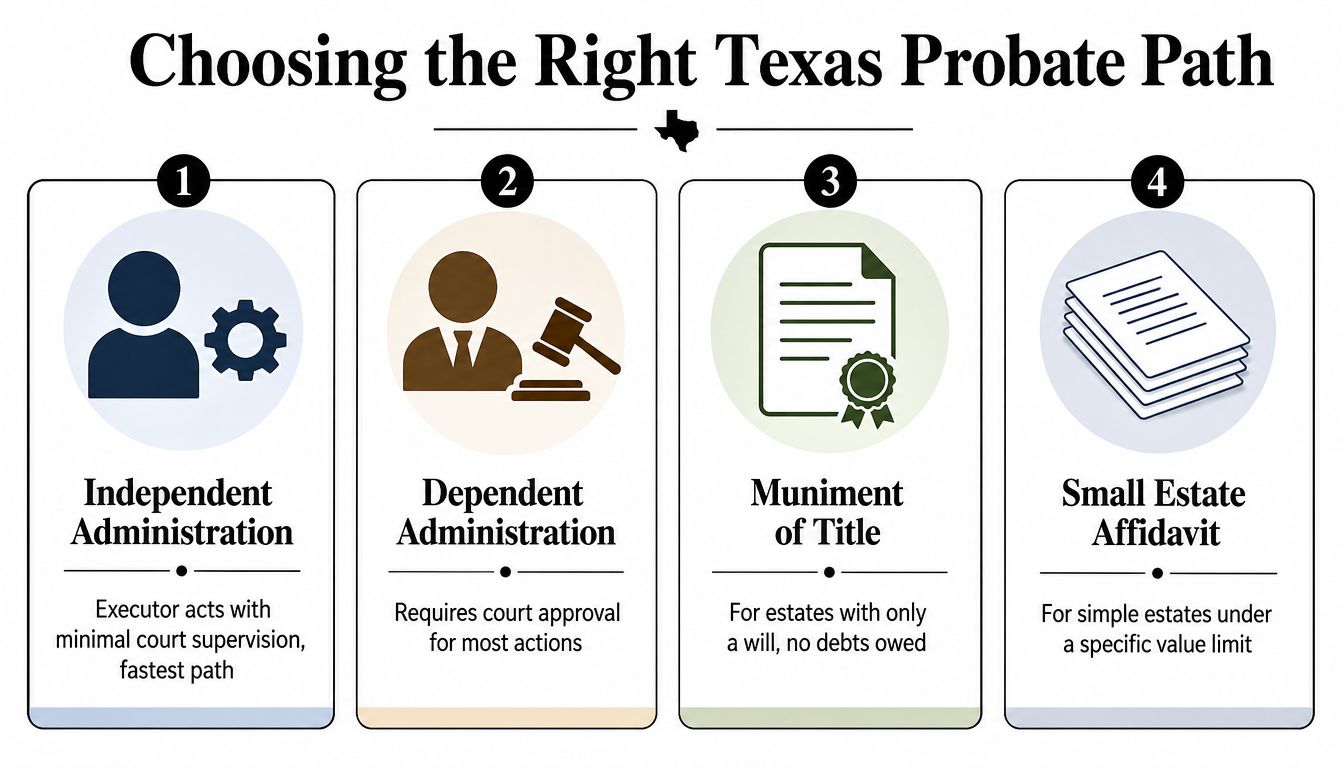
Choosing the Right Texas Probate Path
Not every estate needs the same procedure. Texas gives families a few different probate paths, and the right one depends on the assets, the debts, and how much court supervision the estate needs. The four-year filing deadline applies to the will, but the procedure you choose can change how long the case stays open and how much the judge has to monitor.
Four common tracks
Independent administration is often the least court-heavy route. The executor gets authority to act with less supervision, which can help the estate move more efficiently when the will and the facts support that path.
Dependent administration keeps the court involved in more of the estate's decisions. That means more hearings, more oversight, and more back-and-forth with the judge.
Muniment of title can be a useful shortcut when the estate really just needs title transferred and no full administration is necessary. A Humble-area family can read more about that route on muniment of title in Texas, which is often discussed when the paperwork is simpler than a full administration.
Small estate affidavits can sometimes finish in 30 to 90 days, which makes them helpful for limited estates that qualify. Texas probate guides also note that straightforward estates often finish in 4 to 6 months, medium-complexity estates in 6 to 9 months, and contested estates in 9 to 12+ months. Texas probate timeline guidance reflects those practical ranges.
The right procedure saves time only when it matches the estate. The wrong one can add hearings, delay title transfer, and increase frustration.
The filing deadline does not decide which path fits. The estate's shape does. A house with no debt may point one direction, while an estate with debts, creditors, and family disagreement may point another. In Harris County, the practical goal is to match the procedure to the assets so the family does not waste months on the wrong form of probate.
If you're in Humble, Atascocita, Kingwood, or Northeast Houston, ask early which path is realistic before filing. A good plan now can prevent a much slower court case later.
Will Contests and Creditor Claims in Texas
A probate file can attract two kinds of trouble, family challenges and creditor claims. Those risks don't always show up right away, which is why the calendar still matters after the will is admitted. A valid filing can still turn contentious if someone objects to the will or if creditors step forward once notice is published.
Texas Estates Code § 256.005 provides a two-year window to contest a will. That matters because some families believe the probate hearing ends the issue. It usually doesn't. A later challenge can still surface within that window, so executors should preserve records and keep the estate paperwork organized.
How creditors fit into the process
After probate opens, creditors must be handled according to the probate rules. Once notice to creditors is published, the estate has a defined period for claims, and the executor has to sort valid claims from stale ones. That process is one reason the estate cannot close instantly, even when the family agrees on the will.
A will filed late can still sometimes be admitted as a muniment of title if the applicant was not in default, but that doesn't erase the need to deal with claims, title issues, or proof problems. The late-filing exception is narrow, and it's there to keep the court from being used as a shortcut after avoidable delay.
Executors also need to think like administrators, not just beneficiaries. That means saving notices, keeping a list of claims, and documenting what the estate received and paid. For families who also have paper-heavy matters outside probate, a practical resource on how to streamline contract management workflows can be a useful reminder that organized documents make legal processes easier to manage.
The main takeaway is simple. Probate is not finished just because the will was filed. The estate still has claim deadlines, challenge windows, and paperwork that can shape whether the matter closes cleanly or drags on.
Filing Probate in Harris County as a Humble Family
For families in Humble, Atascocita, Kingwood, and Northeast Houston, probate usually means dealing with Harris County Probate Courts. The local mechanics matter because the court hearing, the paperwork, and the executor's appointment all fit together. If you're new to probate, the process can feel formal, but the first filing is usually about getting the judge the right documents.
What to bring and what happens next
At the first hearing, the court typically wants the original will, the death certificate, and a list of heirs. Those documents help the judge confirm who should act and who should receive notice. Texas probate practice also commonly moves through a court hearing, appointment of an executor or administrator, and then the issuance of letters testamentary, which give legal authority to manage estate assets. One Harris County probate overview notes that hearings are usually scheduled within weeks of filing. Probate process timing in Texas
If you need a basic roadmap for opening the case, the local guide on how to probate a will in Humble, Texas is a sensible place to start. It fits the way local families work through these matters, one document at a time.
Bring the original paperwork first. Copies help, but the court and the lawyer usually need the real thing before the estate can move.
The practical goal of the first hearing is authority. Once letters testamentary are issued, the executor can begin handling estate business under the court's rules. Until then, even a well-meaning family member can be stuck waiting for permission to act.
In Harris County, that early organization matters. The more clearly the family can identify the will, the heirs, and the assets, the less likely the case is to stall while everyone searches for missing records.
Practical Next Steps and How Our Humble Office Can Help
If someone in your family has died, start with four steps. Find the original will. Gather the death certificate and any account statements, deeds, or insurance papers. Write down the names and contact information of the likely heirs. Then speak with a probate lawyer before the calendar starts creating problems you can't undo.
That advice is especially important if the death was recent and nobody has opened the estate yet. The 4-year filing window sounds generous, but the shorter deadlines after filing can catch executors off guard. A calm review now can protect the estate later.
The Law Office of Bryan Fagan serves families in Humble, Atascocita, Kingwood, and Northeast Houston with probate, wills, trusts, family law, and criminal defense matters. If your family is trying to handle probate while also dealing with custody concerns, a divorce, or a criminal charge, having one local office that understands the broader legal picture can make the process easier to manage.
The next move is simple. Schedule a free consultation, bring the paperwork you already have, and let a local team help you figure out whether the will needs to be filed now, whether the estate qualifies for a simpler path, or whether a deadline is already getting close.
A CTA for Law Office of Bryan Fagan. If you're ready to talk through probate after a death in Texas, contact our Humble office to schedule your free consultation and get clear, local guidance on the next steps.