Skip to content

If you're staring at missed child support payments in Humble, the problem can feel financial for a while. Then a notice arrives, or you hear that the other parent filed in Harris County, and the issue stops being about a balance sheet. It becomes a court-order enforcement case with real hearing dates, service rules, and consequences that depend on what the judge sees in the record.
That shift matters because Texas treats unpaid child support as more than a private dispute. Under Texas Family Code Chapter 157, a support order can be enforced by contempt, and the Texas Attorney General says enforcement remedies can include contempt, probation, and possible incarceration (Texas Attorney General child support enforcement). For parents in Humble, Atascocita, Kingwood, and Northeast Houston, the practical question is not just whether money is owed, but whether the paperwork, service, and payment history are strong enough to support contempt.
The problem is usually messier than people expect. One parent thinks the missed payments were temporary, another sees a deliberate refusal, and the court has to decide which story the documents support. In Houston-area hearings, that difference can control everything.
When Unpaid Child Support Becomes a Court Problem in Humble
A Humble parent often finds out the issue has crossed the line when an overdue balance turns into a court filing. Maybe work slowed down, maybe a payment landed late, or maybe the other parent stopped accepting partial payments and filed an enforcement motion anyway. At that point, child support is no longer just a family budget problem, it is a Harris County court-order problem.
The reason that matters is simple. Texas contempt turns on willful violation of a support order, not just the existence of arrears. The Office of the Attorney General explains that enforcement can include contempt proceedings, and a parent who comes to court with reliable payment records has a defense the judge has to consider. If the ledger does not match the claim, that paper trail can change the result. For a local overview of how unpaid support cases are handled, see this guide to unpaid child support in Humble, Texas.
What judges care about first
The court is usually asking three questions at once:
- Was there a valid support order? Without an existing order, contempt does not work the same way.
- What does the ledger show? The judge wants the missed installments, the arrears amount, and the payment history tied together.
- Was the nonpayment willful? Texas contempt is aimed at disobedience, not a simple inability-to-pay story.
For someone in Humble or Northeast Houston, the first move is to identify which bucket the situation falls into. A bookkeeping error, a disputed ledger, and a refusal to pay are not treated the same way. If the facts are unclear, the hearing should be approached like a document case, not a reactionary argument. The court record, the payment history, and the hearing notice usually tell the story before anyone starts speaking.
How Texas Defines Civil and Criminal Contempt
Texas uses contempt in two different ways, and the purpose of the court action changes the risk profile right away. Civil contempt is meant to pressure compliance. The judge is trying to force the parent to follow the order, so confinement can continue until the parent pays or until Texas law cuts it off under Texas Government Code § 21.002.
Criminal contempt works differently. It punishes past defiance, and under Texas Government Code § 21.002, the confinement limit is 18 months cumulative. In child-support cases, Texas also treats contempt as a specialized enforcement setting under Family Code Chapter 157, rather than a generic courtroom sanction.
How to tell which track you are facing
The motion usually gives it away. If the filing asks the court to force payment and keep pressure on until compliance, that points toward civil contempt. If the request reads like punishment for a past violation, criminal-contempt language may be in play. A hearing can still involve both ideas, but the remedy requested tells you what the other side is trying to get.
The practical difference matters in the hearing room. In civil contempt, the judge is focused on whether a purge condition can make the parent comply. In criminal contempt, the court is imposing a fixed sanction for disobedience, and the Texas confinement ceiling matters immediately.
Practical rule: if the payment ledger is clean, bring it first. In these cases, proof beats explanation faster than a story does.
For local readers, Enforcement of Court Orders in Humble covers enforcing divorce decree and custody order provisions in Harris County. Child support contempt is a different remedy, but it lives in the same enforcement mindset, where the judge wants the order, the violation, and the requested relief lined up before the hearing.
Contempt is not a catch-all punishment. It exists because the court already entered an order, and the court expects the enforcement request to match that order precisely. In a Harris County enforcement hearing, wording, proof, and the requested remedy can decide whether the court treats the case as civil pressure, criminal punishment, or something that fails for lack of fit.
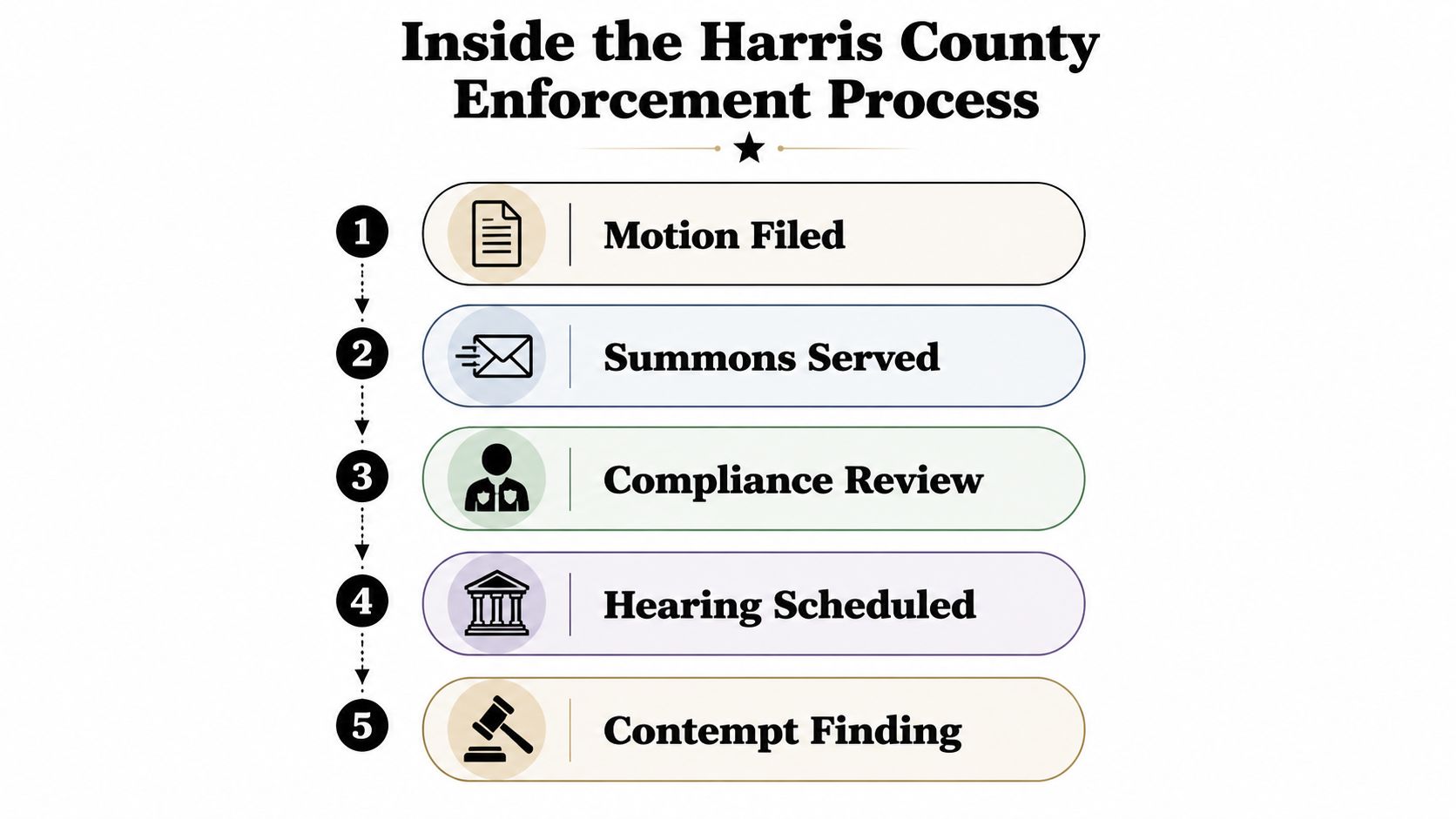
Inside the Harris County Enforcement Process
A Harris County child-support enforcement case often starts before anyone steps into a courtroom. In IV-D matters, the Texas Attorney General's Child Support Division may be involved. In private cases, a parent may file directly in the continuing-jurisdiction court that issued the original order, which is often the court that still controls enforcement under Chapter 157.
Once the motion is filed, service rules start controlling the case. Texas requires personal service of the motion and hearing notice at least 10 days before the hearing. If the respondent does not appear after proper service, the court may not hold them in contempt. The court may instead enter a default judgment and issue a capias for arrest. In a Harris County hearing, that service issue can matter as much as the arrears themselves.
The checkpoints that decide the hearing
A strong enforcement file usually has to answer a few questions before the judge ever reaches the merits:
- Was service proper and timely? A service defect can delay contempt relief or knock it out altogether.
- Does the motion match the ledger? If the arrears figure does not line up with the payment record, the request becomes easier to challenge.
- Is the continuing-jurisdiction court correct? Filing in the wrong court creates avoidable problems and slows enforcement down.
Those details decide a lot of local hearings. A respondent who can point to bad service timing or a bad arrears calculation may slow the case even when missed payments are not really in dispute. A petitioner who files a precise motion gives the judge a cleaner path to enforce the order.
The court is not looking for a general complaint about unpaid support. It wants a documented violation, a valid order, and a legally correct request for enforcement.
For residents searching for a Child Support Attorney in Humble, the practical value is in matching the filing to the record. Establishing, modifying, and enforcing child support in Harris County are related jobs, but enforcement hearings reward precision more than emotion. If you need a closer look at what happens after a missed payment, what follows a missed child support payment in Texas gives that process in plain terms.
If the respondent fails to appear after proper service, the case can move quickly. A default judgment and capias are not the same as contempt, but they are part of the same enforcement path. They show the court is no longer treating the issue casually, and the hearing record matters even more once that happens.
Real Penalties Beyond Jail Time
Jail gets the attention, but in a Harris County enforcement hearing, the pressure often starts somewhere less dramatic. A contempt finding can still lead to confinement when the missed support was willful, yet the judge usually looks at the whole enforcement path, including whether the parent had notice, whether the arrears are documented, and whether a purge path is available. Texas enforcement materials describe punishment options that can include probation and possible incarceration, which means the court can tighten the screws before the case reaches the most severe result (Texas Attorney General child support enforcement).
The practical consequences also come from the broader collection system. Wage withholding, tax-refund interception, license-related consequences, and passport problems can all follow unpaid support, even when the parent never spends a night in a contempt jail cell. That matters in Texas because unpaid child support is not a small bookkeeping problem. A family-law statistics summary tied to a Texas Senate bill analysis reported roughly $19 billion in unpaid child support statewide, and a local-news report cited in that summary said the state had more than 410,000 cases meeting the evader-list criteria, with only 60 parents arrested between 2006 and late 2023 through the state's child-support evader efforts (Texas child support statistics summary).
What changes after a contempt finding
A contempt finding changes the posture of the case. The court may view later requests for modification more skeptically if the parent has already ignored a valid order, and the judge may set purge terms with less patience for vague promises or partial explanations. It also affects credibility at the next setting, which matters in a hearing that turns on payment history and compliance.
The confinement limits matter too. Texas Government Code § 21.002 caps criminal-contempt confinement at 18 months cumulative, and civil-contempt confinement can last only until compliance or 18 months, whichever is less (Texas Government Code § 21.002). In a Harris County courtroom, that ceiling shows the court has real enforcement power, but the judge still has to work within a fixed limit.
A parent who wants to understand the practical side of a missed payment should also look at what happens if you miss a child support payment in Texas. The key distinction is still the same. A missed payment is one thing, and a willful refusal to pay is another, and contempt depends on that difference.
Bottom line: jail is only one risk. In real hearings, the more common pressure points are records, wage withholding, and the way a contempt filing changes the rest of the case.
What Custodial and Noncustodial Parents Should Do Next
Custodial parents in Humble, Atascocita, Kingwood, and Northeast Houston usually need to think like record-keepers. The court cannot enforce what it cannot identify, and a vague complaint about missed support rarely gets as far as a precise motion. Start with the support order, the payment history, and the exact months or installments that were missed.
If you are trying to enforce support
A custodian should pull together the documents that show the problem clearly:
- The order itself: bring the signed child-support order and any later modification.
- The payment record: gather ledgers, bank deposits, and any state or case payment history.
- The communication trail: keep texts, emails, and notes showing requests for payment or explanations for nonpayment.
- The requested remedy: decide whether you want contempt, wage withholding, license-related relief, or another enforcement tool.
The actual filing usually goes through the Harris County court with continuing jurisdiction, and the clerk's office will want the motion drafted cleanly enough that the missed installments and arrears line up. That is why paperwork matters before a hearing is even set. A motion that names the wrong months, or asks for a remedy unsupported by the order, slows everything down.
If you are the parent being served
A noncustodial parent should not wait until the hearing morning to look at the numbers. The first job is to obtain the ledger, compare it with your own records, and see whether the court's version of the arrears matches your version. If you were not served properly or the hearing date is too soon, that needs immediate attention.
The next step is evidence gathering. Termination notices, reduced-hours records, benefit statements, medical documents, or partial-payment proof can matter if the issue is inability to pay rather than refusal. If the current order no longer fits the income situation, a motion to modify may belong in the file, but that does not replace a defense to the contempt setting.
When the notice is short or the records are incomplete, a continuance may be worth requesting so the court sees a complete financial picture instead of a rushed one. In Harris County, the difference between a defensible hearing and a damaging one is often whether the documents are ready before the judge calls the case.
Defenses and Purge Conditions That Actually Work
The defense that matters in a contempt hearing is the one the record can support. In Harris County, that usually means showing the judge a payment history, bank records, or other documents that line up with the arrears claimed in the motion. A parent cannot credibly argue away contempt with a loose explanation if the court file shows the payments were missed and the order was clear.
What the court wants to see
A serious inability-to-pay presentation usually includes a mix of records:
- Payment ledgers showing what was paid and when.
- Bank statements that confirm low balances or payment dates.
- Termination notices if the job ended or hours were cut.
- Benefit statements or denials that show the income gap.
- Partial-payment history that proves effort, not avoidance.
The hearing usually turns on whether the judge sees a documented reason for the shortfall or a pattern that looks like refusal. Texas law distinguishes between a parent who could pay but chose not to and a parent who can point to records showing a real income problem. In a Humble-area enforcement setting, that distinction is often what decides whether the case ends in a finding of contempt or a reset on payment terms.
A judge is more likely to listen when the file shows dates, amounts, and hard proof. General hardship statements usually sound weaker than records.
Purge conditions and counsel
If the court is considering coercive confinement, it may impose a purge condition, which is the payment or compliance step that ends the confinement. The practical issue is whether that condition can be met. A purge amount that ignores the parent's real income, work schedule, or available funds may sound firm in the courtroom, but it can also set up another failure once the hearing is over.
In Harris County enforcement hearings, I pay close attention to the language of the requested purge because it controls what happens if the judge orders confinement. The court can hold a parent in contempt, but confinement in these cases is not open-ended, and the ceiling matters. Under Texas procedure, jail time in this setting cannot run past the 18-month confinement ceiling that applies to contempt enforcement.
For parents facing confinement, the hearing can also change the right to counsel. Texas guidance addresses appointed counsel for indigent respondents in IV-D enforcement cases, and that issue becomes more urgent once jail is on the table. A parent should raise that point early, not after the court has already moved through the contempt findings and started discussing where the confinement will be served.
A calm review with a local attorney can also help frame the hearing around the record instead of emotion. The Child Support Attorney in Humble page reflects the kind of local enforcement work that involves checking the order, the payment history, and the relief the court can grant.
Local Representation and Your Next Step in Humble
Child-support contempt cases in Harris County are rarely won by volume or anger. They're won by knowing which court is hearing the case, what the service rules require, and how local judges handle purge conditions and payment histories. That's why a Humble-based lawyer who already works in these courts can make a difference in how the hearing is prepared and presented.
The Law Office of Bryan Fagan serves families across Humble, Atascocita, Kingwood, and Northeast Houston, and its Child Support Attorney in Humble page reflects work on establishing, modifying, and enforcing child support in Harris County. For a parent facing contempt, that local context matters because the issue is not just whether money is owed, but how the court expects the proof to be organized.
If you're the parent receiving support, you want a file that supports enforcement without gaps. If you're the parent who fell behind, you need a clear defense, a realistic purge strategy, and a plan for the hearing that matches the record. A calm review with a local attorney can clarify which side of that line your case is really on.
If you're dealing with contempt of court for unpaid child support in Humble, the Law Office of Bryan Fagan can review the order, the payment history, and the Harris County hearing process with you. Visit Law Office of Bryan Fagan to schedule a free consultation with the Humble office and get a clear next step before your court date.