Skip to content

You're probably tired of doing the same math in your head and still coming up short. You pack the backpack, check the homework folder, and look at the calendar again because the next handoff is already looming, and the idea of “equal time” still feels like something Texas talks about more than it delivers.
For families in Humble, Atascocita, Kingwood, and Northeast Houston, that frustration usually starts with one blunt question. If both parents care, both parents are available, and both parents want the child, why does the law seem to fight a true 50/50 possession schedule Humble TX setup so hard?
The short answer is that Texas separates decision-making from possession time, and that distinction drives almost every custody fight in Harris County. If you understand that split, you'll stop arguing with the wrong part of the law and start pushing for the schedule that fits your child.
When Equal Time Feels Like the Only Fair Answer
A Humble parent usually doesn't come to this issue thinking in legal terms. They come in after weeks of scrambling, with a school bag half-packed on the kitchen counter, trying to coordinate drop-offs between work, homework, and one more last-minute request from the other parent.
That's where the conflict gets real. The parent who wants equal time isn't always trying to win a fight, they're trying to get back to a stable rhythm that doesn't leave one home feeling like the “real” home and the other one feeling temporary.
What most parents are actually asking for
Most parents in this situation are not asking for some abstract legal theory. They want a calendar that gives both homes a meaningful role, keeps school nights manageable, and avoids the constant sense that one parent is always chasing access.
A fair schedule is usually the one the child can actually live with, not the one that sounds clean in a conversation.
That's why the conversation around Humble, Atascocita, Kingwood, and Northeast Houston has to be practical from the start. Harris County judges are not interested in slogans, they want to see whether a parent can support a schedule that works in real life.
The good news is that Texas does allow equal-time arrangements. The bad news is that equal time is not the automatic default, and that's where many parents lose momentum before they've even made their case.
How Texas Law Handles Conservatorship and Possession
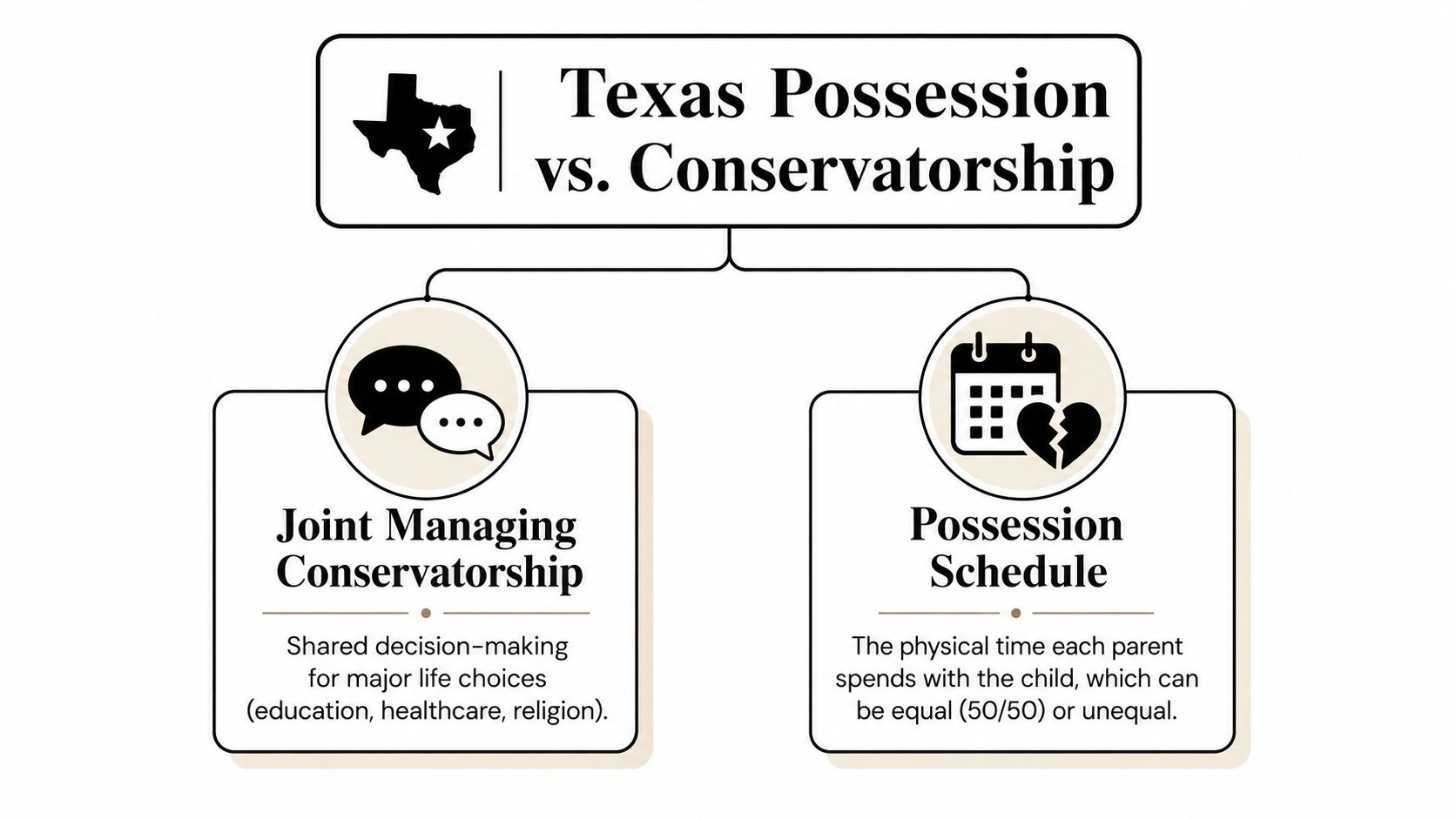
Texas law uses two different ideas that parents often mash together. Joint managing conservatorship deals with decision-making authority, while the possession schedule controls where the child sleeps, where the school clothes live, and who gets the weekdays.
That distinction matters because joint managing conservatorship does not require equal or nearly equal periods of possession. Even when both parents share major decision-making, the calendar can still be uneven unless someone asks the court for something different.
The baseline schedules Texas starts from
For parents who live 50 miles apart or less, the Office of the Attorney General says the Expanded Standard Possession Order is the parenting-time schedule used in the standard framework, and it applies under the state's possession rules for that distance bracket. The practical point is simple, the ESPO is the closest built-in option for nearby parents, but Texas-family-law explanations typically result in approximately a 45% / 55% split when the non-primary parent uses the maximum time allowed, which is still not a literal equal-time schedule. You can review the state's overview of that nearby-parent framework in the Attorney General's parenting time schedule for parents 50 miles apart or less.
For parents living within 100 miles of each other, the standard default is still not 50/50. The noncustodial parent commonly gets the first, third, and fifth weekends, a Thursday evening visit during the school year, alternating holidays, and summer time, which is often described as roughly a 45/55 split.
The legal takeaway is blunt. Shared conservatorship is not the same thing as shared time. If you want true equal possession, you need facts that support a different calendar, not just a label that sounds fair on paper.
A Child Custody Lawyer in Humble, TX handles custody and conservatorship representation for Humble families, and that distinction between authority and access is where most of the planning starts.
Texas courts look hard at whether the child's daily life can support the proposed schedule. Stable school routines, workable exchanges, and a history of cooperation carry real weight because equal time falls apart fast when parents can't communicate.
Sample 50/50 Calendar Templates That Work for Humble Families
Equal time is not one calendar. It's a category of calendars, and the right one depends on school, commute time, and how well the parents handle handoffs without drama.
The benchmark is not a slogan, it's the number of overnights. True equal possession is approximately 182 to 183 overnights per parent per year, so any proposed plan should be checked against that rather than guessed at casually.
The main calendars parents actually use
The 2-2-3 schedule gives each parent two weekdays and then alternates the long weekend rhythm every other week. It's responsive and very equal in feel, but it can be a lot of transitions for younger children who struggle with frequent exchanges.
The 2-2-5-5 pattern spreads the week more predictably. One parent gets the same two weekdays each week, the other parent gets the remaining weekdays, and the weekend flips, which usually makes it easier to protect homework and bedtime routines.
The 5-5-2-2 schedule is one of the most common equal-time patterns because it stabilizes school routines while preserving roughly equal overnights. It works well when both parents want consistency without going a full week between visits.
Alternating weeks is the easiest calendar to explain, but it only works if the parents live close enough and communicate well enough to make the transition smooth. If the child is younger or has a busy extracurricular life, the long stretch away from one parent can be hard.
| Comparing Common 50/50 Calendar Templates | Weekly Rhythm | Approx. Overnights per Year | Best Fit For |
|---|---|---|---|
| 2-2-3 | Frequent exchanges, weekends alternate | About 182 to 183 per parent | Younger children, highly cooperative parents |
| 2-2-5-5 | Two fixed weekdays and alternating weekends | About 182 to 183 per parent | School-age kids who need routine |
| 5-5-2-2 | Five-day blocks with alternating weekends | About 182 to 183 per parent | Families wanting fewer handoffs |
| Alternating weeks | One full week with each parent | About 182 to 183 per parent | Older children, close homes, low-conflict co-parenting |
For parents in Atascocita and Kingwood, school schedules often push the decision toward 5-5-2-2 or 2-2-5-5 because they reduce midweek chaos. That's the practical difference between a schedule that sounds fair and a schedule a child can live inside.
The best schedule is the one that survives school mornings, sports practice, and the first stressful week after it starts.
If you're comparing calendars and don't know where to begin, the local child visitation schedule in Humble resource is a useful starting point for understanding how Texas possession calendars are usually structured.
Negotiating and Filing in the Harris County Family Courts
Equal time is usually won in conversation before it ever gets to a judge. The parents who do best in Harris County are the ones who come in with a plan, not just a complaint.
The process usually starts with informal negotiation. If that stalls, mediation often becomes the next practical step because it gives both sides a structured place to work through exchanges, holidays, summer time, and the handoff details that make or break a possession schedule.
What to bring before you file
A serious 50/50 proposal needs more than a strong feeling. Bring the facts that show the schedule can work:
- Work schedules, so the court can see when each parent is available.
- School pickup and drop-off history, because reliability matters.
- Communication records, especially if you've already been co-parenting respectfully.
- A draft calendar, so the judge sees a real plan instead of a wish.
- Child activity schedules, because sports and school events shape the week.
The case usually gets filed as a Suit Affecting the Parent-Child Relationship in Harris County. If the filing is in the wrong county, or if the parenting paperwork is sloppy, parents waste time they can't afford to lose.
Harris County family courts also expect parents to understand that a schedule is a legal order, not a casual agreement. If there's a court-approved plan, both sides need to follow it or ask for a lawful change.
The Law Office of Bryan Fagan helps Humble families work through family law matters, and that includes custody planning, negotiation, and courtroom filing in Harris County. For parents who are trying to sort out the courthouse process, the firm's Harris County family courts guidance is a practical reference point for what usually comes next.
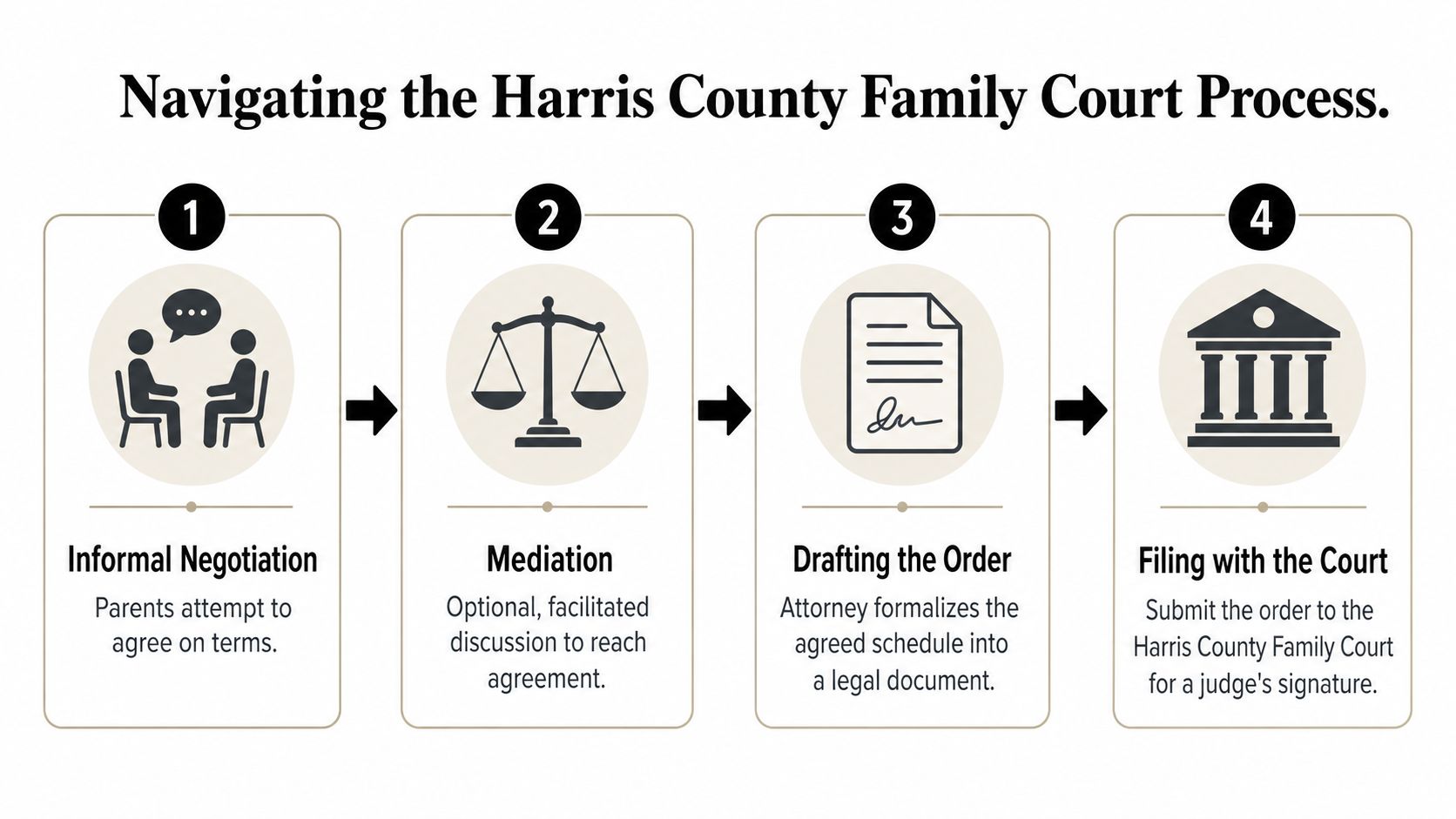
One local mistake keeps showing up. Parents try to rush straight to a final order without cleaning up the schedule details first, and then they wonder why the court pushes them back into mediation or asks for a revised draft. Judges want usable orders, not hopeful language.
How Child Support Math Works When Time Is Equal
A lot of parents assume a 50/50 possession schedule wipes out child support. In Texas, that assumption causes trouble fast.
Child support is calculated from net resources, and equal time alone does not remove the obligation. A parent can have half the overnights and still owe support if the income difference makes that the guideline result.
Why equal time doesn't erase support
Texas looks first at the paying parent's financial picture, then applies the guideline framework. Possession matters, but it does not cancel a higher earner's duty just because both parents share the calendar.
That is where settlement talks often go sideways. One parent says, “If we split time, nobody pays anything.” The other parent knows the support numbers still matter, and that gap can stall the case for weeks.
In a true equal-time setup, support is often still ordered because the court looks at what the child needs and what each parent can reasonably contribute. Equal overnights can reduce support obligations, but they do not guarantee a zero-payment result.
Practical rule: treat the calendar and the money as two separate negotiations. If you combine them too early, you end up bargaining against yourself.
Build the possession plan first, then test the support outcome against the actual income numbers. If the higher earner is still going to owe under the guidelines, you need to know that before you sign anything.
A deviation request can also make sense. If one parent is taking on unusual travel costs, extracurricular expenses, or other child-related burdens, the support discussion should reflect those realities instead of pretending the calendar solves everything.
The point is simple. A 50/50 possession schedule Humble TX parents can live with is only half the job. The financial order has to match the household structure so neither side gets surprised after the judge signs.
Modifications, Enforcement, and Handling Relocation Disputes
A 50/50 order is not something you win once and forget. It has to keep working as school changes, jobs change, and families change.
Texas requires a material and substantial change in circumstances before a court will modify possession. For Humble families, that can look like a job change at the Port of Houston, a parent remarrying and building a new household routine, or one parent trying to move out of the area and break the current rhythm.
What to do when the schedule breaks down
If the other parent starts ignoring the order, document it immediately. Save texts, note missed exchanges, and track every refusal because enforcement cases are won on records, not on vague frustration.
If the problem is minor and temporary, start with co-parenting tools and direct communication. If the parent keeps missing handoffs or blocks visitation, that's when you look at enforcement through the Harris County family courts or, in some child-support-related situations, through the Office of the Attorney General.
Relocation fights need fast attention. If one parent wants to move, the other parent should review the order immediately and get legal advice before the move becomes a fait accompli. The issue isn't just distance, it's whether the proposed move destroys the practical reality of equal time.
The local relocation custody attorney in Harris County resource can help parents think through that problem before it turns into a full modification fight.
A lot of parents wait too long because they hope the issue will settle down on its own. It usually doesn't. The smarter move is to document, stay calm, and get advice before the schedule becomes impossible to enforce.
Your Next Steps and a Local Resource Checklist
Equal-time disputes get easier when you walk into the conversation prepared. That means bringing the calendar, the numbers, and the proof that your plan is rooted in daily life, not just fairness rhetoric.
What to gather now
- Recent pay stubs, so support can be discussed realistically.
- A proposed possession calendar, with holidays and summer time included.
- School schedules, especially if you live in or near Humble ISD, Atascocita, or Kingwood.
- Texts or emails with the other parent, showing whether co-parenting has been cooperative.
- Pick-up and drop-off notes, if exchanges have already been happening informally.
- Any court paperwork you've already received, so nothing gets missed.
If you're trying to build a schedule that works, you need a lawyer who can look at the calendar and the money at the same time. The Law Office of Bryan Fagan handles family law matters for Humble families, including custody, child support, divorce, criminal defense, and estate planning, so local parents aren't left guessing where to turn.

If you're ready to sort out a 50/50 possession schedule Humble TX parents can follow, gather your documents and talk with a lawyer before you sign away flexibility. The strongest cases are the ones built before the courtroom fight starts, not after it's already gone sideways.
If you're dealing with equal-time questions in Humble, Atascocita, Kingwood, or Northeast Houston, the Law Office of Bryan Fagan can help you turn a rough idea into a workable possession plan and a clear support strategy. Visit Law Office of Bryan Fagan to schedule a free consultation with our Humble office and get direct guidance on your next move.