You're sitting at the kitchen table in Humble after the children have gone to bed, looking at bank statements and wondering where to begin. You may know the marriage is ending without knowing who should stay in the house, how parenting will work, or what you're supposed to file. Understanding what divorce lawyers do starts with recognizing that their most important work often happens before anyone enters a courtroom.
For families in Humble, Atascocita, Kingwood, and Northeast Houston, legal help should make decisions clearer, not make an already stressful situation more intimidating. A divorce lawyer identifies the problems that need attention, separates urgent concerns from longer-term questions, and helps turn your priorities into workable Texas court orders.
What a Divorce Lawyer Does From the First Meeting
A useful first consultation starts with your circumstances, not a stack of forms. Perhaps you're worried about paying household expenses, keeping the children's school routine stable, or understanding financial accounts your spouse has always managed. You don't need a polished explanation, but you do need to tell the lawyer what's happening and what concerns you most.
The attorney's job is to distinguish a personal concern from a legal issue that requires action. Family lawyers assess matters such as jurisdiction, temporary orders, parenting arrangements, support, and the evidence behind disputed allegations, while explaining options and leaving major decisions with the client. The American Bar Association's discussion of family lawyers' dispute-resolution role describes this combination of candid advice, communication, and strategic planning.
Bring the facts you already have
You can make the meeting more productive without spending days organizing every document. Start with records you can readily access and a short account of the issues you need help resolving.
- Court papers: Bring anything you've received, including petitions, hearing notices, or existing orders.
- Financial records: Gather available pay records, tax returns, account statements, mortgage information, and debt balances.
- Family concerns: Write down work schedules, childcare arrangements, and any immediate safety concerns.
- Your priorities: Identify what you most want to preserve, such as predictable parenting time or a financially sustainable household.
If a record is missing, say so. Knowing that you lack access to an account can be more useful than delaying the consultation until you have everything.
Expect a plan, not a promise
A careful lawyer should ask questions that test your assumptions. If you want to keep the family home, for example, the discussion should include affordability and the records needed to evaluate that choice, rather than treating ownership as an automatic victory.
Ask what needs attention immediately, what information remains missing, and which decisions can reasonably wait. Also ask how you'll communicate, who will handle your questions, and what work the attorney proposes to undertake.
Practical rule: Leave the consultation knowing your next action, the lawyer's next action, and which unanswered question matters most.
Reassurance should come from a clear plan. No attorney can responsibly promise every outcome you want, but you should understand how the proposed approach fits your family.
Core Legal Tasks Divorce Lawyers Handle
Divorce counsel turns a family's circumstances into filings, evidence, and legally meaningful requests. That work matters because self-representation is common: research summarized by the Institute for the Advancement of the American Legal System reports that approximately 72% of divorce and separation cases involve at least one self-represented party. Its overview of cases without counsel explains the broader context for families navigating court without full representation.
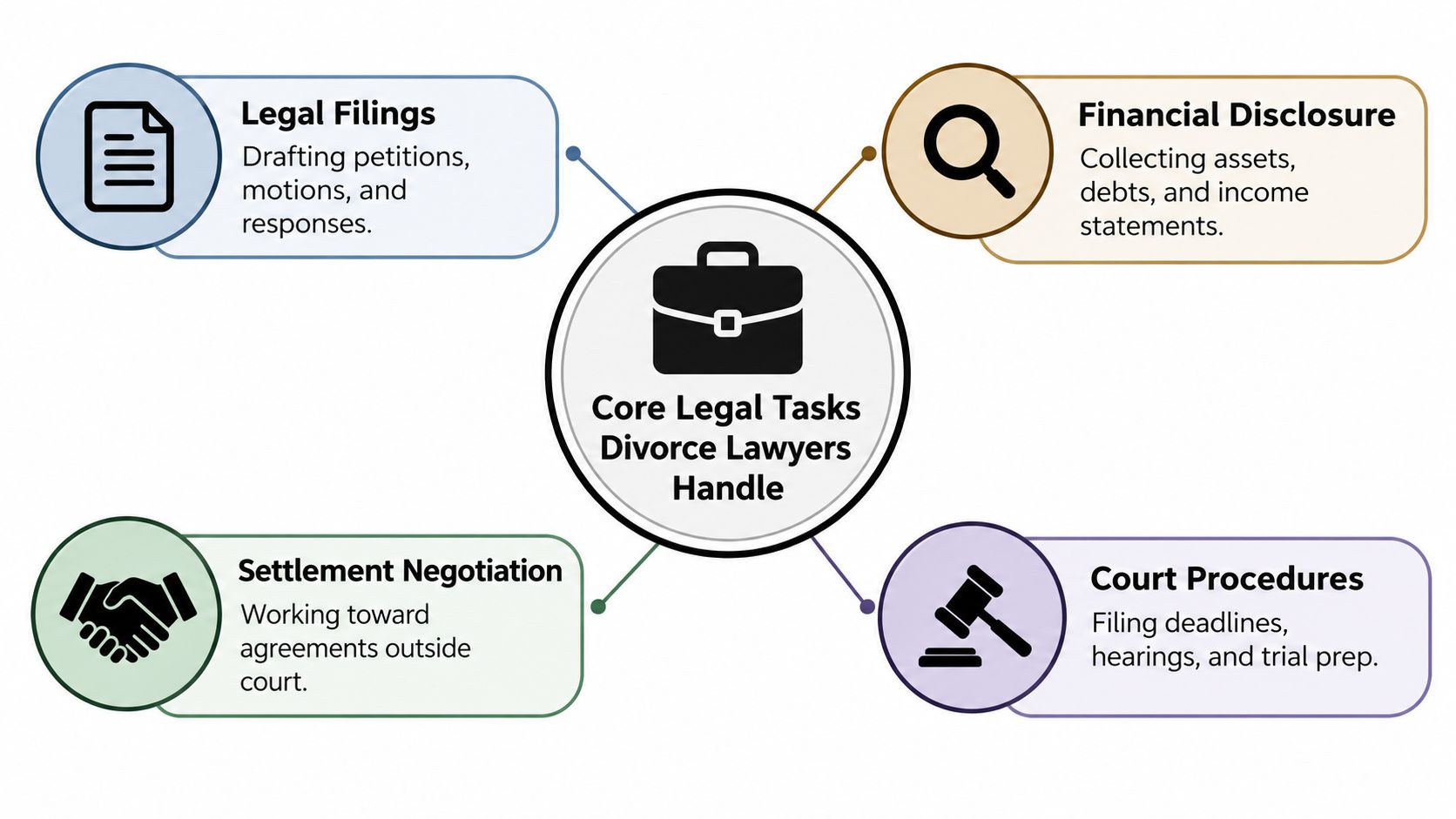
The work generally falls into these connected areas.
Turning records into usable evidence
A bank statement isn't useful merely because it exists. The lawyer needs to understand which account it concerns, what period it covers, and whether transactions support or contradict a disputed financial claim.
Counsel reviews income, expenses, assets, and liabilities, then checks disclosures for missing accounts, inconsistent values, and incomplete calculations. The American Academy of Matrimonial Lawyers' discussion of professional competence identifies thorough asset discovery, competent settlement advice, and properly drafted retirement-asset orders as ordinary components of adequate preparation.
Discovery is the formal process for obtaining information and documents. Depending on the dispute, it may involve written questions, document requests, subpoenas, or testimony under oath; our explanation of the Texas divorce discovery process provides additional context for that work.
Drafting and checking the legal documents
Behind a petition or proposed order are decisions about what relief to request and what facts support it. A lawyer also checks whether a proposed agreement can be implemented, including whether retirement-related language meets the requirements of the applicable plan.
- Legal filings: State the client's position and request appropriate court action.
- Financial disclosure: Organize the information needed to evaluate property and support.
- Settlement documents: Translate agreements into specific obligations.
- Procedural management: Track filings, hearings, and required responses.
For local service context, Divorce Lawyer in Humble, TX concerns divorce representation for clients in Humble and Harris County.
Keep related planning questions on a separate checklist rather than assuming a divorce document resolves everything. Velzee's estate planning guide for young professionals is an optional starting point for questions to raise about future estate planning, not a substitute for advice about your Texas divorce.
Good preparation doesn't mean collecting the largest possible pile of paperwork. It means identifying the records that answer the questions the court or negotiating parties need to resolve.
Negotiation Mediation and Litigation Explained
Settlement and trial preparation aren't opposites. A lawyer can pursue agreement while preparing the evidence needed if discussions fail. The practical question is whether the available process allows informed decisions and produces terms the client can accept.
| Approach | How it works | Main trade-off |
|---|---|---|
| Negotiation | Lawyers exchange proposals and discuss disputed terms. | It can be direct, but progress depends on reliable information and meaningful responses. |
| Mediation | A neutral third party helps the spouses work toward agreement. | It offers room for tailored solutions, but doesn't eliminate the need to evaluate risks. |
| Litigation | Unresolved disputes are presented to a judge. | It provides a formal decision-making process when agreement isn't possible. |
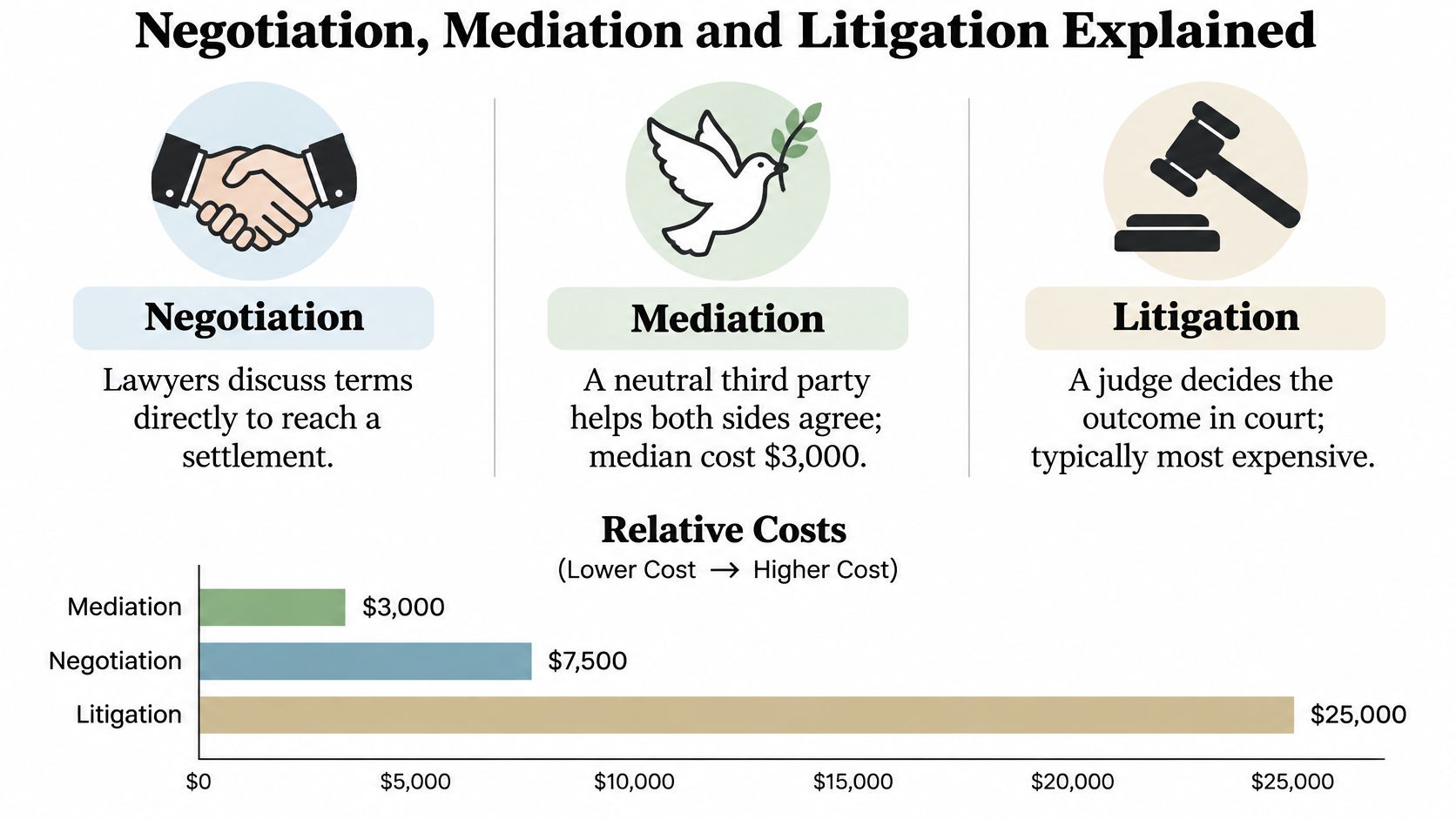
The broad differences are illustrated below.
Put historical cost comparisons in context
An analysis of 199 divorce cases, reported by the ABA Journal in 2007, found median costs of approximately $6,600 for mediation, $19,723 for collaborative divorce, $26,830 for a settlement negotiated by counsel, and $77,746 for litigation, as documented in this discussion of divorce resolution methods and costs. These are historical comparisons, not current Humble price quotes or predictions for your case.
The useful lesson is qualitative: the method of resolution can substantially affect expense. Local costs still depend on the issues, financial complexity, conflict, and attorney involvement.
Choose the process around the problem
For a straightforward disagreement, direct proposals may clarify what remains unresolved. When spouses need help discussing several connected issues, divorce mediation in Humble may be worth evaluating with counsel.
Before recommending mediation, the lawyer should ask whether both spouses can participate safely and make decisions without coercion. Safety concerns deserve assessment before anyone treats compromise as the default answer.
A settlement is useful only if you understand what you're accepting and the written terms reflect that understanding.
Preparation matters in every route. Counsel should know which facts support the proposed outcome, what information remains uncertain, and which concessions would create practical problems afterward.
If a serious disagreement remains, litigation may be necessary. Trial preparation involves selecting admissible exhibits, preparing witnesses, developing questions, and presenting proposed orders, not merely repeating that the other spouse has behaved unfairly.
The goal isn't to avoid court at any price. It's to choose a defensible path while keeping the client informed about costs, uncertainty, and consequences.
The Texas Divorce Process Step by Step
A Texas divorce follows procedural requirements even when both spouses want it finished quickly. Your lawyer's role includes identifying which requirements apply, calculating deadlines, and checking whether the case is ready for the next action.
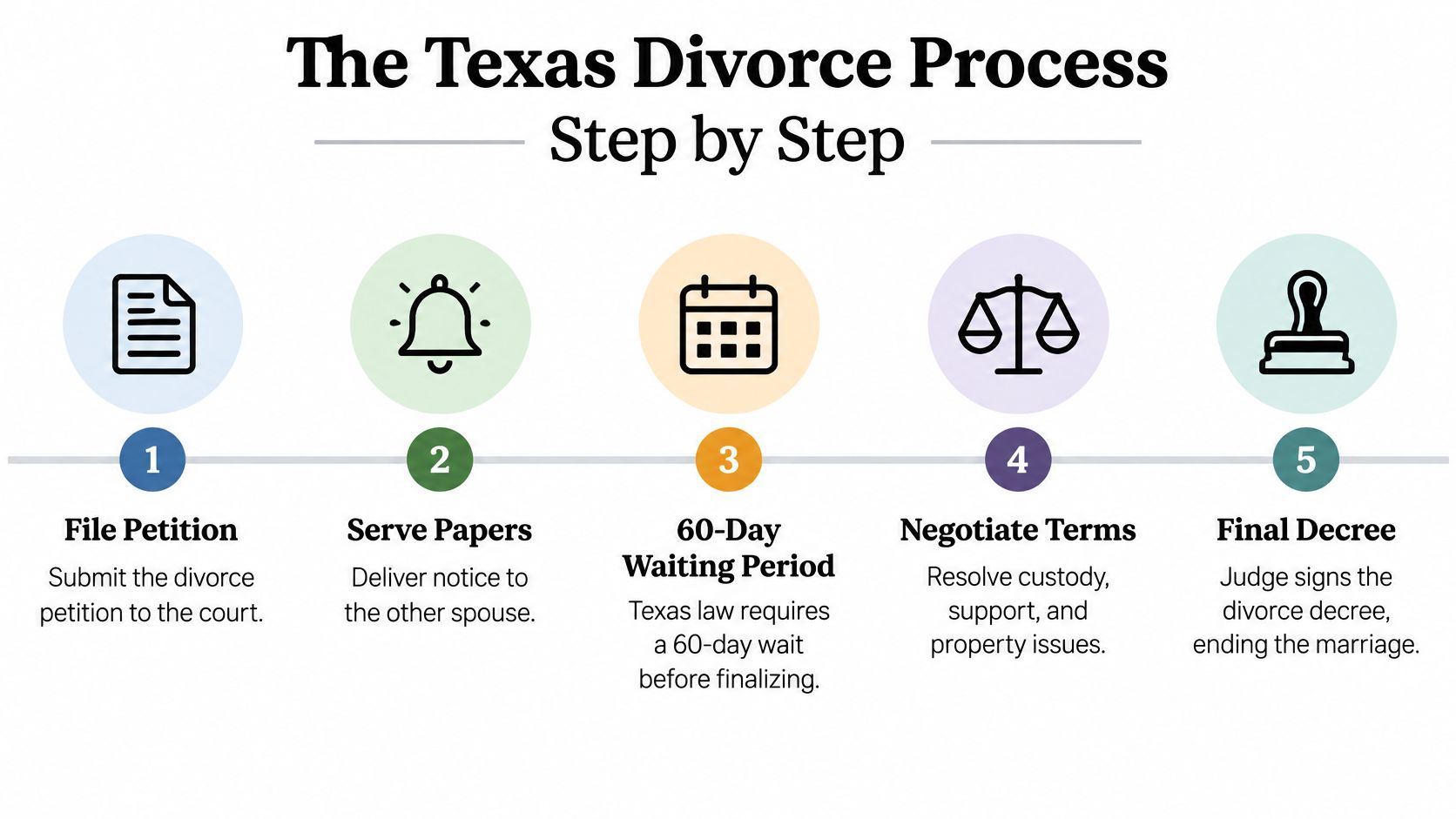
This timeline provides a broad overview rather than a guaranteed completion schedule.
Filing and giving notice
- Prepare and file the petition. Counsel evaluates the appropriate filing requirements and identifies what the client needs the court to address. For Humble-area families, confirm the appropriate county and proceeding rather than relying on a mailing address alone.
- Address service and the response deadline. Texas guidance states that a served respondent generally has 20 days, plus the following Monday at 10:00 a.m., to answer; for a default divorce, the Return of Service generally must remain on file for at least 10 days, excluding the filing and hearing days, according to Texas Law Help's default-divorce instructions.
- Evaluate immediate needs. Ask counsel whether temporary orders are needed while the case is pending, including arrangements concerning children, support, or property.
An answer deadline and a waiting period serve different purposes. Don't assume your spouse's failure to respond means the court can immediately finish the divorce.
Waiting and preparing for completion
Texas generally requires at least 60 days after filing before granting a divorce; weekends and holidays count, and a weekend or holiday ending generally moves the matter to the next business day, subject to the family-violence exceptions described in Texas Family Code Chapter 6. That chapter permits exceptions involving qualifying family-violence convictions or deferred adjudication, or an active qualifying protective or emergency-protection order.
Tell the attorney about protective orders and family-violence proceedings immediately. The relevant documentation may affect both safety planning and the case schedule.
Resolve the remaining terms and prepare the decree. During the pending case, counsel gathers necessary information, addresses disputes, and prepares the documents needed for an agreement or court decision. The minimum waiting period isn't a promise that every case will be ready when it ends.
This video offers another way to become familiar with the divorce process before discussing your circumstances with counsel.
Before signing proposed final documents, ask the lawyer to identify what you must do afterward. A clear explanation of your obligations is as important as knowing the hearing date.
Custody Support and Property Division in Texas
A parent may arrive with a single goal, such as keeping the children in their current home. A lawyer needs to examine the parenting arrangements, available income, property, and debt together before advising whether that goal is practical.
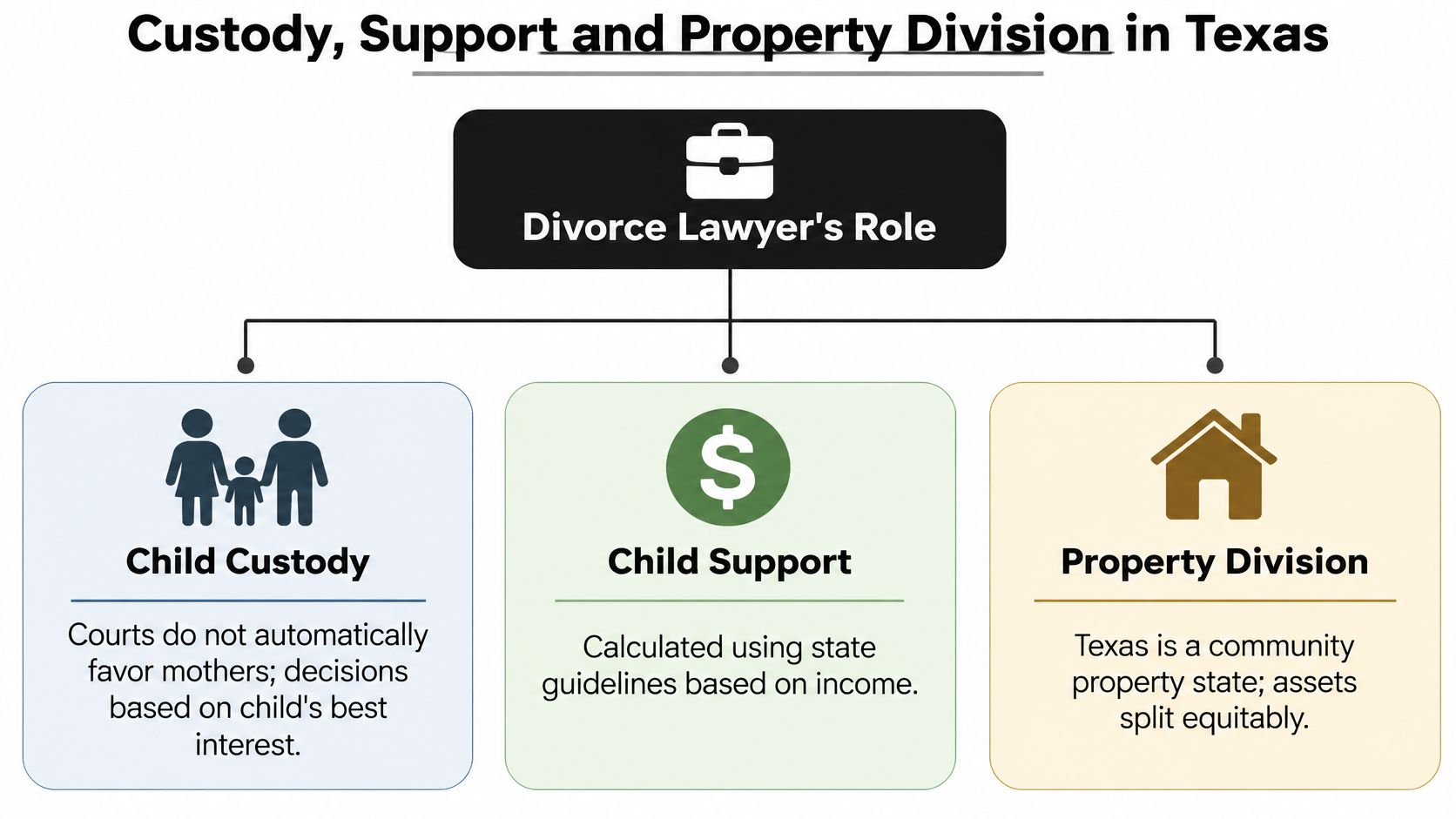
Texas divorces involving minor children typically include orders addressing custody, visitation, and child support, as Texas Law Help's divorce-with-children guidance explains. Ending the marriage is only part of the work.
Make parenting proposals specific
Conservatorship concerns parental decision-making, while possession concerns parenting time. Rather than asking only for a preferred label, discuss what the arrangement needs to accomplish for your children.
For an Atascocita or Kingwood household, useful questions include how exchanges fit work schedules, how parents will communicate about school, and how transportation will operate. A proposed arrangement should be understandable on an ordinary school morning, not just acceptable during a settlement discussion.
- School and childcare records: Bring schedules and information about recurring care needs.
- Medical information: Identify relevant appointments, care arrangements, and expenses.
- Income documents: Provide the records counsel needs to evaluate support.
- Parenting concerns: Describe specific events and available evidence rather than relying on general accusations.
Support questions may also continue after a divorce. A Child Support Attorney in Humble handles establishing, modifying, and enforcing child support in Harris County.
Evaluate property without assuming an equal split
Texas doesn't automatically divide marital property using a fixed 50/50 formula; the court must make a “just and right” division with due regard for each spouse's rights and the marriage's children under Texas Family Code Chapter 7. Counsel therefore needs to examine classification, value, separate-property claims, retirement assets, and debts instead of dividing every balance in half.
Our explanation of how to divide assets in divorce provides context for those conversations. Ask the lawyer to distinguish the value assigned to an asset from the practical burden of keeping it.
Budget check: Wanting the house and being able to maintain the house are different questions.
If homeownership remains a priority, the Home Ready Calculator homestead exemption guide can help you prepare property-tax questions for appropriate professional advice. It shouldn't be used to decide who receives the home in a divorce.
The strongest proposal connects legal terms to the family's actual circumstances. An arrangement that looks balanced on paper still needs to work after separate households begin operating.
When to Hire a Divorce Lawyer
Seek legal advice when you can't confidently identify the consequences of your next decision. You don't have to wait until your spouse files something alarming or a settlement discussion breaks down.
Full representation deserves serious consideration when safety, disputed parenting, difficult financial questions, or unreliable disclosure make it hard to divide responsibilities. A concern that your spouse is hiding assets, a disagreement over relocation, or rapidly changing hearing demands should prompt a discussion about whether narrower assistance is sufficient.
Understand limited-scope representation
Limited-scope representation, sometimes called unbundled representation, divides agreed tasks between the client and attorney. A client might organize records or handle selected filings while the lawyer provides advice, drafts a document, or attends a particular hearing.
Nebraska's judicial guidance on limited legal assistance specifically identifies divorce as a suitable example and emphasizes a written agreement covering responsibilities, appearances, communications, deadlines, and emergency procedures. That's guidance from another state, not a statement about what any particular Texas lawyer or court will permit.
Use it as a practical checklist for questions:
- Task ownership: Who prepares, files, serves, and reviews each document?
- Deadline monitoring: Who receives notices and tracks required responses?
- Settlement review: Will the lawyer evaluate proposed terms before you sign?
- Escalation planning: What happens if a new hearing or dispute requires broader help?
Match the arrangement to your ability to manage it
Partial representation isn't automatically cheaper or safer. It works only if the task division is appropriate and you can reliably perform the responsibilities you accept.
Organizing documents yourself may be manageable; evaluating whether a proposed retirement provision protects your interests is a different kind of task. Be candid about your time, confidence, access to information, and ability to communicate safely.
For Northeast Houston residents balancing employment and parenting, the question isn't whether you're capable of learning legal procedures. It's whether the proposed arrangement gives you dependable help at the points where a mistake would matter most.
Divorce Lawyer Costs and Fee Structures
Ask for a clear explanation of fees before deciding on representation. You should understand both how charges are calculated and what work the agreement includes, rather than relying on a headline estimate.
Compare the terms rather than the label
| Fee term | What to ask |
|---|---|
| Hourly billing | Whose time is charged, at what agreed rate, and how are calls and emails recorded? |
| Flat fee | Which tasks are included, and what changes would require a new agreement? |
| Retainer | How will the advance payment be handled, applied, replenished, and accounted for? |
Don't assume a flat fee covers every development or that a retainer is the total price. Ask the attorney to explain the proposed terms in writing and identify expenses that may be billed separately.
Keep budgeting practical
Case complexity, conflict, financial issues, and the path to resolution can affect the work required. Request an explanation of what's reasonably predictable and what depends on your spouse's response or unresolved evidence.
- Clarify the scope: Identify whether hearings, discovery, settlement work, and final documents are included.
- Ask about updates: Understand when you'll receive bills and how to raise questions.
- Use attorney time deliberately: Organize documents and group routine questions when practical.
- Revisit the plan: Discuss costs when the case changes rather than waiting for a surprise.
A free initial consultation gives you an opportunity to discuss the proposed approach before committing. Bring your immediate concerns, available paperwork, and billing questions so the conversation addresses both legal needs and affordability.
The Law Office of Bryan Fagan offers divorce representation and free consultations through its Humble office for families in Humble, Atascocita, Kingwood, and Northeast Houston. Schedule a consultation to review your concerns, identify urgent decisions, and discuss the level of legal help appropriate for your family.