Parental alienation describes a family law pattern in which a child persistently rejects one parent in a way alleged to be out of proportion to that parent's conduct, often alongside denigration, loyalty pressure, or interference with contact. It isn't itself a DSM or ICD diagnosis.
If you're reading this late at night after a failed exchange, you're probably not looking for a textbook definition. You're trying to understand why your child suddenly won't get in the car, won't answer a call, or repeats adult phrases that don't sound like them. That confusion is understandable, and it deserves a careful answer that protects your child first.
What Parental Alienation Looks Like at Home
It's Friday in Humble. You arrive for the exchange you've done many times before, and your child stays by the other parent's door. They say you don't care, you never listen, or you're dangerous, but they can't point to a specific event when you ask gently what happened.
On Sunday, the calls go unanswered. A school program in Atascocita passes without anyone telling you. In Kingwood or Northeast Houston, another parent describes the same slow change at exchanges, on FaceTime, and around holidays. One angry weekend after a divorce isn't the same as a repeated pattern, and that distinction matters.
A Pattern, Not a Single Bad Day
When parents ask what is parental alienation, they're usually describing a child who persistently resists or rejects one parent, with an allegation that the rejection is larger than that parent's actual conduct would explain. The claim often involves denigration, loyalty pressure, or interference with contact.
That might look like this in daily life:
- Changed language: Your child repeats harsh, adult sounding accusations but offers few concrete details of their own.
- Blocked small connections: Gifts, photos, calls, or messages are refused, returned, or never delivered.
- All or nothing views: One parent can do no wrong, and the other can do nothing right, even for ordinary mistakes.
- Spread to relatives: Grandparents, cousins, or a new partner on the rejected side are suddenly pushed away too.
None of those signs, alone, proves the other parent caused them. A child can be angry about the separation itself. They can feel caught between homes, worry about hurting the parent they're leaving, or react to conflict they overheard. Understanding how family systems influence teen relationships can help parents see that children often respond to tension across the whole household system, not only to one conversation.
A child's refusal is always information. It isn't, by itself, proof of who caused it.
That sentence may feel frustrating if you're the parent being rejected. It can also feel protective if you're the parent who believes your child is scared for a real reason. Both reactions point to the same need. Slow down, separate what you observed from what you suspect, and don't ask your child to become the messenger, spy, or judge.
Why Parental Alienation Is Not a Diagnosis
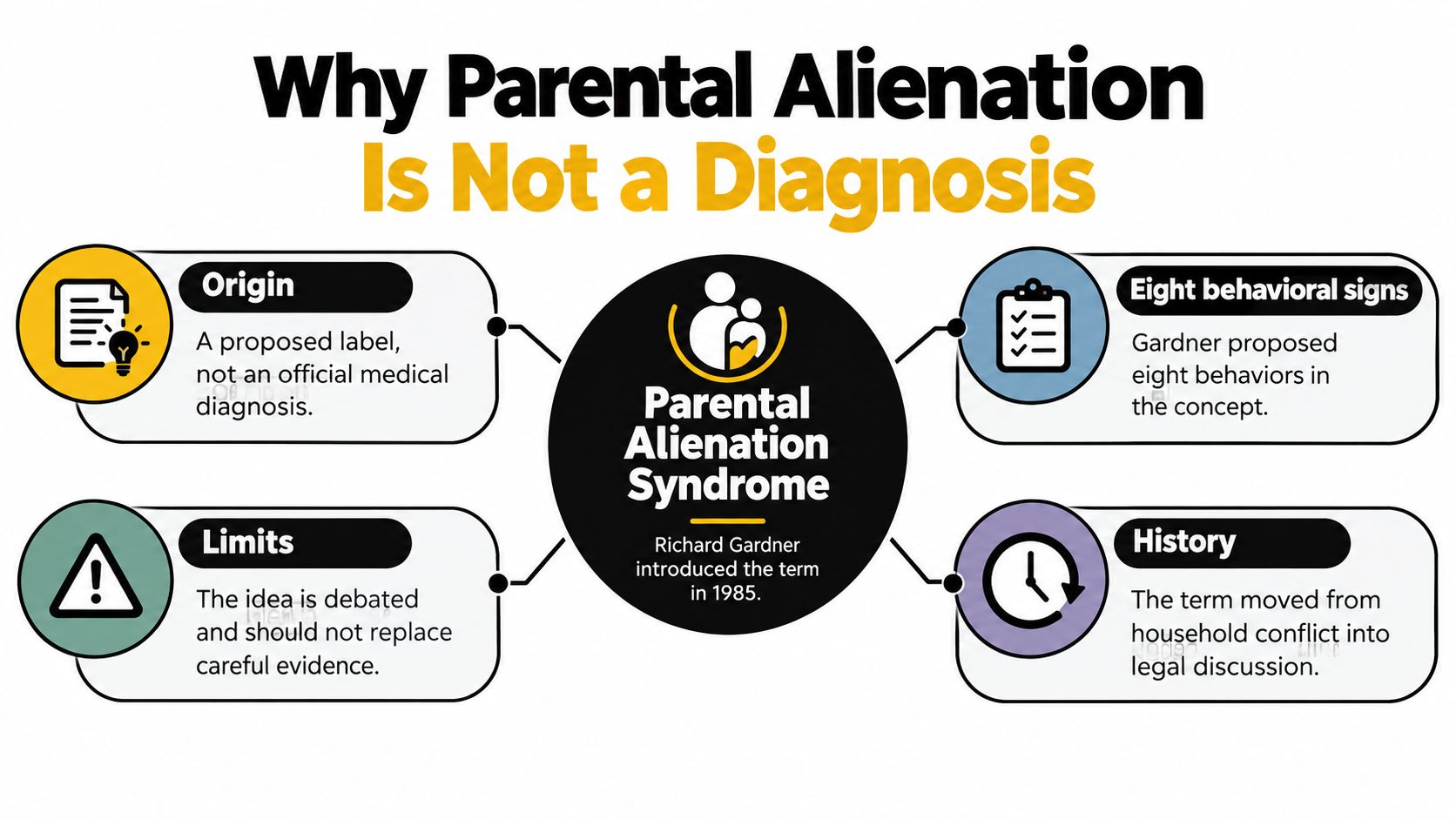
The modern term entered public discussion in 1985, when child psychiatrist Richard Gardner introduced Parental Alienation Syndrome and proposed eight behavioral signs he believed could indicate unjustified alienation, a history summarized in a record of the concept's development and debate. The idea spread quickly into custody disputes, but speed isn't the same as scientific acceptance.
Through the 1980s and 1990s, the theory generated extensive debate. Many publications rested mainly on clinical experience or conceptual analysis rather than empirical research. That gap is one reason careful lawyers and evaluators use the words cautiously today.
What the Diagnostic Manuals Did and Didn't Do
The American Psychiatric Association didn't include parental alienation syndrome in DSM-IV, published in 1994, and it wasn't included in DSM-5. The World Health Organization also decided during ICD-11 development not to include parental alienation as a health care diagnosis, explaining that the term is mainly used in custody litigation and wouldn't contribute to health statistics, as described in the WHO explanation of its ICD-11 decision. WHO points instead to broader relational categories, including caregiver-child relationship problems.
That doesn't mean your family's problem isn't real. It means the label works differently from a medical diagnosis like diabetes or asthma. A doctor can't settle a custody dispute by checking a box, and a parent shouldn't present the phrase as if it proves causation.
Why the Research Numbers Vary So Widely
There's no universally accepted prevalence rate, largely because researchers use different definitions, samples, and tools. One published summary of alienating behaviors reported rates ranging from 10% to 81% across studies, a spread shown in a research table comparing alienating behavior studies.
That same summary described an Italian study of 470 adults whose parents had separated or divorced. Participants had a mean age of 25.4 years, 55.5% were female, and the separation or divorce had occurred an average of 12.7 years earlier. It also reported that 65% to 70% perceived dysfunctional parenting by both parents.
Read those figures carefully. They concern recalled experiences and related behaviors, not clinically proven parental alienation. For a Harris County parent, the practical lesson is simple. Treat alienation as a hypothesis to test with behavior and records, and always check other explanations before you ask a court to act on the label.
Signs That Differ From Real Safety Fears
Parents often ask for a checklist. A checklist can help you organize observations, but it can't tell you why your child is refusing contact. The safer habit is to write down what happened, when it happened, who saw it, and what else could explain it.
Possible warning signs include missed or sabotaged visits, repeated denigration, fear statements that don't match known events, refusal of gifts or photos, and interference with calls, school information, or medical updates. Each sign raises a question. None answers the question by itself.
Rejection Pattern Versus Other Explanations
| What you may notice | Question it raises | What else must be checked |
|---|---|---|
| Repeated missed exchanges | Is contact being blocked, or is the child avoiding something specific? | Illness, schedule confusion, fear, conflict at exchanges, or a safety concern |
| Harsh adult phrases | Is the child repeating someone, or describing their own experience in borrowed words? | Exposure to arguments, loyalty pressure, coaching, or real events the child struggles to explain |
| Refusal before visits but calm during visits | Is transition anxiety driving the protest? | Separation worry, loyalty conflict, or pressure connected to departures and returns |
| Fear that stays specific and consistent | Is there a concrete event that needs investigation? | Abuse, neglect, family violence, coercive control, or frightening discipline |
| Preference for one home | Is this rejection, or a developmentally normal preference? | Age, routines, siblings, school distance, activities, and each parent's availability |
A careful assessment checks abuse, family violence, coercive control, neglect, developmentally appropriate preferences, conflict exposure, loyalty pressures, and genuine estrangement before it settles on manipulation. If control or intimidation may be part of the adult relationship, trauma-informed guidance for complex relationships can help you recognize patterns that shouldn't be brushed aside during that screening.
Practical rule: Describe conduct first. Save conclusions about motive for later, after safety and alternative explanations have been checked.
This caution isn't academic. The United Nations Special Rapporteur on violence against women and girls reported there's no commonly accepted clinical or scientific definition of parental alienation and warned the label can obscure domestic abuse and child safety concerns, a warning set out in the Special Rapporteur report on custody and violence.
If you're worried a visit would put your child at risk, don't improvise and don't ignore the court order without advice. Read about whether visitation can be denied for safety concerns in Texas and get guidance promptly. An allegation isn't proof, in either direction.
How Alienation Can Affect Children Over Time
It's natural to worry about lasting harm. A child caught between parents may carry stress into school, friendships, sleep, and later relationships. At the same time, long term research can't predict your child's future, and it can't prove why your child refused last Friday's exchange.
Keep those two ideas together. Take the risk seriously, but don't turn association into certainty.

What Professional Agreement Does and Doesn't Show
In a survey of 119 child custody evaluators, approximately 80% agreed or strongly agreed with each of 11 proposed definitions concerning child alignments, estrangement, and alienation, with an 88% response rate, according to a survey of child custody evaluators on alienation definitions.
That's a meaningful signal about shared terminology. It isn't proof of how common alienation is, and it isn't proof that one parent caused a particular child's rejection. Professional consensus doesn't replace a case specific investigation.
Longer Term Outcomes Need Careful Reading
A systematic review screened 1,284 records and included 13 studies on longer term consequences associated with childhood exposure to parental alienation. The reported outcomes included adult depression and anxiety symptoms, insecure attachment, lower self-esteem, relationship difficulties, substance-use risk, and reduced quality of life.
Because definitions differ and the underlying designs are observational, those findings support risk attention, not deterministic prediction. Your child isn't doomed because they're caught in conflict, and no parent should use adult outcome research as a shortcut to win a custody argument.
What helps now is steadier, child focused support. For older children who are overwhelmed by transitions and divided loyalties, a therapist's guide to teen coping skills offers practical language for emotional regulation that parents can reinforce without interrogating the child about the other home.
Before anyone recommends reunification work or a custody change, document timelines, earlier attachment, independent records, each parent's help or obstruction, spontaneous versus rehearsed sounding statements, and safety claims. That record gives professionals something firmer than competing labels.
How Texas Courts Weigh Alienation Claims
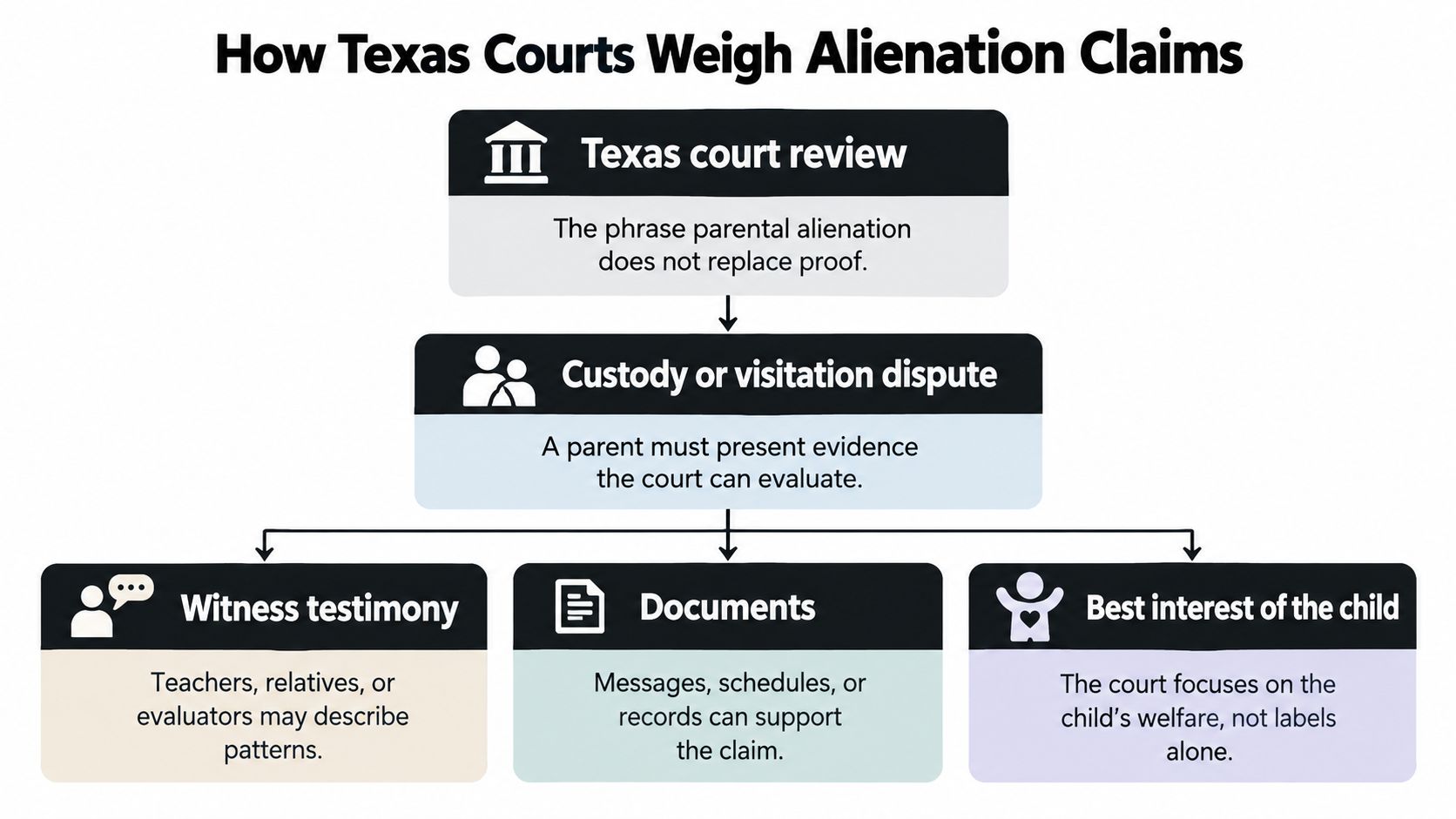
Texas law doesn't treat the phrase parental alienation as a substitute for proof. In a custody or visitation dispute involving a family in Humble, Atascocita, Kingwood, or Northeast Houston, the controlling standard is the child's best interest.
Texas Family Code §153.002 states that the child's best interest is always the court's primary consideration when deciding conservatorship, possession, and access, in the Texas Family Code provisions on conservatorship and possession. In plain terms, the judge asks what arrangement serves this child, not which parent uses the stronger label.
Conduct Matters More Than Terminology
A parent who believes the other parent is turning a child against them should present concrete, child focused evidence. Examples include documented interference with court ordered visits, repeated refusal to share required information, or communications that pressure the child to reject the other parent.
To understand the wider best interest inquiry, many local parents start with how judges decide custody in Harris County before they frame a request. That framing matters because the remedy has to connect to your child's welfare, schooling, health, stability, and relationships.
Joint Conservatorship Doesn't Always Mean Equal Time
Texas generally presumes both parents should serve as joint managing conservators. The Texas State Law Library explains that joint managing conservators share decision making responsibilities, while the possession schedule may still give one parent substantially more time, as explained in the State Law Library guide to Texas child custody and support.
So the practical issue is often enforcement or modification of the parenting schedule, not an automatic request for sole custody. Families who need custody and conservatorship representation for Humble families may review what a Child Custody Lawyer in Humble, TX handles, then compare that with the narrower schedule problem they need solved.
Texas Family Code §153.191 also matters. A parent who isn't appointed sole or joint managing conservator must ordinarily be appointed a possessory conservator unless the court finds that appointment isn't in the child's best interest and that possession or access would endanger the child's physical or emotional welfare, under Texas Family Code section 153.191 on possessory conservators. A child's resistance doesn't, by itself, prove the rejected parent is dangerous or that contact should end.
Evidence Remedies and Local Legal Help
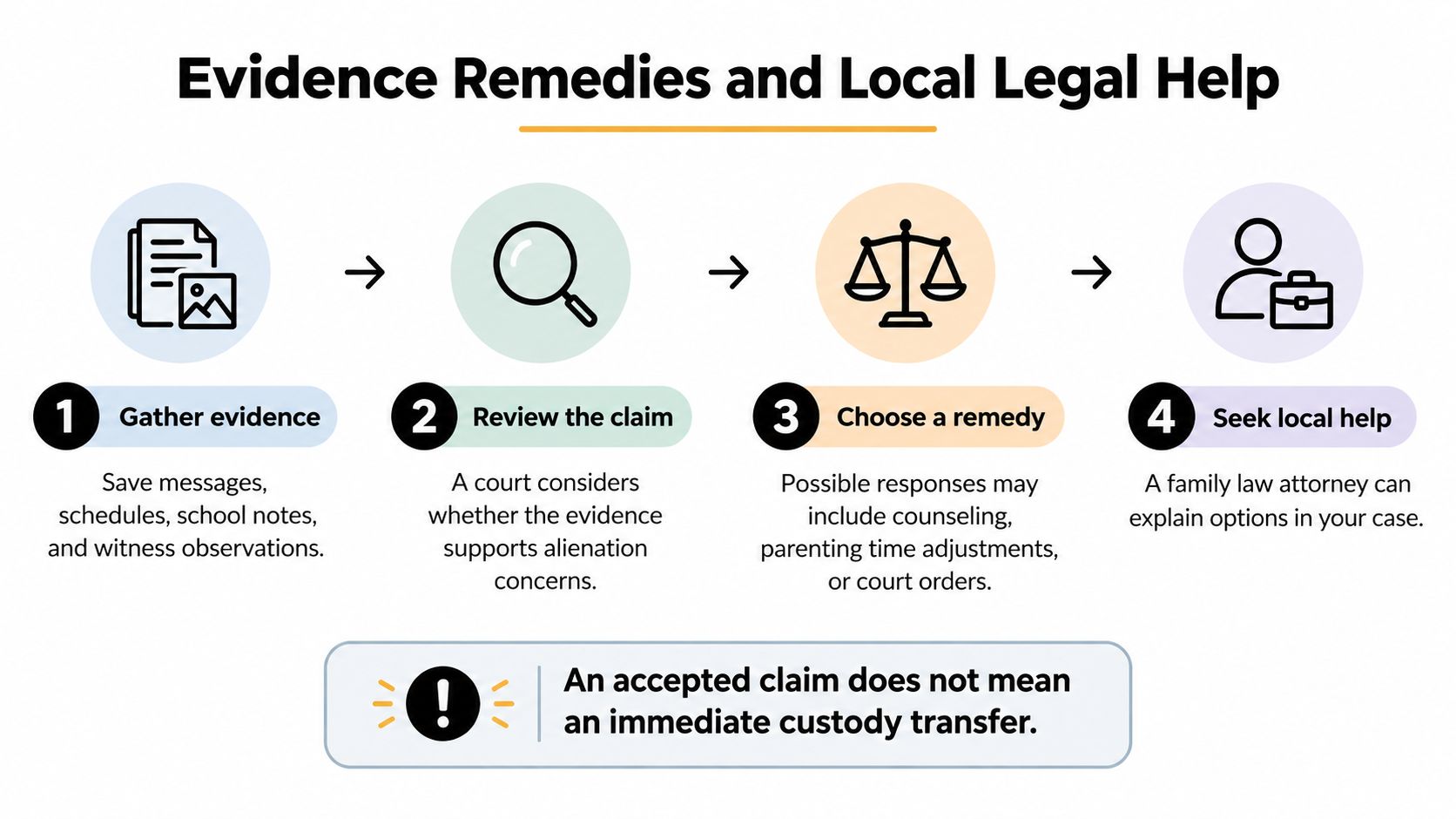
Even when a court or professional accepts that alienating conduct may be happening, the next question is harder. What response helps the child?
Ontario research is a useful caution. Studies of professionals in cases with parental alienation findings reported few effective legal responses or clinical resources and called for better interdisciplinary practice, challenging the assumption that transferring custody or ordering immediate reunification automatically resolves the problem, in Ontario research on professional responses to alienation findings. Interviews with 62 professionals and focus groups involving 50 more also described these cases as complex, with slow legal responses and limited coordinated resources.
Proportional Responses to Consider
Graduated options often fit better than an all at once change:
- Reviewable parenting time: A schedule that can expand, contract, or add safeguards based on observable results.
- Neutral child focused assessment: An evaluation that tests competing explanations instead of starting with a conclusion.
- Trauma informed therapy: Support for coping and relationships, without asking therapy to determine legal truth.
- Structured communication: Written, documented exchanges about school, health, and logistics.
- Review hearings: Court check ins tied to attendance, completed visits, and the child's functioning.
Those options only work with reliable evidence. Texas appellate decisions emphasize that evidence of possible harm must go beyond mere suspicion or speculation when a court considers removing a parent from a conservatorship role, a point made in a Texas Court of Appeals decision on best interest evidence. Preserve complete texts and emails, exchange logs, school or medical records, and names of witnesses with firsthand knowledge, and review the evidence needed for a custody case in Harris County before you file anything.
Don't coach your child, secretly record where it isn't allowed, or put unsupported accusations in pleadings. If an existing order is being ignored, Enforcement of Court Orders in Humble covers enforcing divorce decree and custody order provisions in Harris County. The Law Office of Bryan Fagan is a downtown Humble firm serving Humble, Atascocita, Kingwood, and Northeast Houston in divorce, custody, and possession disputes, and parents whose conflict sits inside a broader separation can also review its guide to the Humble divorce process.
Next Steps for Humble and Harris County Parents
Start with the order you already have. Read every page, follow it, and don't invent a new schedule because you're frustrated. Withholding support, refusing an exchange to make a point, or criticizing the other parent in front of your child usually makes the record worse.
A One Week Paper Trail You Can Start Today
- Log each exchange: Write the date, time, place, who was present, and what happened in neutral words.
- Save complete messages: Keep full text and email threads, not cropped screenshots that remove context.
- Track calls and information: Note denied calls, missed school notices, and medical updates you didn't receive.
- Build a one page timeline: Separate what your child said, what each parent did, and any safety facts that still need a specialized look.
- Identify neutral records: List teachers, counselors, medical providers, or other witnesses with firsthand knowledge.
Keep your child's part small. Don't quiz them after visits, ask them to carry messages, or promise what a judge will do. A calm, repeatable routine at your home gives your child one place where the adult conflict gets quieter.
Bring the order, the log, and the timeline. A useful first meeting starts with documents, not labels.
If the pattern is affecting conservatorship or possession in Harris County, schedule a free consultation with the Law Office of Bryan Fagan at its Humble office. A local attorney can review your order and records and explain whether enforcement, a best interest modification, or a more limited communication remedy fits your facts.
Parents in Humble, Atascocita, Kingwood, and Northeast Houston don't have to choose between protecting a child and preserving a real parent child relationship. When safety is checked carefully and the facts lead, both goals can be pursued together.
If your child is refusing visits and you're unsure whether you're seeing manipulation, a safety problem, or the strain of separation, the Law Office of Bryan Fagan can review your Harris County order, your records, and your options for enforcement or modification in plain language. Visit Law Office of Bryan Fagan to schedule a free consultation at the Humble office and bring your current order and exchange log with you.