In Harris County, an uncontested guardianship can require roughly $1,200 in court charges, according to the Harris County Clerk's probate fee information. That covers filing, e-filing, service, and an attorney ad litem deposit, but not your private lawyer's fees or any bond. The filing fee is the entry ticket, not the full cost.
A Kingwood parent who can no longer pay bills and an Atascocita spouse who needs medical decision-making authority face the same first question: who pays? The answer depends on the family's finances and the person's resources. Court charges, legal fees, medical evaluations, and bond premiums may fall on different people, and a fee waiver may not cover every charge. A single number cannot show what your family will owe.
How Much Does Guardianship Cost Beyond a Filing Fee
A Harris County filing fee is the entry ticket, not the full price of guardianship. The total has two parts: a court case to get appointed, and a continuing job caring for a person, managing an estate, or both. Families who call the Harris County Clerk usually hear the filing fee first, and that figure can be mistaken for the total.
Split the budget into two lines: court charges and professional work. Court charges can include probate filing, electronic filing, and service on people who must receive notice. Professional work may include your lawyer, evaluations, and, if the guardian will manage money, a bond premium. The next section explains who each professional works for and why their fees differ.
Why One Quoted Fee Misleads Families
A filing fee varies by place. A multi-state overview of guardianship filing fees reported a midpoint average filing fee of approximately $317 across 10 jurisdictions. Those filing fees excluded attorney fees, evaluations, service, bond premiums, training, medical documentation, and recurring reporting. A lower filing fee in another state gives a Harris County family little guidance about its own total.
The case can cost more when relatives disagree. If they agree, records are ready, and the proposed ward's needs are clear, the lawyer may have less corrective work to do. Disputes about capacity, the proposed guardian, or past money management can require more professional time and court attention.
Planning mindset: Budget for an opening phase and a yearly phase, rather than for a courthouse stamp alone.
Start by asking who needs protection and whether you will manage money, personal decisions, or both. Consider whether the person owns a home or receives income, and whether anyone may object. Those answers help show which charges apply and which costs may return each year.
The question “How much does guardianship cost?” has three parts: what Harris County collects to open and hear the case, what professionals and a bond company charge, and what you may spend each year after the judge signs the order. Keeping those amounts separate helps prevent a modest entry fee from being mistaken for the final bill.
Harris County Court Fees Families Should Expect
A family in Humble, Atascocita, Kingwood, or Northeast Houston begins with a county filing, not a city-court charge. That filing fee is the entry ticket, not the full court bill. The court-controlled charges below are separate from what a lawyer, doctor, or bond company may charge.
The county clerk lists $360 in associated court filing fees for a guardianship of a minor, an incapacitated person, a temporary guardianship, or a qualifying proceeding under Texas Estates Code section 1353.002. The schedule also lists a $30 state electronic filing fee for each new case and a $2 county fee for each filing envelope, according to the Harris County Clerk probate fee information. Ask your e-filing provider for its per-filing charge before you submit, and add that figure to the subtotal.
The Deposit Families Often Miss
Harris County Probate Courts require a $750 advance deposit for attorney ad litem fees before setting a hearing, effective March 14, 2025. The county also lists an $85 guardianship application service charge, according to the Harris County Probate Court guardianship page. The deposit is collected in advance; it is not necessarily the ad litem's final bill, which the court reviews in the case.
| Harris County Court-Controlled Guardianship Charges | | |
| Charge | Listed amount | When it applies |
| Associated guardianship filing fees | $360 | Minor, incapacitated person, temporary, or qualifying statutory case |
| State electronic filing fee | $30 | Each new case |
| County electronic filing fee | $2 | Each filing envelope |
| Guardianship application service | $85 | Application service charge |
| Attorney ad litem advance deposit | $750 | Before a hearing is set |
Sources: Harris County Clerk probate fee information and Harris County Probate Court guardianship page.
Add the five lines above and the court-controlled subtotal is $1,227 ($360 + $30 + $2 + $85 + $750), before legal fees and bond costs, according to the sources cited above. The $2 envelope fee applies to each filing envelope, so additional envelopes increase the subtotal. Citation or service charges may also apply if more relatives or interested people need formal notice.
New filers often ask which courtroom will hear the case. Read which of Harris County's Statutory Probate Courts 1 through 4 may hear your case to understand the assignment before heading downtown.
Confirm the current clerk schedule shortly before filing, because county charges can change.
Write the court subtotal down before meeting with counsel. It gives your family a clear starting point for separating county charges from professional costs, which depend on the case and the person appointed to serve.
Attorney Bonds and Evaluation Costs Explained
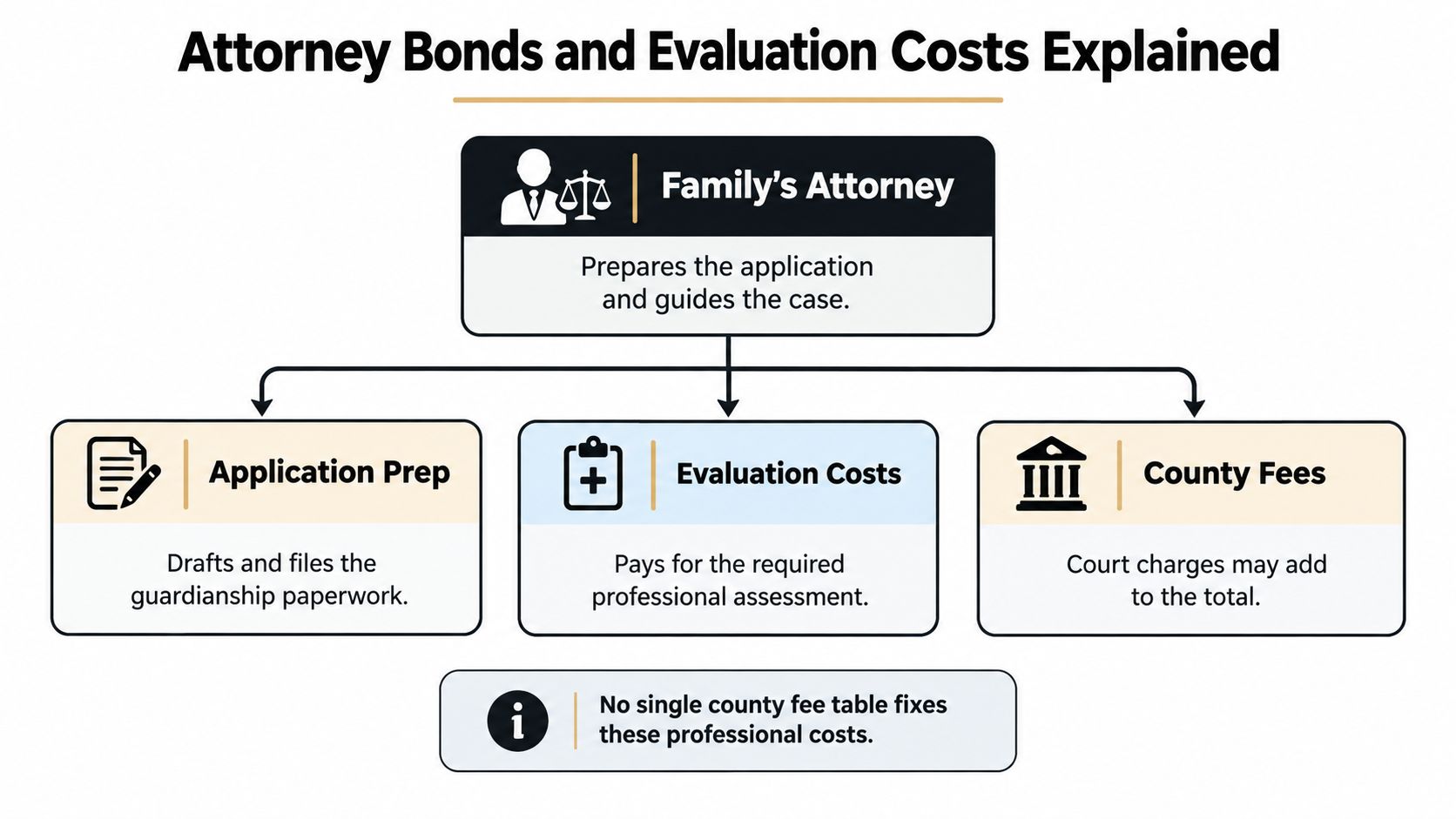
A Humble family can start with a Harris County filing subtotal near $1,200, yet that is only the entry ticket. A lawyer, an appointed attorney ad litem, a medical evaluator, and a bond company may each charge separately. Which costs fall on the family, and which may be paid from the proposed ward's assets, depends on the case and the person's finances.
Your lawyer prepares the application, gathers capacity and physician paperwork, identifies relatives entitled to notice, coordinates service, and appears with you in Harris County Probate Court. Missing records or disagreement among relatives can add work and cost. A probate quote typically covers estate administration; a guardianship quote covers court appointment and duties for a person. Families handling estate matters may consult a Probate Lawyer in Humble, TX, but should ask for a separate guardianship estimate.
Your Lawyer and the Attorney Ad Litem Do Different Jobs
Your attorney represents you as the applicant. The attorney ad litem is appointed to represent the proposed ward's interests and report to the court. The fees cover two different jobs: your attorney builds and presents the application, and the ad litem reports to the court on whether guardianship is needed. The ad litem's advance deposit is part of the court-controlled subtotal described earlier, while your lawyer's fees are separate.
For example, a Kingwood family with an uncontested application and a home still needs to plan for both legal roles. A home or other property may also affect the bond required if the guardian will manage an estate. Ask which charges are paid to the court and which are billed by professionals.
What a Bond Protects Against
A bond works like insurance for the ward's money when the guardian manages an estate. The bond company charges a premium, which depends on what must be protected and continues while the guardianship remains open. A guardianship involving only the person, with no estate to manage, is usually less costly than one involving a house, accounts, benefits, or business interests.
Evaluation expenses are separate too. The physician or other evaluator may charge for an assessment and supporting records, so ask who will provide the evaluation and what the fee includes. If three relatives must be personally served and one lives out of state, budget for process service fees separately, because those charges are not in the Harris County subtotal.
Who pays these expenses depends on the family's situation. An applicant may pay upfront while the case is pending; if the proposed ward has available assets, some costs may be paid from those assets, subject to court requirements. A family without funds may ask about a fee waiver, but a waiver generally does not erase private attorney, evaluation, bond, or process service charges.
Conflict can raise the total. Disputes over who should serve, concerns about a proposed guardian's suitability, or disagreements over a larger estate may require more attorney time, professional review, and court appearances. Ask a lawyer to estimate the uncontested path and identify what events could increase the bill.
Yearly Costs After a Guardian Is Appointed
A Humble family may budget for the court case and still be surprised by the work that follows. Appointment starts a court-supervised duty that can last for years, so budget for it as a recurring line.
The timeline below lays out the recurring duties in order, from the first annual report to the final accounting.
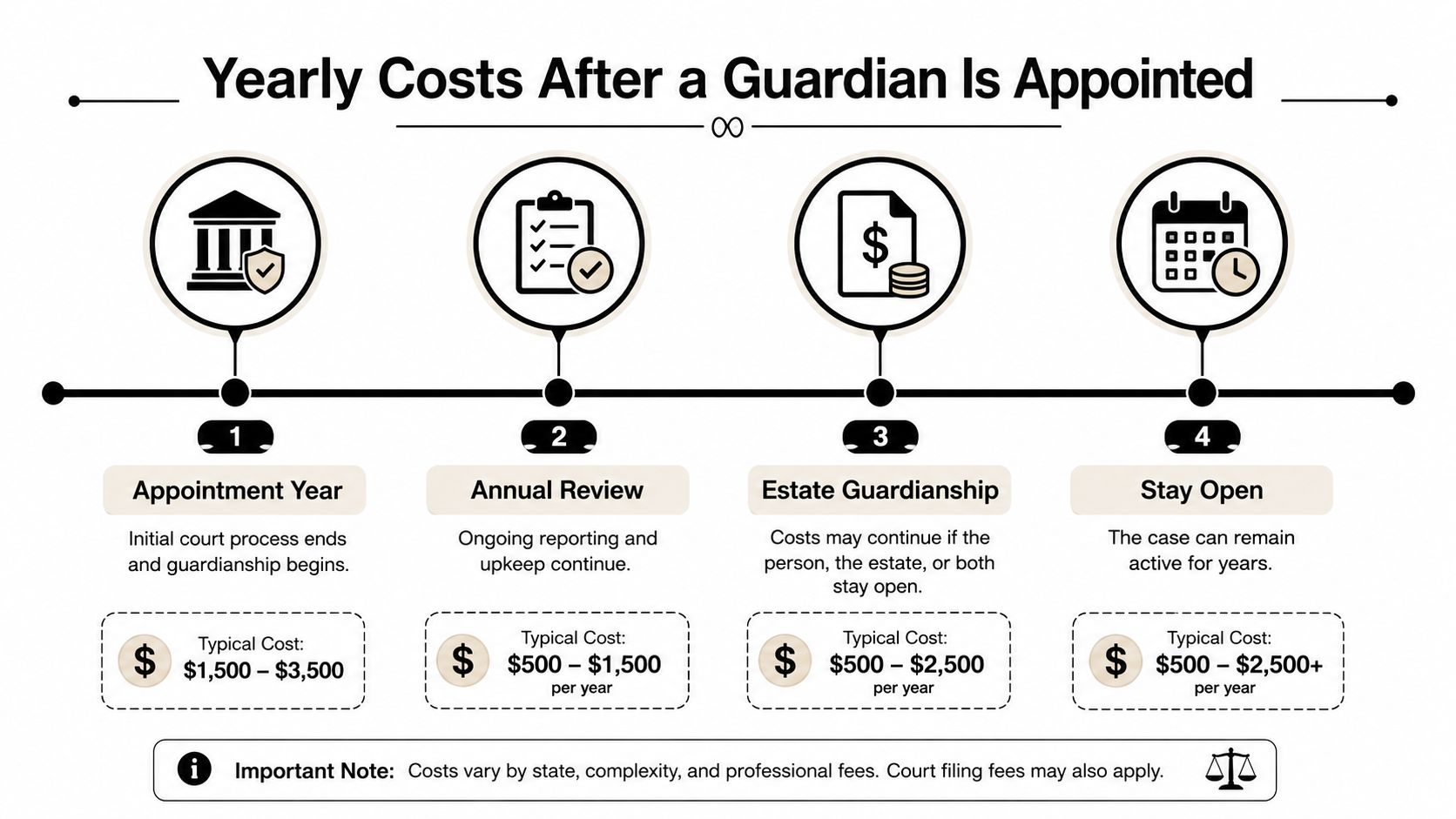
Texas guardians must complete recurring duties, including annual reports or accountings. The state reporting system is free, but filing charges may still apply at the local court. Harris County families should confirm the fee for each report or accounting with the court, since fees from another county may not match local charges.
The Recurring Bills Families Forget
- Attorney preparation: A lawyer may charge to prepare an annual accounting or respond to questions about a report.
- Bond premiums: Coverage may need to remain in place while you manage the ward's money or property.
- Appraisals and records: Property valuations, copies, postage, and financial recordkeeping can add costs.
- Court review: Additional work may be needed if the judge requests receipts, explanations, or updated information.
Keep a monthly ledger of every payment made for the ward, so the annual accounting does not require rebuilding a year of receipts. Save bank statements, receipts, benefit letters, medical updates, and notes about major decisions together. That routine makes it easier to explain how money was handled and gives your lawyer organized records if the court asks questions.
Guardian Compensation Has a Statutory Limit
Under Texas Estates Code Chapter 1155, a guardian may generally receive compensation from the ward's estate, subject to court approval. The amount cannot exceed the greater of $3,000 per year or 5% of the ward's gross income, unless an exception or court order applies. The court reviews the requested compensation through the annual or final accounting process.
Don't count on guardian compensation to balance your household budget until the judge has approved the amount in your specific case.
A person-only guardianship with stable care arrangements may require less yearly administration. Managing an estate usually means tracking income, bills, property, and account balances. If someone challenges your decisions or accounting, legal work may increase. Consider what your family can sustain each year while the ward continues to need protection.
Who Pays in Three Common Family Situations
A Kingwood daughter may pay the first guardianship bills for a parent who owns a home and receives retirement income. Whether she can later seek repayment depends on the ward's funds and the court's approval. The filing fee is the entry ticket, not the whole cost, and the payer may change as the case proceeds.

Situation One: The Proposed Ward Has Assets or Income
If the parent has enough money, court costs and legal fees may be paid from the ward's estate, subject to court approval. The daughter might advance the initial charges, keep receipts, then ask the court to approve reimbursement from her parent's funds.
Reimbursement requires court review, and expenses must benefit the ward or the administration of the guardianship. The guardian also needs records showing what was spent. Families concerned about memory loss can review guidance on assessing financial risks with dementia to help identify risks to accounts and unpaid bills.
Situation Two: A Relative Petitions and the Ward Has Little Cash
An Atascocita son may petition for guardianship of a parent whose income covers basic living costs but leaves little in reserve. He may need to pay filing costs, attorney fees, and evaluation expenses up front. The court can later consider whether any appropriate expenses may be repaid from the parent's limited estate.
Situation Three: The Person Is Indigent
When the proposed ward is indigent, some court costs may be waived or shifted, depending on the court's rules and findings. A waiver usually does not automatically cover private counsel, medical assessments, service, bonding, or later fiduciary administration. A Northeast Houston family should ask early which costs it may need to advance and what proof of inability to pay the court requires.
Cook County offers a useful comparison. Illinois guardianship procedure information lists a $50 person-only filing fee and states that attorney and guardian ad litem fees may be paid from the disabled person's estate with court approval, while indigent cases can shift fees to the petitioner. Cook County is a different system, but it shows how a small filing fee can leave the who-pays question unanswered.
Before speaking with a lawyer, write down the proposed ward's income, accounts, home, debts, and benefits. That snapshot helps counsel discuss possible advances, reimbursement, and which expenses may remain the petitioner's personal responsibility.
Ways Humble Families Can Reduce Guardianship Costs
A Humble family may be able to reduce some court charges if it qualifies for a fee waiver. The Harris County filing fee is only the entry ticket, though. A waiver may cover certain court costs, while attorney, medical evaluation, service, bond, and ongoing guardian expenses can remain separate.
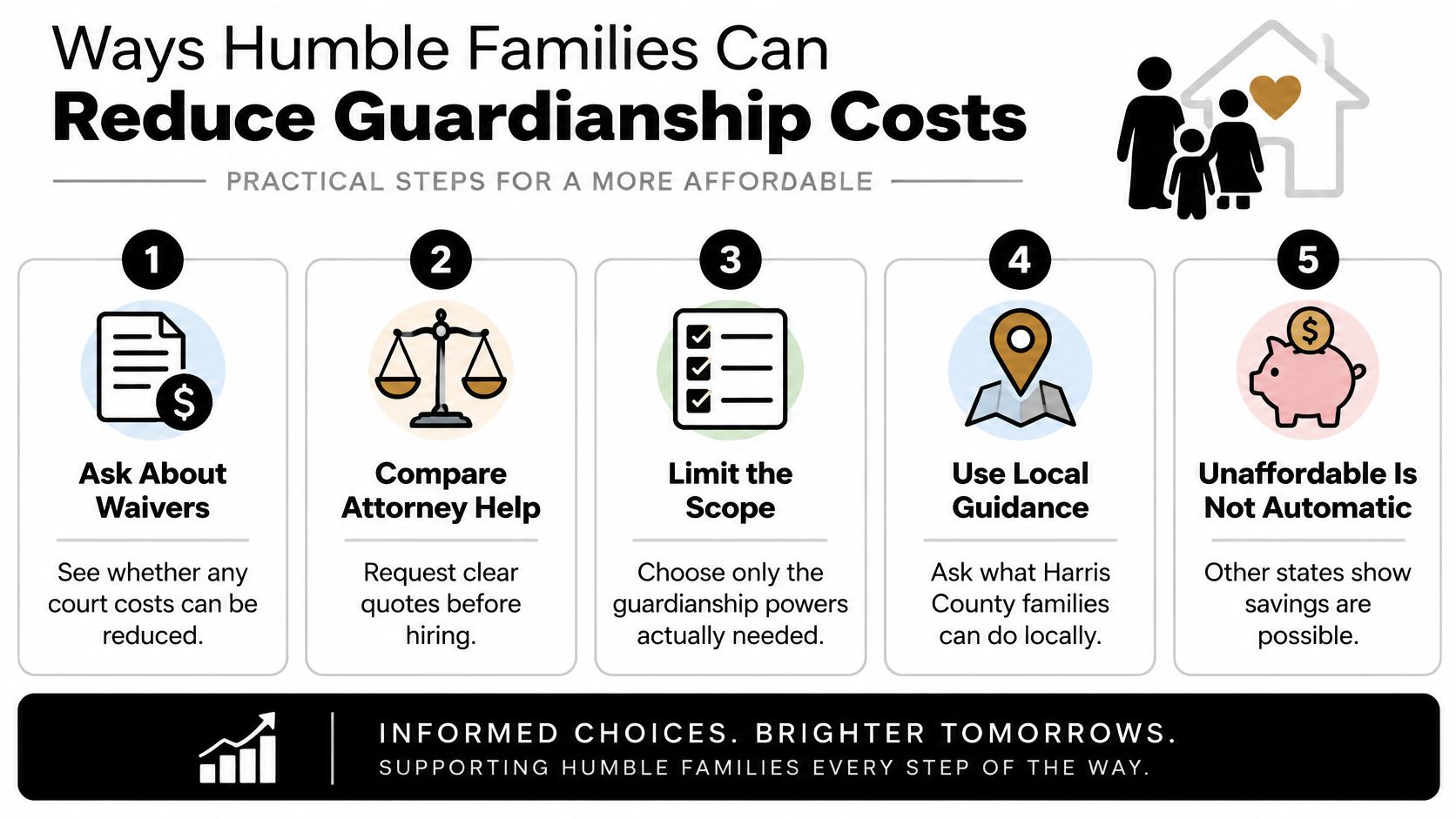
Other states offer examples of what to ask about. California says an approved waiver may cover filing fees, investigation costs, certified copies, and other court fees in guardianship or conservatorship cases, according to California court fee waiver guidance for guardianship and conservatorship. California's rule is not Texas law, so ask the Harris County clerk which charges, if any, an inability-to-pay showing would cover.
A Practical Savings Checklist
- Ask about inability to pay: Request the Harris County fee waiver process and find out what financial documents the court requires.
- Separate court and private costs: A waiver generally does not automatically cover private counsel, medical evaluations, service, bonding, or yearly fiduciary work.
- Clarify the application steps: Ask the clerk whether a fee waiver application needs its own affidavit and a separate hearing date.
- Arrive organized: Gather medical records, benefit information, asset documents, and relatives' contact details before legal work begins.
- Seek family agreement where safe: Agreement can reduce disputes, additional hearings, and corrective legal work.
The right legal arrangement also affects the total cost. Ask whether a temporary or limited guardianship fits the need, or whether existing estate-planning documents provide some needed authority. Review guardianship versus power of attorney to prepare questions. A document signed in the past may not help if your loved one no longer has capacity to make a new one.
If a website asks you to pay to register a Texas guardianship with the statewide certification commission, stop and check the form before sending money.
Registration with the Texas Judicial Branch Certification Commission is free. Its guardianship registration questions explain that a payment request indicates the wrong form was completed. This registration is separate from opening a Harris County Probate Court case, which has its own fees and possible deposits.
For broader probate and family guidance, see the firm's probate services page. Use general resources to prepare for a case-specific discussion of which costs may apply and who is expected to pay them.
When to Talk with a Humble Guardianship Attorney
A relative may need help paying bills or making care decisions today, while the documents in place give no one authority to act. That gap can turn a manageable family discussion into an urgent court matter. Talk with local counsel promptly if relatives disagree about who should serve, the proposed ward owns a home or accounts in Harris County, or someone needs temporary authority.
Early advice also helps families understand which costs belong to the court and which may come from a lawyer, doctor, or bond company. A court filing fee is the entry ticket, not the whole budget. If a bond or yearly accounting will be required, ask how those duties could affect the ward's estate and what court approval may be needed before expenses are paid from it.
Signs the Lighter Path May Not Be Enough
- No usable authority exists: Banks, medical providers, or care facilities will not accept the documents your family has.
- Money is at risk: Bills are unpaid, scams are reaching your loved one, or someone is controlling accounts without transparency.
- Care decisions are stuck: Relatives disagree, or no one can consent to needed placement or treatment.
- A court fight is likely: A relative plans to oppose the application or question the proposed guardian's fitness.
A lawyer can help compare guardianship with a power of attorney or another estate planning tool if your loved one still has capacity to choose. For local guidance on Harris County probate, review information about a Harris County probate attorney near Humble. If guardianship overlaps with an unresolved estate plan or pending probate matter, bring those documents to the consultation so counsel can consider both.
Bring what you have, even if the file is incomplete. An asset and income list, medical evaluations, estate planning documents, and names of relatives who may need notice can help make the cost discussion specific. Ask which charges the court collects, which professionals bill separately, and whether any expenses may be paid from the ward's estate. You can also ask what financial hardship options apply, since a waiver of court costs may not cover lawyer, evaluation, or bond charges.
If your family needs a case-specific budget, contact the Law Office of Bryan Fagan through its Humble office contact page. Schedule a consultation at the downtown Humble office and bring your asset list, medical information, and family contact details. A clear discussion can help you understand the likely costs and the next step for protecting your loved one.