Skip to content
Your mother's will is in a folder on the kitchen table. The death certificate is beside it, and relatives in Humble, Atascocita, or Kingwood are asking the same urgent question: Harris County statutory probate courts 1 through 4, which one hears my case?
The answer usually isn't based on which courtroom looks closest on the directory board. Harris County assigns probate matters through a combination of case type, venue, internal court assignment, and each court's scheduling process. Knowing those filters can save a family an unnecessary trip downtown and help prevent a filing from being directed to the wrong place.
When You Walk Into the Harris County Civil Courthouse Not Knowing Where to Go
You arrive from Humble with a will, medical records, bank statements, and questions from relatives in Atascocita or Kingwood. The directory lists several probate courts, yet the court number you need is not determined by which floor looks easiest to reach.
The courthouse is the starting point, not the answer. A clerk does not hear the facts at a window and send every family to Court No. 1, No. 2, No. 3, or No. 4. New matters pass through the probate division's filing and administrative procedures. The case type, proper venue, assignment process, and scheduling requirements all affect what happens next.
Families preparing for a downtown visit can review this Harris County probate court guide for Humble residents before gathering documents. It explains the connection between Humble residents and the county probate system in practical terms.
Practical rule: The courthouse address identifies the facility. It does not identify the judge assigned to your case.
Use three filters before focusing on a court number:
- Case type: Is the matter an estate, guardianship, trust dispute, heirship proceeding, will contest, or mental-health case?
- Venue: Does Harris County have the required connection to the decedent, ward, property, or dispute?
- Assignment and scheduling: Once the filing is accepted, which court receives it, and what does that court require before the first hearing?
Those filters work like sorting mail into the right office. They help separate the question of where a case belongs from the separate question of when a judge will hear it.
County materials identify five statutory probate courts. Courts No. 1 through No. 4 operate at the Civil Courthouse, while the county's probate information provides the current court directory. The listed public service hours are Monday through Friday, 8:00 AM to 4:30 PM. Review the county's Harris County Probate Court information for directory details, then confirm filing and hearing instructions before traveling.
What a Statutory Probate Court Actually Does in Texas
A Humble family may arrive with a will, medical records, or a dispute over property and still be unsure which judge should handle the matter. The court number becomes clearer after you identify the legal job the court must perform.
A statutory probate court is a specialized Texas court for probate-related work. In plain language, it handles legal questions about a person's property after death, protects people who cannot manage their own affairs, oversees certain trusts, and resolves connected disputes. Its authority comes from Texas law, rather than from a simple courthouse label.
Texas recognizes Harris County Probate Courts No. 1 through No. 5 as statutory probate courts. That designation gives them specialized probate jurisdiction instead of treating them like ordinary county civil courts with an added probate docket.
A family in Northeast Houston may encounter several types of proceedings:
- Estate administration: The court may prove a will, appoint an executor or administrator, address creditor claims, and oversee distribution of estate property.
- Guardianships: The court may decide whether a minor or an adult who cannot manage personal or financial matters needs a guardian.
- Trust disputes: Certain lawsuits involving trustees, beneficiaries, or fiduciaries may remain tied to the probate court.
- Heirship and contested matters: A judge may determine who inherited property or resolve a challenge involving a will or estate administration.
- Mental-health proceedings: Probate Courts No. 3 and No. 4 handle specific mental-health matters, including involuntary commitments and forced medication. Court-specific information is available through Harris County Probate Court No. 3.
Why Harris County uses multiple probate courts
Harris County divides probate work among several specialized courts. The Harris County court directory lists separate judges for Courts No. 1 through No. 4 and identifies Probate Court No. 3 as the administrative judge's court.
That arrangement gives the county judges, coordinators, and clerks who regularly handle estate and guardianship procedures. It also means a family generally works through the probate division's assignment system, rather than selecting a court because one number seems preferable.
For help with probate administration and estate settlement in Harris County, families may review Probate Lawyer in Humble, TX as a local legal resource. The practical starting point remains the legal matter itself, followed by venue and assignment rules.
How Case Type Decides Which Probate Court Hears Your Matter
Start with the legal substance of the filing, not the court number. Harris County statutory probate courts have original jurisdiction over probate proceedings, guardianships, trusts, and related civil disputes connected to estates or fiduciaries. Texas law also provides exclusive jurisdiction over probate proceedings, while allowing concurrent jurisdiction with district courts for certain trust and representative-capacity lawsuits. (Texas probate jurisdiction overview)
That means a contested estate claim may stay within the probate system instead of automatically moving to a general civil court. But case type doesn't always produce a simple one-to-one court match. The county uses a coordinated structure across Courts No. 1 through No. 4, and special subject-matter rules can affect the destination.
| Case Type | Examples | Assigned Court(s) | Filing Notes |
|---|---|---|---|
| Decedent's estate | Independent or dependent administration, probate of a will | Courts No. 1 through No. 4, according to assignment procedures | File the correct application and identify the decedent, will status, and requested administration |
| Small-estate or title proceeding | Small-estate affidavit or muniment-of-title request | Probate division assignment | The chosen procedure depends on the estate's facts and the property involved |
| Contested estate matter | Will contest, heirship determination, fiduciary dispute | Assigned statutory probate court, with jurisdiction reviewed | A dispute may require additional service, notice, or an appointed attorney |
| Guardianship | Minor guardianship or adult guardianship | Probate division assignment | The proposed ward's residence and the nature of the guardianship matter |
| Trust dispute | Trustee, beneficiary, or fiduciary claim | Probate court or another court with concurrent jurisdiction, depending on the claim | The pleading should identify the trust relationship and legal basis for probate jurisdiction |
| Mental-health matter | Involuntary commitment or forced medication proceeding | Probate Courts No. 3 or No. 4 | The specialized mental-health designation can directly affect assignment |
A Kingwood family filing an adult guardianship shouldn't assume it can select Court No. 2 because that court is convenient. A family handling a decedent's estate connected to Channelview likewise shouldn't assume geography within Harris County determines the judge. The filing enters the probate division, and the assignment process applies the relevant rules.
For families preparing wills, trusts, and estate plans for Humble families, an Estate Planning Attorney in Humble can help organize the documents before a court filing becomes necessary. Good preparation won't let a person choose a probate judge, but it can make the legal issue easier to identify.
Filing and Assignment at the Caroline Street Complex
A family driving from Humble, Atascocita, or Kingwood may reach 201 Caroline Street and still not know which courtroom handles the filing. Courts No. 1 through No. 4 share this central location, but the building address does not answer the legal question. The case type, proper venue, and assignment process do.
County materials describe different administrative contacts and procedures among the probate courts. Court No. 2 provides online docket-scheduling information. Court No. 4 sets out separate procedures for hearing requests, ancillary settings, scheduling conferences, and show-cause matters. Its usual practice is to hold hearings in person, with Zoom available only in special circumstances. Check the Harris County Probate Court home page before relying on an older instruction.
A practical intake sequence
- Identify the filing. State whether the request concerns probate of a will, administration, heirship, guardianship, or another order.
- Confirm venue. Collect the decedent's last residence, the proposed ward's residence, and relevant property or facility information. Venue determines whether Harris County is the proper county, not which courtroom door is closest.
- Review current instructions. Procedures may differ by court. A coordinator can clarify the filing channel and documents needed.
- Submit the matter correctly. Depending on the case, filing may involve electronic submission, clerk intake, or a court-specific process.
- Confirm assignment. After acceptance and assignment, use the cause number, assigned judge, and coordinator's directions to prepare for the next step.
The filing process works like triage at a clinic. First, staff identify the kind of problem. Then they verify whether the location is appropriate. Only after those questions are addressed does the matter reach the court assignment stage.
Hours and phone numbers are listed in the overview above. Confirm the assigned court's coordinator before traveling, especially if you need a hearing date, an in-person appearance, or instructions for an ancillary or show-cause matter.
Before you travel: Verify the current filing, hearing, and appearance procedure with the relevant coordinator or clerk. General courthouse information may explain the structure, while the assigned court controls immediate scheduling details.
After filing, use the county's online case search to confirm where the matter was assigned. Keep the cause number, judge, coordinator contact, and hearing instructions together. Those records guide the next action more reliably than choosing a courtroom based on convenience.
Why Where the Decedent or Ward Lives Matters for Venue
Venue means the proper county for the case. It answers a question that comes before Court No. 1 versus Court No. 4: should Harris County hear the matter at all?
For a decedent's estate, venue can be connected to the person's last residence and, in some circumstances, the location of estate property. For a guardianship, the proposed ward's residence and the circumstances giving rise to the proceeding can matter. The specific facts should be checked under the Texas Estates Code and current local rules before filing.
Consider an Atascocita family whose mother lived in Kingwood before she died. She owned a home or other property connected to Harris County, and she also had property in Liberty County. The family shouldn't treat the two counties as interchangeable just because assets are located in both places. The decedent's residence and the estate's legal connections must be analyzed first, then the Harris County probate division's assignment process determines the statutory probate court.
Residence creates different questions for different filings
For an adult guardianship, the proposed ward's residence usually provides the starting point for venue analysis. If an adult lives in Northeast Houston, that fact may be more important than where the proposed guardian lives. A proposed guardian who lives in Humble may still need to file where the ward resides or where the law otherwise permits.
Minor guardianships require a separate review of the child's residence, possession, and surrounding circumstances. A child temporarily staying with relatives in Atascocita may raise different venue questions from a child who has been living there as the primary home.
Venue also doesn't mean the filer gets to pick a preferred judge. Once Harris County is the proper venue, the matter moves through the county's internal assignment system for Courts No. 1 through No. 4. A careful filing identifies the county connection clearly, because an unclear venue statement can delay the assignment or lead to a challenge.
What Day One Looks Like After Court Assignment
Assignment starts the court's administrative process. For a Humble-area family, the next task is to learn that court's instructions, not to assume all four courts work from one shared script. The assigned court may require a specific request, proposed order, notice method, coordinator email, or hearing format.
The case type sets the pace. An emergency guardianship may need an urgent request. An estate dispute may involve immediate questions about property, access, or a fiduciary's authority. A routine, uncontested application usually follows a slower document-review process, required notice, and a scheduled hearing or order.
The differences are procedural, not necessarily jurisdictional
Court No. 2 publishes online docket scheduling information. Court No. 4 has its own process for hearing requests, ancillary settings, scheduling conferences, and show-cause matters. County materials indicate that Court No. 4 generally expects in-person hearings, while Zoom is reserved for special circumstances. Confirm the current procedure with the assigned coordinator.
The county's public instructions do not create one timeline, one cost deposit, or one email format for every court. A chart can help you organize questions, but it cannot replace the assigned court's current directions.
| Court | Coordinator Email Format | Typical Uncontested Timeline | Primary Docket Style |
|---|---|---|---|
| Court No. 1 | Confirm with the assigned coordinator | Depends on filing completeness and the court's calendar | Court-specific probate docket |
| Court No. 2 | Confirm through current court instructions | Depends on online scheduling and available settings | Online docket scheduling may apply |
| Court No. 3 | Confirm with the assigned coordinator | Depends on the filing and calendar | Probate docket, with specialized mental-health jurisdiction |
| Court No. 4 | Confirm through the court's hearing-request procedure | Depends on review, setting, and hearing requirements | In-person hearings generally, with Zoom only in special circumstances |
A complete uncontested filing may move more smoothly when it includes the application, supporting records, proposed order, and required notices. A contested matter generally takes longer because interested parties must receive notice and an opportunity to respond. A ministerial order, meaning an order requiring limited judicial action after the paperwork is complete, may follow a different path from a disputed petition.
The practical rule is simple: the assigned court controls the next scheduling step. Instructions from Court No. 1 do not automatically apply in Court No. 4, even when both matters involve Harris County probate. Before relying on a hearing format, deposit amount, or coordinator practice, verify it with the court handling the case.
Edge Cases and Common Misconceptions
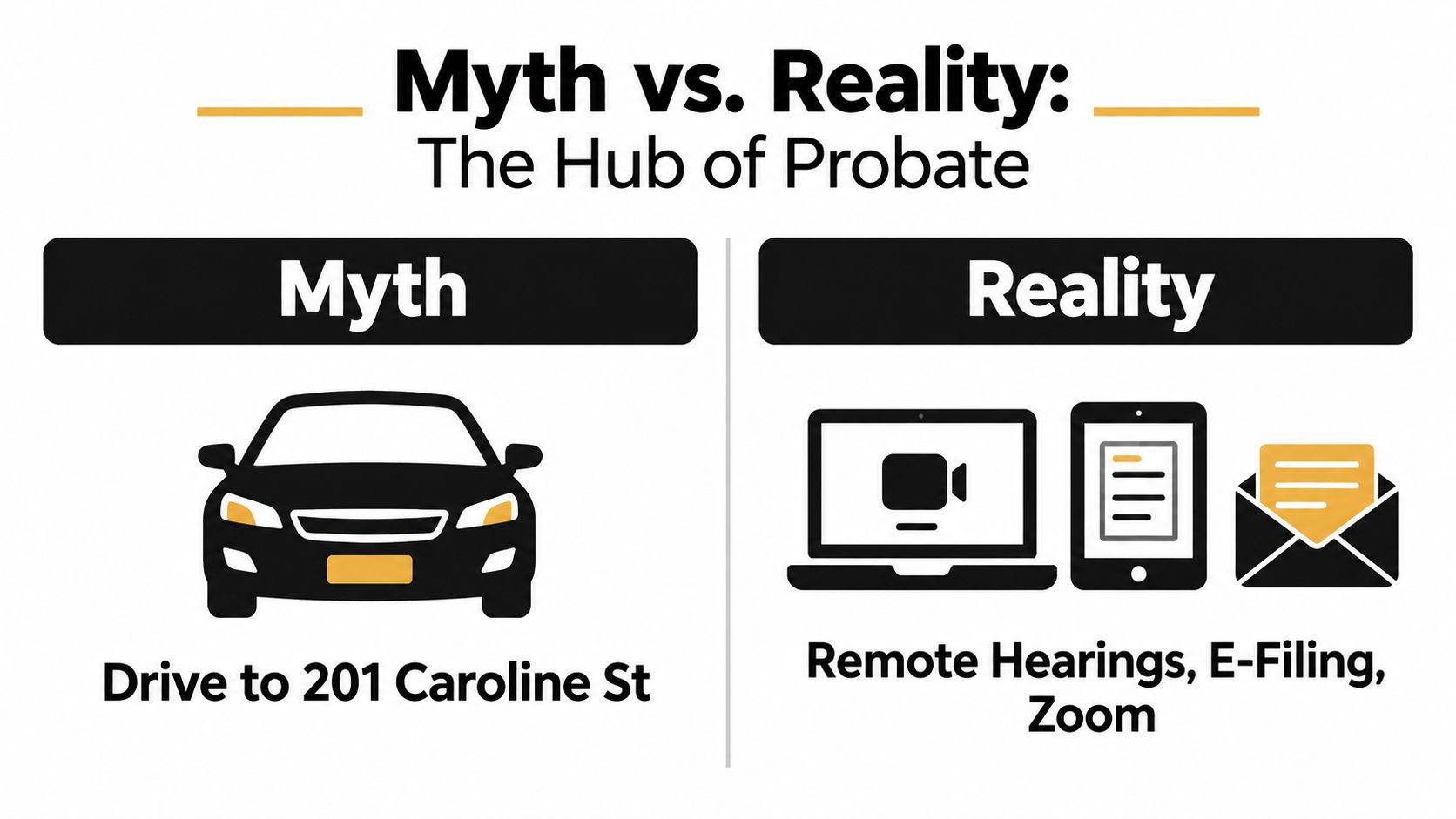
A common myth is that you must drive to 201 Caroline Street to be heard. That isn't always true. Electronic filing, remote hearings, and Zoom appearances may allow a petitioner, attorney, witness, or family member to participate without personally entering downtown Houston, subject to the assigned court's instructions.
A second misconception is that living outside Harris County disqualifies someone from participating. A nonresident executor, beneficiary, or proposed guardian may still have a role in a Harris County proceeding when the estate, ward, or venue satisfies Texas law. The person's address is only one fact in the analysis.
Court names can cause confusion
The four statutory probate courts should not be confused with every court or department that uses the word “probate.” Courts No. 1 through No. 4 are part of Harris County's statutory probate court structure. Other county resources may address limited guardianship or related administrative functions, but the court's actual jurisdiction must be confirmed before filing.
A transfer between Courts No. 1 through No. 4 also isn't something a filer usually requests just because another judge seems preferable. A judge-ordered transfer may arise from recusal, docket balancing, consolidation of related estates, or another procedural reason.
Potential jurisdiction problems include an heirship claim filed in the wrong court, a will contest directed to a court without the needed authority, or a federal matter removed from the state system. The right response isn't to guess based on the courthouse directory. It's to review the claim, parties, venue, and requested relief before the first pleading is filed.
Families handling a title question may also need to understand the requirements for a muniment of title in Texas. A local attorney can pre-screen these issues, identify missing facts, and help determine whether the filing belongs in the Harris County probate division or another court.
Your Next Steps and How Local Counsel Helps
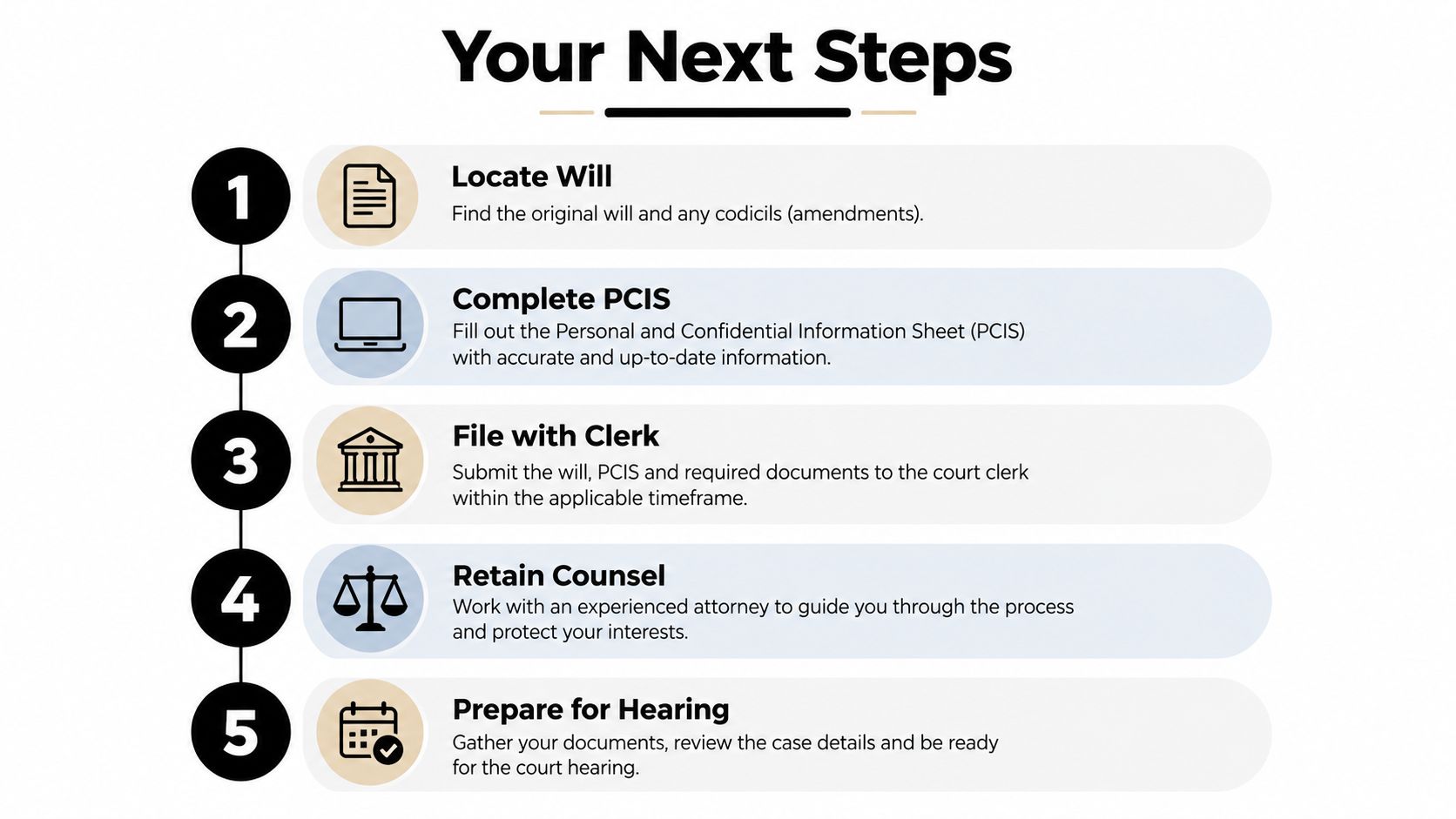
Once your family has identified the case type and confirmed a Harris County connection, gather the documents before contacting a coordinator. A complete packet makes it easier to explain the matter and spot issues that could affect assignment.
Use this checklist:
- Locate the most recent will. Keep the original, if available, with the death certificate and any codicils or related documents.
- Confirm residence. Record where the decedent last lived, or where the proposed ward lives, and collect documents that support that fact.
- List the interested people. Write down heirs, beneficiaries, next of kin, proposed guardians, creditors, and anyone named in the documents.
- Describe the property and dispute. Note real estate, accounts, business interests, trust assets, and any disagreement involving the estate or fiduciary.
- Verify the court process. Contact the assigned court's coordinator, request the current local rules, confirm the judge, and ask whether the first setting is in person or remote.
The four-month creditor notice window is one example of a statutory deadline that can affect estate administration. Don't calculate or rely on a deadline from a general internet checklist without matching it to the estate's filing date, procedure, and current Texas law.
Law firms can also improve intake systems so families receive clearer answers before a filing is prepared. For background on how legal teams can improve law firm response times, focus on processes that capture the case type, venue facts, documents, and urgent hearing needs at the first contact.
Local counsel can turn those facts into a properly e-filed application, communicate with the assigned coordinator, prepare proposed orders, and attend the first ex parte or uncontested hearing when appropriate. The Harris County probate attorney serving Humble can also help a family connect estate planning decisions with the probate process that may follow.
The Law Office of Bryan Fagan helps Humble, Atascocita, Kingwood, and Northeast Houston families identify the right probate path, prepare estate documents, and understand what happens after Harris County assignment. Schedule a free consultation by visiting the Law Office of Bryan Fagan so you can discuss your specific court, venue, and filing questions with a local legal team.