Skip to content
You've just received a court order requiring supervised visitation, and your first reaction may be a mix of fear, confusion, and frustration. If you live in Humble, Atascocita, Kingwood, or Northeast Houston, you may be wondering where visits happen, who schedules them, what intake involves, and whether missing a session could affect your custody case.
The Harris County safe supervised visitation program for Humble families is structured to protect children while preserving a safe path for parent-child contact. It isn't a casual drop-in arrangement or a punishment designed to end a relationship. It's a court-managed process with specific eligibility rules, interviews, schedules, and financial requirements. Understanding those details before the first appointment can make the experience more predictable and help you avoid preventable problems.
Understanding the Harris County Supervised Visitation Process
A Humble parent can leave court with a supervised visitation order and still lack a practical plan for the first visit. The order may answer the legal question, yet leave everyday concerns unresolved: who contacts the center, whether both parents must participate, whether the child can attend, and how a work conflict or missed Saturday appointment will be handled.
The Harris County Domestic Relations Office Visitation Center supplies the structure for those decisions. Texas Family Code Section 153.014 connects supervised visitation to court authority, so the arrangement functions as a formal safety measure rather than an informal agreement between parents. The center provides a controlled setting for parent-child contact while the court-ordered safeguards remain in place. Harris County describes the Visitation Center and its structured program.

A bridge, not an informal workaround
Supervision may feel like a barrier, particularly when a parent believes the events behind the order were misunderstood. The program can also create a defined route for continuing contact. Staff apply established procedures, parents receive expectations, and the child's safety guides each stage.
That framework matters during a custody dispute. A supervised visit must follow the order rather than operate like an ordinary family outing. Parents should not resolve disagreements informally if the order addresses transportation, communication, activities, or exchanges. Unclear wording deserves legal review before either parent makes a choice that could later be treated as noncompliance.
Practical rule: Read the court order and the center's procedures together. Ask questions early, and retain records of registration, messages, attendance, and notices.
The program's practical system has several connected parts. Eligibility determines whether the center can accept the case. Both parents then pass through intake before scheduling can proceed. Scheduling cycles affect available appointments, while fees and possible funding arrangements affect planning. Visit-day rules determine what happens at the center, and private providers may offer a different setting or process.
Viewing these pieces as one sequence helps a parent prepare before arriving at the Visitation Center. It also reduces avoidable delays and creates a clearer record when a scheduling problem or compliance question arises.
Eligibility Requirements and Mandatory Intake Steps
A parent may arrive prepared for a first visit and still discover that scheduling cannot begin. Harris County's supervised visitation program accepts Harris County residents who have a court order directing supervised visitation through the Visitation Center. A phone call or walk-in request cannot replace the required court authority and registration process. The county explains the program's registration requirements.
Four steps before a visit is scheduled
1. Confirm the court order.
Read the order closely. It should specifically direct supervised visitation through the Harris County Visitation Center. General language, missing details, or instructions that appear inconsistent with the center's rules should be reviewed with a family lawyer before registration. The order functions like the program's instruction sheet, so a small wording issue can affect whether staff can accept the case.
2. Verify residency and program eligibility.
The county program is intended for qualifying Harris County residents. A Humble family should confirm that the case, residence, and order fit the program before treating a placement as available. Eligibility is the first gate in the process.
3. Register both parents.
Each parent must register and complete a personal intake interview. Scheduling cannot proceed until both interviews are finished. The office advises allowing one to two hours per parent, and registration requires official photo identification. Intake gives staff the information needed to identify the adults, review the court's restrictions, and set safe boundaries for contact.
4. Complete child interviews when required.
Children age four and older are also interviewed. The interview does not ask a child to choose between parents. It gives staff age-appropriate information about the child's needs and the circumstances surrounding contact.
The dual-intake rule causes many avoidable delays. One parent cannot complete the other parent's interview, and a completed registration does not permit visits to start while the second parent's intake remains unfinished. Treat both interviews like two keys needed to open the scheduling process.
Gathering orders, timelines, identification details, and contact information can be difficult during a custody dispute. Virtual Legal Assistants intake support may help a law office collect those materials efficiently. It does not replace legal advice or the county's required interviews, but organized records can make an attorney consultation more useful.
Grandparents face a separate question. Grandparents' Rights in Humble concerns grandparents' custody and visitation rights in Harris County, not a parent's registration for supervised visitation.
Parents seeking general access resources can review Texas access and visitation hotline information. Keep copies of the court order, identification, registration messages, and notices sent to the center. Those records help show what was submitted and where a delay occurred.
Visitation Schedule and Location Logistics
A parent in Humble may plan for a Saturday visit, arrange transportation, and then discover that the program does not operate every Saturday. Harris County uses a repeating calendar structure: supervised group visitation occurs on the Saturday following the first, third, and fifth Friday of each month. Each session lasts four hours, from 9:00 a.m. to 1:00 p.m., at a designated Harris County site.
The calendar works like a set of checkpoints. A Friday must qualify first, and the visit follows on the corresponding Saturday. Parents should confirm the actual dates with the center rather than rely on memory, an old message, or an assumption that every Saturday is available.
Quick planning reference
| Program detail | What parents should understand |
|---|---|
| Visit type | Supervised group visitation |
| Visit day | Saturday following the first, third, and fifth Friday of the month |
| Session length | Four hours |
| Session hours | 9:00 a.m. to 1:00 p.m. |
| Location | Designated sites in Harris County |
| Legal setting | Court-managed supervised contact |
Travel planning matters for families coming from Humble, Atascocita, Kingwood, or Northeast Houston. Check the route, parking, childcare for other children, and work schedule before confirming a visit. The county identifies 1310 Prairie, Suite 1030, Houston, TX 77002, as an intake location and lists 713-274-7285 as the phone number. Intake is a separate function, so that address may not be the site for the actual visit. Confirm the assigned visitation location directly with the office.
A simple written calendar can prevent many disputes. Record the confirmed visit date, arrival requirements, notice deadline, and pickup responsibility. A shared calendar helps coordinate logistics, but it cannot change the court order or the center's instructions.
Late arrival or a missed session can affect more than one afternoon. Because the program operates under court authority, attendance may matter if either parent later claims that the order was not followed. If an emergency threatens attendance, contact the center and the other parent promptly, follow the required notice process, and keep proof of each communication.
For courthouse questions, filing logistics, or related family-law proceedings, a lawyer can explain how those steps relate to the Harris County Family Law Center at 1115 Congress.
Fees, Funding Sources, and Financial Considerations
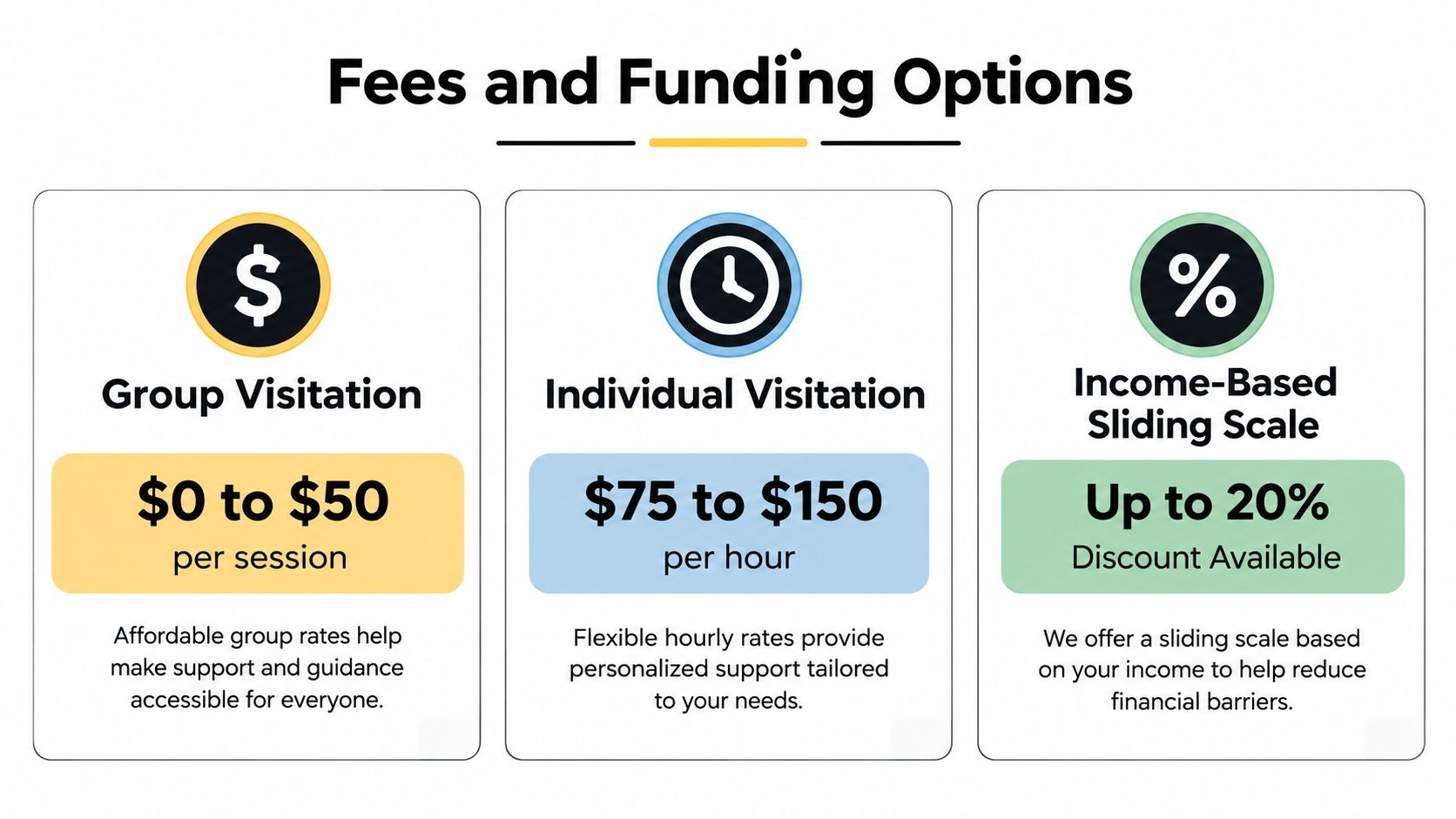
For a parent in Humble, the fee question often comes before the first visit: what must each parent pay, what does the county's grant cover, and what happens if a visit is missed? Harris County states that supervised group visitation is currently supported by a VOCA Grant from the Office of the Governor. That support may reduce the cost of the basic group-visitation service, while registration and compliance-related charges may still apply. The county lists current visitation fees and funding information.
Charges to identify before registration
The published information lists a $75 registration fee for each party and $35 per Saturday visit payable a month in advance. It also states that supervised group visitation is covered by the grant. Ask the office to confirm which service you are receiving, which portion the grant covers, and what each parent must pay.
Missed visits and delayed pickups can create separate charges:
- Failure to appear: The office lists $35 for the first child and $5 for each additional child when a parent does not appear without timely notice.
- Late pickup: If the custodial parent waits beyond 1:00 p.m., the listed charge is $10 for every 15 minutes.
These fees connect directly to the program's recordkeeping. A missed session may affect the child's routine, create an amount due, and give the other parent a reason to question reliability. If an emergency threatens attendance, follow the center's notice procedure and keep written proof of the communication.
A practical financial plan
Before registration, request current written answers to these questions:
- Which services does the VOCA Grant cover?
- Which fees apply to each parent?
- When are advance payments due?
- What notice counts as timely for an absence?
- How are pickup delays recorded and billed?
- Is a fee-waiver process available for your circumstances?
Treat the written information like a map for the program's financial rules. An old text message, a friend's experience, or a social-media post may not reflect current grant coverage or administrative requirements. Keep receipts, confirmations, and payment records with your custody documents.
A lawyer can help separate a center fee from an obligation imposed by the court. Those are different questions. If work, transportation, disability, or another substantial problem makes payment or attendance difficult, raise it promptly so the issue can be addressed before a missed visit creates a record.
What to Expect During a Typical Visitation Session
A first visit can feel uncertain: you may not know how the room is arranged, who handles the handoff, or what staff will record. Treat the session like a carefully defined routine. Arrive prepared, follow instructions, and give the child a calm setting rather than trying to settle the custody dispute during contact.

A visit-day routine
Before leaving home, confirm the site, arrival instructions, approved participants, and pickup plan. Bring identification and only items the center has authorized. Leave custody documents, arguments, and messages for the other parent at home. The visit belongs to the child, not to case negotiations.
At arrival, follow staff directions and keep adult communication brief and respectful. Staff may verify attendance, manage the transition, and explain the rules for that session. Do not arrange an unscheduled exchange or ask the child to carry information between households.
During contact, choose ordinary parent-child activities that fit the setting. Reading, talking, playing, drawing, or sharing a snack can help the child settle if the center permits them. Supervision does not prevent warm interaction. Staff remain present to protect the child and document compliance with the court order and program rules.
Child-focused guidance: Keep court allegations and questions about the other household out of the visit. Do not promise a custody change. A child should be able to enjoy time with a parent without feeling responsible for the adults' conflict.
At departure, use the designated pickup procedure and leave on time. A delayed pickup can upset the child and may create a charge under the center's published rules. If an incident occurs, record the details while they are fresh and notify your lawyer instead of confronting the other parent in front of the child.
The following video may help families consider how children adjust emotionally during family transitions:
The program may feel formal, yet your conduct remains important. Calm speech, reliable attendance, clear boundaries, and predictable contact help the child now. They also create a consistent record that you are following the program and the court's requirements.
Supervised Visitation vs. Private Alternatives
A parent in Humble may have two possible paths: the Harris County Visitation Center or a private supervised visitation provider. The appropriate option depends on the court order, safety concerns, the child's needs, scheduling demands, and whether the court permits a private setting.
| Consideration | Harris County program | Private provider |
|---|---|---|
| Authority | Operates within a court-managed county framework | May be selected by agreement or permitted by court order |
| Scheduling | Uses the county's structured visitation cycle | May offer different scheduling options |
| Funding | Group visitation is currently covered through the published VOCA Grant arrangement | Fees and policies depend on the provider |
| Neutrality | Uses a public, court-adjacent program | Requires review of provider policies and neutrality |
| Privacy and setting | Follows county procedures and designated sites | May offer a more private or customized environment |
| Compliance | Parents must follow county registration and attendance rules | Parents must follow the provider's rules and the court order |
The county program may fit a family that needs a clearly defined process connected closely to the existing order. Its fixed schedule can make attendance predictable and give both households the same operating rules. The limitation is flexibility. A parent working weekends, traveling from Kingwood, or arranging transportation from Atascocita may struggle to fit the county calendar.
A private provider may offer appointment times or a setting better suited to the child's age and circumstances. That choice can involve provider fees, separate documentation, and an intake process that differs from the county's. Before selecting one, confirm what the order permits and whether both parents must agree.
The court order functions like the rulebook for this choice. If it names the Harris County center, one parent should not replace that provider alone with a private service. A private arrangement may require written agreement, court approval, or clarification from the judge. Ask counsel to review the order before paying a private provider or changing the visitation location.
Keep the child's experience central
The provider affects logistics, but the child experiences the transition personally. Children may need reassurance that supervised contact is not their fault and that they do not have to choose sides. Guidance on supporting kids through divorce can help parents reduce emotional pressure during custody changes.
For families in Northeast Houston, the workable arrangement is the one that can be followed safely and consistently. Compare travel, scheduling, cost, provider rules, and court authorization before choosing. If the county structure no longer fits the child's circumstances, seek written agreement or ask the court for clarification or modification rather than making an informal substitution.
How Local Legal Guidance Supports Your Custody Goals
A parent in Humble may leave a visitation session believing that one difficult exchange will decide the entire custody case. Usually, the larger question is how the parent follows the order over time, responds to problems, and shows that contact can remain safe and consistent. Supervised visitation is one part of that record, not the whole case.
A lawyer can turn the court order into a practical checklist. That review should identify the approved provider, transportation duties, communication limits, intake requirements, and any language describing progress toward less restrictive contact. Counsel can also help address missed appointments, refusal to cooperate, an inaccurate incident report, or confusion about which program rule controls.
Local guidance matters because the county process has several moving parts. The attorney can compare the order with the center's scheduling and intake procedures, identify a problem before it becomes a violation, and explain when written agreement, court clarification, enforcement, or modification may be appropriate. For help reviewing those issues, a Humble supervised visitation attorney can assess the order and the family's practical circumstances.
Build a record without escalating conflict
Treat each visit as an opportunity to demonstrate reliable conduct, not as a courtroom argument. Keep the order and center communications together. Record confirmed dates, attendance, cancellations, and notices. Save receipts and written explanations for unavoidable problems. Do not discuss litigation with the child, and bring significant concerns to counsel before filing anything.
Follow the center's instructions even when you disagree with them. A clear record helps an attorney determine whether the facts support enforcement, modification, or a request for clarification. It may also show that the actual obstacle is scheduling, transportation, intake, or communication rather than unwillingness to parent.
The Law Office of Bryan Fagan serves families in Humble, Atascocita, Kingwood, and Northeast Houston in family-law matters, including custody, visitation, divorce, and related proceedings. Its guidance can help parents prepare for intake, communicate through proper channels, and keep decisions focused on the child's safety and the parent-child relationship.
Supervision may end after a court-approved change, but it does not end automatically. Consistent compliance, respectful conduct, and evidence of changed circumstances can support a request for different terms. Do not stop visits or substitute an informal arrangement without first obtaining legal advice about the procedure that applies.