Skip to content
You may be sitting at your kitchen table in Humble with divorce papers open, or checking your email after filing a custody case and asking the same nervous question I hear all the time: Which Harris County family court gets my case? If you live in Atascocita, Kingwood, or Northeast Houston, it's easy to assume your neighborhood decides your judge.
It doesn't work that way.
That's where a lot of stress starts. People hear there are 11 Harris County family district courts, they know family cases go downtown, and then they try to guess which court they'll end up in based on where they live, where their spouse lives, or where the children go to school. In most situations, that guess is wrong.
If you've searched for Harris County 11 family district courts which one gets my case, answer is more practical than expected. Harris County uses a centralized system, family filings go through intake, and your assigned court becomes clear through the case paperwork and clerk tools after filing. If you're also trying to sort out where to go once you reach the courthouse, this guide to the Harris County Family Law Center and court location details can help with the downtown side of the process.
How Harris County Family Court Assignment Feels When You File in Humble
A Humble parent might file for divorce on Monday and spend the rest of the week refreshing email, checking paperwork, and wondering whether the case will go to one judge or another. A Kingwood grandparent helping with a custody matter may ask whether filing from Northeast Houston means the case stays closer to home. An Atascocita spouse may assume a local address leads to a local courtroom.
That confusion is normal.
The question most families ask first
When people start a family case, they usually want certainty fast. They want to know where to park, what judge they'll stand before, and whether one courthouse serves Humble while another serves the rest of Houston. Family court in Harris County doesn't feel intuitive at first because the system isn't built around neighborhood lines.
Practical rule: Your home address in Humble doesn't automatically place your divorce or custody case with one specific family judge.
That can feel unsettling. Family law already brings enough worry. You may be dealing with parenting schedules, child support concerns, property questions, or a spouse who won't communicate clearly. Adding court assignment uncertainty on top of that can make the process feel bigger than it really is.
Why this feels harder than it should
Part of the problem is that people mix together two different questions:
- Where do Harris County family cases get handled
- Which specific court gets my individual case
Those aren't the same question. One asks about the overall system. The other asks about your file.
For families in Humble, Atascocita, Kingwood, and Northeast Houston, the key point is that family cases move through a countywide structure. That means you're not choosing among neighborhood courts the way people often imagine. You're entering a centralized family-law system that serves the whole county.
Most people don't need to predict the court before filing. They need to know how to confirm the assignment once the clerk processes the case.
That shift in thinking helps. Instead of guessing, you track. Instead of assuming geography controls everything, you look at the cause number and assigned court once the file enters the system.
Understanding the 11 Harris County Family District Courts
For a Humble parent filing a divorce or custody case, the court system can feel larger than expected. Your case does not go to a neighborhood courtroom near home. It enters a county family division centered at 201 Caroline Street in Houston.
Which courts are in the family division
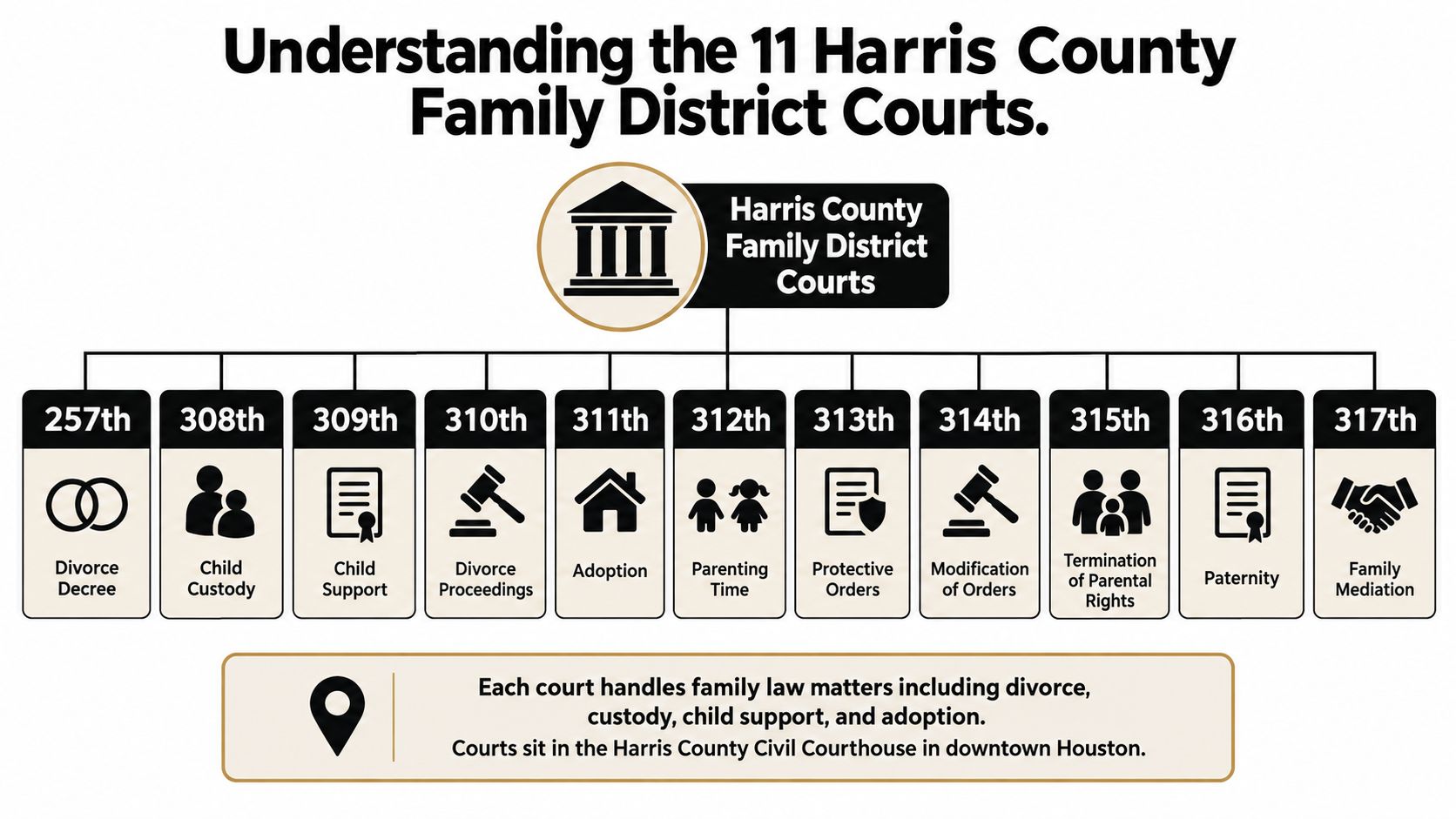
Harris County's family division includes these district courts: 245th, 246th, 247th, 257th, 280th, 308th, 309th, 310th, 311th, 312th, and 507th. Those are the courts that handle the core family-law docket countywide.
The list matters because it answers a common worry with something concrete. If your case involves divorce, custody, support, or related family issues, it is assigned within this group of courts rather than sent to a general civil court.
These courts commonly hear matters such as:
- Divorce cases, including property division and final decrees
- Child custody matters, including conservatorship and possession
- Child support cases, including establishment, enforcement, and modification
- Visitation disputes, when parents disagree about parenting time
- Protective orders, including family-violence related filings
- Emancipation matters, where Texas law allows them
That specialization helps. A family judge spends the day dealing with parenting plans, temporary orders, support questions, and final hearings, not business contract disputes or injury lawsuits.
Why these courts are grouped together
The setup works like a hospital with separate departments. Family cases go to the family department. Criminal cases go elsewhere. Juvenile matters follow a different track.
That is why so much family-court activity funnels downtown. The county groups these family district courts together and sends new family filings into that shared system at 201 Caroline, instead of splitting them up by Humble, Kingwood, Atascocita, or another part of Harris County.
If you want a local explanation focused on what this looks like for nearby families, the Harris County family court page for Humble residents gives a practical overview.
| Common assumption | What Harris County family court structure means |
|---|---|
| A Humble case goes to a Humble judge | Family cases are handled through the countywide family division |
| One part of town has one designated family court | Eleven family district courts share this category of cases |
| Address alone tells you the court | The assigned court is confirmed through the filing and clerk process |
One more point helps calm the confusion. These court numbers describe the pool of possible family courts. They do not tell you in advance which one will receive your file. That answer shows up after intake and assignment, which is why cause number tracking matters so much.
How Random Assignment Decides Which Court Gets Your Case
A Humble parent can file a divorce on the same morning as a neighbor and still end up in a different family court. That feels strange at first, especially if you assume your address should point to one judge. In Harris County, it usually does not work that way.
Zip code does not pick the judge
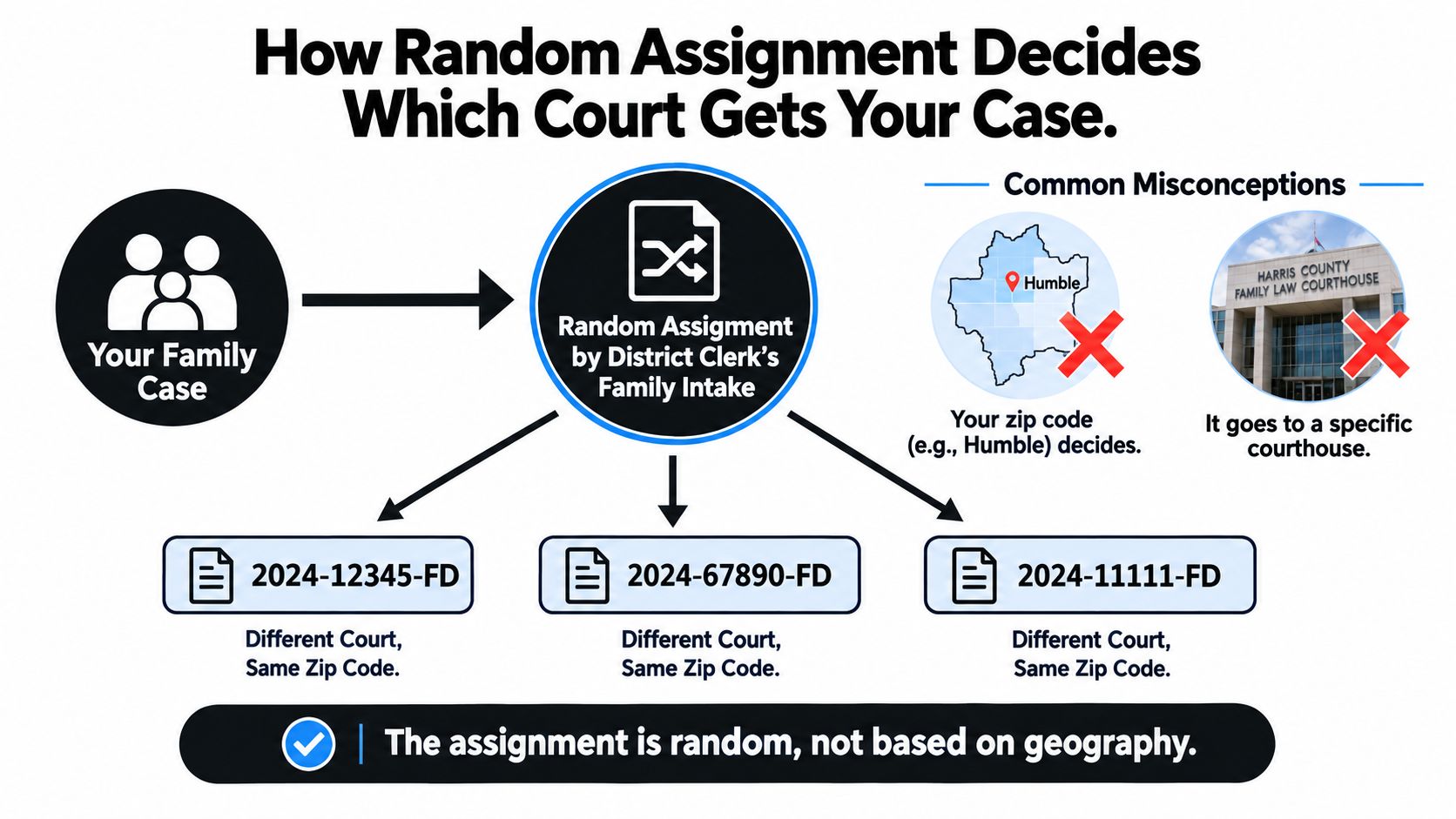
New family cases are generally assigned through a centralized county process, not by neighborhood. So a case from Humble, Kingwood, or Atascocita can be sent to any one of the family district courts handling that case type.
A simple way to picture it is a lottery drum with family courts in the pool. When your paperwork goes through intake at 201 Caroline, the system places the case into that countywide family-court group. The result is that two households on the same street can get different courts.
That is the practical answer to the question, which one gets my case? Geography alone usually will not tell you.
Why Harris County uses random assignment
The county uses random assignment to spread new filings across the family docket. If every case from one area went to one courtroom, that court could get overloaded while others sat lighter. Random distribution helps balance the flow of new divorces, custody suits, modifications, and support cases.
An independent description of the process compares assignment to a physical lottery wheel, where the drawn court gets the case, in the District Clerk Substack discussion of reassignment and assignment mechanics. That comparison is useful because it matches what many families experience. You file downtown through the shared intake system, and the case is assigned within the family-court group.
Here is what that means for a Humble family:
- Your case can be assigned to any family district court in the county's family division
- Filing first does not let you choose a judge
- Hearing dates and docket procedures depend on the court assigned to your case
- That assigned court usually keeps the case unless a transfer or related-case rule changes it
If your issue is divorce specifically, the Divorce Lawyer in Humble, TX page describes divorce representation for clients in Humble and Harris County.
After assignment, the court number matters a lot
Once the case is assigned, that court becomes the control center for your deadlines, hearings, and local procedures. Two families with very similar filings may get different docket call times, different coordinator instructions, or different hearing settings because they drew different courts.
That is why the most helpful question is usually not, “Which court should my Humble address go to?” It is, “Which court did Harris County assign after intake, and what is my cause number?”
Cause Numbers and Family Intake and What They Mean for Your Case
A lot of Humble parents hit the same moment of confusion after filing. They ask, “Do I call the courthouse near me, or do I wait for someone to tell me which judge I got?” In Harris County, the answer usually starts with two things. Your cause number and the Family Intake process.
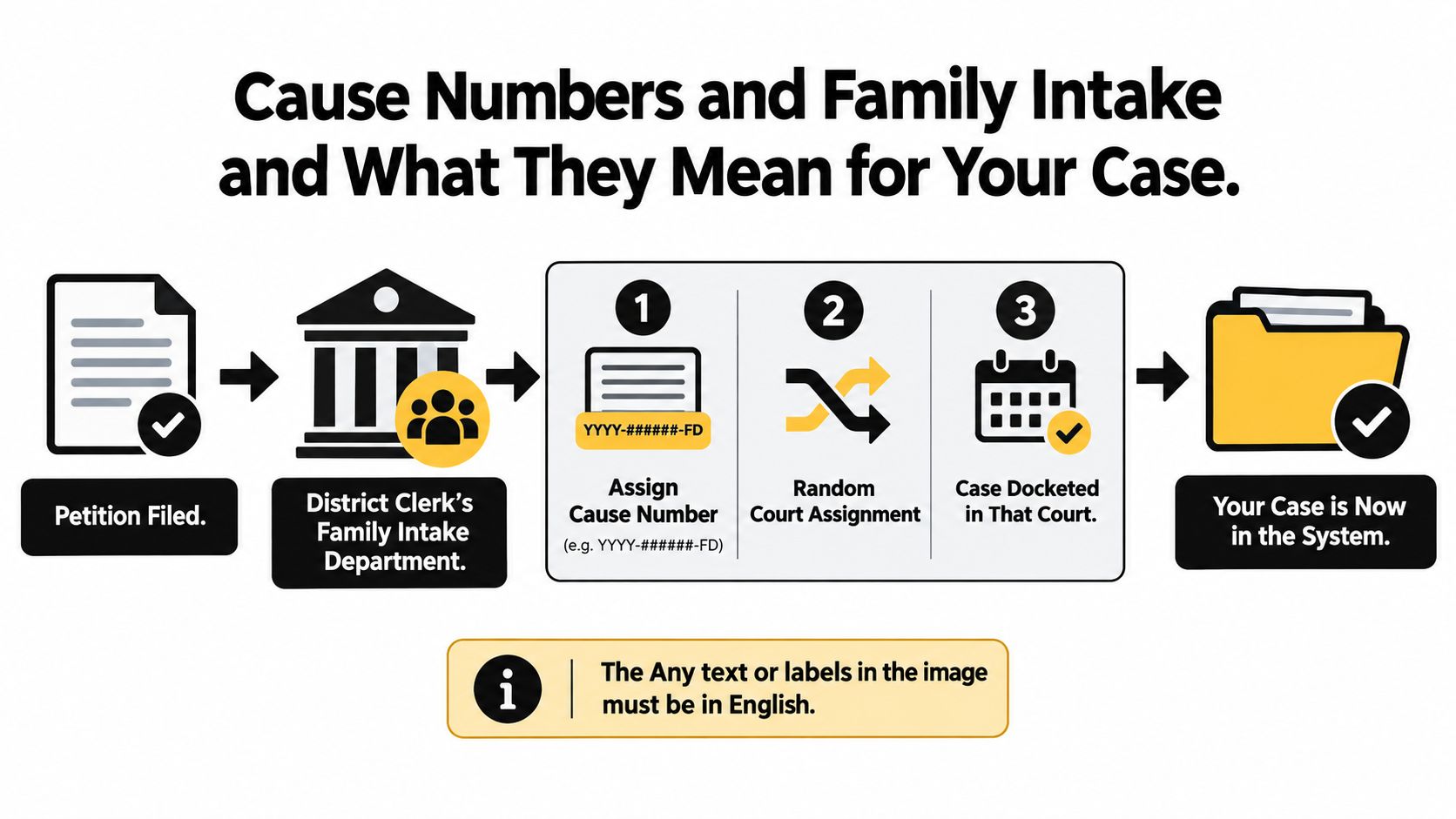
Once a new family case is filed, the District Clerk's Family Intake gives it a cause number and places it with an assigned family court, according to the District Clerk's Family Intake page.
What Family Intake actually does
Family Intake is the county's front desk for new family cases. It does more than stamp papers. It enters the case into the shared system, creates the cause number, and ties that case to the court assigned through the county process.
That detail helps clear up a very common misunderstanding. A Humble address does not send your divorce or custody case to a neighborhood courthouse the way a school zone assigns a campus. The filing goes through the central intake process, and the case identity is built there.
Transferred family cases go through that intake process too. According to the Family Intake information page, incoming transfers into Harris County receive both a case number and a family court through that same office.
Why the cause number matters
Your cause number works like the tracking number on a certified mail receipt. It is the fastest way to confirm where your case landed and how to look it up later.
Without it, you can still search in some situations, but it gets slower and more frustrating. Names can be entered different ways. Parties may share common last names. A cause number points to the exact file.
For a Humble family, the sequence usually looks like this:
- You file the petition.
- Family Intake opens the case in the Harris County system.
- The clerk assigns the cause number and records the assigned family court.
- That cause number becomes the reference you use with the District Clerk and court records.
If you want a clearer picture of what happens before and during that first filing step, this guide on filing for divorce in Harris County from Humble connects the paperwork side to what families usually see in practice.
What this means in real life
If you filed yesterday and still do not know “which of the 11 courts” has your case, that does not automatically mean something is wrong. It often means you are still waiting for the intake trail to show up clearly in the record.
Once you have the cause number, finding the assigned court becomes much easier.
Key point: Save every filing receipt, confirmation email, and stamped copy you receive. If your cause number is missing, delayed, or entered differently than expected, those documents make it much easier to track your case down.
Exceptions and Transfers That Can Change Your Assigned Court
Random assignment answers most new-case questions, but not all of them. Some situations can override the ordinary process.
Related cases and procedural links
Local Harris County rules for county civil courts at law state that a newly filed case is assigned randomly to one court's docket and stays there for all purposes unless later transferred under the rules, and related refiled cases can be assigned to the court where the earlier case was pending, according to the Harris County local rules PDF.
That local rule is for county civil courts at law, not the family district courts themselves, but it illustrates an important legal idea families should understand. When a case has a procedural relationship to an earlier matter, courts often try to avoid conflicting handling.
The independent description of Harris County assignment mechanics also notes that procedural constraints, such as a related appeal or original proceeding, can control which court receives the matter instead of pure random draw. That means prior case history can matter.
Transfers and specialized family matters
Some family issues have special routing concerns. Public court information notes that specialized courts such as the 280th District Court handle family-violence and domestic-violence protective-order matters within the Harris County family system, as summarized on the county overview reference.
Incoming county transfers follow their own path too. The District Clerk states that transfers into Harris County family court go through Family Intake, where the receiving court is assigned after administrative processing.
Here's a side-by-side look at when a case might not follow the ordinary random path.
| Situation | Which Court Gets the Case | What to Expect |
|---|---|---|
| Brand-new family filing with no special procedural issue | A family district court through ordinary assignment | The assigned court will manage the case unless later transferred |
| Refiled or related matter tied to an earlier case | Often the court connected to the earlier matter, depending on the procedural posture | Prior filings can affect where the case belongs |
| Appeal or original proceeding affecting assignment | The linked procedural history may control assignment | The clerk's ordinary draw may not be the final word |
| Family-violence protective-order matter | A specialized family court may be involved, including the 280th District Court in the county system | Families should confirm the assigned court quickly because protective-order timing can move fast |
| Transfer coming into Harris County from another county | A Harris County family court is assigned through Family Intake after processing | The clerk says the transfer process generally takes about a month |
If your case has any history at all, don't assume the usual assignment logic applies. Prior filings can change the path.
This is one place where a careful file review helps. That's true in family law, and it's also true across related legal issues many local families face, including criminal defense concerns and estate planning matters where court procedure affects timing and expectations.
How to Find Out Which Specific Court Has Your Case Today
Once filing is complete, you don't need to guess anymore. You need to verify.
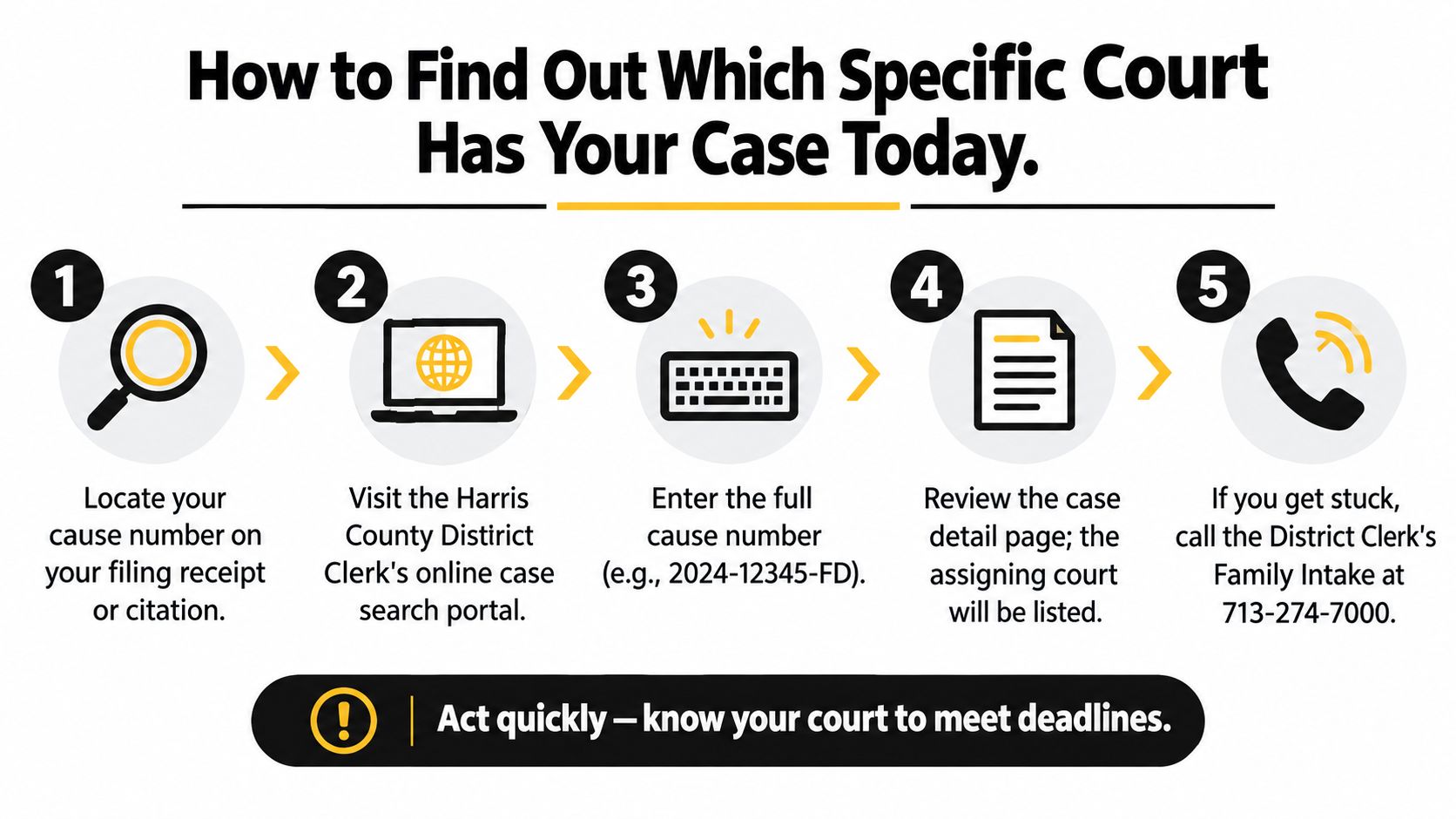
The Harris County District Clerk says filing methods include e-filing, mail, and a drop box at the Civil Courthouse, and the clerk's FAQ also notes that docket call times vary by court, so parties should contact the specific assigned court, according to the District Clerk FAQ page.
Start with your own paperwork
Your first check should be the documents you already have.
- Look at the filing receipt if you e-filed or received confirmation another way
- Check any stamped petition or citation for identifying case information
- Save the cause number in more than one place so you can pull it up quickly later
If a family member filed on your behalf through counsel, ask for the filed petition and confirmation materials. Many court-location questions are answered right there.
Use the clerk tools and the assigned court
After that, move to the District Clerk's online tools and your assigned court information.
- Search by cause number. That's usually the most reliable method.
- Review the case detail carefully. You're looking for the court designation tied to the case.
- Write down the court number exactly. Don't rely on memory.
- Contact that specific court for scheduling questions. Docket call times vary by court.
- If you need in-person help, remember the courthouse location. Harris County family district courts are located at 201 Caroline Street in Houston, as listed in the Texas Law Help guide to Harris County Family District Courts.
Bring your cause number to every phone call about the case. Without it, the clerk or court staff may have trouble locating the file efficiently.
Don't call the wrong place
A lot of frustration comes from calling a general office when the assigned court is the one controlling scheduling. Once your case is assigned, that court becomes the practical center of the file.
Use a simple checklist:
- Confirm the cause number
- Confirm the assigned court
- Confirm the next setting or deadline
- Confirm whether the court has any specific instructions
That same habit helps in other legal areas too. Whether someone in Northeast Houston is dealing with a custody dispute, a criminal charge, or probate paperwork, accurate case identification usually saves time and stress.
Local Help for Humble Families Navigating Harris County Family Courts
For families in Humble, Atascocita, Kingwood, and Northeast Houston, the biggest relief often comes from finally understanding that the system is organized, even if it doesn't feel local at first. Your family case goes into a centralized downtown structure. Assignment usually happens through the county's process, not by neighborhood. Then your cause number and assigned court tell you where the case lives.
That gives you a much better way to think about the problem. Instead of trying to predict the judge based on address, you focus on confirming the assignment accurately and responding to the court that has your file.
What local families should keep in mind
- Centralized doesn't mean random chaos. It means Harris County handles family matters through a countywide family-court system.
- Assignment isn't usually a geography question. It's an intake and case-management question.
- Your paperwork matters. The cause number is often the fastest path to clarity.
- Special situations can change the path. Transfers, related matters, and protective-order issues may follow different routing logic.
For contested family matters, Contested Divorce Attorney in Humble is one local resource that addresses advocacy for high-conflict divorces in Harris County courts. Another practical option is working directly with the Law Office of Bryan Fagan, which provides family law guidance for Humble-area residents dealing with divorce, custody, support, and court procedure questions in Harris County.
When court procedure feels confusing, it helps to talk with someone who understands both the downtown system and the day-to-day concerns of local families. That's true whether you're worried about a divorce filing, trying to understand a custody case, or balancing family-law issues with other legal needs such as estate planning or criminal defense concerns.
If you're trying to figure out which Harris County family court has your case, the attorneys at the Law Office of Bryan Fagan can help you understand the assignment process, review your paperwork, and explain what your next court steps likely look like. We serve families in Humble, Atascocita, Kingwood, and Northeast Houston, and you can schedule a free consultation by visiting Law Office of Bryan Fagan.