Skip to content

A false accusation can reach a Humble neighborhood before you've had time to understand what happened. A small business owner near Town Center may wake up to a Google review claiming fraud. A teacher may see a false allegation repeated in a Humble ISD Facebook group. A healthcare worker may find a Nextdoor post tagging their name and workplace. Within hours, customers, coworkers, relatives, and potential employers may be reacting to a story that isn't true.
The legal question isn't whether the post feels cruel. It's whether the communication contains a provably false fact, reached someone else, was made with the required level of fault, and caused legally recognized harm. The answer may also depend on whether the speaker can invoke the Texas Citizens Participation Act, a defense that can change a case from expensive discovery to an early dismissal.
This guide covers the practical issues that matter in Humble, Atascocita, Kingwood, and Northeast Houston, including libel, slander, deadlines, damages, defenses, Harris County procedure, and how to evaluate a local lawyer. If you're facing an accusation, preserve the evidence before responding publicly, and review what to do if you've been falsely accused before taking steps that could make the dispute harder to resolve. For businesses, a careful response can also build trust with reputation management, especially when the best solution is correction and documentation rather than immediate litigation.
When a False Statement Becomes a Legal Problem in Humble
A rumor becomes a legal problem when a person states a false fact to someone else and the statement threatens your reputation, livelihood, or relationships. Suppose a small business owner near Town Center is accused online of taking deposits and never completing work. The accusation is false, but a customer cancels, a referral partner stops responding, and the owner's spouse begins receiving messages about the business.
That situation creates real pressure, but emotion alone doesn't establish defamation. The owner still needs to identify the exact words, show where they appeared, determine who saw or heard them, and connect the statement to a legally recognized injury. A false accusation can also create complications in a divorce, a workplace investigation, a professional licensing matter, or a neighborhood dispute.
Practical rule: Don't delete the post, argue in the comments, or ask friends to attack the speaker before the evidence is preserved.
Texas law separates written and recorded statements, called libel, from spoken statements, called slander. Both can matter. A Facebook post, email, review, text, or workplace message may support a libel theory. A statement made at an HOA meeting, to a customer by phone, or during a workplace conversation may raise slander issues.
The timeline matters too. Texas generally imposes a one-year limitations period for defamation claims, so waiting for a rumor to disappear can eliminate the lawsuit. A lawyer will also examine whether the statement falls within defamation per se, whether the publisher can prove truth, and whether the TCPA creates an early dismissal risk.
The right response isn't always filing suit. Sometimes a carefully drafted demand for correction works better. Sometimes litigation is justified. Sometimes the speaker's post is protected opinion or public-concern speech, and pursuing a claim may expose the plaintiff to fees. A practitioner's review should address those trade-offs directly.
How Texas Law Defines Defamation
A Humble contractor sees a neighborhood post accusing him of taking deposits without doing the work. Whether that post supports a lawsuit depends on the words used, who received them, what the speaker knew, and what harm followed. Texas defamation law treats those questions as separate elements that must fit together.
The statement must be fact, not just criticism
“Worst contractor in Humble” may be harsh, but the surrounding context could make it opinion or rhetorical exaggeration. “This contractor took my money for three jobs and never performed any of them” makes a concrete allegation that can be tested against records. Courts examine how a reasonable reader or listener would understand the statement as a whole.
The communication also must reach someone other than the person allegedly defamed. A text forwarded to a neighbor, a Slack message sent to coworkers, a Google review, or a post in a neighborhood group may satisfy publication. The plaintiff must identify the audience and the communication, rather than rely only on the fact that the statement was offensive. The basic elements are summarized in Texas defamation guidance.
Fault depends partly on the plaintiff's status. A private individual generally must show negligence, meaning the publisher failed to use reasonable care regarding whether the statement was true. A public official or public figure must prove actual malice, meaning the statement was made knowing it was false or with reckless disregard for its truth. Texas appellate authority discusses that distinction in this decision.
Damages can work differently in per se cases
Ordinary defamation claims typically require proof of harm. Defamation per se may allow presumed damages when the statement falls within recognized categories, including falsely imputing a crime, loathsome disease, unchastity, or professional incompetence. Texas law also treats some statements differently from older common-law assumptions. A statement about a dead bedroom, for example, is not automatically defamation per se.
Pleading detail matters under Texas Rule of Civil Procedure 91a. A petition that says only “the defendant damaged my reputation” may fail to identify the words, audience, falsity, fault, or resulting harm clearly enough. Preserve the original post, messages, reviews, edits, timestamps, comments, and witness information before filing.
| Element | What It Means | Humble-Area Example |
|---|---|---|
| False statement of fact | The words assert something provably untrue | A review falsely states that a Kingwood contractor stole a customer's deposit |
| Publication | Someone other than the plaintiff received the statement | A workplace Slack message is read by coworkers |
| Fault | The publisher acted negligently or with actual malice, depending on status | A speaker repeats an accusation without checking obvious records |
| Damages or presumed harm | The plaintiff proves injury, or the statement qualifies for a legal presumption | A false crime accusation causes reputational injury even without a precise lost-client calculation |
For a dispute connected to divorce or custody proceedings, Harris County Family Courts: A Humble Resident's Guide explains how family cases proceed in the Harris County courts serving Humble. The defamation claim still requires separate civil-law analysis. Related civil law resources can help frame that issue alongside the broader dispute. A filing decision should also account for potential early dismissal under the Texas Citizens Participation Act, because an unsuccessful claim can create fee exposure before the case reaches discovery.
Libel vs Slander and Private vs Public Figures
The form of the statement affects the evidence and pleading strategy. Libel covers written or recorded communications, including social-media posts, online reviews, emails, direct messages, and recorded material. Slander concerns spoken or transient statements, such as an accusation made during a neighborhood meeting or a conversation with a prospective customer.
Online disputes are usually libel disputes because the words remain available, can be shared, and may be viewed by an identifiable audience. That permanence also creates an evidence advantage if the plaintiff preserves the original post, edits, timestamps, comments, and links. Spoken statements require more attention to witnesses, memory, recordings, and the exact language used.
The speaker's target doesn't automatically become a public figure because they own a popular business, lead an HOA, teach locally, or have a visible role in Atascocita or Kingwood. Public-figure status depends on the person's role and the subject of the controversy. Most local families, employees, and small-business owners are private figures, although the analysis can change if someone voluntarily enters a public controversy.
| Form of Statement | Plaintiff Status | Fault Standard |
|---|---|---|
| Written or recorded libel | Private individual | Generally negligence |
| Written or recorded libel | Public official or public figure | Actual malice |
| Spoken slander | Private individual | Generally negligence |
| Spoken slander | Public official or public figure | Actual malice |
A private plaintiff generally has the easier fault standard, but that doesn't make the case simple. The plaintiff still has to prove falsity, defamatory meaning, publication, and the required injury. A public figure faces the additional burden of proving that the speaker knew the statement was false or acted with reckless disregard for its truth.
The distinction also matters when the defendant invokes the TCPA. A social-media post may be both alleged defamation and speech connected to a matter of public concern. The plaintiff must therefore prepare for the possibility that the defense will seek early dismissal, not merely answer the petition and proceed through ordinary discovery.
In practice, the fault standard shapes how much evidence is needed, how credible witnesses become, and whether summary judgment is a serious possibility. It also affects the mediation dynamic. A strong private-figure claim may still settle if the plaintiff can show the exact statement, clear falsity, identifiable publication, and concrete consequences. A public-figure claim requires a much more developed record about the speaker's state of mind.
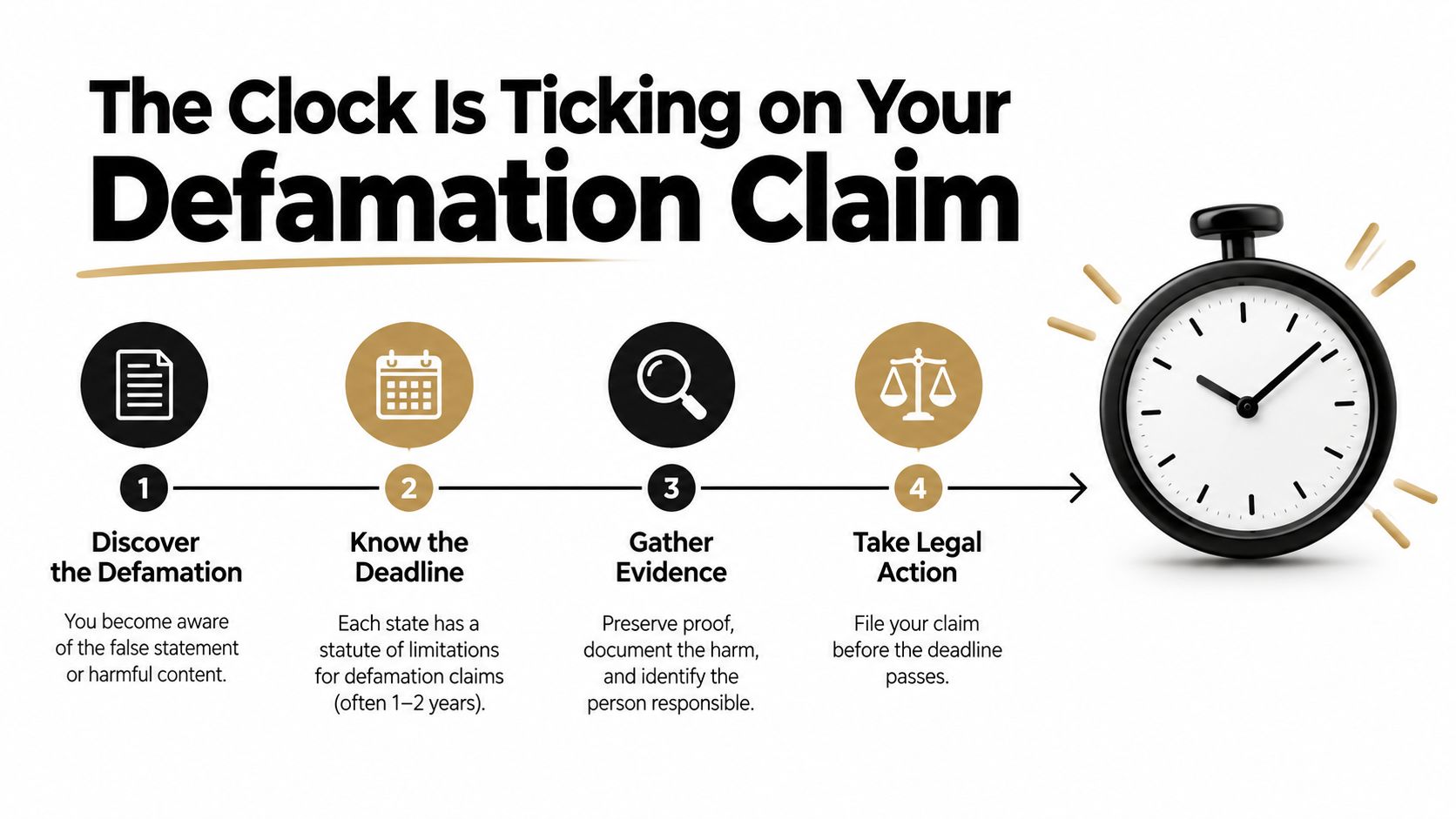
The Clock Is Ticking on Your Defamation Claim
Texas generally gives a defamation plaintiff one year to file under Civil Practice and Remedies Code section 16.002. The deadline usually turns on the publication date, not the date the harm becomes obvious. Republishing a statement, restricting it from ordinary view, or discovering it later can complicate the analysis, so counsel should examine the full publication history before calculating the deadline.
Texas recognizes limited exceptions for concealed publication, and minors may receive a limited extension. These exceptions depend on specific facts and should not be treated as permission to delay.
A workplace allegation illustrates the risk. If a former coworker sends a false accusation to a supervisor, the recipient list, message date, and later employment decision may all matter. Waiting for the employer's investigation to finish can consume time without extending the limitations period.
Preserve the record immediately
Save the original material as soon as you learn about it:
- Capture the full screen. Keep screenshots showing the account, date, platform, complete wording, comments, and visible audience.
- Record source information. Preserve post links, usernames, email headers, text-message details, and the names of people who received the communication.
- Protect related evidence. Keep customer messages, canceled appointments, rejected job communications, workplace notices, and financial records that may connect the statement to harm.
- Contact witnesses carefully. Ask witnesses to preserve what they saw or heard. Do not coach their recollection or encourage a public confrontation.
A demand letter may request correction, retraction, or removal under section 73.055 of the Civil Practice and Remedies Code. A carefully prepared demand can narrow the dispute and affect the actual-malice analysis. An aggressive letter can also spread the accusation further or create new statements that become evidence.
Filing in Harris County
A civil case typically begins with a petition, followed by service on the defendant. The parties then exchange mandatory initial disclosures and address motions, evidence, discovery, mediation, and trial preparation. Harris County's civil courts at law operate under local rules amended through December 8, 2023, as shown in the county's revised local rules. A Humble residence does not automatically determine venue. The parties, events, and requested relief also matter.
The case may move from demand negotiations to mediation or trial preparation, but its pace depends on the court, evidence, opposing party, and motions such as a TCPA challenge. A defendant's early anti-SLAPP motion can change the economics quickly by forcing the plaintiff to address dismissal before ordinary discovery develops.
For lower-value disputes, residents may compare defamation issues with procedures described in this Houston small claims lawyer resource. Defamation claims often require more careful pleading and evidence than a property or payment dispute, so evaluate the proper forum before filing. Missing the limitations deadline remains one of the most damaging avoidable errors. Consult counsel promptly if the claim appears viable, even if the post later disappears.
Damages You Can Recover and Defenses You Will Face
A successful plaintiff may seek economic damages, such as a lost contract, terminated employment, canceled work, or a documented decline in business revenue. The evidence should show more than timing. A canceled customer should ideally identify the communication or reason, and a business should preserve invoices, proposals, customer messages, and other records that connect the false statement to the loss.
Non-economic damages can include reputational injury, emotional distress, humiliation, and the personal consequences of being falsely accused. Texas pleading rules require fair notice, particularly when a plaintiff seeks substantial non-economic recovery. The petition should identify the nature of the harm without exaggerating what the evidence can support.
Defamation per se changes the damages analysis. A false accusation of a crime, moral turpitude, or professional unfitness may allow harm to be presumed rather than proved through a precise lost-customer calculation. That presumption doesn't eliminate the need to prove falsity, publication, defamatory meaning, and fault.
Exemplary damages require a higher showing. Under section 41.003 of the Civil Practice and Remedies Code, a plaintiff must establish by clear and convincing evidence that the defendant acted with actual malice or knowingly made a false statement. The possibility of exemplary damages can increase settlement pressure, but it also raises the need for strong proof about what the defendant knew and when.
| Category | What It Means | Plaintiff Must Show |
|---|---|---|
| Economic damages | Financial losses tied to the statement | A reliable connection between the publication and the lost money or opportunity |
| Non-economic damages | Reputation, distress, humiliation, and related harm | The nature and extent of the personal injury |
| Presumed damages | Harm inferred in a qualifying per se claim | The statement fits the recognized category and the other elements are proved |
| Exemplary damages | Additional damages for especially blameworthy conduct | Clear and convincing evidence of actual malice or knowing falsity |
| Injunctive or corrective relief | Court-ordered limits or negotiated correction in appropriate circumstances | A legally available remedy supported by the facts and procedural posture |
The defendant's first response is often truth, which is a complete defense. A statement can be damaging and still not be defamatory if it's substantially true. The defense may also argue opinion, fair comment, substantial truth, or privilege.
Common-interest and qualified privileges can protect communications made in a legitimate context, such as certain workplace, employment, association, or business communications. A plaintiff may defeat a qualified privilege by proving the speaker acted with malice or exceeded the protected purpose. That makes the audience, reason for the communication, wording, and speaker's conduct important discovery subjects.
A Humble business owner shouldn't assume that every negative review supports a lawsuit. A harsh opinion may be protected. A factual accusation supported by records may defeat the claim. The practical value of litigation depends on the evidence available before filing and the defenses the publisher can credibly establish.
The Texas Citizens Participation Act Changes the Game
The Texas Citizens Participation Act, found in Chapter 27 of the Civil Practice and Remedies Code, gives defendants a way to challenge lawsuits based on protected speech. A defendant may argue that the claim is based on, relates to, or responds to an exercise of free speech concerning a matter of public concern. Online accusations involving public safety, business conduct, neighborhood disputes, or community issues can raise that question.
The TCPA isn't a general license to publish false accusations. Its reach has limits, and Texas courts have narrowed applications that extend beyond protected activity. But a plaintiff who treats the statute as an afterthought can face a motion designed to end the case before full discovery develops.
The defense changes the case economics
The motion is expedited. The parties must address the statutory deadlines and hearing process quickly, often before the plaintiff has gathered every witness and document. The defendant's objective is early dismissal, while the plaintiff must present a focused record supporting the legal elements of the claim.
If the defendant prevails on an anti-SLAPP motion, the court must award costs and attorney's fees to the prevailing movant under the TCPA. The statute also permits an award against a motion found frivolous or brought solely for delay, as described in Texas anti-SLAPP guidance. That fee exposure is a serious consideration before filing, especially for a family or small business without a large litigation budget.
Defense-side reality: The question may not be only whether you can prove reputational harm. It may be whether the defendant can obtain dismissal before the case reaches expensive discovery.
Texas coverage has described the continuing relevance of anti-SLAPP rules in real disputes, including a 2025 Texas case involving First Amendment and defamation claims that ended in a $725,000 settlement as reported in this coverage. That result doesn't predict the outcome of a Humble case, and it isn't a valuation formula. It shows why both sides should assess free-speech issues early.
A plaintiff's lawyer should prepare the petition with the TCPA in mind. That means identifying the exact statement, explaining why it is a factual assertion, pleading falsity and fault specifically, and organizing evidence that supports each element. Filing first and researching the defense later is a poor strategy when an early motion can reshape the entire dispute.
Choosing the Right Defamation Lawyer in Humble TX
A demand letter is not the same as litigation experience. When interviewing a defamation lawyer in Humble TX, ask whether the attorney has handled libel or slander claims through serious motion practice, mediation, summary judgment, or trial. A lawyer who understands only reputation management may not be prepared for a TCPA motion, discovery dispute, or Harris County scheduling requirement.
Use the consultation to ask direct questions:
- Texas qualification: Confirm the lawyer is admitted in Texas and regularly handles civil litigation involving Harris County courts.
- TCPA experience: Ask whether the attorney has prosecuted or defended an anti-SLAPP motion, and what evidence was important.
- Case evaluation: Ask which exact statement is actionable, who received it, and what proof connects it to harm.
- Fee structure: Reputation cases can require substantial discovery and are often handled through hourly retainers. Some matters may be considered on contingency when documented economic harm is strong.
- Communication: Find out who answers urgent calls after a post spreads, how updates are delivered, and whether an attorney reviews filings.
- Trial readiness: Be cautious of guarantees. Ask what happens if settlement fails and the case proceeds toward trial.
- Local context: Confirm the lawyer understands workplace allegations, neighborhood association disputes, local media, and review platforms used around Humble and Atascocita.
Questions that expose weak fit
Ask for a redacted demand letter, if the lawyer can ethically provide one, and ask what happened afterward. You can also ask how the lawyer distinguishes an actionable fact from opinion, how they calculate damages, and what facts might support truth, privilege, or substantial truth.
A strong lawyer should be candid when a claim is weak. Filing a lawsuit may amplify the accusation, trigger a TCPA motion, or create fee exposure. In another case, refusing to act may allow evidence to vanish and the one-year deadline to close.
The Law Office of Bryan Fagan handles legal matters for residents across Humble, Atascocita, Kingwood, and Northeast Houston, including family law, criminal defense, estate planning, and civil disputes. That local reach can be relevant when a reputation issue intersects with divorce pressure, a criminal accusation, employment consequences, or estate and business concerns. A consultation should produce analysis, not a promise of a guaranteed result.
Your Next Step with the Law Office of Bryan Fagan
A reputation injury rarely stays still. A false post may be copied, forwarded, discussed at work, or raised during a family dispute. The one-year limitations period continues to matter while you decide whether the situation is serious enough to address.
A no-cost consultation with the Law Office of Bryan Fagan can help screen the four Texas defamation elements, identify possible TCPA exposure, and discuss whether a demand letter or litigation makes practical sense. Bring the original posts or recordings, a timeline of events, names of people who saw or heard the statement, and documents showing lost work, canceled business, employment consequences, or other harm.
You should expect a useful initial conversation to clarify three things:
- What to preserve: Screenshots, witness names, messages, financial records, and platform information.
- Whether litigation is justified: The evidence may support a demand letter, a lawsuit, or no viable claim.
- What representation would involve: If you choose to proceed, the engagement letter should explain the scope, fees, and responsibilities.
The firm serves clients in Humble, Atascocita, Kingwood, and greater Harris County. Its broader practice includes family law, criminal defense, estate planning, wills, trusts, probate, and civil matters, which can matter when the false statement affects more than business reputation.
Don't respond publicly before you understand the evidence and the legal risk. Gather the material today and schedule a confidential consultation before delay makes the claim harder to pursue.
The Law Office of Bryan Fagan offers local legal consultations for Humble residents facing reputation disputes, civil conflicts, and related family or criminal consequences. Bring your preserved evidence and timeline to the Law Office of Bryan Fagan to discuss the defamation elements, TCPA risk, and the most practical next step.