Skip to content

You're helping a parent settle an estate after a death, reviewing property in Humble or Kingwood, or trying to protect your family before a crisis arrives. The first question often sounds simple: “Will we owe estate tax?” In Texas, however, that may not be the question causing the greatest practical difficulty.
A family may instead need to determine how property passes, whether a will must be admitted to probate, how real estate title should be transferred, or whether a surviving spouse's federal tax options must be preserved. Those concerns can affect families in Humble, Atascocita, Kingwood, and Northeast Houston regardless of whether federal estate tax is ultimately due.
This guide explains the federal rules, Texas's tax position, portability, local probate procedure, attorney services, and fee structures in plain language. The Law Office of Bryan Fagan serves local families dealing with estate planning, probate, family law, and criminal defense, with an office in downtown Humble and an understanding of the Harris County communities surrounding it.
Introduction for Humble Families Searching for Answers
After a loved one dies, a surviving spouse in Atascocita might find financial statements, a deed to a Kingwood home, and an old will in the same folder. Relatives may ask whether the inheritance will be taxed, whether court involvement is required, and whether a deadline is close. Estate administration brings grief together with paperwork, property rights, and tax rules, so even ordinary decisions can feel urgent.
For most Humble families, the first answer is reassuring: Texas has no state estate tax or inheritance tax. Federal estate tax still deserves attention in very large estates, but many families need help with wills, trusts, probate, title transfers, creditor concerns, and organized records instead. Texas-focused estate planning information provides additional context about Texas planning rules.
That distinction changes what an estate tax attorney in Humble, TX may need to do. Tax analysis can be part of the work, while the immediate problem may be determining how Texas property passes after death or preventing an avoidable administrative mistake. A will does not automatically place every asset in a beneficiary's name. A trust also depends on proper design and funding, much like a set of instructions that cannot control property left outside the system.
A useful first question: Is your concern an estate tax bill, or is it the legal process for transferring what your family owns?
Families in Northeast Houston can separate those questions before choosing a solution. An attorney may review the estate's value and structure, then examine documents, ownership records, beneficiary designations, business interests, and real estate. That review can show whether the family needs routine planning, trust work, probate administration, portability planning for a surviving spouse, or time-sensitive tax compliance in Harris County.
You do not need to understand every federal form or court procedure before asking for help. A free consultation with a local attorney can provide a practical starting point and clarify which issue deserves attention first.
Understanding Estate Tax Rules That Affect Humble Residents
A Humble family can own a home, retirement accounts, investments, and a small business without facing an estate-tax bill because those assets pass to heirs. Estate tax is a federal transfer tax tied to the value transferred at death. Related gift-tax rules can also affect some lifetime transfers, but receiving an inheritance does not automatically create a tax.
The exemption works like a very high deductible
For calendar year 2026, the federal estate, gift, and generation-skipping transfer tax exemption is $15,000,000 per person, up from $13,990,000 in 2025, according to the Internal Revenue Service's 2026 tax adjustment guidance. The federal estate tax rate is 40% on the amount above the applicable exemption, subject to the estate's facts and the tax calculation.
The exemption works much like a very high deductible. The estate's value must exceed the available federal exclusion before federal estate tax becomes the primary concern. That calculation can change as real estate appreciates, a business grows, investments increase, lifetime gifts occur, or ownership and liquidity arrangements shift.
For a married couple, portability can preserve a deceased spouse's unused exclusion and make up to $30,000,000 available for transfer free of federal estate and gift tax. That combined amount is not automatic. The surviving spouse's estate and tax filings still require timely review.
A permanent higher baseline beginning January 1, 2026, changed the planning picture. Earlier law had expected the exemption to revert, while the 2025 legislative update made the higher amount permanent and provided for inflation indexing beginning in 2027, as described in the IRS guidance above. For many Humble families, planning therefore centers on control, liquidity, basis, and orderly transfers rather than an immediate federal tax reduction.
Texas adds no separate estate or inheritance tax
Texas does not impose its own estate tax or inheritance tax. A family usually looks to federal law for estate-tax exposure, then uses Texas law to determine how property is administered and transferred. No Texas estate tax does not mean no probate, title work, creditor questions, or disagreements among heirs.
A will states who should receive property, but some assets may still require a court process or another transfer method. A trust can provide a different structure when it fits the family's property and goals, and it must be properly designed and funded. Families exploring that option can review how to create a trust in Texas for Humble families before discussing their circumstances with counsel.
For most Humble families, the practical starting point is not an elaborate tax shelter. It is an accurate inventory, current wills or trusts, updated beneficiary designations, and a clear plan for how Texas property will reach the intended people, including through probate in Harris County when necessary.
What an Estate Tax Attorney Does for You
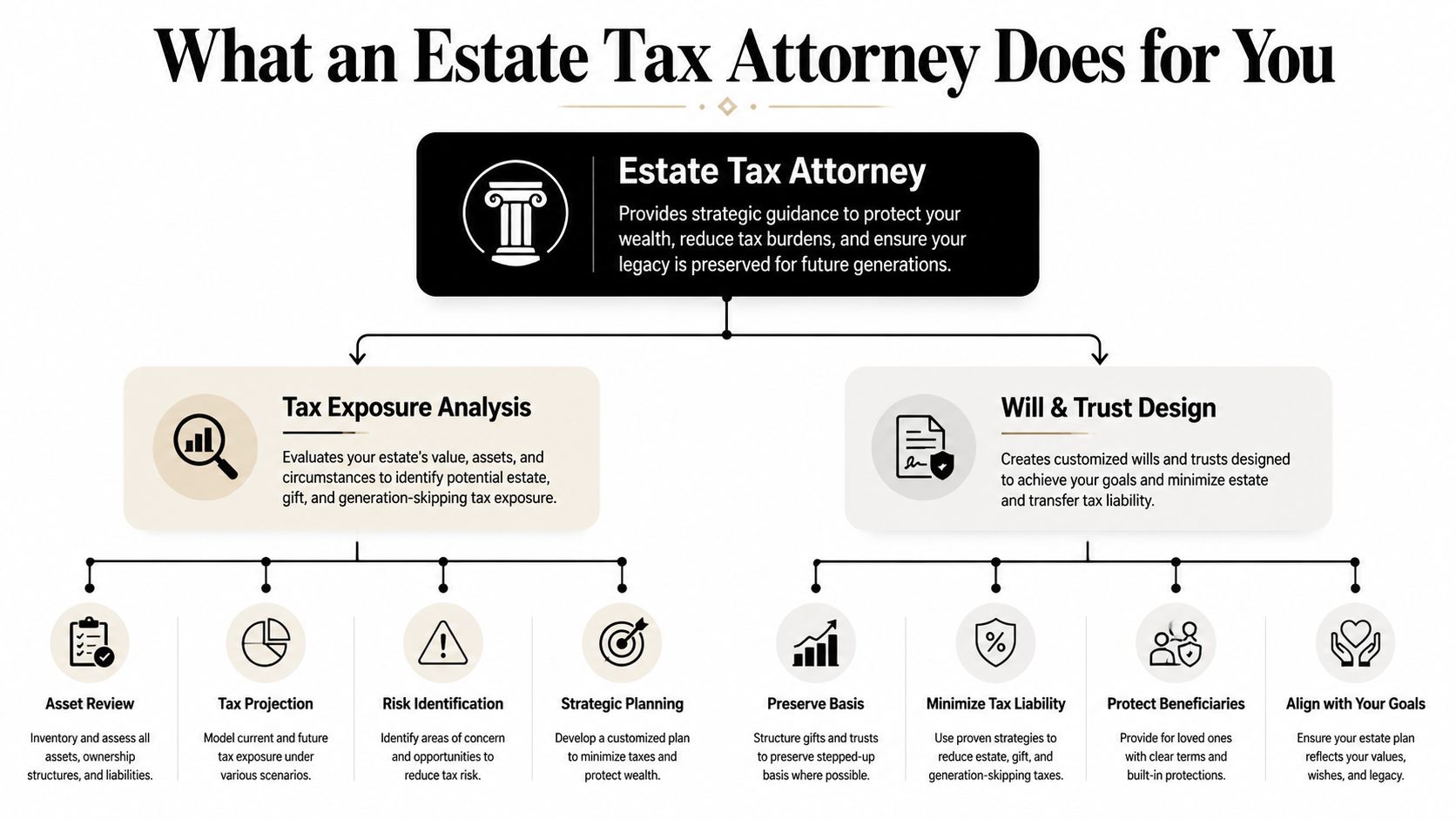
A Humble family may contact an estate tax attorney expecting a tax calculation and discover that the larger task is coordination. The attorney connects federal rules with property ownership, beneficiary forms, wills, trusts, and the court procedures that determine how assets reach the intended people.
Reviewing assets, ownership, and flexibility
The review usually begins with an inventory of real estate, bank and investment accounts, business interests, life insurance, retirement assets, personal property, debts, and prior gifts. Each item can follow a different path at death. The attorney checks who owns it, who receives it, whether a court process is involved, and whether the estate has enough cash to pay expenses and obligations.
For a moderate-size estate, the plan may center on preserving basis, keeping control of property, supporting a spouse or children, and reducing the chance of a dispute. A larger estate may require analysis of federal estate and gift-tax exposure, trust design, lifetime transfers, and gifts across generations. Since Texas has no separate estate or inheritance tax, many Humble families need careful probate and transfer planning more than an elaborate tax structure.
The Estate Planning Attorney in Humble resource covers wills, trusts, and estate plans for local families. Tax review can support that work by showing how each document fits the family's assets and goals.
Matching documents to real property
A will should reflect current relationships, property, and instructions. A trust needs a defined purpose, suitable terms, and assets properly connected to its structure. The attorney may also review powers of attorney, medical directives, beneficiary designations, and provisions for children or vulnerable beneficiaries.
Drafting works like fitting pieces of a map together. A home titled in one way, a retirement account naming a different beneficiary, and a business interest controlled by an operating agreement may each follow separate rules. Clear language cannot correct an ownership arrangement that contradicts the plan, so the documents and account records must be reviewed together.
Coordinating portability and administration
For a married couple, portability can preserve a deceased spouse's unused federal exclusion for the survivor. The executor must timely file Form 706 to make the election, even if the estate does not appear to owe federal estate tax. The election applies retroactively to the date of death, which makes timely review important.
An attorney can also coordinate probate, communicate with the executor, address creditor claims, prepare court filings, and help transfer real estate. That work may involve property in Humble, Kingwood, or elsewhere in Northeast Houston, including matters that reach Harris County courts.
The IRS identifies the 2026 basic exclusion amount as $15,000,000 per decedent. For married couples, the combined shelter can effectively reach $30,000,000 when the deceased spouse's unused exclusion is preserved through a timely estate-tax return election, as explained in the IRS estate and gift tax update.
When Humble Families Should Consult an Estate Tax Attorney
Not every family needs emergency estate-tax planning. Some events, however, justify prompt legal advice because waiting can limit available options.
Call promptly after a spouse's death
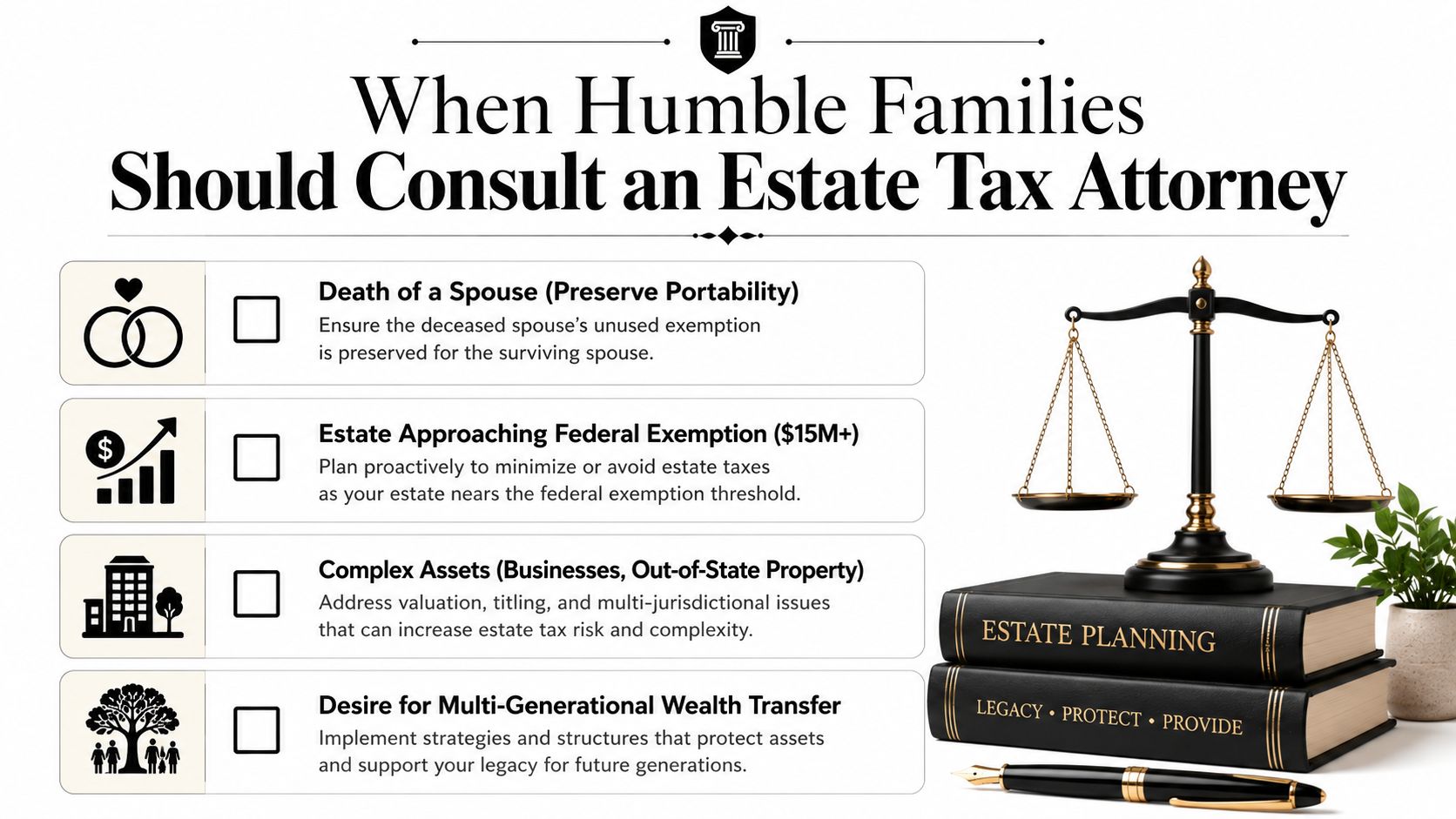
The death of a spouse is the clearest example. The surviving spouse may not owe estate tax at the first death, but the executor may need to preserve the deceased spouse's unused exclusion. Portability is not automatic. A timely Form 706 filing is required, and the election applies retroactively to the date of death, according to the National Association of Estate Planners and Councils' portability discussion.
The survivor shouldn't assume that no tax is due means no filing deserves consideration. A lawyer can review the estate, explain the election, and identify the applicable deadline.
Seek advice when the estate or transfer plan is complex
An estate approaching the federal exemption deserves careful analysis, particularly when values may grow or assets are difficult to sell. The same is true for large lifetime gifts, closely held businesses, out-of-state property, or a plan involving multiple generations.
Blended families also benefit from early review. A spouse may need support during life while children from an earlier relationship eventually receive particular property. Clear trust terms and coordinated beneficiary designations can reduce confusion.

Routine planning can still be enough
A family with straightforward assets, current documents, and no urgent death or transfer issue may need a standard will and trust review rather than specialized tax structuring. That doesn't make the planning unimportant. It means the attorney can match the scope of work to the facts instead of selling complexity the family may not need.
For residents of Humble and Atascocita, this simple decision rule helps:
- Act now: A spouse has died, a Form 706 decision may be pending, or property is being transferred.
- Schedule soon: The family owns a business, has blended-family concerns, holds out-of-state property, or has made substantial lifetime transfers.
- Plan routinely: The family wants to create or update wills, trusts, powers of attorney, and beneficiary designations.
Local Considerations for Probate in Humble and Harris County
For many Humble families, probate is the practical center of the estate process. Probate is the court-supervised process used to validate a will when appropriate, appoint an executor or administrator, address debts and claims, and transfer property according to Texas law.
Texas probate doesn't operate through one statewide probate court system. Depending on the county, a matter may proceed in a statutory probate court, a county court at law, or a constitutional county court, making local venue and procedure important for Humble and Harris County families, as explained in this overview of Texas probate courts and procedure.
What the local process may involve
A family typically begins by locating the original will and identifying the deceased person's residence, assets, debts, and immediate relatives. Counsel can then help determine the appropriate Harris County filing, seek appointment of the personal representative, and obtain authority needed to manage estate property.
The work may include notifying interested parties, collecting financial information, addressing creditor claims, preparing inventories or related filings, and transferring real estate. If there is no will, the family may need an heirship proceeding or an administration process that follows Texas intestacy rules.
A downtown Humble law office can be convenient for residents of Humble, Kingwood, Atascocita, and surrounding Northeast Houston communities. Convenience doesn't replace legal analysis, but local familiarity can help families organize documents and understand which Harris County procedure fits the estate.

Prepare before filing
Bring the death certificate, original will if available, deeds, account statements, insurance information, business records, debt notices, and a list of close relatives. Don't distribute property informally before understanding the estate's obligations, especially when real estate or creditor claims are involved.
Families can also review how long you have to file probate after a death in Texas and compare that question with the broader court process. The Harris County Family Courts guide for Humble residents concerns how family-law cases proceed in the Harris County courts serving Humble, so it addresses a different court context than probate.
Typical Costs and Fee Structures in Humble TX
Legal fees depend on the work required, not merely on the phrase “estate tax.” A basic will package, a trust-centered plan, a federal tax return, and a contested probate administration involve different documents, risks, and attorney time.
Texas families generally focus on federal rules because Texas has no state estate or inheritance tax. For 2026, the federal estate and gift-tax exemption is $15 million per person and $30 million per married couple, with annual inflation adjustments beginning in 2027, according to this Texas estate planning analysis. Those thresholds can make the legal objective more about effective administration and long-term control than immediate state tax savings.
Common fee structures
| Fee Model | Best For | How It Works |
|---|---|---|
| Flat fee | Wills, powers of attorney, or defined trust work | The lawyer quotes a set amount for an agreed scope of services. |
| Hourly billing | Tax analysis, unusual assets, or Form 706 preparation | The client pays for attorney and staff time spent on the matter. |
| Blended arrangement | Probate administration with changing demands | Some services may have a defined fee, while disputed or additional work is billed separately. |
A flat fee can make a predictable planning project easier to budget, but ask what revisions, execution meetings, funding assistance, and later changes include. Hourly work may be appropriate when the attorney cannot know the full complexity at the outset. Probate often changes as the lawyer discovers assets, claims, heirs, or title problems.
Readers comparing estate administration expenses across jurisdictions may find this guide to navigating Arizona probate costs useful for general comparison, though Arizona rules and fees don't determine what a Harris County matter will cost.
Before hiring counsel, ask:
- Scope: Which documents, filings, meetings, and communications are included?
- Billing: Is work billed hourly, by a flat fee, or through a combination?
- Changes: What happens if the family discovers another asset or a dispute develops?
- Court work: Are filing fees and other outside costs separate from attorney fees?
- Updates: Does the engagement include future revisions, or are they separate services?
How to Choose the Right Estate Tax Attorney and Take the Next Step
The right lawyer should understand both federal transfer-tax planning and the Texas process that your family will use. Start by confirming that the attorney is licensed in Texas and handles estate planning, probate, or estate-tax matters relevant to your circumstances.
A practical selection checklist
Look for experience with Harris County probate procedure, wills and trusts, basis considerations, liquidity planning, and portability. If a spouse has died, ask directly whether the attorney evaluates a Form 706 filing rather than assuming no federal tax means no filing is needed.
Communication matters just as much as technical knowledge. You should be able to explain your family structure, property, and concerns without being embarrassed by unfamiliar legal terms. A lawyer serving Humble, Atascocita, Kingwood, and Northeast Houston should also be able to explain how local court involvement may affect your next step.
Use this guide to choosing an estate planning attorney as a starting point for comparing qualifications and communication style.
Bring useful information to the consultation
Gather the current will and trust documents, deeds, account statements, retirement and insurance beneficiary information, business records, prior gift information, debt notices, and a list of family members. If someone has died, bring the death certificate and any letters or notices from a court, creditor, financial institution, or tax professional.
You don't need a perfect inventory. Even incomplete information helps the attorney identify what must be located and which deadlines may matter. Be candid about family disagreements, second marriages, adopted or stepchildren, property outside Texas, and prior planning documents.
The Law Office of Bryan Fagan handles wills, trusts, estate planning, probate, family-law matters, and criminal defense for local residents. Its Humble office offers free consultations, giving families a chance to discuss whether they need routine planning, probate assistance, or a more focused estate-tax review.
Schedule a free consultation with the Law Office of Bryan Fagan to review your will, trust, probate questions, or portability concerns with a local Humble attorney. Bring the documents you have, and let the firm help you identify the practical next step for your family in Humble, Atascocita, Kingwood, or Northeast Houston.