Skip to content

A parent dies, and the family quickly discovers that the Humble home is still titled only in the parent's name. The payoff check is on the kitchen counter, a buyer may be interested, and everyone wants to move forward, but no one knows which document changes ownership. For many families in Humble, Atascocita, Kingwood, and Northeast Houston, the answer may be an affidavit of heirship, but only when the estate and family history fit the legal requirements.
An affidavit of heirship can help establish who inherited Texas real property without opening a traditional probate case. It also has firm limits. It isn't a universal substitute for probate, and using it for the wrong asset or with incomplete family information can create a title problem that lasts for years.
What an Heirship Affidavit Covers
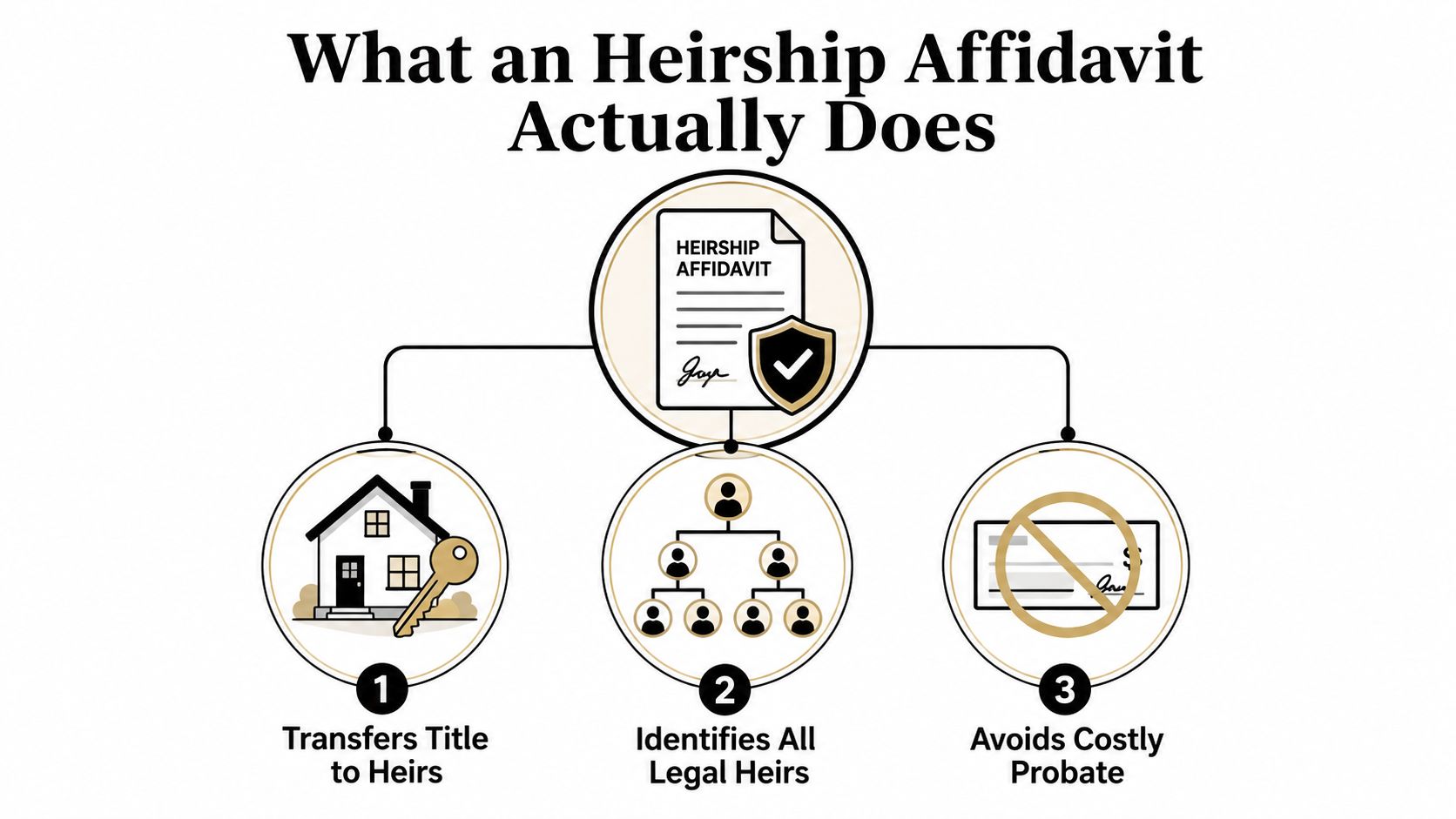
A Wilson Road homeowner whose parent died without a will, with one sibling having died earlier, may face a title problem even when the family agrees about who inherited the house. An affidavit of heirship records the deceased person's family history, marriages, children, and other relevant relationships, then identifies the heirs entitled to the property under Texas law.
The document is recorded in the county clerk's real property records where the land is located. For a home in Humble, that generally means the Harris County real property records. It is a deed-records tool, not a request for a probate judge to issue an order. Its job is to create a public record that helps connect the deceased owner's title to the heirs' ownership.
What it can reach
The affidavit is most useful for real property, including a family home, vacant land, and interests tied to real estate. After recording, it can give a title company or closing professional a documented basis for recognizing the heirs' ownership.
An institution may accept the affidavit for certain other interests, but families should not assume a bank or financial company must release funds on that basis. A mortgage payoff check, brokerage account, retirement account, or similar financial asset may require its own procedure.
Where it stops
An affidavit of heirship is not a probate court order. It does not authorize someone to administer the estate, resolve creditor claims, decide a family dispute, or transfer every asset owned by the decedent. It may also fail for titled vehicles or other property that an institution requires to pass through probate.
Practical rule: Treat the affidavit as a deed-records tool first. If the estate includes assets needing court authority, recording the affidavit does not resolve the entire estate.
If the estate is straightforward, the main issue is clearing title to a Humble house, and every heir agrees about the family history and ownership, an affidavit may resolve that title issue without probate. If heirs disagree or the estate includes assets outside the land records, use a probate process or obtain legal advice before relying on the affidavit.
Texas Law and Why Humble Families Use This Document
Texas Estates Code Sections 203.001 through 203.002 provide the legal foundation for an affidavit of heirship. The document must identify the heirs, explain their relationships to the decedent, and state the share each heir receives. Texas practice also requires signatures from the distributees and two disinterested witnesses with personal knowledge of the family history, with the signatures completed before a notary.
The affidavit belongs in the county's real property records because its central purpose is proving ownership of land. It doesn't operate like a probate judgment. The Harris County clerk records the instrument, while a probate court becomes involved only if the family chooses or needs a court-based procedure.
Texas law also recognizes a long-term evidentiary effect. Under Sections 203.001 and 203.002, a properly recorded affidavit becomes prima facie evidence of the heirship facts after five years. That rule matters when a future buyer, lender, or title underwriter reviews the history of a Humble, Kingwood, or Northeast Houston property.
Families often prefer this route when the heirs are known, the property is the central issue, and no one is contesting the inheritance. It can be less disruptive than opening a formal Harris County probate matter, but it doesn't offer the same court-supervised process for disputed or complicated estates. Families dealing with an estate without a will can also review this Texas probate resource for estates without a will.
For broader household concerns, local residents may also find it useful to identify common spider species Houston homeowners may encounter. That has nothing to do with heirship law, but practical estate work often happens alongside ordinary homeownership responsibilities.
Affidavit of Heirship vs Formal Administration at a Glance
| Feature | Affidavit of Heirship | Formal Administration |
|---|---|---|
| Main purpose | Records family history and identifies heirs for real property | Allows a court-supervised representative to administer the estate |
| Filing location | County real property records | Probate court with jurisdiction |
| Court order | Not normally a court order | Court involvement is central |
| Best fit | Known heirs, uncontested family history, and a real-property title issue | Disputes, complex assets, creditor issues, or a need for formal authority |
| Evidence | Recorded affidavit supports the chain of title | Court orders and administration records establish authority |
The right choice depends on the asset, the family, and the title company's requirements. A recorded affidavit can be effective, but it shouldn't be presented as a guarantee that every institution will accept it for every purpose.
Who Counts as a Disinterested Witness
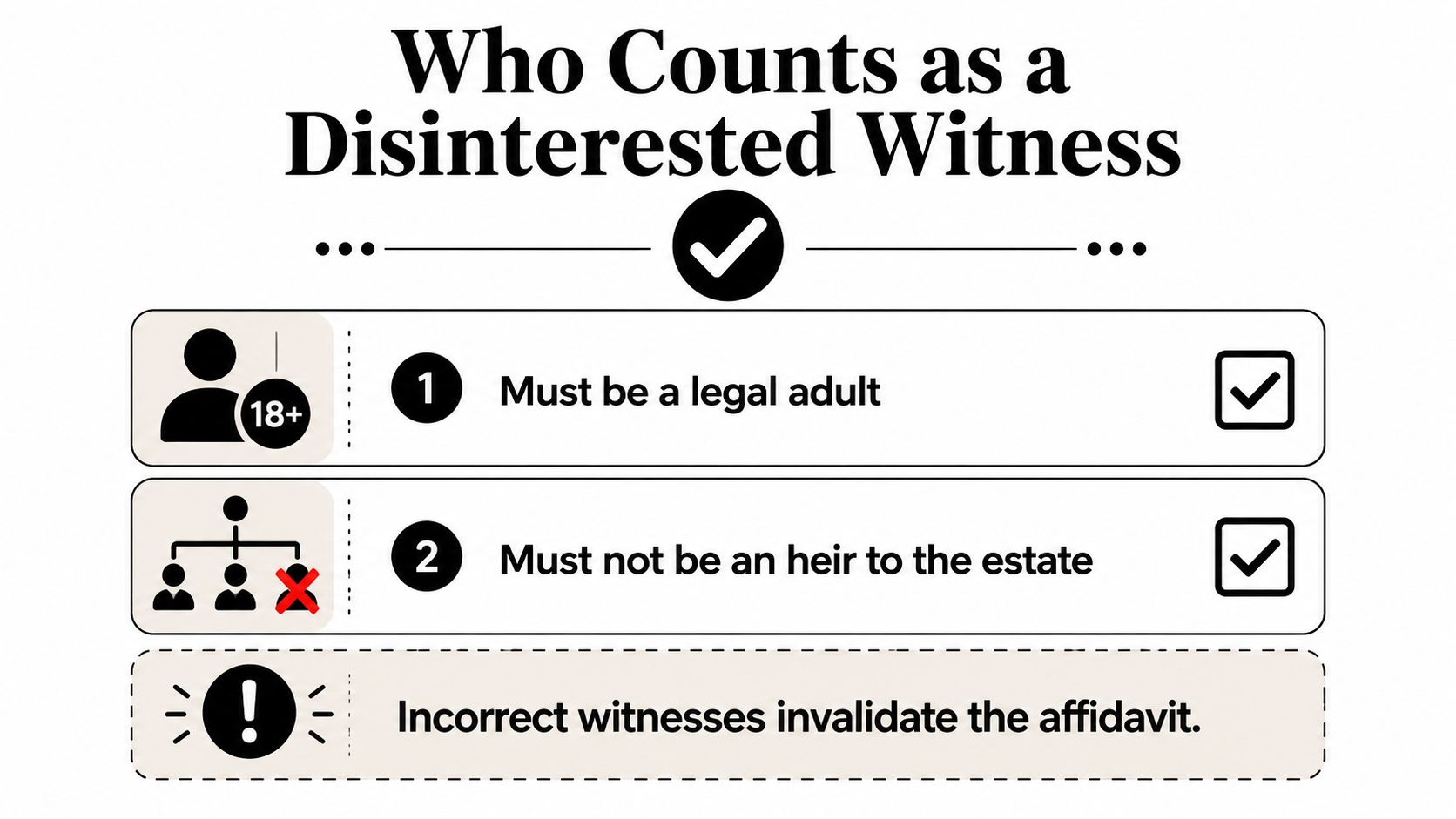
A disinterested witness is an adult who knew the decedent and the family history but doesn't stand to inherit or receive a financial benefit from the affidavit's statements. Texas requires two such witnesses for the heirship process described here. Their role is important because they provide independent confirmation of the family story.
A witness shouldn't sign just because the family trusts that person. The witness must be outside the line of inheritance and able to speak from personal knowledge.
People who often qualify
A longtime Humble neighbor who knew the decedent for decades may be a good candidate. So might a former coworker who knew the family's history or a church member from a parish near Wilson Road who had regular personal contact with the decedent.
The witness should be able to address more than the decedent's name. The affidavit may require information about marriages, divorces, children, deceased relatives, and other relationships that affect who inherits.
People who should not sign
The surviving spouse, adult children, parents, siblings, nieces, nephews, and in-laws generally have an inheritance connection or may have one under a different family-history scenario. They shouldn't be treated as neutral witnesses just because they agree with the affidavit.
Borderline situations deserve special care. A neighbor may appear independent but become interested if the decedent named that neighbor to receive property in a will. A second cousin may seem remote, yet still have a potential inheritance claim if closer heirs died first. The test isn't whether the person feels impartial. The test is whether the person could benefit under any relevant inheritance theory.
Witness check: Before scheduling notarization, ask whether the proposed witness could inherit, receive a gift, or gain financially if the affidavit is accepted. If the answer is unclear, have a Humble probate attorney review the choice first.
Every witness must understand the family history well enough to swear that the statements are accurate to the witness's knowledge. A notary confirms identity and execution, but a notary doesn't decide whether a witness is legally disinterested or whether the family tree is complete.
This video may help families understand why witness selection and factual accuracy matter:
Drafting and Notarizing Your Affidavit Step by Step
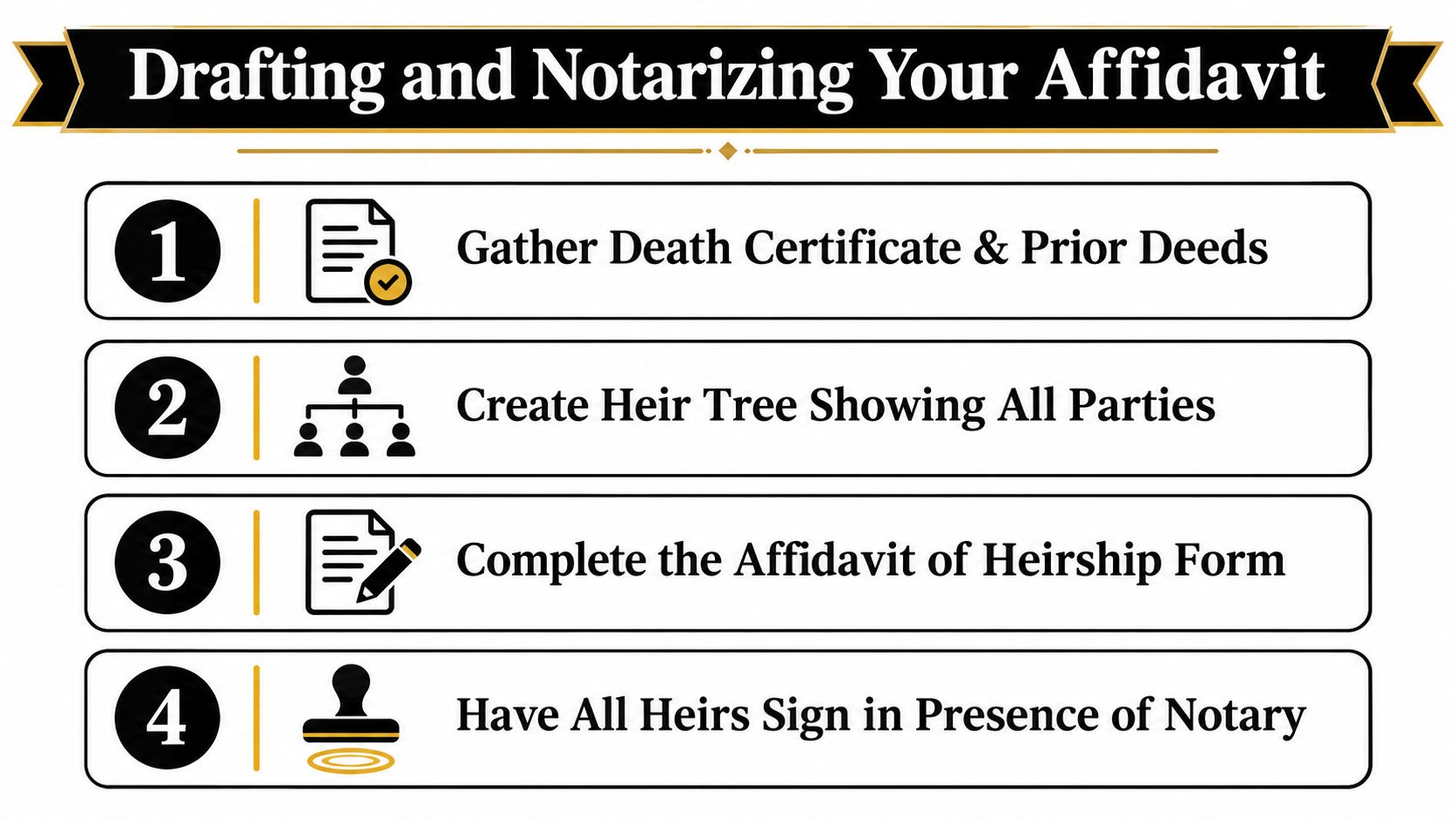
The drafting process starts with facts, not a blank form. Gather the decedent's death certificate, prior deeds, and documents that help establish the family tree. The deed matters because the affidavit must connect the inheritance statement to the actual real property being transferred.
Build the family record first
List every person who could inherit under Texas intestacy law. Include the decedent's spouse, children, adopted children, parents, and other relatives whose position may matter. Identify each heir by full name, address, and relationship to the decedent. If a possible heir died before the decedent, record that fact and identify any descendants who may have stepped into that person's place.
Review marital history carefully. A prior marriage, divorce, or child who was omitted from the family's working list can change the title analysis. Don't rely on memory alone when records or relatives can confirm the information.
Prepare the sworn document
Use the statutory framework in Texas Estates Code Sections 203.001 and 203.002. The affidavit should identify the decedent, describe the family history, list all heirs and their relationships, and connect the statement to the property involved.
Have two disinterested witnesses review the facts before the appointment. All required signers should understand what they are swearing to. If the family also needs advice about marital property arrangements unrelated to the estate, Prenuptial & Postnuptial Agreements in Humble concerns drafting and review of those agreements for Humble clients, not heirship affidavits.
Sign before the notary and preserve the record
The heirs and witnesses should sign in front of a notary public. Bring identification and the complete, final version of the document. Don't sign early if the notarization block requires the signature to occur in the notary's presence.
Notary appointment checklist
- Death certificate: Bring a copy that accurately identifies the decedent.
- Prior deeds: Gather deeds and legal descriptions for the Humble or Harris County property.
- Family history: Prepare marriage, divorce, birth, adoption, and death information relevant to inheritance.
- Heir list: Include each heir's full name, address, and relationship.
- Witness information: Confirm that two adult witnesses knew the decedent and have no inheritance interest.
- Draft affidavit: Review every statement before anyone signs.
- Identification: Each signer should bring the identification the notary requires.
- Supporting records: Bring documents that resolve disputed dates, names, or family relationships.
The notary appointment is not the time to discover that a child was omitted or that the legal description doesn't match the deed. Fix those issues before signing. A careful factual review is usually easier than correcting a recorded document later.
Filing in Harris County and Proving Title
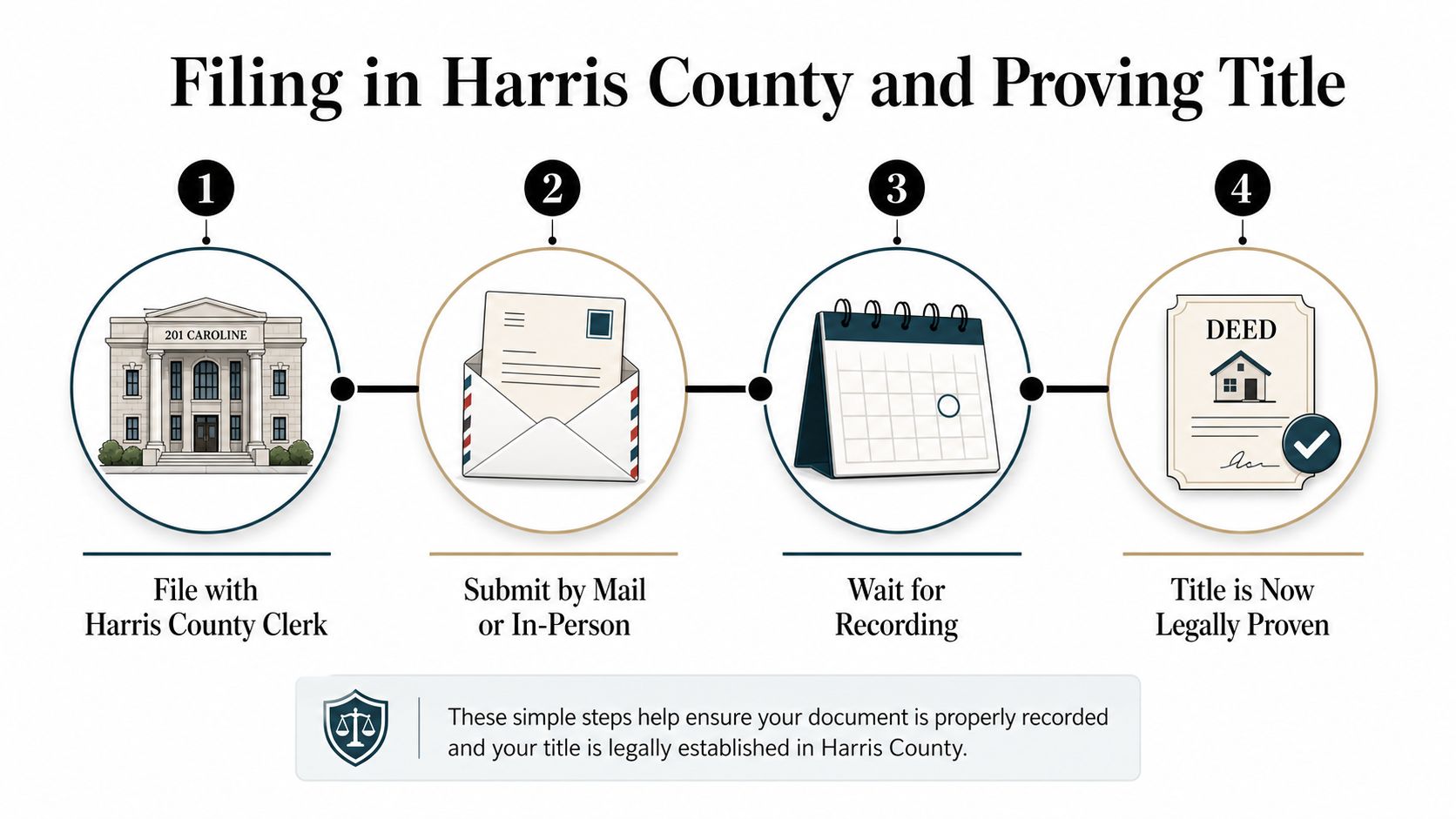
After notarization, the affidavit must be recorded in the Harris County real property records because the property is located there. Humble families generally work through the Harris County Clerk's recording system rather than submitting the affidavit to a probate judge. The county clerk's office is located at 201 Caroline in Houston, and recording may also be handled by mail.
The document must be prepared as a recordable instrument. That means the names, signatures, notarial acknowledgment, and property description must be complete and legible. Before mailing or submitting it, confirm the county's current procedural requirements and recording charges because fees and submission rules can change.
Protect the title file
Request certified copies after recording. A title company may need one for a sale or refinance. The mortgage company or payoff department may need proof of authority connected to the property, and a closing agent may ask for a certified record before preparing transfer documents.
A recorded affidavit becomes prima facie evidence of the stated heirship facts after five years under Texas Estates Code Sections 203.001 and 203.002. That evidentiary rule can become important later, particularly when the family home changes hands or a title professional reviews older records.
Expect title review, not automatic acceptance
A title underwriter may still request additional proof. The underwriter may see an omitted heir, an unclear marriage history, conflicting deeds, a trust, or another fact that makes the affidavit unreliable for the proposed transaction. Recording proves that the document is in the public records. It doesn't force every title company to accept the document without further review.
If the family is considering selling inherited land, a general guide to inherited land cash buyers Texas may help explain practical sale considerations, but it doesn't replace title review. Families may also encounter separate Harris County matters, such as Child Support Attorney in Humble services involving establishment, modification, and enforcement of child support.
When a valid will exists and the family needs a court-recognized transfer, review whether a Texas muniment of title fits instead. That is a different legal route and shouldn't be blended casually with an heirship affidavit.
Heirship Affidavit vs Small Estate Affidavit vs Probate
These tools solve different problems. An affidavit of heirship is primarily a real-property title document. A small estate affidavit is a court-approved procedure for qualifying estates that may include personal property, bank assets, and other property. Formal probate provides court supervision when the estate or family situation requires it.
Texas guidance allows a small estate affidavit only when the decedent died without a will, no administration has started, and at least 30 days have passed since death. The estate's qualified value must be $75,000 or less, excluding the homestead and exempt property. The court must approve the affidavit before heirs can use it to collect property from banks or other institutions, and a homestead copy must be recorded in the county property records. See this overview of the probate process in Texas for broader context.
Comparing Texas Estate Tools for Humble Families
| Tool | Assets Covered | Court Filing | Typical Cost | Best Use |
|---|---|---|---|---|
| Affidavit of heirship | Primarily real property and related title interests | Recorded in county real property records | Varies with drafting and recording needs | Known heirs and an uncontested real-estate title issue |
| Small estate affidavit | Qualifying personal property and other estate assets within the statutory limit | Filed in the court with jurisdiction and venue | Varies with court and legal needs | A qualifying intestate estate with no pending administration |
| Formal probate | Broad estate administration, including assets requiring court authority | Filed in probate court | Varies with complexity and representation | Disputes, complex assets, creditor concerns, or required court authority |
The decision rule is straightforward. Real estate only, complete family history, and uncontested heirs usually point toward an heirship affidavit. Mixed assets, a need to collect funds from institutions, or an estate that meets the small-estate requirements may point toward the small estate process. Disputes, missing heirs, complex ownership, or a title company's refusal may require formal probate.
Don't confuse “small” in everyday language with “small estate” under Chapter 205. The statutory conditions all have to be satisfied. Harris County heirs must submit the small estate affidavit to the court with jurisdiction and obtain approval before using it to collect qualifying assets.
Common Mistakes and When to Call a Humble Attorney
The most damaging mistake is treating the affidavit like a simple family form. It is a sworn legal record, and one incomplete relationship or improper witness can undermine the title work that follows.
Watch for these recurring problems:
- Interested witness: A spouse, relative, beneficiary, or possible heir signs as though neutrality doesn't matter.
- Omitted family member: The affidavit leaves out a child, descendant, surviving spouse, or person whose status must be addressed.
- Vague property description: The document names a street address but fails to connect the transfer to the deed's legal description.
- Unresolved marital history: A prior marriage, divorce, or community-property issue is ignored.
- Wrong asset assumption: The family expects the recorded affidavit to release bank, brokerage, retirement, or other assets that require separate authority.
- Unverified statutory issue: The family relies on an incorrect understanding of the evidence and timing rules instead of checking the governing statute.
A flawed affidavit can cloud title and force the heirs to seek a court remedy later. The cost and disruption of repairing a defective title can exceed the effort required to review the family history correctly before signing.
Call a Humble or Harris County probate attorney before notarization if an heir can't be located, a beneficiary is a minor, a will exists, real estate is held in a trust, or the estate includes property outside Texas. Those facts can change the correct legal path. A focused review can protect a multigenerational home without automatically turning the matter into a full probate administration.
The Law Office of Bryan Fagan helps Humble-area families evaluate heirship affidavits, probate alternatives, wills, trusts, and estate administration needs. Schedule a free consultation by visiting Law Office of Bryan Fagan to discuss the property, family history, and documents before anyone signs.