A landlord in Humble discovers that rent is two months behind and assumes there's time to sort things out. A tenant finds a notice taped to the door and decides to look for a new apartment next week. Both assumptions can cause serious harm. The eviction process in Humble, Texas moves through Harris County Justice Courts on tight deadlines, and a mistake at the beginning can affect possession, rent recovery, housing stability, and future rental screening records.
Harris County recorded 76,321 eviction filings in 2024, about one filing for every ten renter households. The total was about 5% lower than the 80,110 filings recorded in 2023, but the filing rate remained around 20% above pre-pandemic levels. The countywide filing rate was reported at 9.7%, meaning roughly one in ten renter households in a tract received an eviction filing in 2024. Harris County eviction data shows why a Humble, Atascocita, Kingwood, or Northeast Houston household shouldn't treat an eviction notice as an informal warning.
Why Eviction Cases Move So Fast in Humble and Harris County
Texas eviction law is built around a fast forcible-detainer process. A landlord generally must provide at least 3 days' written notice to vacate, unless the lease sets a different period, and may then file in the appropriate Justice Court. Texas State Law Library guidance confirms that the landlord must wait until the notice period expires before filing.
That timeline creates pressure for both sides. A landlord who serves the wrong notice may have the case dismissed and need to start again. A tenant who ignores the notice may miss the opportunity to correct a problem, gather evidence, negotiate, or prepare for court. The notice taped to the door isn't the same thing as a court judgment, but it can be the first step toward one.
Harris County's filing volume changes the practical stakes
Humble sits inside the broader Harris County eviction system. The county reported that justice courts scheduled 1,865 eviction hearings in one week in August 2022, and tenants had attorneys in only 1.96% of eviction cases from January through July 2022. Those figures come from Harris County information discussed in the county eviction mapping report.
That representation gap matters. Many tenants in Humble and Northeast Houston appear without counsel while landlords may have property managers, repeat-court experience, or attorneys. A tenant who fails to appear can face a default judgment. A landlord who treats the process casually can lose weeks or months because the notice, filing, service, or evidence was defective.
Practical rule: Treat the first written notice as a legal deadline, not as a conversation starter.
What an eviction case can affect
An eviction lawsuit can determine possession of the home and may also involve a claim for unpaid rent or other amounts allowed by law. Even when a tenant moves before the hearing, the filing itself can create practical problems during future rental screening. Anyone reviewing Burnt eviction records should distinguish between a filing, a judgment, and the final outcome, because those are not interchangeable events.
The safest course is early action. Landlords should verify every procedural step before filing. Tenants should read every page of the notice and citation, preserve the envelope and delivery evidence, and seek advice immediately if the case involves nonpayment, repairs, retaliation, disability, military service, or a disputed lease violation.
Required Notices Before Filing an Eviction in Texas
A Humble landlord who files before serving a valid notice can lose valuable time. A tenant who treats a notice as an informal warning may miss the only opportunity to correct the problem before a Justice Court case begins. The written notice starts the legal process, and its wording, deadline, and delivery method can determine whether the later filing succeeds.
Start with the lease, then identify the notice period
For nonpayment of rent, Texas law generally requires at least 3 days' written notice, unless the lease sets a different period. A similar statutory threshold may apply to certain holdover or lease-violation situations, subject to the lease and applicable requirements. The Harris County Justice Court instructions explain that written notice must come before a forcible-detainer filing.
Review the lease before preparing the notice. It may change the deadline, provide a right to cure, or require a particular delivery method. The notice should identify:
- The property: Provide the complete rental address and unit information.
- The tenant: Name each tenant covered by the lease when appropriate.
- The reason: State whether the issue is unpaid rent, a lease violation, or holding over.
- The deadline: Give the date and time by which the tenant must vacate or comply.
- The consequences: State that the landlord may file an eviction case if the tenant does not comply.
A simple nonpayment example could read:
“You are notified that you must vacate the premises at [complete address] because rent remains unpaid under the lease. You must vacate no later than [date and time]. If you do not vacate, the landlord may file an eviction suit in the Justice Court precinct where the property is located.”
That wording is only an example. Generic internet forms often omit lease-specific language, cure rights, or accurate delivery instructions. In Harris County, a small defect can force the landlord to restart the notice period after the case is already filed.
Deliver the notice correctly
Texas law recognizes several delivery methods, including personal delivery, certified mail, or posting on the inside of the main entry door in circumstances authorized by law. Taping a notice to the outside of a door or sliding it underneath may not satisfy the required method.
Landlords should record the date, time, delivery method, person who delivered the notice, photographs, mailing records, and tracking information. Tenants should photograph the notice as found, preserve the envelope, and keep markings that may show when and how it arrived. Those details can matter if the tenant disputes service or the landlord claims the deadline expired.
A lease-violation notice may address an unauthorized pet, property damage, excessive noise, or another breach. Whether the tenant receives an opportunity to cure depends on the lease and applicable law. A month-to-month tenancy presents a different issue. Ending it generally requires notice covering the full rental period, often described as monthly notice, rather than automatically using the nonpayment procedure.
Keep notice separate from the court case
The notice to vacate is a demand before litigation. The eviction petition is the lawsuit. After filing, the tenant must respond to the citation and hearing date instead of treating the matter as a private disagreement.
Texas law does not automatically require a landlord to accept partial rent after serving notice. Payment discussions can still affect the case, so document them carefully. A landlord who accepts money without a clear written agreement may create uncertainty about whether the default was cured or the tenancy continued. A tenant who wants to pay should make the offer in writing and keep proof of every payment and communication.
For a separate contract dispute, residents can review how to sue for breach of contract. An eviction remains a specialized Justice Court matter with its own deadlines, filing requirements, and proof issues.
Filing and Attending an Eviction Hearing in Harris County Justice Court
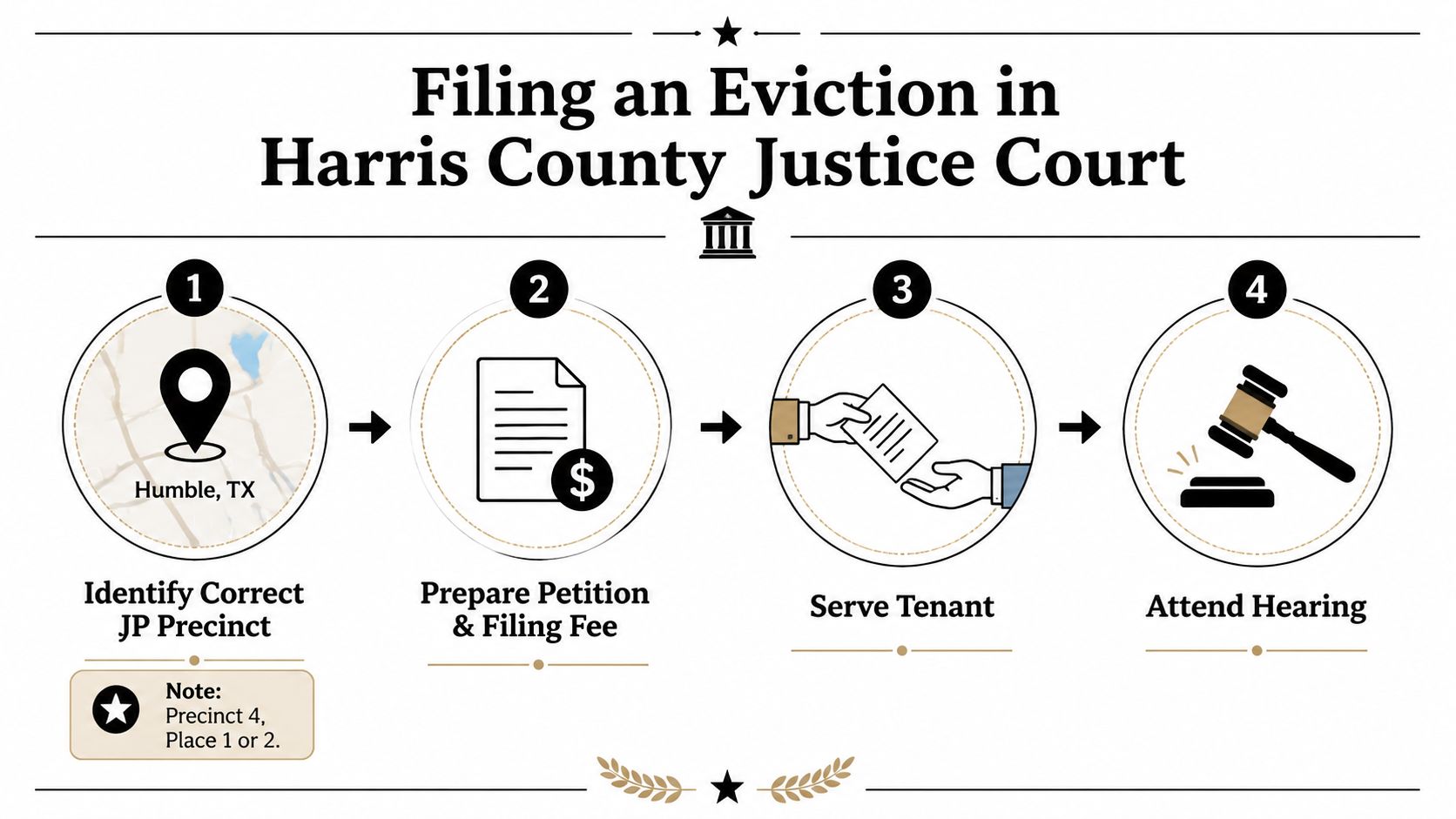
A Humble landlord can lose valuable time by filing in the wrong Justice Court precinct. After the notice period expires, file in the precinct where the rental property sits. Humble properties generally fall within Precinct 4, Place 1 or Place 2, depending on the exact address. Verify the location before preparing the petition.
The petition must tell the court what happened
The petition should identify the landlord and tenant, provide the complete property address, explain the grounds for eviction, and state whether the landlord seeks possession, money, or both. Build the evidence file before the hearing date arrives. Include the lease, rent ledger, notice, delivery proof, photographs, messages, repair records, and any other document supporting the claim.
The court issues a citation for service after filing. The tenant must be served at least 4 days before the hearing, and the hearing is generally set 10 to 21 days after filing. Confirm current local procedures and filing requirements with the Harris County Justice Court before submitting documents.
Service must follow the applicable rules. A constable or authorized process server serves the citation. If the tenant cannot be found, the court may authorize another method, including posting and mailing. A landlord should not assume that photographing a document on a door proves valid service. Keep the return of service and review it before appearing.
Prepare for the hearing like a trial
Justice Court hearings may feel informal, but the ruling controls possession and can include monetary relief. The landlord must prove the right to possession, compliance with the required steps, proper service, and the factual basis for the eviction. The tenant should present documents, photographs, payment records, messages, witnesses, and any applicable defenses.
Organize copies of:
- The lease: Include amendments, renewals, and relevant rules.
- Payment evidence: Show the ledger, receipts, returned payments, and written demands.
- Notice records: Include the notice itself and proof of delivery.
- Condition evidence: Use dated photographs, repair requests, inspection reports, and communications.
- Court papers: Bring the petition, citation, and any answer or motion.
Arrive early, find the courtroom, check in, and review the file. Address the judge respectfully. Answer the question asked, do not interrupt the opposing party, and use documents whenever they can establish the fact more clearly than testimony.
Representation is often limited in eviction court, and that gap can catch Humble families off guard. A landlord should obtain advice before filing if the lease, service, or requested damages are disputed. A tenant should seek help immediately after receiving the citation, not wait until the hearing begins. The firm's small claims lawyer resource covers related Justice Court disputes, although eviction deadlines require advice focused on forcible-detainer procedure.
Missing court can decide the case
If a tenant does not appear, the landlord may obtain a default judgment. The judgment can award possession and potentially unpaid rent or other amounts supported by the case. If the tenant appears, the judge hears both sides and rules on possession, defenses, and requested monetary relief.
A judgment does not mean immediate physical removal. Post-judgment procedures still apply, including the limited appeal period and any writ-of-possession process. A tenant who loses should obtain the signed judgment immediately and calculate the deadline without delay. Residents handling separate family-law matters can review Harris County Family Courts: A Humble Resident's Guide, which explains how family-law cases proceed in the Harris County courts serving Humble.
Common Tenant Defenses That Can Stop or Delay an Eviction
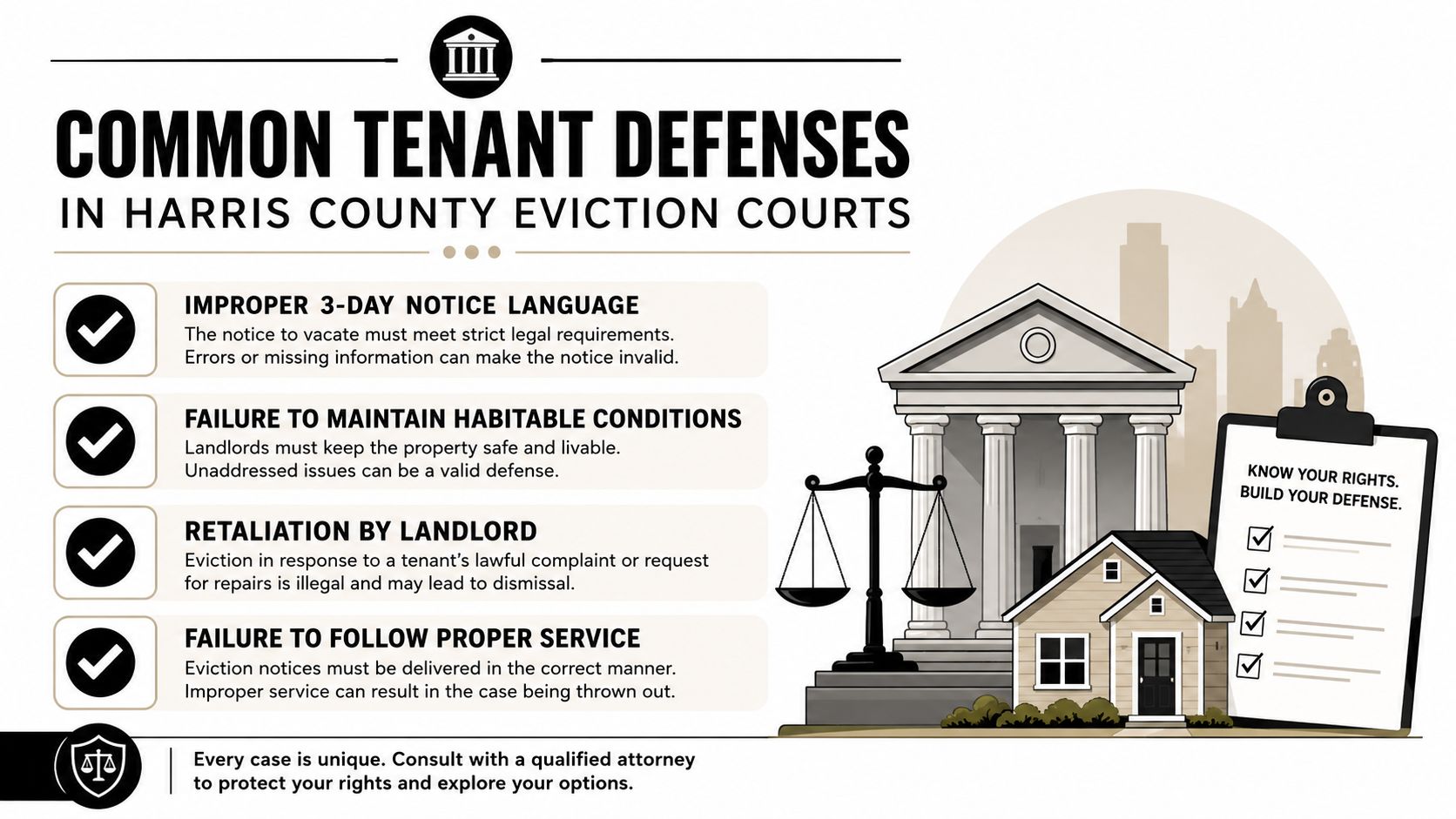
A tenant shouldn't rely on hardship alone to defeat an eviction. Judges decide possession based on legal rights and evidence. The strongest defenses usually attack a required step, dispute the alleged default, or show that the landlord's conduct violated a legal protection.
Notice defects can end the case
A tenant may challenge a notice that:
- Uses the wrong deadline: The landlord filed before the notice period expired.
- Misstates the breach: The notice doesn't identify the unpaid rent or lease violation clearly.
- Ignores the lease: The lease requires a different notice period or cure opportunity.
- Was delivered incorrectly: The landlord can't prove a legally authorized method.
- Names the wrong party or property: The documents don't match the tenancy.
These defenses can be powerful because the landlord generally must complete the notice step before filing. If the judge finds the filing premature or the notice legally insufficient, the case may be dismissed, although dismissal doesn't necessarily prevent a landlord from serving a corrected notice and starting again.
Retaliation and repair claims require proof
Texas Property Code Section 92.331 may protect a tenant who faces retaliation after making a good-faith repair request or reporting a code concern. A tenant should preserve the repair request, dates, photographs, inspection communications, and the landlord's response. A vague claim that the landlord was angry won't carry the same weight as a documented sequence of events.
Habitability arguments also require precision. Texas law doesn't give a tenant a general right to withhold rent because the property needs repairs. Certain repair-and-deduct remedies exist only under specific conditions, and a tenant who deducts money without following those rules may strengthen the landlord's nonpayment claim rather than defeat it.
Procedural and federal protections
A tenant should check whether the landlord filed in the correct precinct and whether a constable or authorized process server completed citation service. A military service member may also have protections under the Servicemembers Civil Relief Act, including the possibility of a stay when the legal requirements are met.
Some arguments merely delay a hearing. Others can defeat the present case. Judges commonly reject defenses unsupported by documents, defenses based only on inability to pay, and claims that don't connect the landlord's conduct to a specific legal requirement.
Evidence beats explanation: Bring the lease, payment records, repair requests, photographs, notices, and court papers in an organized file.
Appeals, Writs of Possession, and Post-Judgment Deadlines
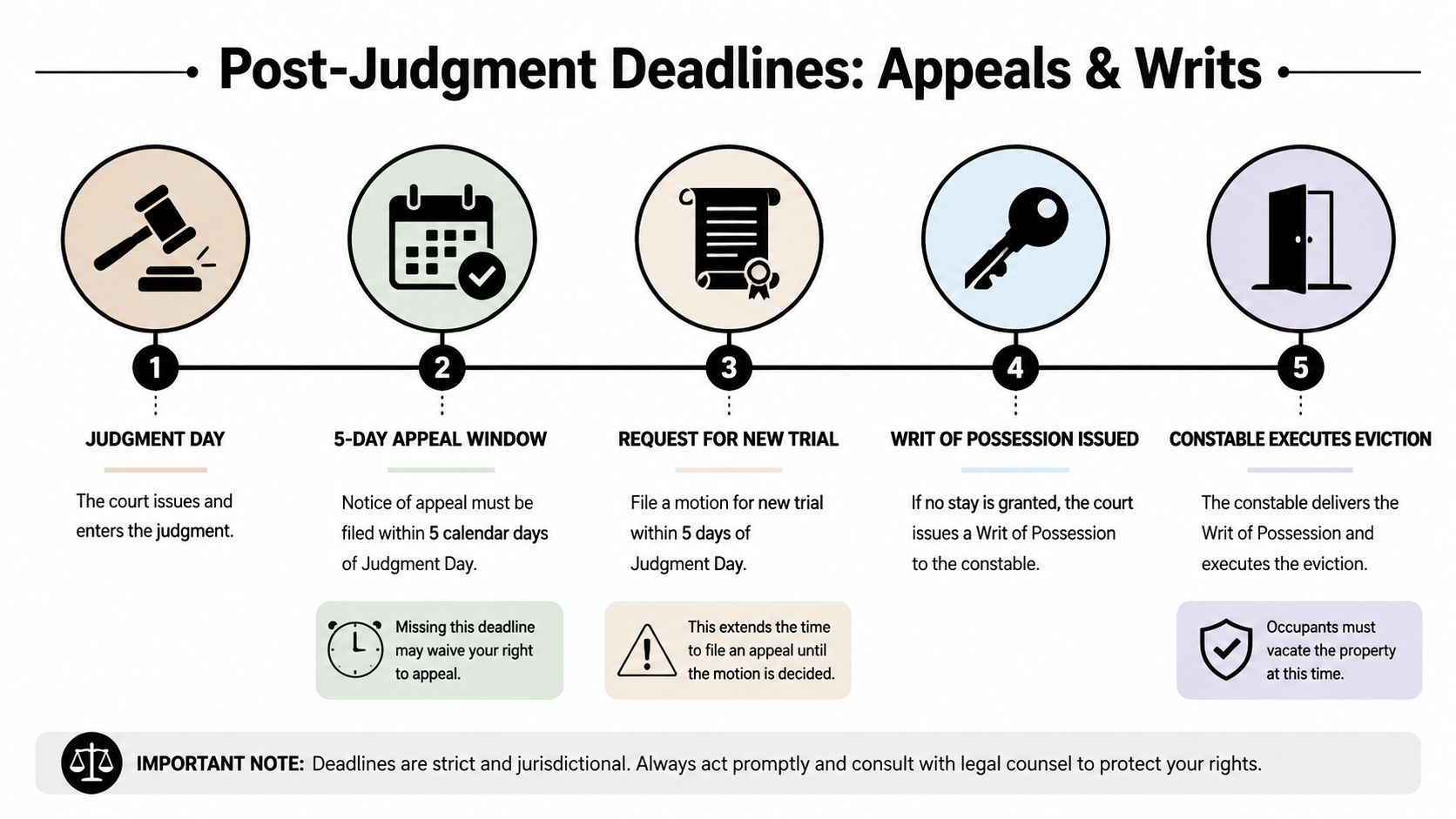
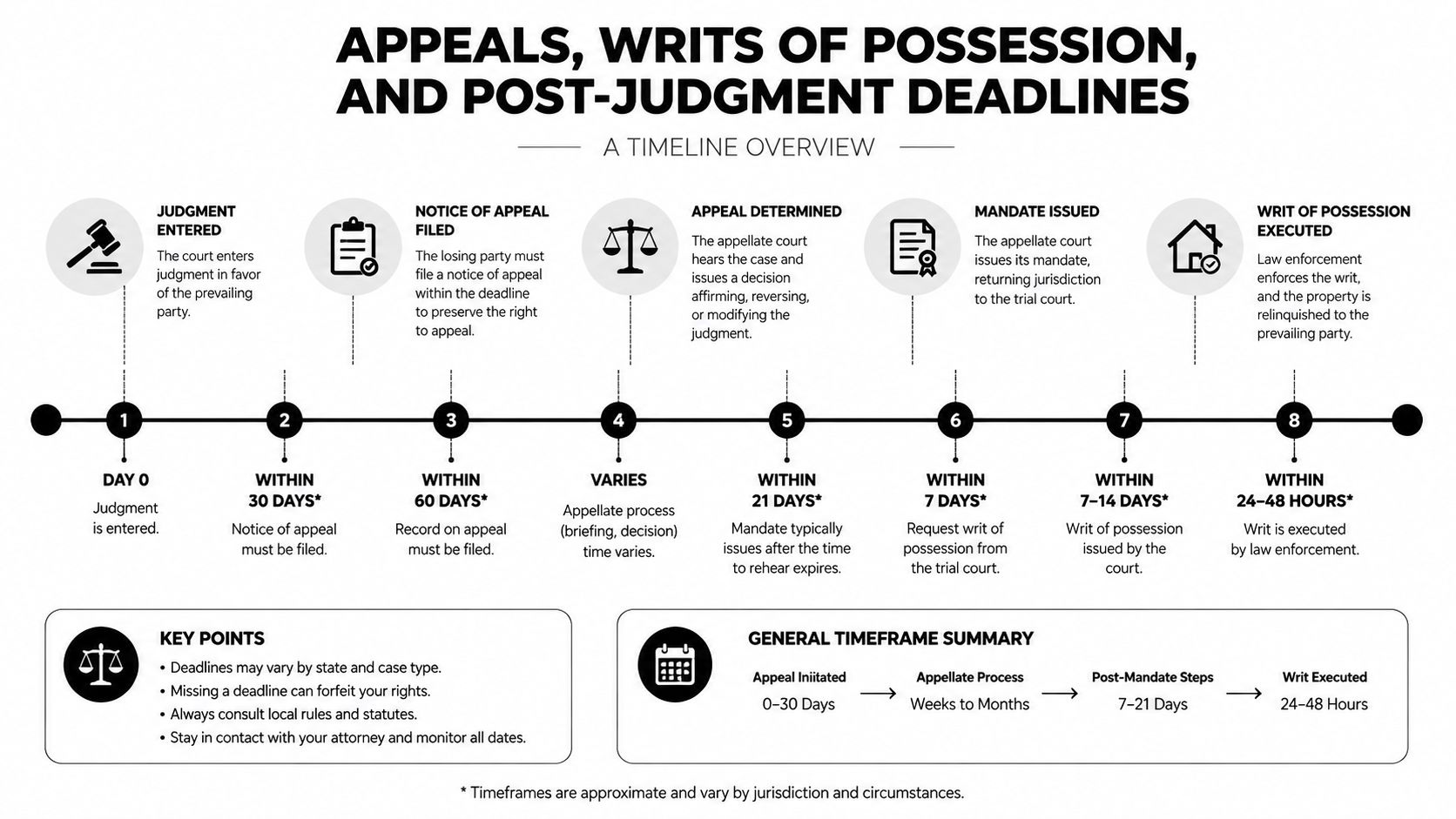
The signed judgment starts a new deadline sequence. A tenant who loses in Justice Court has only 5 days after the judgment is signed to appeal, and that five-day period includes weekends and holidays unless the court is closed on the deadline day. TexasLawHelp's eviction appeal guidance explains the urgency of that deadline.
An appeal requires more than telling the judge you disagree. The tenant must file the required appeal paperwork and satisfy the applicable bond or inability-to-pay requirements. In a nonpayment case, Texas Property Code Section 24.0053 requires an appealing tenant who files an appeal bond to pay one rental period's rent into the Justice Court registry no later than the fifth day after filing the bond, as determined by the court. The statutory text warns that missing that registry payment can allow the landlord to request an immediate writ of possession without a hearing if the transcript hasn't been sent to county court.
Changes for cases filed in 2026
For Texas cases filed on or after January 1, 2026, statutory changes streamline the process. The earliest no-trial judgment can occur on day 10 after filing, and the justice court is intended to forward an appeal within 6 days, with the county court hearing it within 21 days of receipt, creating a total appeal-resolution target of about 32 days. Harris County Justice Court's eviction materials should be reviewed for the current process.
Landlords should not remove a tenant themselves after winning. A writ of possession authorizes the constable to enforce possession under the applicable procedure. Tenants should not assume that moving out automatically eliminates every monetary issue, and landlords should not change locks, shut off utilities, or use threats instead of lawful enforcement.
The appeal process is different from appealing a family-court ruling. For that separate subject, see how to appeal a family court decision. The practical lesson is the same, however. Obtain the signed order, identify the deadline, and act before the deadline expires.
Preventing Eviction Disputes and When to Hire a Humble Attorney
The best eviction case is often the one avoided through clear communication and enforceable documentation. Landlords should use leases that identify rent obligations, late-payment rules, notice provisions, repair duties, occupants, pets, and property standards. Keep a dated record of payment demands, maintenance responses, inspections, photographs, and every notice delivered.
Tenants should report repairs in writing, preserve photographs with dates, and keep copies of payment confirmations. If a payment problem is developing, propose a written payment plan before the landlord files. A phone call may open the conversation, but written terms protect both sides from later disagreement.
Prevention works only when records are usable
A landlord with multiple properties faces repeated opportunities for error. A tenant who waits until the hearing may have difficulty locating the message, receipt, photograph, or witness needed to support a defense. Use a simple chronological file:
- Lease and amendments.
- Rent ledger and payment records.
- Repair and violation communications.
- Notices and proof of delivery.
- Court filings, citation, and hearing information.
Don't attempt a lockout or utility shutoff. A landlord must use the court process, and a tenant must respond through the court rather than assuming an informal dispute will disappear.
When local counsel becomes essential
Legal help is especially important when the landlord has a disputed notice, multiple occupants, a commercial lease, prior partial payments, or a property in an uncertain precinct. Tenants should seek counsel when they have retaliation, habitability, service, military-service, disability, or payment-registry issues. These defenses depend on facts and evidence, not broad statements about fairness.
A local attorney can also help identify whether the immediate objective is dismissal, negotiation, an appeal, protection of possession, or a proper transition after judgment. The Law Office of Bryan Fagan provides legal services from its Humble office and serves residents of Humble, Atascocita, Kingwood, and Northeast Houston in several practice areas. For an eviction dispute, the important step is to bring the notice and court papers to a lawyer quickly, before a short deadline becomes a missed deadline.
The Law Office of Bryan Fagan offers consultations and practical legal guidance for Humble-area residents dealing with eviction notices, Justice Court filings, defenses, and appeals. Visit Law Office of Bryan Fagan to schedule a free consultation with the Humble office and discuss your next step before the court deadline passes.