Skip to content

An arrest for public intoxication can turn an ordinary evening in Humble, Atascocita, Kingwood, or Northeast Houston into a frightening phone call home. You may be sitting in a holding area, wondering whether you'll lose your job, how you'll get home, and whether an arrest automatically means you're convicted. It doesn't. A careful response during the first hours can protect your rights and give a lawyer the information needed to evaluate the case.
Texas public intoxication law focuses on more than whether someone had been drinking. The state generally must prove that the person appeared in a public place while intoxicated to the degree that they may endanger themselves or another person. A public intoxication lawyer in Humble, TX can examine whether each required part of that allegation is supported by evidence, rather than treating the arrest itself as the end of the analysis.
What to Do Immediately After a Public Intoxication Arrest
The first moments after an arrest often feel disorganized. An officer may ask questions, family members may be trying to locate you, and you may not know whether you'll be released or held. Your safest approach is calm, limited communication and careful attention to what happens next.
Protect your rights first
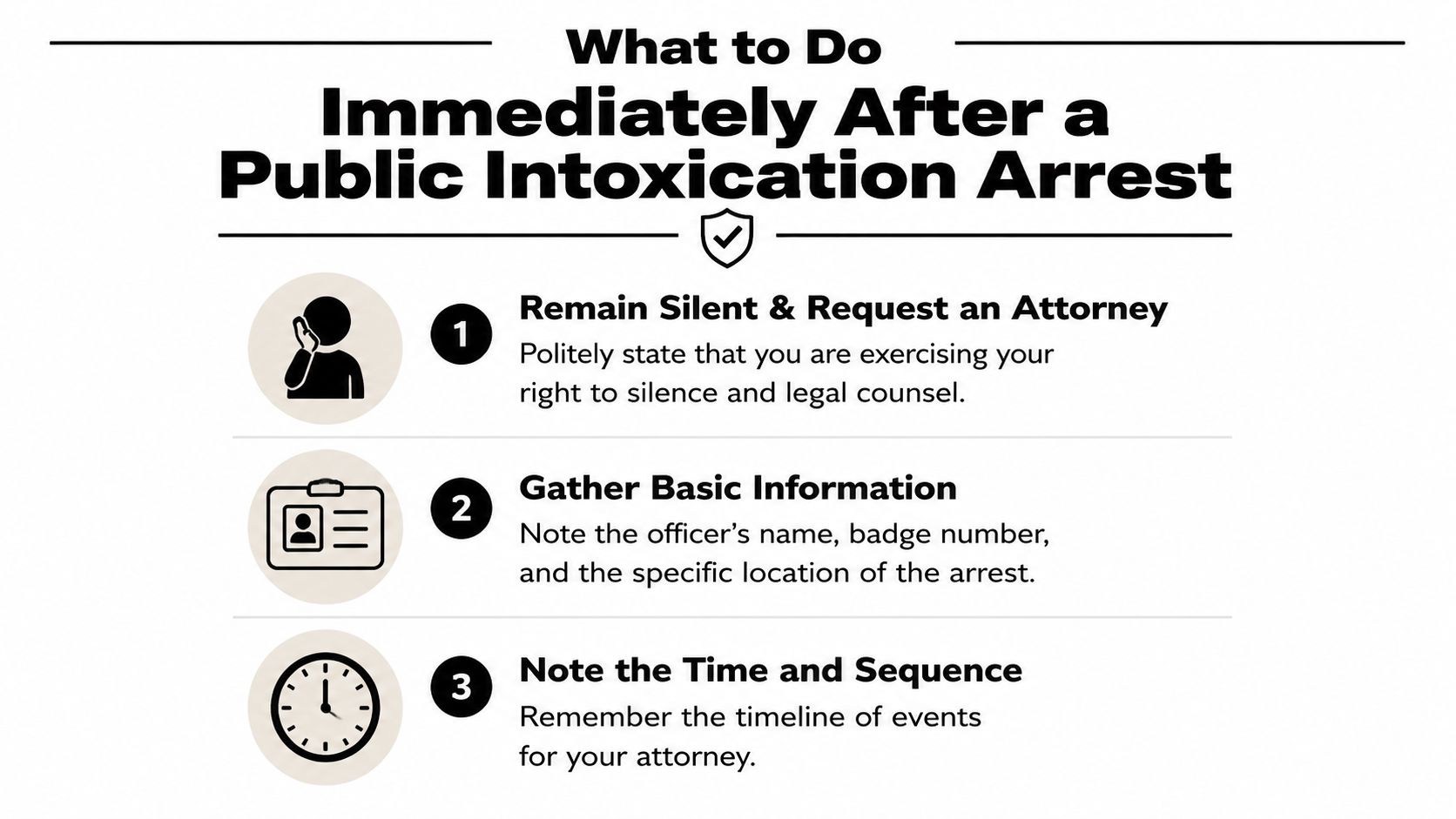
You have the right to remain silent and request an attorney. State that decision politely, then stop discussing the facts with officers, other people in custody, or anyone calling on a recorded jail line. Don't argue about how much you drank, try to persuade an officer that you're harmless, or guess about what happened. Those explanations can later be compared with body-camera footage, witness accounts, and the officer's report.
If you're released, write down what you remember while the details are fresh. Note the location, the sequence of events, what officers said, whether anyone saw the interaction, and whether you were injured or needed medical attention. Don't post about the arrest or send angry messages to people involved.
Understand the release process
Texas law allows for noncustodial resolutions and citation releases in many public intoxication cases when local authorities decide detention isn't necessary. The exact process depends on the circumstances and local procedure. You may be released to a responsible adult, receive a citation, or need to address a bond before release. The custody process is separate from the criminal sentence, so ask your family to document what paperwork you receive and what deadlines appear on it. The Texas legislative materials describe this statutory framework and related procedures at Texas Penal Code resources.
A family member may need practical help arranging release, transportation, or communication with the jail. Guidance on the process is available through how to bail someone out. Once you're home, preserve citation papers, booking information, property receipts, and any medical records. Bring those materials to a consultation instead of relying only on memory.
Practical rule: Don't try to win the case in the holding area. Protect your silence, get safe, preserve information, and obtain legal advice.
Understanding the Law and Potential Penalties
Texas Penal Code § 49.02 generally classifies public intoxication as a Class C misdemeanor. The statute applies when a person appears in a public place while intoxicated to the degree that they may endanger themselves or another person, and the statutory maximum fine is up to $500. These points appear in the official Texas Penal Code text for Section 49.02.
The prosecution's three-part burden
The allegation has three practical components. First, the state must connect the person to a public place. Second, it must prove intoxication as the statute uses that term. Third, it must show the level of intoxication created a possible danger to the person or someone else. The prosecution must prove the required facts beyond a reasonable doubt.
That structure matters because an officer's conclusion doesn't replace proof of each element. A report may describe slurred speech, an odor, unsteady movement, unusual behavior, or statements attributed to the accused. A defense lawyer should compare those observations with video, witness statements, dispatch records, medical information, and the precise location where the encounter occurred.
Public intoxication also isn't the same offense as DWI. Texas transportation guidance identifies 0.08 percent BAC as the legal intoxication limit for driving, but Section 49.02 doesn't use a fixed BAC cutoff for public intoxication. Instead, the public-place, intoxication, and possible-danger requirements control. The distinction is explained in Texas impaired-driving guidance.
Why the classification still matters
A Class C misdemeanor is a low-level criminal matter in most adult cases, but it remains a criminal charge. A conviction can create collateral concerns involving employment, licensing, reputation, and future legal proceedings. Protective custody before release generally isn't the criminal sentence itself, which is why the paperwork and the court outcome need to be reviewed separately.
The history also provides context. In 1968, the U.S. Supreme Court upheld a Texas public-intoxication conviction in Powell v. Texas and affirmed a $20 fine imposed under an older Texas statute. That history doesn't decide a modern Humble case, but it shows that public-intoxication law has long involved questions about the relationship between intoxication, public conduct, and criminal punishment.
Residents who are handling unrelated family-law matters should keep those court systems separate. Harris County Family Courts: A Humble Resident's Guide addresses how family-law cases proceed in the Harris County courts serving Humble.
Common Defenses Against Public Intoxication Charges
An arrest report can make the allegation sound conclusive. A defense review starts from a different position: what exactly can the state prove, and what evidence supports each required element? The strongest approach is usually fact-specific, not a generic claim that the officer was wrong.

Test the location
Start with the alleged public place. Identify exactly where officers encountered you, who controlled the property, whether you were inside or outside, and whether the report describes the location accurately. A crowded business, parking area, private residence, apartment property, or sidewalk can raise different factual questions. The location doesn't decide the case by itself, but an imprecise description may weaken the state's proof.
Separate intoxication from ordinary behavior
Next, examine the evidence of intoxication. Officers may describe speech, balance, smell, eyes, coordination, or conduct. A lawyer should ask whether those observations could have another explanation, such as illness, injury, medication, fatigue, anxiety, a language barrier, or a medical episode. Video may show a fuller interaction than a brief written summary.
The question isn't whether you consumed alcohol. The legal issue is whether the evidence supports the statutory allegation and connects it to possible danger.
Challenge the danger allegation
Finally, identify the alleged danger. Did the report describe stepping into traffic, falling, threatening conduct, unsafe physical behavior, or another concrete circumstance? Or does it rely on a broad conclusion without explaining what risk existed? A person can appear impaired without the state having sufficient proof that the person may endanger themselves or someone else.
Use this sequence after receiving the citation or release paperwork:
- Preserve evidence: Save messages, photographs, receipts, location information, and names of witnesses.
- Write a timeline: Record where you were, who was present, when officers arrived, and what happened before release.
- Avoid contact about the facts: Don't ask witnesses to change their accounts or discuss the incident publicly.
- Review the case with counsel: Ask how the lawyer will evaluate the report, video, witnesses, and court requirements.
A dismissal is possible in some cases, but no lawyer can promise one. Information about general dismissal considerations appears in how to get charges dismissed. The same discipline applies in other legal matters. For example, an Uncontested Divorce Lawyer in Humble handles efficient uncontested divorce matters for agreeing Humble couples, but a criminal defense case requires a separate strategy built around the evidence and statutory elements.
How a Local Attorney Can Help Your Case
Local representation matters because a criminal charge moves through real people and procedures, not just statutory language. In a Humble or Harris County public-intoxication case, the practical questions include where the matter is filed, what release paperwork says, when an appearance is required, and how the prosecutor evaluates the available evidence.
Different paths carry different trade-offs. A quick payment may close the immediate court obligation but can produce a conviction. A negotiated resolution may reduce uncertainty but still involve conditions or a record. A contested defense may require more preparation, but it can be appropriate when the evidence fails to establish public place, intoxication, or possible danger.
Public Intoxication Outcomes
| Outcome | Description |
|---|---|
| Citation or release | The person is released without a prolonged custodial process when local authorities determine detention isn't necessary. |
| Dismissal | The charge ends without a conviction, often after counsel identifies evidentiary or procedural problems. |
| Negotiated resolution | The case resolves through an agreement, with the precise terms depending on the facts and prosecutorial position. |
| Trial | The state must prove the charge beyond a reasonable doubt, while the defense challenges the evidence and presents its position. |
| Conviction | The court enters a finding of guilt and imposes the legally available consequence. |
A lawyer can request and examine reports, recordings, witness information, and release documents. Counsel can also communicate with the prosecutor without asking you to make statements that may harm your position. The lawyer's role isn't to guarantee a result. It's to identify the strongest lawful path and explain what you gain or give up with each option.
Confidentiality matters: Before sharing sensitive details, ask how the firm protects communications and case information. General background on client confidentiality best practices can help you prepare informed questions.
The Law Office of Bryan Fagan handles criminal defense alongside family-law matters. Its related Child Support Attorney in Humble resource concerns establishing, modifying, and enforcing child support in Harris County, which is a different legal process from defending a criminal charge.
Tips for Choosing the Right Lawyer
The right attorney should make the case clearer, not more confusing. Look for someone who understands criminal defense in Harris County and who will discuss the actual facts of your encounter instead of offering a guaranteed outcome.
Ask direct questions during the consultation:
- Relevant experience: Has the lawyer handled public-intoxication and related misdemeanor cases in the local court system?
- Evidence review: Will the attorney examine the report, body-camera footage, witness accounts, and release paperwork?
- Communication: Who will answer questions, and how will the firm explain court dates and decisions?
- Strategy: What weaknesses might exist in the public-place, intoxication, or danger allegations?
- Trade-offs: What are the risks of paying, negotiating, seeking dismissal, or contesting the charge?
A compassionate lawyer should also recognize the personal pressure behind a low-level charge. You may be a parent, employee, student, caregiver, or business owner trying to keep one arrest from disrupting your life. Good counsel won't shame you for the circumstances. They'll ask careful questions and give you a realistic plan.

A local office can add practical value by helping you understand Harris County procedures and by keeping your defense focused on the charge rather than unrelated speculation. Review how to choose a criminal defense lawyer before your consultation, then bring every document you received.
Contact a Humble Public Intoxication Lawyer Today
Waiting rarely improves the quality of your evidence. Memories fade, recordings may become harder to locate, and missed paperwork can create avoidable problems. A consultation gives you a chance to identify deadlines, understand the allegation, and decide whether you need counsel to communicate with the court or prosecutor.
Bring your citation, bond or release paperwork, booking information, and any documents connected to the arrest. Be candid about alcohol, medication, medical conditions, injuries, witnesses, and what you remember. A lawyer can only evaluate possible defenses accurately when the factual picture is complete.
For residents of Humble, Atascocita, Kingwood, and Northeast Houston, local guidance can make an unfamiliar Harris County process feel manageable. The Law Office of Bryan Fagan provides criminal-defense assistance as part of a broader practice that also serves families with divorce, custody, child support, wills, trusts, probate, and estate-planning needs. Those matters are separate from a public-intoxication case, but the same family may need help with more than one legal issue at a time.
You don't have to decide the entire case during the first phone call. Start by learning what you're charged with, what the state must prove, what documents matter, and which outcome best protects your future.
The Law Office of Bryan Fagan offers local criminal-defense guidance for Humble-area residents facing public intoxication charges, with attention to Harris County procedures and the evidence in each case. Schedule a free consultation by visiting Law Office of Bryan Fagan and take the first practical step toward protecting your rights and your future.