 Skip to content
You're in the middle of a frightening week. Maybe police responded to a domestic call near Humble ISD, your spouse filed for divorce in Kingwood, or someone who used to date you keeps appearing near Town Center in Atascocita. You searched “protective order vs restraining order Humble TX” because you need to know which court order can help.
The short answer is direct. Choose a protective order when violence, threats, stalking, sexual assault, trafficking, or personal safety is the problem. Choose a temporary restraining order when you need to preserve property, custody arrangements, or the status quo during a divorce or SAPCR case. Calling the wrong order by the wrong name can send you down the wrong legal path.
Why Humble Residents Confuse These Two Orders
A domestic assault arrest in Humble may lead to an emergency protective order. A divorce filing in Kingwood may involve a temporary restraining order. A stalking complaint near Atascocita may require a protective-order application, even if the person stalking you isn't your spouse. These situations can happen in the same community, but Texas law treats the available remedies differently.
A protective order is designed around safety. It can restrict contact and other dangerous conduct involving family violence, dating violence, sexual assault, stalking, trafficking, or other conduct covered by Texas law. A restraining order, usually a temporary restraining order or TRO, is generally a civil litigation tool. In a divorce or custody case, it helps preserve the situation until the judge can hold a hearing.
The biggest mistake I see is treating the two orders as interchangeable. They aren't.
Start with the problem, not the label
Ask yourself what you need the court to stop:
- Physical safety: If someone hit you, threatened you, stalked you, or made you reasonably fear violence, start by asking about a protective order.
- Property or financial conduct: If a spouse may transfer money, sell property, or empty an account during divorce, a TRO may fit better.
- Child-related status quo: If the concern is relocation, interference with custody, or disruption of school or visitation arrangements, discuss a TRO with your family lawyer.
- Ongoing unwanted contact: If repeated contact has become stalking or creates a safety concern, a protective order may be the stronger remedy.
Texas Law Help explains that a TRO in a divorce or custody case generally lasts 14 days or until the temporary-orders hearing, whichever comes first. By contrast, protective orders can last substantially longer, and some sexual-assault and stalking protective orders can last for life. See the Texas Law Help explanation of temporary orders and TROs for the distinction.
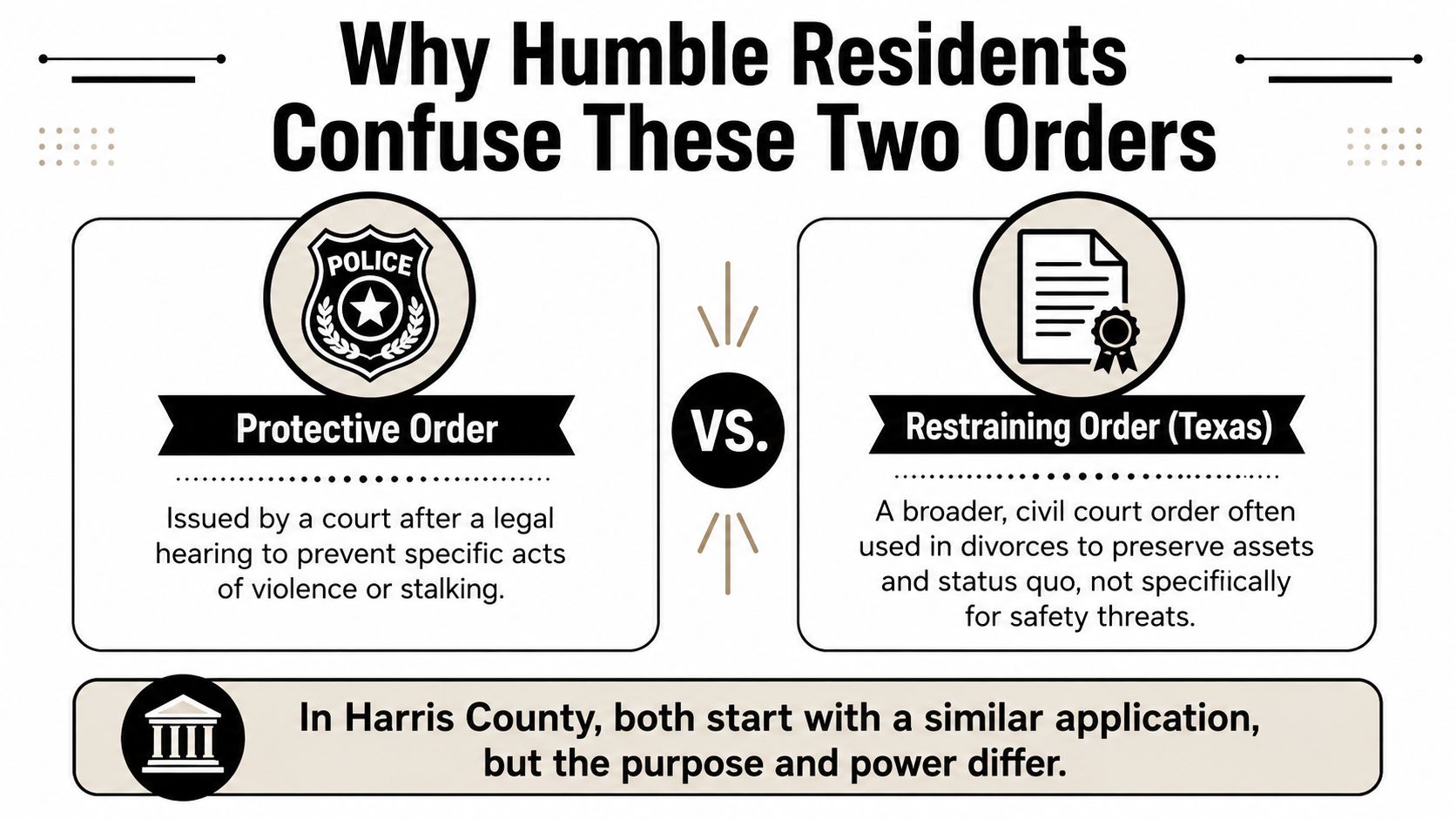
Practical rule: A TRO protects the case. A protective order protects people from specified dangerous conduct.
If you're in immediate danger, call 911 first and move somewhere safe. Legal paperwork matters, but it shouldn't delay emergency help.
Definitions and Legal Basis in Texas
A domestic assault arrest near Humble ISD, a divorce dispute in a Kingwood SAPCR, and stalking near Atascocita can all produce urgent safety concerns. They do not automatically call for the same court order. The legal basis and the case setting determine whether a protective order or a temporary restraining order fits.
Texas protective orders draw authority from provisions in the Texas Family Code, the Code of Criminal Procedure, and other laws. The Texas Courts report identifies 143 statutory provisions across six different codes that make up the protective-order structure. That breadth reflects the range of conduct and relationships these orders can address.
A restraining order, usually called a TRO, generally belongs to an active civil case. In Humble, Atascocita, Kingwood, and Northeast Houston, the underlying case may be a divorce, SAPCR, property dispute, or another lawsuit. The applicant asks the judge to restrict conduct that could damage property, custody arrangements, or the litigation before the court can hold a fuller hearing.
The enforcement difference is practical. A protective order imposes restrictions aimed at dangerous or threatening conduct and may support criminal enforcement after a violation. A TRO operates within the civil lawsuit, where contempt is generally the main enforcement tool.
The side-by-side answer
| Factor | Protective Order | Restraining Order (TRO) |
|---|---|---|
| Main purpose | Protect a person from family violence, dating violence, sexual assault, stalking, trafficking, or other covered dangerous conduct | Preserve the status quo during divorce, custody, property, or another civil case |
| Typical trigger | Violence, credible threats, stalking, sexual assault, trafficking, or another qualifying incident | Risk that someone will move money, transfer property, relocate a child, destroy property, or interfere with litigation |
| Where it fits | Protective-order proceedings and related criminal or family-law matters | An existing or newly filed civil case, such as divorce or SAPCR litigation |
| Length | Often up to two years, with longer periods allowed in specified circumstances | Usually short-term, including 14 days or until the temporary-orders hearing under the Texas Law Help description |
| Enforcement | Violation may create criminal consequences and can involve law enforcement | Usually enforced through civil contempt in the underlying case |
| Best local use | Personal safety in Humble and Harris County | Property, custody, and litigation-management problems in a family case |
For the civil remedy, read this explanation of what a temporary restraining order does in Texas. For a domestic assault, stalking, or other personal-safety concern, use the Protective Orders in Humble resource to review that path.
Local volume also affects how quickly and accurately you should prepare. From 2021 through 2023, courts statewide issued an estimated 162,497 magistrates' orders of emergency protection, final protective orders, or similar protective-order types. Harris County accounted for more than 39,270 magistrates' orders of emergency protection, or 32% of the statewide total, according to the Texas Courts protective-order report. A Humble applicant should identify the conduct, the correct case type, and the order's enforcement consequences before filing.
Who Qualifies and What Each Order Actually Covers
Protective-order eligibility starts with the conduct and the safety risk. Texas recognizes protective-order categories involving family violence, dating violence, sexual assault, stalking, and human trafficking. A 2025 legal change also expanded access for certain burglary victims when the burglar intended felony, theft, or assault. That change shows why residents shouldn't assume protective orders apply only to a classic spouse-on-spouse domestic-violence case.
A TRO has a different threshold. Violence isn't required. The issue is whether the other party may take action that harms the property, children, or integrity of the lawsuit before the judge can make a fuller decision.
Use this qualification checklist
- Identify the relationship or conduct. Write down whether the person is a family or household member, dating partner, former partner, stranger, neighbor, or another person. Then identify whether the conduct involved violence, threats, stalking, sexual assault, trafficking, burglary, or a non-safety dispute.
- Separate fear from inconvenience. A protective-order application should explain the specific conduct creating a safety concern. A TRO request should identify the concrete civil harm you're trying to prevent, such as a transfer of property or interference with custody.
- Preserve evidence. Keep texts, emails, voicemails, photographs, police reports, court papers, and witness information. Don't edit threatening communications. Save them in a secure location the other person can't access.
- Protect your support system. Legal action can be emotionally exhausting. If abuse has affected your mental health, consider finding the right trauma therapist through Be Your Best Self & Thrive Counseling, PLLC.
The Harris County protective-order path
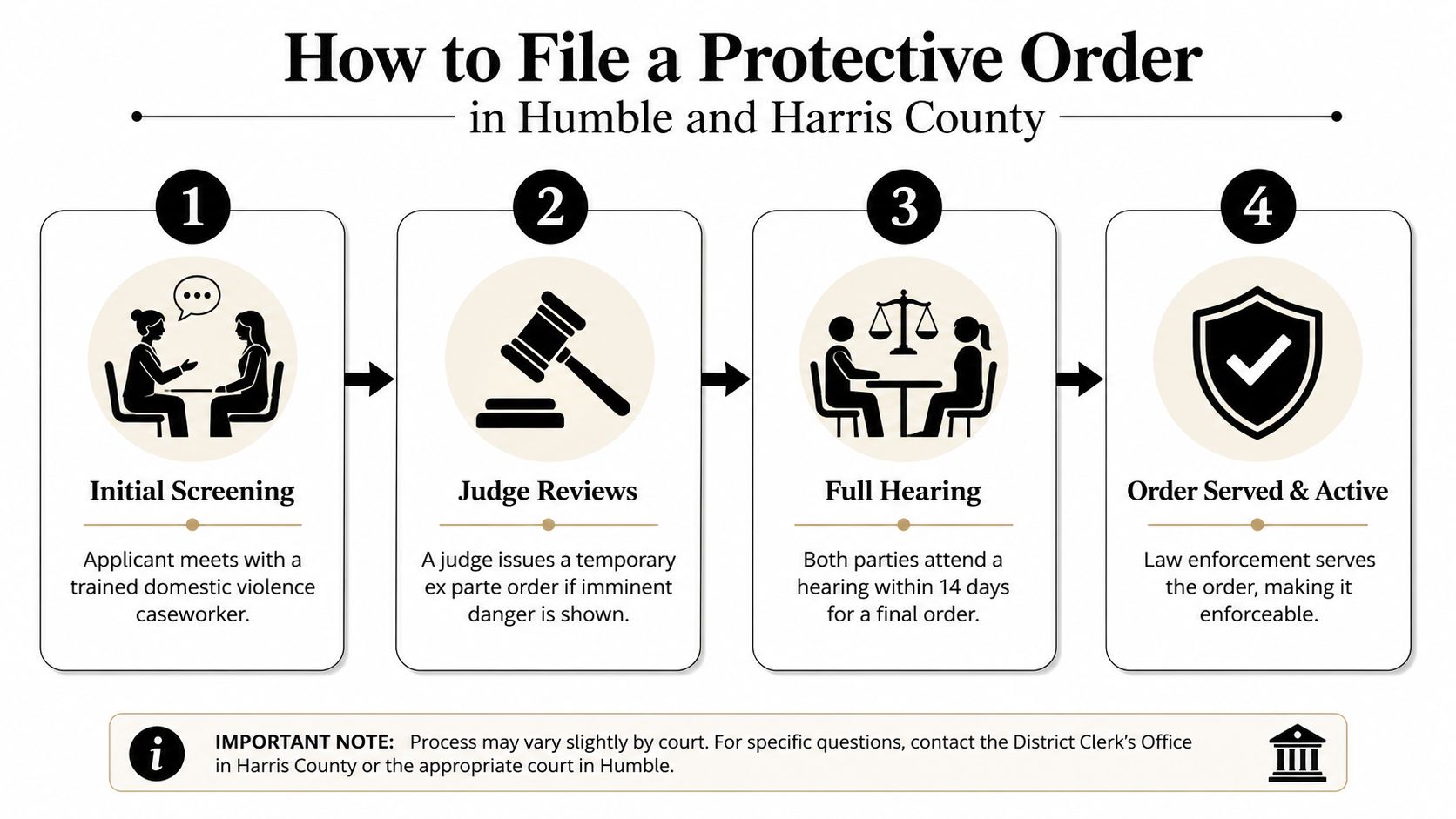
Harris County adds a screening step before the application reaches family court. A specially trained domestic-violence caseworker or social worker screens the person seeking protection. A domestic-violence prosecutor then reviews the file, and only after approval is the application filed in family court.
The court may consider an emergency request without the other person present when the facts support immediate protection. A later full hearing gives both sides an opportunity to appear and present their positions. Bring organized evidence and attend every setting. Harris County's domestic-violence information states that applicants must attend the hearing in person or the case may be dismissed, as described by the Harris County Domestic Violence Division.
How to File in Humble and Harris County
The correct filing route depends on the order you need. A protective-order applicant starts with the Harris County screening process. A person seeking a TRO usually works through the lawyer handling the active divorce, SAPCR, or other civil case.
Protective-order filing steps
First, complete the screening. Speak with the trained domestic-violence caseworker or social worker. Explain what happened, when it happened, who was involved, and why you believe the conduct may continue.
Next, prepare the application and evidence. Include specific facts, not conclusions. Dates, messages, police involvement, witness names, injuries, threats, and descriptions of stalking behavior can help the reviewing professionals understand the risk.
Then, wait for the prosecutor's review and filing. In Harris County, the file goes through domestic-violence review before the application is filed in family court. The judge may consider an emergency request without the respondent present.
Finally, attend the full hearing. Bring your records and follow the court's instructions. Don't assume the order will remain in place if you miss the setting. The applicant's in-person attendance is required under Harris County's stated process, and failure to attend can result in dismissal.
TRO filing steps
A TRO is requested through the underlying civil case. Your attorney typically files it with, or alongside, a divorce or custody petition and drafts specific restrictions for the judge to consider. The request might address moving a child, transferring property, changing account access, destroying records, or disrupting the litigation.
The TRO process isn't the same as the protective-order docket. Your divorce or custody lawyer handles the request within the family-law case, prepares the proposed order, and presents the facts supporting immediate temporary relief. For procedural organization, resources such as court filing help via FaxZen may help explain document-handling issues, but they don't replace legal advice or the local court process.
For local courthouse context, review the Harris County Family Courts guide for Humble residents. If divorce is the underlying case, The Divorce Process in Humble: What to Expect provides a step-by-step look at filing for divorce in Humble and Harris County.
Duration, Extensions, and Enforcement Power
The duration difference can determine whether an order protects you beyond the next hearing. A final protective order is generally effective for the period stated in the order, up to two years if no period is stated, although Texas law allows longer durations in specified circumstances, according to Texas Family Code Chapter 85. Sexual-assault and stalking protective orders can last for life under the Texas Law Help information cited earlier.
A TRO is temporary by design. In the divorce and custody setting, Texas Law Help states that it lasts 14 days or until the temporary-orders hearing, whichever comes first. It may be followed by further civil orders as the case proceeds, but the TRO itself isn't a substitute for a protective order when personal safety is the central concern.
Safety distinction: A protective-order violation can trigger criminal enforcement and possible arrest. A TRO violation is generally addressed through contempt in the civil case.
Three local examples
A family-violence arrest in Humble can lead to a magistrate's order for emergency protection. These orders may be issued immediately after certain arrests and generally remain valid for 31 to 61 days, or 61 to 91 days when the arrest involved family violence with a deadly weapon, according to Women'sLaw's Texas protective-order information. The protected person may need to pursue a longer final protective order afterward.
In a Kingwood SAPCR, a parent may fear that the other parent will remove a child or disrupt the existing arrangement before the court hears the case. That fact pattern points toward a TRO through the custody case, not a protective order, unless separate facts show violence, stalking, or a credible safety threat. For questions involving emergency custody and related relief, review how fast a judge can grant emergency custody in Texas.
Near Atascocita, repeated unwanted contact after a breakup may be stalking rather than a mere relationship disagreement. If the behavior creates a personal-safety concern, a protective order is the remedy to investigate. Renewal requires a new application filed no more than 30 days before expiration, as explained in the Texas State Law Library guide to getting a protective order.
Three Humble Scenarios and the Right Order for Each
The fastest way to choose correctly is to match the legal tool to the immediate harm.
A domestic assault arrest near Humble ISD
Police arrest a dating partner or household member after an assault. The first question isn't whether you also have a divorce case. It's whether you need protection from further contact or violence.
Start with the emergency-protection process connected to the arrest and ask about a final protective order for longer-term restrictions. Save the police paperwork, medical records, photographs, messages, and witness information. Don't contact the accused person to negotiate safety terms on your own.
A Kingwood divorce involving joint accounts
A spouse files for divorce and threatens to drain joint accounts, sell marital property, or move valuable items. No violence or stalking has occurred, but the financial risk is immediate.
Ask your divorce lawyer to request a TRO in the divorce case. The order should identify the conduct that needs to stop and protect the status quo while the judge considers temporary orders. A protective order isn't the right tool because the divorce is hostile.
Stalking near Atascocita Town Center
A former partner repeatedly appears near work, home, or familiar locations and keeps sending unwanted messages. The issue is no longer ordinary post-breakup conflict. Repeated unwanted contact combined with fear for personal safety can support a protective-order strategy.
Document each incident without putting yourself at risk. Tell law enforcement about immediate threats, preserve digital evidence, and seek help with the Harris County protective-order screening process. A TRO inside a divorce case won't substitute for a safety-focused protective order when stalking is the core problem.
Decision rule: Violence or a credible personal-safety threat means protective-order advice comes first. Property, money, custody status quo, or litigation interference means ask your divorce or custody lawyer about a TRO.
These remedies can coexist. A person may need a protective order for safety while a divorce TRO addresses shared accounts, property, or custody arrangements. The filings serve different purposes and should be drafted so they don't conflict.
Which Path Should You Take and What to Do Next
A domestic assault arrest near Humble ISD, a divorce dispute in a Kingwood SAPCR, and stalking near Atascocita may all involve urgent court action. They do not call for the same order.
Choose the protective-order path when violence, threats, stalking, sexual assault, trafficking, dangerous unwanted contact, or a credible fear for personal safety is the central problem. Certain burglary-related conduct may also qualify under the recent statutory expansion.
Choose a TRO through your divorce or SAPCR lawyer when you need to preserve shared property, stop transfers or destruction of assets, prevent a child relocation, or protect the status quo while the civil case proceeds. A hostile divorce alone does not make a protective order the proper remedy.

Record each incident, preserve texts and other evidence, and identify the next court deadline. Do not file a generic request and hope the judge sorts out the fit. A Humble family lawyer can determine whether to use the Harris County protective-order process, an existing family case, or both.
The Law Office of Bryan Fagan handles protective orders, divorce, custody, and Harris County court procedures. Review the firm's Harris County Family Courts information before calling.
If violence, stalking, threats, or a custody or property dispute has disrupted your week, visit Law Office of Bryan Fagan to schedule a consultation with a Humble attorney serving Humble, Atascocita, Kingwood, and Northeast Houston.


