The first sign is usually quiet. Your child turns 18, the school routine changes, and the paperwork on the kitchen table suddenly feels bigger than the whole year before. For a Humble parent caring for a young adult with autism, Down syndrome, cerebral palsy, or another disability, that moment can bring a hard question, what happens to child support now?
Texas treats this situation differently from ordinary child support. The law gives families a path for continued support when a child cannot support themselves and still needs substantial care, and it can continue for an indefinite period if the legal requirements are met. In practical terms, that matters for families in Humble, Atascocita, Kingwood, and Northeast Houston who are also juggling school transitions, benefit renewals, and caregiver schedules.
A parent in this position often needs more than a legal answer. They need a plan for medical records, school documents, financial structure, and what to do before the birthday arrives. If guardianship is part of the picture, many families start by reviewing how to establish legal guardianship so the court paperwork, care decisions, and support structure all work together.
Practical rule: don't wait for a crisis to sort this out. The strongest cases are usually built from years of records, not last-minute scrambling.
A Humble Parent's First Question When Their Child Turns 18
A Humble mom told me recently that her son had just finished high school, but his needs hadn't changed at all. He still needed daily supervision, help with routines, and regular appointments. Her fear wasn't only legal, it was practical. She wanted to know whether the support that had helped hold the family together would stop because he had become an adult.
That's the right question to ask, because Texas does not treat every 18th birthday the same way. For a disabled adult child, support can continue if the law's conditions are met, and the court can keep the support going as long as those conditions remain true. That's a very different rule from the ordinary child-support timeline most parents know.
In families across Atascocita and Kingwood, the pressure usually hits at the same time. School-based services may be ending, adult-day programs may be shifting, and benefits paperwork starts demanding exact answers. The legal issue and the caregiving issue show up together, which is why parents can feel like they're being asked to solve three problems at once.
Why the first month matters
The first month after age 18 often becomes a paperwork race. Families start gathering medical records, school evaluations, and proof of ongoing care because those are the documents that show what the child still needs. If the receiving structure is wrong, support can also affect benefits in ways parents didn't expect, which is why planning early matters more than most families realize.
A local attorney can help map the pieces before they turn into emergencies. For families also sorting out estate or trust planning, Prenuptial & Postnuptial Agreements in Humble is a related service page that covers drafting and review of marital property agreements for Humble clients, which can matter when long-term family finances are being organized.
A child's 18th birthday changes the paperwork, but it doesn't end the caregiving reality. Texas law recognizes that distinction when the evidence supports it.
Who Qualifies Under Texas Law
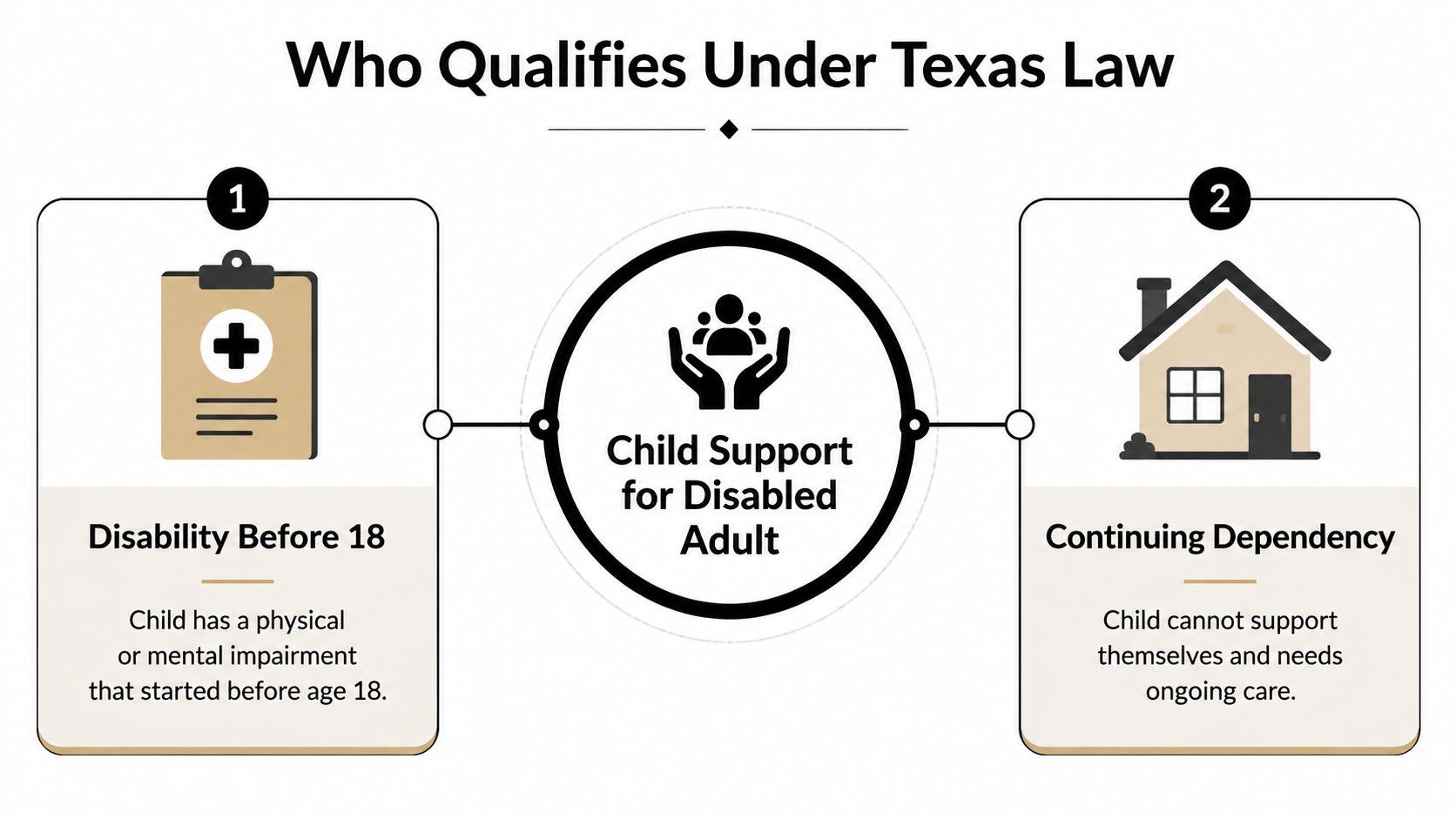
Texas uses a two-part test. First, the adult child must need substantial care and personal supervision because of a mental or physical disability and must not be capable of self-support. Second, the disability must have existed, or the cause of it must have been known, on or before the child's 18th birthday. That timing rule is the part many parents misunderstand.
Think of it this way. A young adult with cerebral palsy who has needed ongoing supervision since childhood may fit the statute if the records show pre-18 onset and continuing dependency. A young adult who is injured in a car crash at 21 usually does not fit this particular child-support pathway, because the disability began after minority.
Questions a parent can ask at home
- Did the condition exist before 18? Medical records, developmental history, school files, and therapy notes matter here.
- Does the child still need ongoing supervision? The court looks for proof that the child can't support themselves independently.
- Is the need substantial, not occasional? A parent's day-to-day care burden often becomes central evidence.
The law doesn't care whether the child is 18, 19, or older if the threshold facts are met. It cares about when the disability began and whether the child's present condition still requires real support. Texas commentary also notes that a suit can be brought later, so long as that pre-18 timing requirement is satisfied, which gives families room to act if they didn't file right away.
Why evidence needs to tell the story
A diagnosis alone usually isn't enough. Courts want the history, how the child functioned before 18, what changed, and what ongoing care looks like now. That's why records from doctors, schools, therapists, and caregivers are so important in child support for a disabled adult child Humble TX cases.
Child Support Attorney in Humble is the local practice page for establishing, modifying, and enforcing child support in Harris County, and it fits naturally with cases like this when parents need help organizing the proof.
How Harris County Courts Set the Support Amount
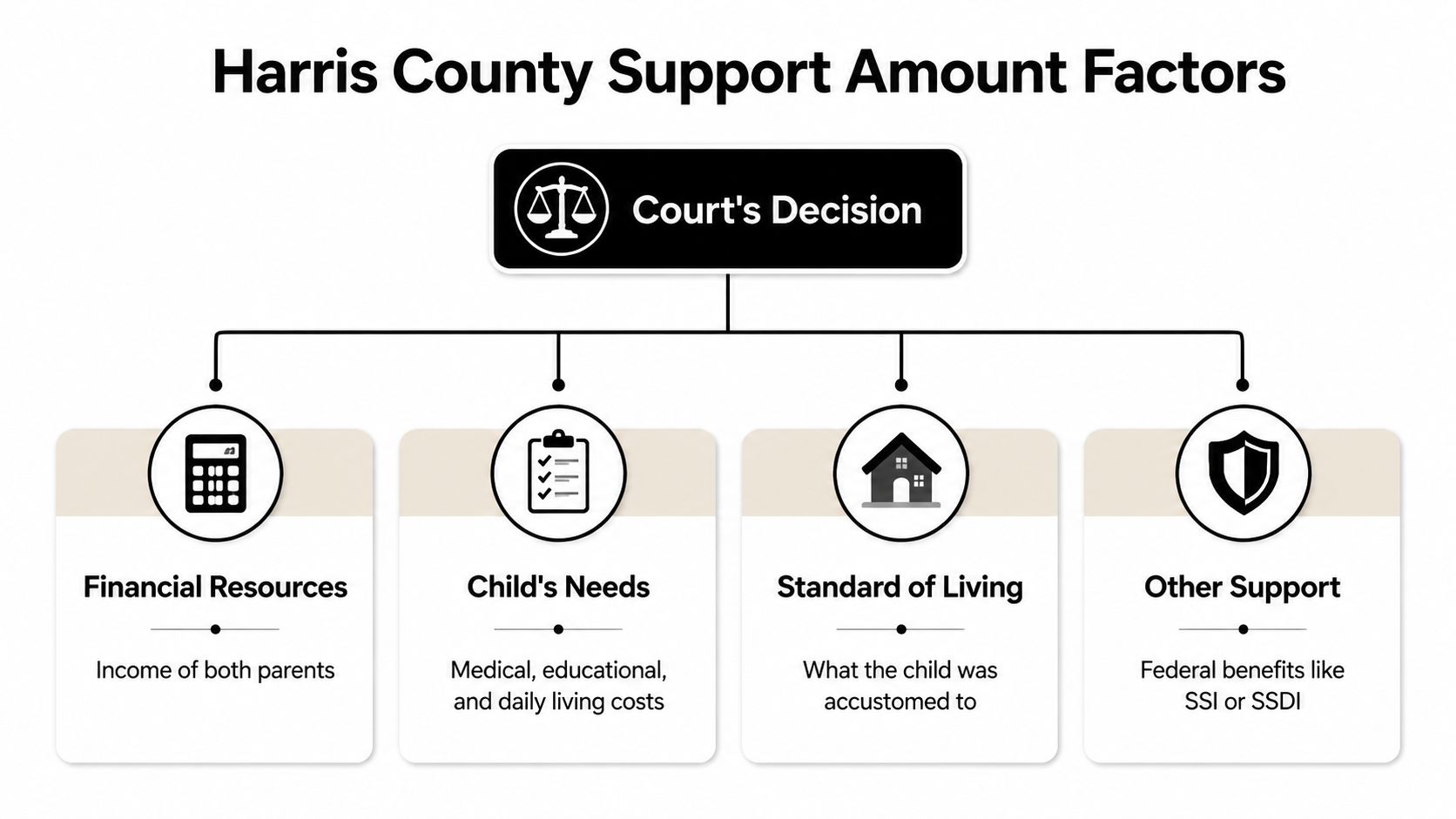
A parent in Humble often expects a child support case to turn into a simple worksheet exercise. Harris County judges usually start with the Texas guideline structure, but a disabled adult child case rarely ends there. The statewide guideline percentages are based on the capped income base of $11,700 in net monthly resources as of September 1, 2025, with the guideline percentages set at 20% for one child, 25% for two, 30% for three, 35% for four, and 40% for five children, and 40% or more for six or more children. In a case involving child support for a disabled adult child Humble TX, the judge still uses that framework as a starting point, then looks at the child's real needs and the family's real resources.
The four factors the court weighs
Texas law directs the court to look at the child's disability-related needs, the extent to which each parent already provides substantial care or supervision, the financial resources of both parents, and any other available resources or public programs. A judge may want to know what therapy costs look like, who handles day-to-day supervision, and what benefits are already in place.
That is the practical question behind the order. The court is trying to fill the gap between what the child needs and what the family already provides. In a case involving a young adult in Northeast Houston, that can include transportation to appointments, medication routines, and whether one parent has become the main caregiver in everyday life.
What evidence actually helps
The strongest files usually include:
- Care plans, so the court can see what assistance the child needs.
- Therapy and medication costs, so the support request is tied to actual expenses.
- Supervision logs, especially when daily oversight is part of the case.
- Proof of benefits or trust assets, so the court can avoid double-counting resources already available.
A judge is looking for unmet need, not sympathy alone. Clear records turn a vague request into a support order the court can enter.
For families comparing how the numbers are assembled in other cases, the firm's guide on how to calculate child support in Humble TX shows the basic financial method that still sits underneath these cases. The special-needs version uses the same starting point, then tests it against the child's actual care needs and available resources.
Filing and Proving the Case in a Harris County Court
A parent usually starts here with a simple but stressful question, does the court already have an order, or does the family need to ask for one? If an order already exists, the case may proceed as a modification. If there is no order yet, the family may need an original petition asking the court to set support for a disabled adult child. The path changes a little, but the purpose stays the same, get the right facts in front of the right judge.
What happens after filing
In Harris County, the case usually moves through service on the other parent, an exchange of disclosures, and then preparation for hearing. Families in Humble, Atascocita, and Kingwood often see these matters handled by the local family courts that serve the area, and those courts may use standing orders that set rules for both parents while the case is pending. Temporary orders can also matter if support, care, or access issues need to be addressed before the final hearing.
Once the petition is filed, the evidence work begins right away. Medical records should identify the diagnosis, but they should also help show when the condition started or when it became known. School records, including any IEP history, can help establish the timeline before age 18. Physician letters, day-to-day care logs, and therapist notes help show the child's current dependency.
What the hearing often looks like
On hearing day, the judge usually wants a clear timeline. Who cared for the child, when the disability became apparent, what support the child needs now, and what each parent can provide. Witness order, document organization, and direct answers matter because the court is trying to understand both the legal trigger and the practical reality.
Self-represented parents often have trouble when the other side appears with an attorney who knows how to present the evidence. That does not mean a family should panic. It means the file should be built early, with labels, dates, and a clear explanation of why the child still needs support.
A few practical steps that help
- Collect records now. Do not wait for the hearing notice.
- Keep the timeline simple. The pre-18 disability evidence has to be easy to follow.
- Track daily care. Even short notes can show the level of supervision.
- Bring financial proof. The court needs both needs and resources.
If you are also dealing with parenting-time or conservatorship concerns, those issues should be handled in the same broader case file so the court can see the full family picture.
Where the Money Goes and How It Is Protected
Texas lets support be directed in more than one way, and the receiving structure matters as much as the amount. A parent who assumes “just send the check” is enough can create problems later, especially when public benefits are involved.
Three common receiving structures
| Receiving Option | Best For | Key Benefit | Watch Out For |
|---|---|---|---|
| Parent or custodian | Families with a primary caregiver already handling day-to-day needs | Simple to administer and familiar to most families | Can create confusion if the funds are not tracked separately |
| Guardianship estate | Cases where a court-appointed guardian controls finances | Adds legal oversight for significant decisions | More administration and court involvement |
| Special needs trust | Families planning around long-term benefits and support | Helps isolate funds for the child's benefit | Must be drafted and handled carefully |
Texas law specifically allows support to be paid to a special needs trust, and in non-Title IV-D cases that payment may not have to go through the state disbursement unit. That is not a small detail. For a family thinking years ahead in Humble or Kingwood, the payee structure can protect the support from being handled the wrong way.
Why this choice matters
A regular bank account can create avoidable problems if it holds money that should have been protected another way. Families sometimes deposit support into a child's checking account without thinking through the benefit impact. That mistake can complicate eligibility and can also make it harder to track how the money is being used.
The better approach is to decide early who should receive the support and how it will be documented. A parent, a court-appointed guardian, or a trust can all be appropriate in the right situation, but each one carries different administrative responsibilities.
How SSDI, SSI, and Medicaid Change the Picture
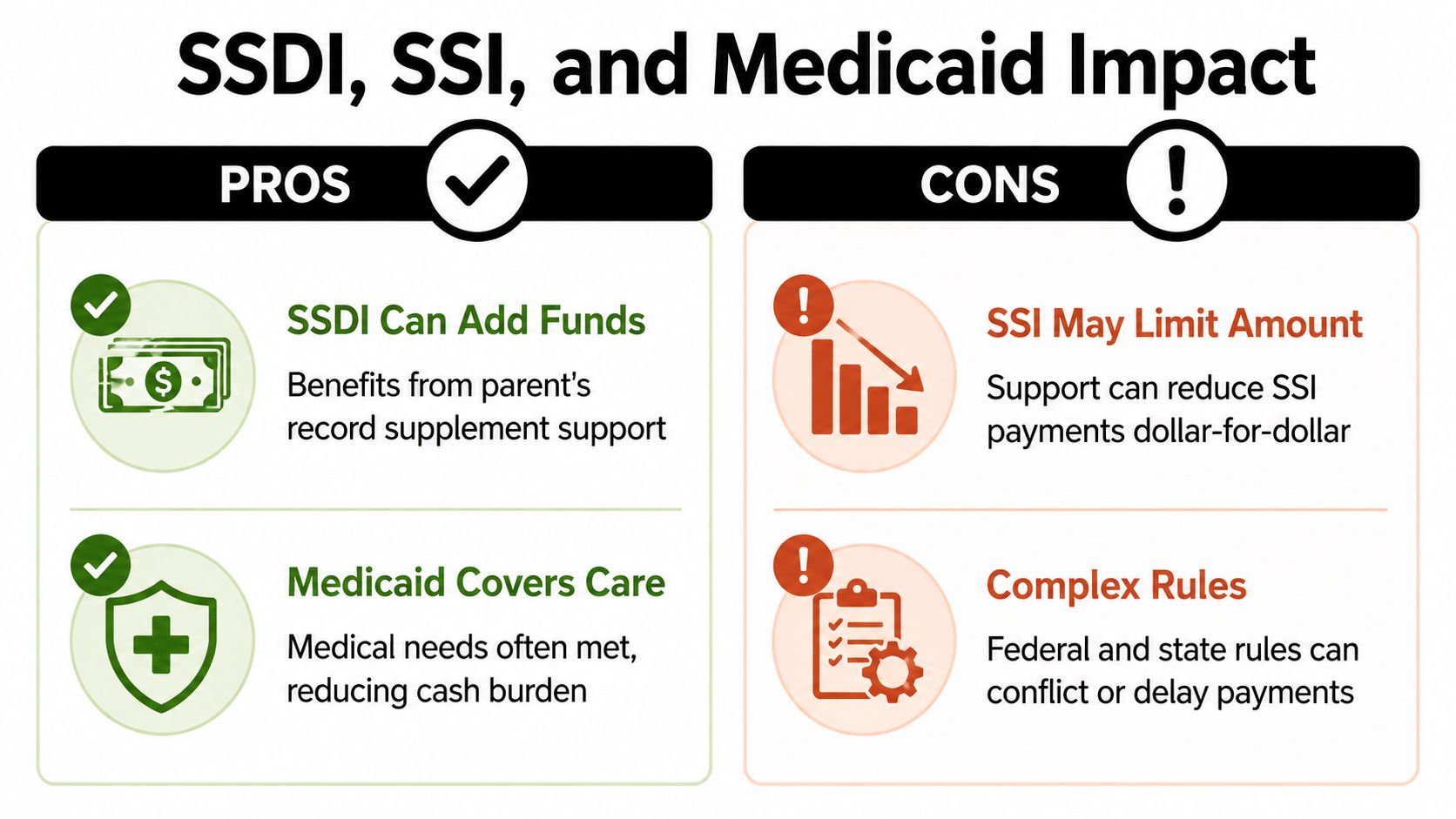
Federal benefits can change the way a support order should be structured. SSDI, SSI, and Medicaid do not all work the same way, and families often find that one program helps with income while another covers care. The challenge is making the child-support plan fit the benefit plan instead of colliding with it.
The basic interaction parents should understand
If support is paid directly to the child, it can affect SSI because SSI is means-tested. A properly drafted special needs trust can help preserve benefits while still giving the child access to extras that Medicaid or SSI don't cover. That's why timing matters when a child is about to apply for benefits or go through a redetermination.
Support can also help cover the gaps Medicaid leaves behind. For example, if a family is comparing ramps, home access, or other mobility-related changes, a resource like the DME Superstore ramp guide can help them think through accessibility needs alongside the legal plan.
The common trap
Parents sometimes redirect support into a regular checking account because it feels easiest. That can backfire. The money may be available in a way that disrupts benefits, and then the family ends up fixing one problem while creating another.
Before finalizing the receiving structure, families should talk through these points with counsel or a benefits planner:
- Who receives the money
- Whether SSI is involved
- Whether a trust is already in place
- How Medicaid services and home care fit into the overall budget
For readers who want a local page focused on this overlap, Social Security Disability and Child Support Humble TX is the firm's related resource.
The same planning mindset often shows up in home modification questions, too. A family that needs a wheelchair ramp, widened entry, or safer access points may also be thinking about what support dollars should cover. That's why child support for a disabled adult child Humble TX cases often touch both legal and practical planning at once.
Questions Humble Parents Ask Us Most Often
Can child support ever end once it's ordered? Yes, but only if the legal basis for continued support no longer exists or the order is changed by the court. If the child's condition and dependency continue, the support can continue too.
What if the child's needs change later? A parent can ask for modification when the facts change enough to justify it. That might happen if the child's care needs increase, if a parent's resources change, or if another support source becomes available.
What if the other parent lives in another state? The case can still move forward, but service and enforcement need to be handled carefully. Cross-state logistics matter, especially when the parent is hard to locate or regularly changes addresses.
Does college create a separate support rule? Not by itself. The issue here is disability-based support, not ordinary college support. If a family is also thinking about living arrangements for an adult child, a resource like the in-law suite cost breakdown for Houston can help frame the housing conversation, but the legal support question stays separate.
Will asking for support trigger a custody fight or a benefits review? Not automatically. It can, however, bring conservatorship, guardianship, or benefits questions into the open, which is why families should think through the full picture before filing. If the child's decision-making capacity is part of the dispute, a guardian ad litem may be useful in the right case.
Your Next Step in Humble

The best time to prepare is before the child turns 18 or before the paperwork gets urgent. In the first 30 days, focus on three things, collect the medical and developmental records, decide who should receive the support, and map out how public benefits fit with the order. That's the part families in Humble, Atascocita, Kingwood, and Northeast Houston can control right now.
A careful file makes the hearing easier, the support structure clearer, and the long-term plan safer. If you're unsure whether your family's facts fit Texas law, that's exactly the point to get help rather than guess.
The Law Office of Bryan Fagan works with Humble families on child support, custody, and related family-law planning, and the firm's local child support page can give you a starting point if you want to keep reading first.
If you're trying to figure out child support for a disabled adult child, the Law Office of Bryan Fagan can help you sort through the court process, the evidence, and the benefits-planning issues that matter most. Schedule a free consultation with our Humble office so you can get clear next steps before a deadline or benefits change forces your hand.