Skip to content

If you're a grandparent in Humble and the calls have stopped, the visits have dried up, and nobody's giving you a straight answer, you're not alone. We hear from grandparents in Humble, Atascocita, Kingwood, and Northeast Houston who went from regular pickup duty to complete silence, sometimes overnight. That kind of cutoff hurts, but Texas law does not treat it like an automatic right to keep seeing a grandchild.
The hard truth is this, grandparent possession and access in Texas is narrow. A loving relationship matters, but it does not open the courthouse door by itself. In Harris County, the fight usually turns on whether the law's strict gatekeeping rules are met, not on whether the grandparent has been kind, involved, or important in the child's life.
When a Grandparent Gets Cut Off in Humble
A grandmother from Humble calls the office and says she used to have the kids every Friday after school. Then the parent she was helping had a disagreement with the other parent, the texts got colder, and suddenly she is being told not to come by at all. There is no court order in place, no hearing, just a hard stop.
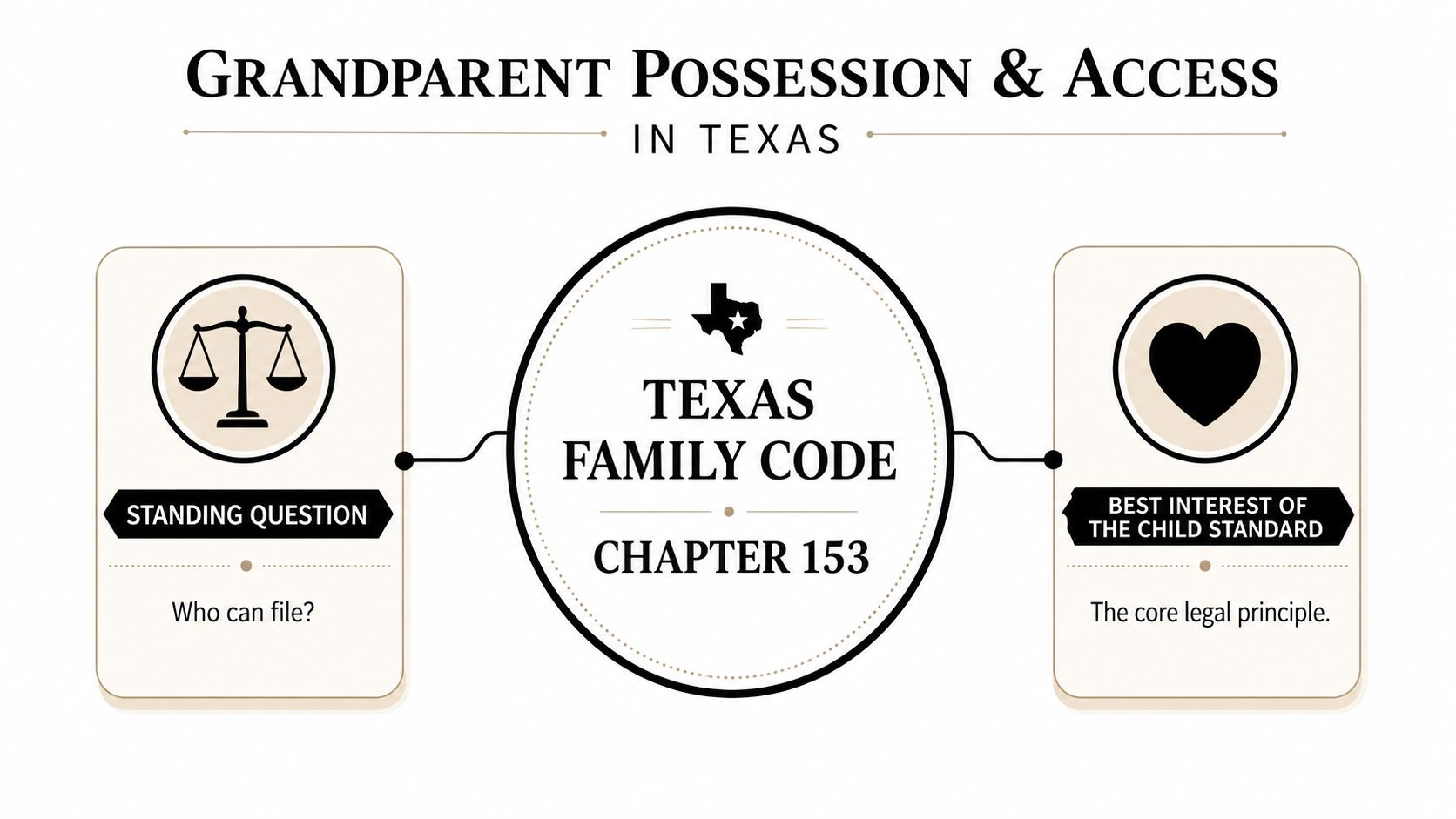
That is the moment many families get the law wrong. Texas does not start from the idea that a grandparent should keep seeing a child because the bond is real. It starts from a strong presumption that fit parents act in their child's best interest, so grandparent access is a statutory exception, not a routine right. The law you are dealing with is found in Texas Family Code Chapter 153, and it is much tighter than many people expect. Texas grandparent visitation law under Family Code § 153.432 lays out that narrow framework.
A judge in Harris County is not starting with sympathy. The judge is asking whether the statute lets the case go forward at all, and whether the grandparent can clear the legal gatekeeping requirements that Texas puts in front of these claims.
If you want a local overview of how these cases are handled, our guide on grandparent visitation rights in Texas explains the basics in plain language. For a broader look at related custody issues, Child Custody Lawyer in Humble, TX is a useful local resource for Humble families.
Practical rule: If there is no current order and no qualifying legal trigger, do not assume a judge will hear the case just because the family situation feels unfair.
The right move is to stop thinking in terms of hurt feelings and start thinking in terms of statutory proof. That shift matters from the first call, because the wrong framing can waste time, money, and momentum before the case ever gets in front of a judge.
How Texas Law Treats Grandparent Possession and Access
Texas treats grandparent possession and access like applying for a permit, not asking for a favor. You don't just show that you care about the child. You first have to show that the law lets you file, and then you have to prove the deeper harm required for relief.
The statute makes that clear. Under Texas Family Code § 153.432, a grandparent can file for possession or access through an original suit or a modification suit, but the petition has to be backed by a sworn affidavit with supporting facts. If the affidavit is weak on its face, the court must dismiss the case. The framework described in the Texas grandparent-rights materials emphasizes that this is an early screening device, not a formality. Texas grandparent access overview explains the same two-step hurdle, filing standing first, then substantive proof.
The filing question comes first
The first question is standing, meaning whether you can file at all. Texas only allows this in narrow situations, and the statute requires that at least one parent still has parental rights. The grandparent also has to fit one of the gateway conditions in the code. Section 153.433 makes those triggers part of the threshold, not an afterthought.
The proof question comes second
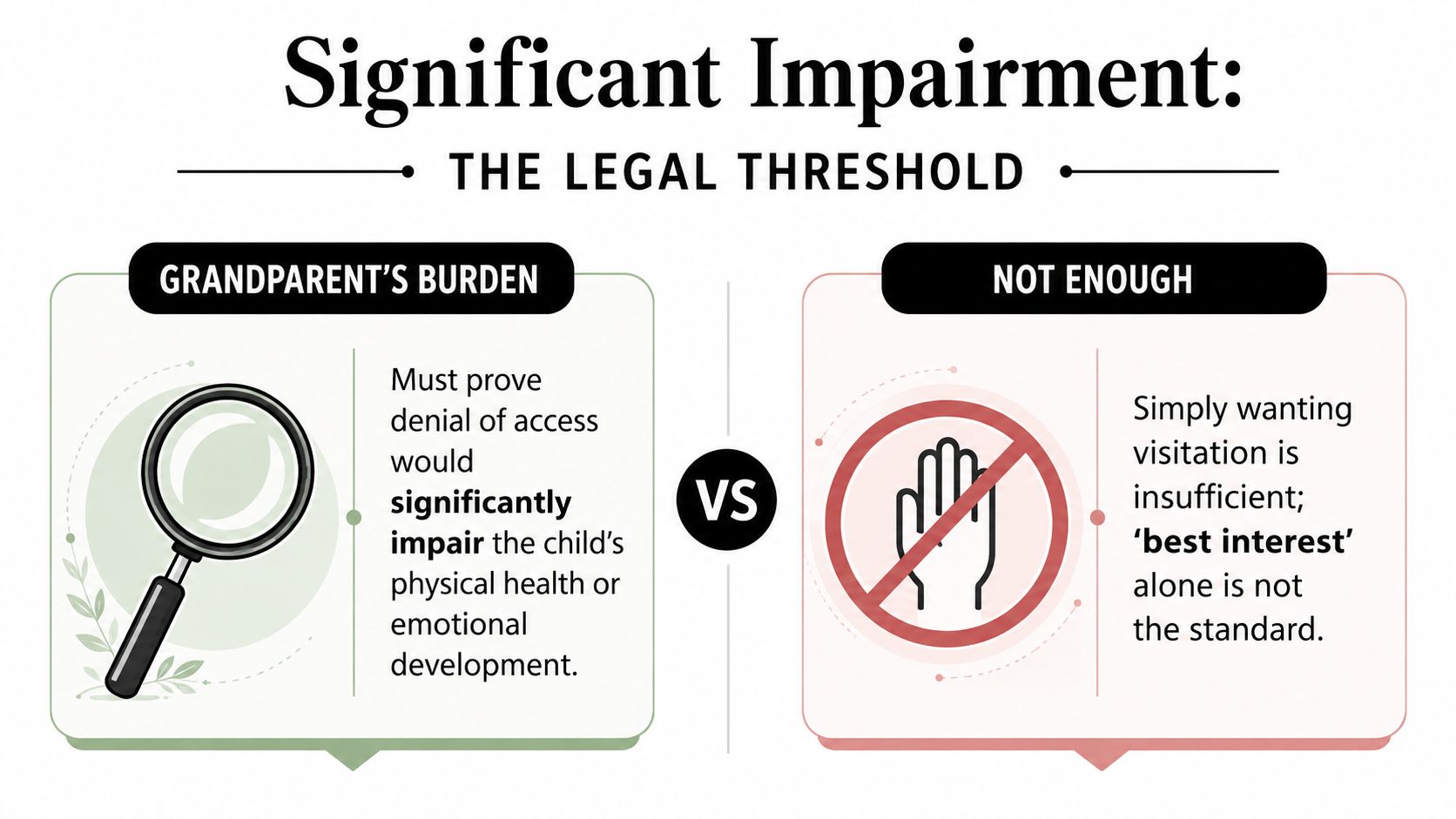
Even if you can file, you still have to prove the child's physical health or emotional well-being would be significantly impaired without access. That is not the same thing as saying the child would benefit from more time with grandma or grandpa. Texas law requires proof by a preponderance of the evidence that denial of access would cause that level of harm, not just that contact would be nice. Texas Family Code § 153.432 states that the suit fails if the sworn facts, even if true, would not support that legal standard.
That's the part people miss. The law is not asking whether you are a good grandparent. It is asking whether denial of contact crosses a legal line into significant impairment. In Harris County, that distinction is everything.
The Four Gateway Conditions That Unlock a Case
A grandparent case in Texas does not even get to the main fight unless one of four gateway conditions is present. That is by design. The Legislature narrowed these cases so tightly that the court first checks whether the family fits one of the statutory triggers before it spends time on the merits. Texas Family Code § 153.433 spells out those conditions.
Incarceration during the three months before filing
If a parent has been incarcerated during the three months before the grandparent files, that can qualify. Think of a Humble grandmother helping while a son is jailed and the child is staying with the other parent, or with no stable contact at all. That situation may open the door, but it does not win the case by itself.
A judicial finding of incompetence
If a court has found a parent incompetent, the gateway may be met. That's the kind of case where the parent cannot reliably carry the responsibilities the statute assumes. In real life, this often shows up in families already dealing with a guardianship-style dynamic or a long-term incapacity issue.
The death of a parent
If a parent has died, the statute may allow the grandparent to seek access, as long as the other requirements are also satisfied. A Kingwood grandparent in that position often assumes the loss itself gives standing. It doesn't. It only satisfies one statutory condition, and the rest still matter.
Lack of actual or court-ordered possession or access
If a parent lacks actual or court-ordered possession or access, that can also qualify. This is the condition that catches families where a parent is present on paper but not really exercising access in any meaningful way. The code treats that as a real gateway condition, not a technicality.
The key point is simple, meeting one gateway condition gets you to the courthouse door, not into the win column.
Even with a qualifying trigger, the grandparent still has to prove significant impairment. That second hurdle is where many cases fail, because families confuse eligibility with entitlement. They are not the same thing in Texas family law.
What Significant Impairment Actually Means to a Judge
Many grandparents get blindsided. They come in expecting a best interest of the child fight, the kind people talk about in ordinary custody disputes. Texas grandparent access is not that. It is a higher bar.
The grandparent has to prove, by a preponderance of the evidence, that denying access would significantly impair the child's physical health or emotional well-being. That language matters. It means the court wants proof of real harm, not just tension, not just disappointment, and not just a child who misses a grandparent. The Texas grandparent-rights guide notes that this is the central mismatch between lay expectations and courtroom reality.
What judges are really looking for
A judge in Harris County is not impressed by a warm story alone. A grandparent saying, “I've always been there,” may be true, but it usually isn't enough on its own. The court wants evidence that the child is being harmed, or will be harmed, in a concrete way if contact stays cut off.
That is why the case often turns on records, not emotion. If the child's health, school performance, therapy notes, or behavior have changed in a way that lines up with the loss of contact, that kind of evidence can matter. If all you have is a sincere belief that visitation would be good, the case is much weaker.
What the law is not asking
The statute is not asking whether grandparent time would be pleasant. It is not asking whether the parent is being stubborn. It is not asking whether the grandparent is the “better” adult. It is asking whether the child's physical health or emotional well-being is being significantly impaired without contact.
That is a much harder question, and it is the question that decides these cases. If a Humble family walks into court with the wrong standard in mind, the case can be lost before it ever gets traction. The smartest strategy is to build the file around impairment, not around sentiment.
How a Grandparent Case Moves Through Harris County Courts
Most grandparent access cases for Humble, Atascocita, Kingwood, and Northeast Houston get handled in Harris County family court, and the pace is usually slower than families expect. You file first, then the court reviews whether your affidavit clears the statutory gatekeeping. If the petition survives that screen, the case moves into the normal family-court process, which can include temporary hearings, mediation, and a final hearing.
The forms usually sit inside the broader SAPCR framework, because these are suits affecting the parent-child relationship. That means the paperwork has to be clean from the start. A sloppy filing in Harris County can cost you weeks, and sometimes the chance to get the issue heard at all.
Typical Harris County Grandparent Access Case Timeline
| Stage | What Happens | Typical Window |
|---|---|---|
| Filing | Petition and sworn affidavit are submitted | Early in the case |
| Initial screening | Court reviews whether the affidavit states enough facts | Before a full hearing if the affidavit is weak |
| Temporary settings | Judge may address immediate issues while the case is pending | After filing, if the case survives screening |
| Mediation | Parties often try to resolve access terms without trial | Before final hearing |
| Final hearing | Judge hears evidence on statutory requirements and impairment | Later in the case, after preparation |
A local family court judge may also expect the parties to try mediation before a final showdown. That's common in Harris County, and it often makes sense because the court wants a narrow, workable arrangement if the statute allows one. But mediation is not a substitute for proof. If the legal threshold isn't met, no agreement is guaranteed.
The practical lesson is simple: don't wait until the eve of filing to gather records, organize witnesses, or understand the relief you're asking for. If you're already looking at a broader custody or conservatorship dispute, Divorce Lawyer in Humble, TX and related family-law planning can matter too, because access disputes often overlap with bigger parent-child issues.
Evidence That Actually Moves a Texas Judge
A strong grandparent case usually looks less like an argument and more like a file. The judge needs something concrete to connect the loss of contact to the child's condition. That means records, dates, and credible witnesses, not just a heartfelt story told from the witness stand.
One Humble-area grandparent may say the child started acting out after visits stopped. That claim matters more if it lines up with school records, therapy notes, or a teacher's observations. Another family may have medical concerns, and then medical records or treatment history become the focus. The point is to show the effect of the cutoff, not just the value of the relationship.
Keep the paper trail clean. Judges trust organized records more than emotional summaries.
What usually helps
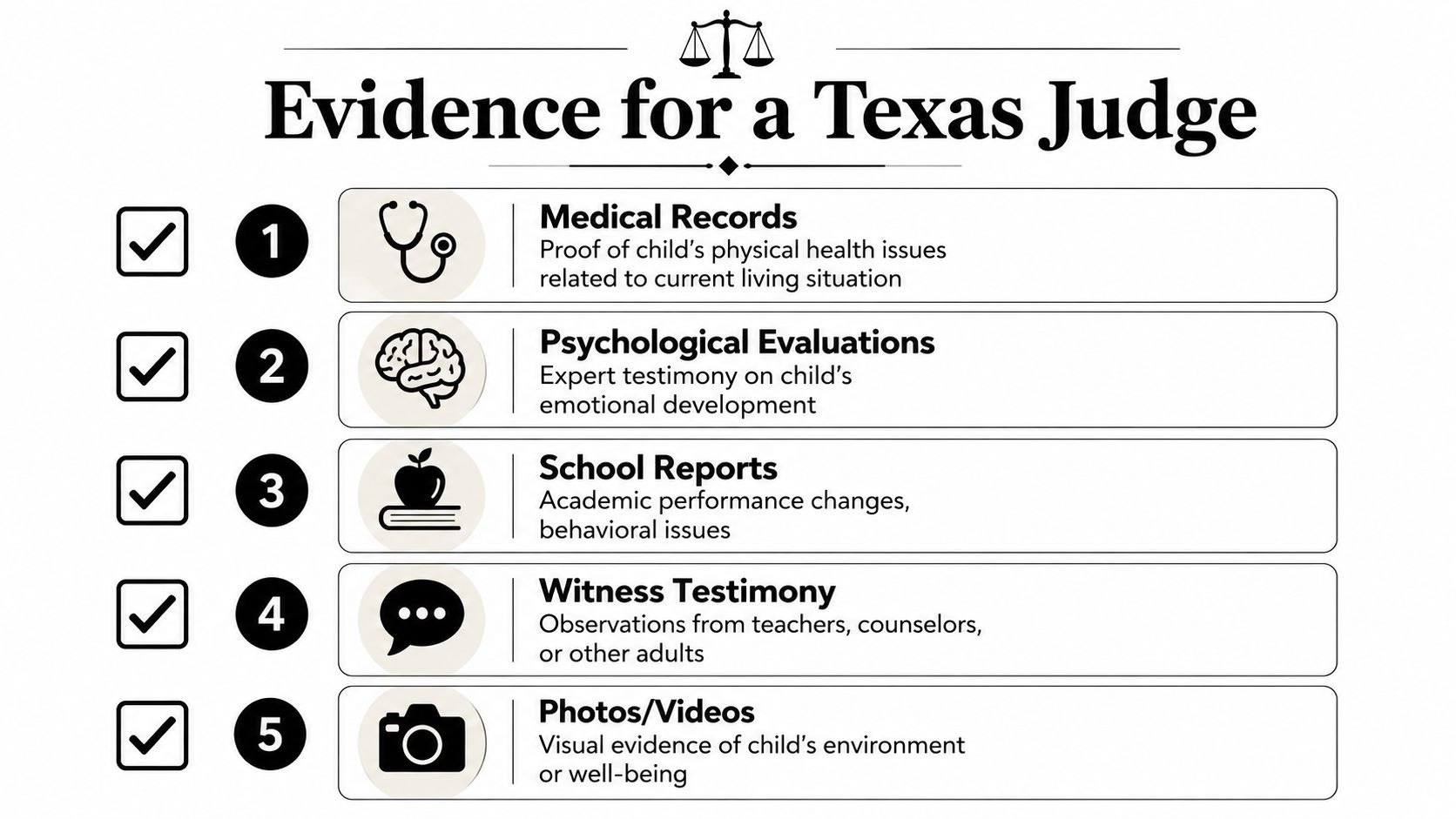
- Medical records: Use them when the child's physical health seems tied to instability or neglect.
- Psychological evaluations: These can matter when emotional development is at issue, especially if a therapist can explain the change.
- School reports: Attendance drops, behavior notes, and grade changes can show disruption.
- Witness testimony: Teachers, counselors, and other adults can describe what they saw without inflaming the conflict.
- Photos or videos: These can help show the living situation or the child's condition, as long as they are relevant and lawfully obtained.
A parent's sudden refusal to communicate can also become evidence if you document it properly. Save the texts, emails, and call logs. Don't harass anyone trying to build your case. That line is easy to cross when emotions run hot, and it can hurt credibility fast.
For families trying to figure out what documentation matters most, evidence needed for a custody case in Harris County gives a useful local frame for the kind of proof family courts review. The same discipline applies here, because access cases rise or fall on the quality of the record.
Practical Preparation Tips and Common Mistakes to Avoid
Start with a timeline. Write down when the contact changed, who said what, and what happened next. Save texts, emails, voicemail notes, and any messages that show the cutoff or the reasons given.
Do not try to “fix” the problem by taking matters into your own hands. Showing up uninvited, bypassing the parent, or turning the conflict into a standoff rarely helps in court. Judges want to see restraint, not retaliation.
- Keep a written chronology: Put dates next to each missed visit, refusal, or message.
- Preserve digital evidence: Screenshot texts and emails before they disappear.
- Track witness names: Teachers, relatives, counselors, and caregivers can all matter later.
- Avoid verbal-only promises: If a parent says access will resume, that promise means little without an order.
- Get legal advice early: A local family attorney can tell you whether the case fits the statute before you spend time and money on the wrong filing.
The most common mistake is filing a petition that never had a legal gateway condition in the first place. The next mistake is submitting an affidavit full of conclusions, but thin on facts. Courts in Texas can dismiss that kind of petition at the screening stage if the sworn facts would not meet the statute.
Another trap is trying to reopen a finished custody order without meeting the modification standard. That is a different fight, and the court will treat it that way. If the case belongs in a different county, or the order was entered elsewhere, file in the right place and let a lawyer check venue before you move.
The best preparation is calm, organized, and focused on the statutory proof. If your evidence can't show significant impairment, don't assume a judge will infer it for you.
Your Next Step With a Humble Family Attorney
The law on grandparent possession and access in Humble, TX is strict for a reason. Texas wants more than a loving relationship, it wants a qualifying gateway condition, a proper affidavit, and proof that denial of access would significantly impair the child's physical health or emotional well-being. That's a narrow path, and in Harris County, a lot of cases get lost because families start with the wrong question.

If you're in Humble, Atascocita, Kingwood, or Northeast Houston, and you're trying to figure out whether your case fits Texas law, the next move is a real legal review, not guesswork. The team at the grandparents' rights lawyer in Humble page handles the same kind of family-law issues that come up when access, conservatorship, and custody overlap in one case.
If your family needs help sorting out whether there's a valid claim, whether the affidavit is strong enough, or whether the case should be framed differently, our Humble office can walk through it with you. We also help families with divorce, custody, criminal defense, wills, trusts, and probate, so the bigger picture stays clear while you protect what matters most.
If you're worried about losing time with your grandchild, don't guess at the law and hope for the best. Contact the Law Office of Bryan Fagan for a free consultation, and let us look at your situation the right way. We'll help you understand what Texas grandparent access law really requires and what steps make sense next.