Skip to content

You can work through a divorce for weeks thinking the house, the bank accounts, and the retirement numbers are the whole story, then discover the fight is about money one spouse used to improve the other spouse's property. In Humble, Atascocita, Kingwood, and Northeast Houston, that happens often enough that it's worth slowing down and tracing every transfer before anyone assumes a fair settlement is obvious. Reimbursement claims are usually not about taking title to the asset, they're about proving one marital estate got used to benefit another and should be repaid for that benefit.
Understanding Reimbursement Claims in Texas Divorce
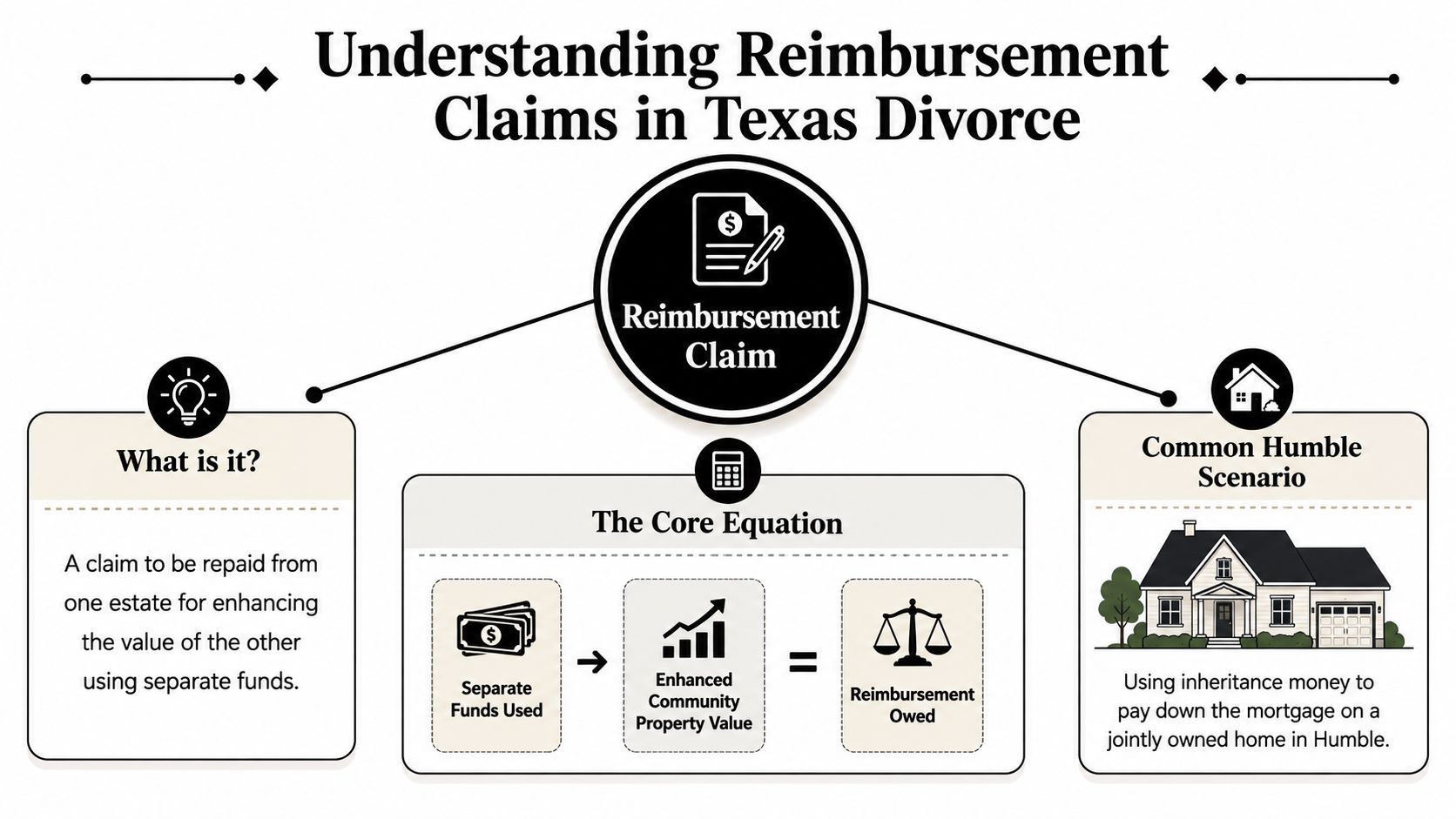
A common call starts with a spouse saying, “I paid the mortgage on the house we owned before marriage, and now my spouse says that doesn't matter.” It does matter, but not in the simplistic way many people expect. Texas law treats a reimbursement claim as a request for economic repayment when one marital estate uses property to benefit another in a way that would otherwise create unjust enrichment under Texas Family Code § 3.402 and be resolved by the court under § 7.007 using equitable principles and a just-and-right division. Texas reimbursement claim statute summary
What the claim actually is
The claim is not automatic ownership of the house, truck, rental property, or business asset. It is a request for repayment tied to the value of the benefit one estate conferred on another. That distinction matters in real divorce cases because the court can recognize the claim without changing title at all.
If a spouse used community income to reduce principal on a separate-property mortgage, that may support reimbursement. The same is true when community funds pay for capital improvements, or when one estate pays a spouse's separate debt. Texas practice sources identify those as the kinds of cross-estate transfers that can support a claim, and they're the kinds of transactions that show up in Humble homes, small businesses, and blended family finances. Texas reimbursement claim examples
Practical rule: if the money just kept the household running, that usually isn't the same thing as a reimbursable transfer.
Texas also draws lines around what usually does not qualify. Everyday living costs, child support, spousal maintenance, student loans, and nominal contributions are excluded, which narrows the dispute to more substantial transfers. That means the focus stays on things like principal reduction, property improvements, and uncompensated labor that increased value.
Why Humble families run into this issue
In Humble and Northeast Houston, the facts are often messy. One spouse may have come into the marriage with a house in their name, while the other spouse helped pay bills from a joint account, covered repairs, or funneled inheritance money into renovations. The issue isn't whether money moved. The issue is whether the records can prove what moved, from where, and for whose benefit.
That's why reimbursement claims often overlap with tax and debt questions too. If a divorce also created questions about who benefited from a debt payoff, a related resource like Omni Tax Help tax resolution can be useful for understanding how financial responsibility can follow a marriage even after the relationship ends.
A strong reimbursement theory starts with the right category, but it wins or loses on proof. If the contribution can't be tied to a clear benefit, the court may view it as ordinary marital spending rather than a reimbursable transfer.
Gathering and Tracing the Evidence You Need
A reimbursement claim in Humble can look strong on paper and still fail if the records do not show the path of the money. By the time a divorce is contested, statements go missing, accounts are blended, and the story behind each payment gets fuzzy. Texas sources require proof of both the contribution and the amount, so the documents do more than support the claim, they carry it. Evidence requirements for reimbursement claims
Build the file before the file gets messy
Start with bank statements, mortgage records, refinance papers, receipts, invoices, and debt statements. Those papers connect the source of funds to the benefit they produced, and they matter even more when the claim turns on separate-property tracing. Separate property tracing guidance in Humble divorce
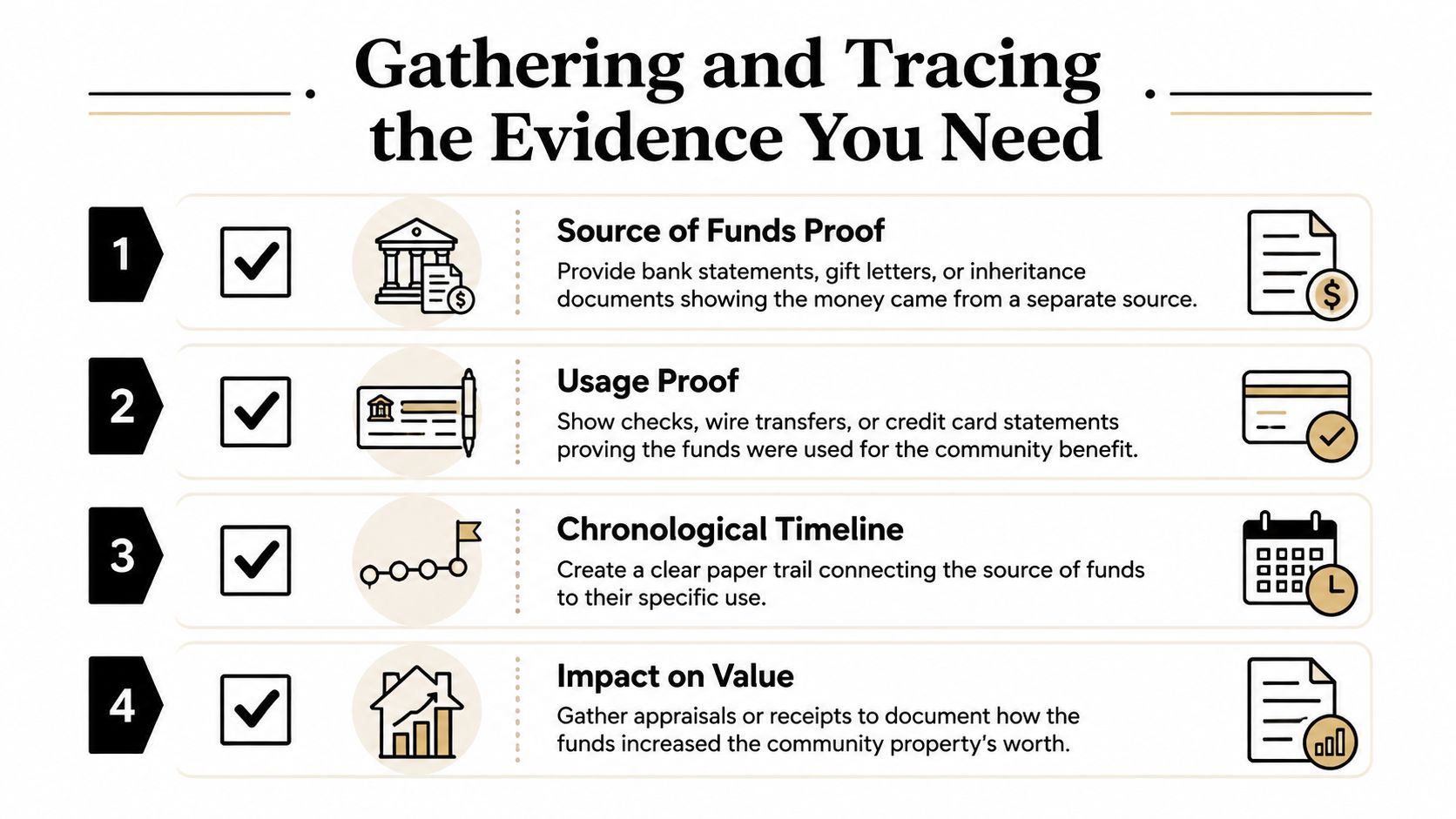
A clean file usually answers four questions:
- Source of funds proof: show whether the money came from inheritance, a gift, premarital assets, or another separate source.
- Usage proof: show the check, wire, transfer, or card charge that paid the debt or vendor.
- Chronological timeline: match the deposit, withdrawal, and expenditure in order, so the court can follow the trail.
- Impact on value: tie the spending to a repair, payoff, or improvement that increased the property's worth.
The hardest files usually involve mixed accounts. Once community and separate funds are commingled, tracing gets harder fast, and a judge may be left weighing credibility instead of clean numbers. Informal cash transfers, family loans with no writing, and home-improvement payments made without receipts create the same problem, the benefit may have happened, but the proof does not travel with it. When accounts are commingled, engaging a professional with Lighthouse Consultants divorce expertise can help reconstruct the trail.
Why blended finances create trouble
That problem shows up often for couples in Humble, Atascocita, and Kingwood who run a small business, share a household account, or move money around casually. A spouse may say, “I know I paid for the kitchen remodel,” but without a receipt, an invoice, and an account record showing the source, the claim becomes much harder to prove. Courts do not award reimbursement just because the story sounds fair, they need a documented trail.
The strongest reimbursement case is the one that reads like a ledger, not a memory.
If a divorce decree or later order needs to be enforced, paperwork matters there too. A tool like Enforcement of Court Orders in Humble is relevant when parties need to enforce divorce decree and custody order provisions in Harris County, but the same lesson applies here, if you cannot show the underlying obligation clearly, enforcement gets harder.
The practical step is simple, but people delay it anyway. Save every statement, download every transaction, and keep a note beside each payment explaining what it paid for and who benefited. That is how you build a strong case in a Harris County courtroom.
Computing Reimbursement Amounts and Potential Offsets
Once a claim is established, the next question is money. Judges don't just ask whether a benefit existed, they ask what it was worth and whether equity calls for the full amount, part of it, or less after offsets. Texas law gives the court room to do that because the calculation is guided by equitable principles, not a rigid formula. Texas Family Code § 7.007 reimbursement treatment
What courts usually try to measure
The first piece is principal reduction. If one estate paid down a debt tied to separate property, the court looks at the amount of principal reduced, not just the total monthly payments. Interest, taxes, and insurance may not track the same way, so the supporting records matter.
The second piece is capital improvements, which are different from routine maintenance. Replacing a worn appliance or fixing a leak may keep a property usable, but a renovation that increases the property's value is the kind of expense that can support reimbursement. That's why receipts, contractor invoices, and appraisals belong in the same folder.
The third piece is debt payoff. A payment made by one estate for the benefit of another, including unsecured debt or separate debt paid with community funds, can create a reimbursement issue. That same logic is why small business owners in divorce need to map debts carefully, especially when business debt and household money have been mixed.
| Common Reimbursement Claim Categories | Example Scenario | Key Documentation Needed |
|---|---|---|
| Mortgage principal reduction | Community funds paid down a separate-property home loan | Mortgage records, amortization history, bank statements |
| Capital improvements | Funds paid for a remodel that increased value | Receipts, invoices, contractor estimates, photos |
| Separate debt paid with community money | Community income paid a spouse's separate credit card or loan | Debt statements, statements showing payment source |
| Uncompensated labor | One spouse's unpaid work increased property value | Business records, valuation materials, time records |
Offsets can shrink the claim
The other side will usually argue offsets. If the benefiting estate contributed money of its own, if the claiming spouse used and enjoyed the property, or if value flowed back to the claimant in another way, the court can reduce the amount. Those arguments matter because reimbursement is not about simple reimbursement in the retail sense. It's about fairness in the overall property division.
Courts in Harris County often focus on the story the records tell, not the story each spouse prefers.
For Humble homeowners, that means the best estimate is usually a conservative one backed by documents. For business owners, it means principal reduction and improvement costs should be separated from operating expenses. If the claim is built on mixed expenses, the other side will press offsets hard, and the court may agree.
The safest approach is to treat every reimbursement number as a range until the proof is fully assembled. That keeps settlement expectations realistic and avoids overreaching in front of a judge who has to divide the estate as just and right.
Preparing Pleadings and Meeting Court Deadlines
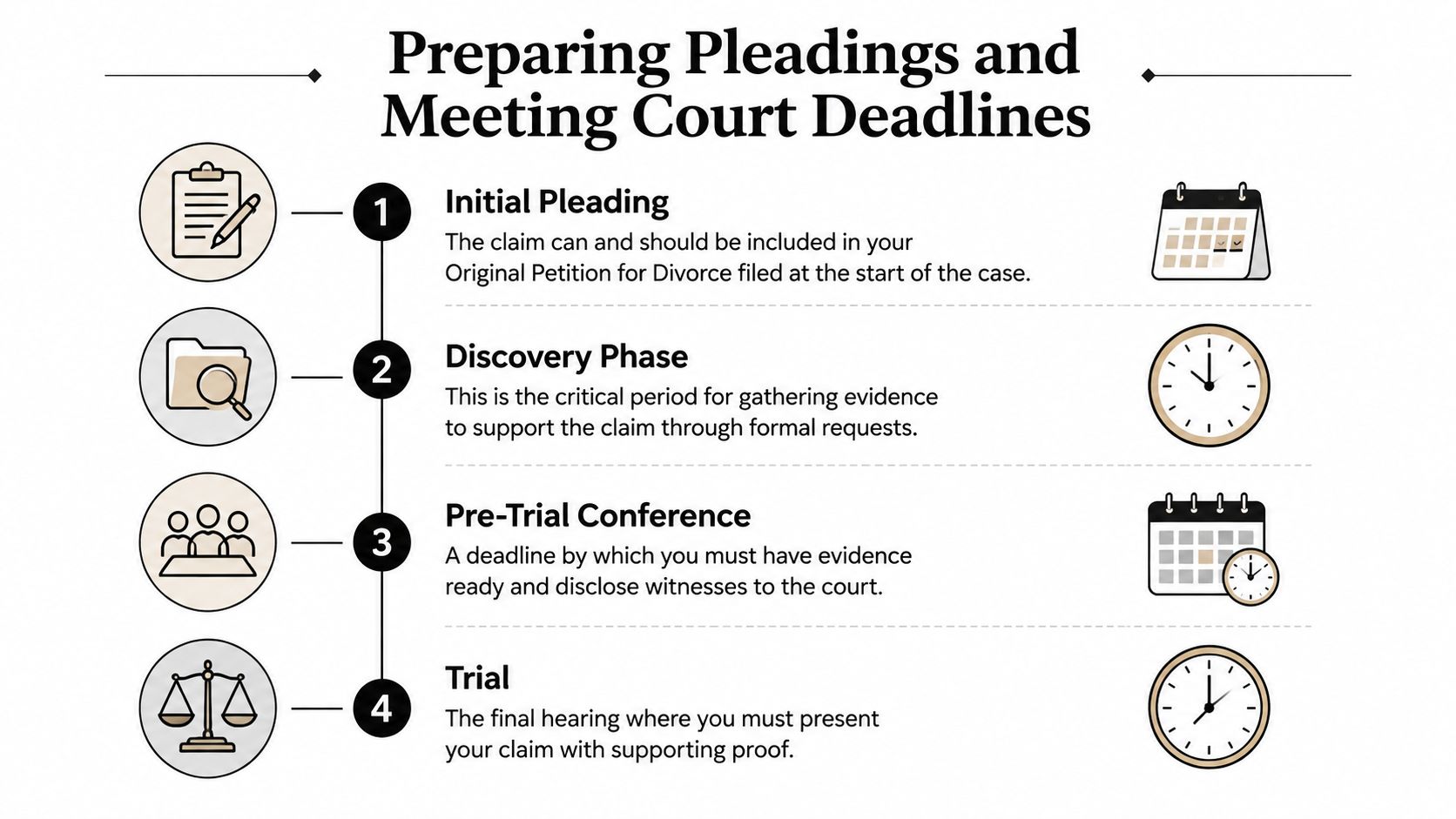
A reimbursement claim can't sit in the background and hope the court notices it. It needs to be pled, supported, and carried through the case like any other property issue. In Harris County family court, the spouse who wants the claim should raise it early in the Original Petition for Divorce or in a counterpetition, not assume the judge will sort it out automatically at the end. Divorce discovery process in Texas
Put the claim in writing early
The pleading should identify the reimbursement theory clearly enough that the other side knows what is being claimed. That matters because property division disputes are not handled by vague hints. They move through formal requests, responses, and disclosures that define the issues for trial or settlement.
Discovery is where many claims are won or lost. Bank records, loan files, vendor invoices, tax returns, and account histories can be requested and compared against the story each spouse gives. For Humble and Atascocita families, especially those with blended finances or small businesses, that discovery work often exposes whether the money trail is real or just reconstructed after the fact.
Know the local rhythm
Humble, Kingwood, and Northeast Houston cases filed in Harris County move through the county's family court process, and the clerk, courtroom, and scheduling rules matter. The exact courthouse and judge assignment can affect timing, but the practical point stays the same, deadlines control the case, not informal promises between spouses. If the evidence isn't disclosed on time, a strong claim can become a weak one very quickly.
A few actions help keep the case on track:
- File the claim early: include the reimbursement issue in the first pleadings or a timely counterpetition.
- Request the documents fast: ask for statements, loan histories, receipts, and appraisals before the paper trail gets thinner.
- Track disclosure deadlines: make sure the evidence and witness list are ready before the pretrial stage.
- Prepare for decree language: the court must decide the claim in the final decree if it's being pursued.
If the case also includes property classification questions, the community-property analysis should be handled alongside reimbursement, not after it. What community property means in Texas is useful background because the reimbursement claim only makes sense once the underlying estate character is identified.
A judge can't divide what hasn't been pled, and the other side can't negotiate fairly against a claim that was never clearly stated. Filing it correctly sets the tone for the whole case.
Negotiating Settlement Versus Taking the Claim to Trial
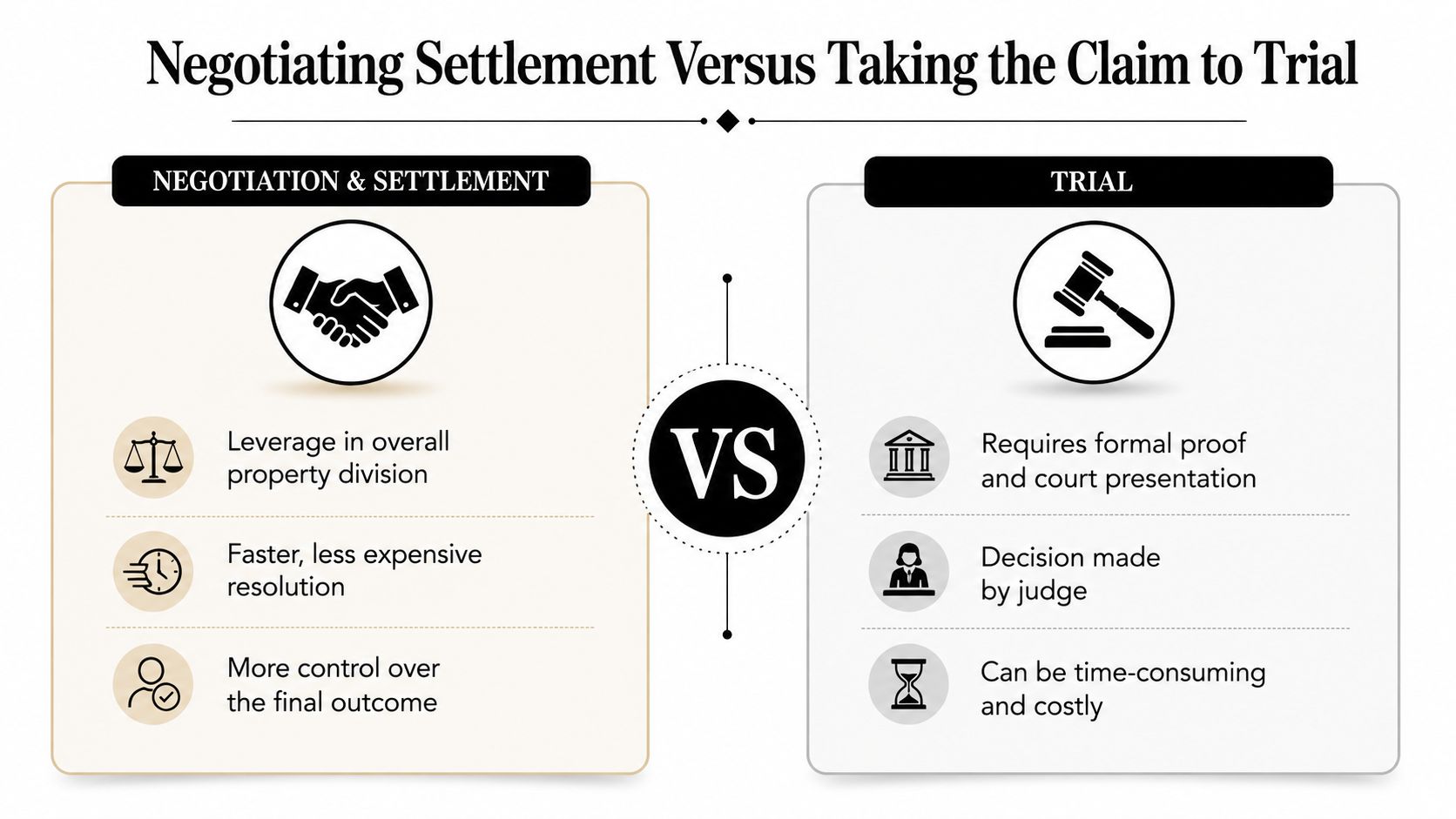
Many reimbursement claims settle because neither side wants to spend the time and money needed to prove every transaction. That's especially true when the records are decent but not perfect. In those cases, the claim becomes a point of negotiation inside the larger property division discussion, not just a standalone demand for repayment.
Where settlement has the edge
Settlement tends to work best when the documentation is strong, the benefit is easy to follow, and the underlying facts feel fair to a neutral person. A spouse who can show mortgage payments, receipts, and a clear increase in value usually has a stronger negotiating position. That position may be used to trade for another asset, accept a reduced number for certainty, or avoid the risk of a judge cutting the claim down with offsets.
Negotiation also gives the couple more control. Instead of leaving the answer entirely to a courtroom ruling, the spouses can decide how the reimbursement issue fits into the broader division of assets and debt. That matters in families with one main residence, retirement accounts, and a business that needs to stay intact after divorce.
When trial risk grows
Trial becomes more likely when records are incomplete, the valuation is disputed, or the other side has its own reimbursement theory. If the money trail is murky, a judge may decide the claim differently than either spouse expects. Harris County courts will still apply equitable principles, but equity is not predictability.
A trial also forces the claimant to present the evidence cleanly, not just argue that the spending happened. If the documentation can't connect the funds to the benefit, the claim may get trimmed or denied. That's why many cases are resolved before final hearing, not because the claim is weak, but because trial risk is real.
A good settlement is usually the one that reflects what the records can actually prove.
For families in Northeast Houston, the practical decision is often this, do you want certainty now, or are you prepared to prove every link in the chain later? The answer depends on how strong the paper trail is and how much the claim matters to the overall property picture.
How the Law Office of Bryan Fagan Helps Humble Families
Reimbursement claims are rarely clean, and that's exactly why local representation matters. In Humble, Atascocita, Kingwood, and across Northeast Houston, these cases often involve homes bought before marriage, mixed household accounts, informal family help, and business or rental property records that need to be sorted before they get lost. The right approach is early preservation, careful tracing, clear pleadings, and negotiation grounded in what the documents can support.
The Law Office of Bryan Fagan works with families who need that kind of practical property analysis during divorce. That includes reviewing bank and loan records, identifying what can be traced, and helping clients understand whether a reimbursement claim is strong enough to push, settle, or narrow before trial. It also means explaining the process in plain language so clients can make decisions without guessing what a judge might do.
For some families, reimbursement is one issue inside a larger divorce, custody, or estate plan conversation. For others, it's the issue that changes the property division outcome. Either way, the goal is the same, protect what can be protected and avoid letting incomplete records decide the result.
If you're sorting through a divorce in Humble and think community funds may have paid down separate property, or separate money may have benefited the marital estate, don't wait until the numbers disappear into guesswork. Talk with a lawyer who can help you organize the paper trail, evaluate the claim, and move forward with a plan.
If you're facing a reimbursement dispute in a divorce, the Law Office of Bryan Fagan can review your records, explain your options, and help you build a strategy around the facts that matter most. Visit Law Office of Bryan Fagan to schedule a free consultation with our Humble office and get clear guidance on your next step.