Harris County Domestic Relations Office parenting coordination is a court-ordered, confidential, child-focused service through Family Court Services, not a new custody trial and not a substitute for the judge. It helps parents address recurring problems carrying out their parenting arrangements, with the appointing order defining the coordinator's responsibilities.
If you're exhausted by arguments over pickups, school messages, or holiday exchanges, the important question is whether you need help following your order or need a judge to change it. Those are different problems, and choosing the right response starts with the paperwork you already have.
When a Pickup Fight Keeps Restarting
It's Thursday afternoon in Humble. One parent arrives late, the other refuses to use the usual exchange spot, and the texts turn harsh while their child waits in a parking lot.
The immediate disagreement sounds simple: where should the pickup happen? But by the time everyone leaves, the parents are arguing about fairness, missed time, and who should have custody.
That scene may involve an implementation problem, meaning trouble carrying out an existing possession order. It isn't automatically a reason to change conservatorship, the legal arrangement governing parental rights and responsibilities.
Start with the failed exchange, not the entire history of the relationship. Identify what the order says and what prevented the parents from following it.
For Atascocita and Northeast Houston families whose cases are already in Harris County family courts, the Harris County Domestic Relations Office's Family Court Services parenting coordination program may be a court-connected option for repeated parenting disputes.
Separate emotional support may also help parents manage difficult conversations. Wald Behavioral Health family counseling is a resource to explore when family relationships need attention beyond the practical work of implementing a court order.
Understanding the service means looking at referral, appointment duties, intake, sessions, documents, and costs. A realistic exchange example can also help you recognize when coordination fits and when a private lawyer should step in.
Keep your current court order nearby, especially the possession provisions and any paragraph appointing a coordinator.
What Parenting Coordination Means at the DRO
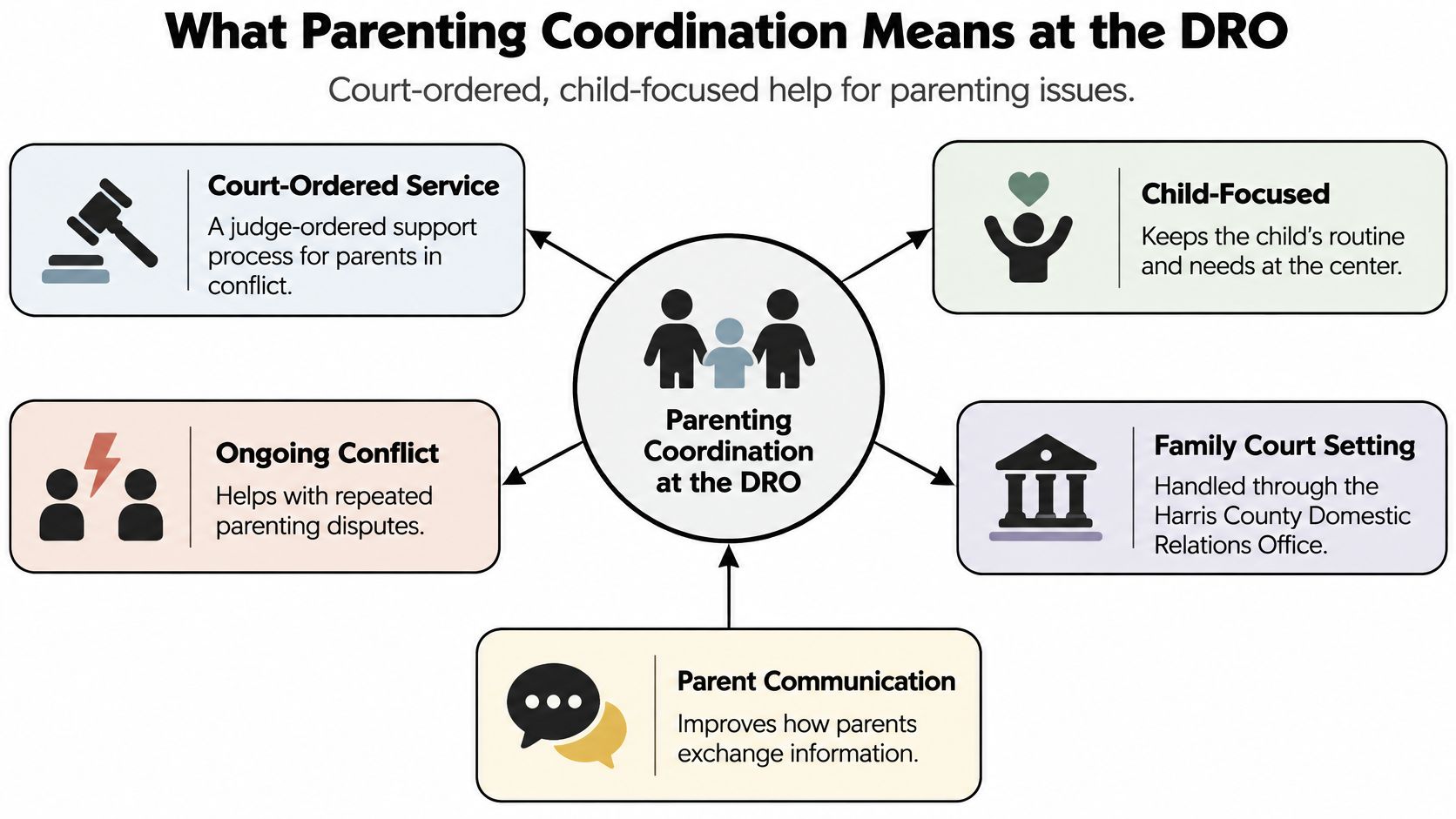
The Harris County Domestic Relations Office parenting coordination program describes a court-ordered, child-focused service through Family Court Services for parents experiencing ongoing parenting conflict, delivered by a mental-health professional with mediation training and relevant experience; its materials also describe the process as private, confidential, and privileged, with appointment based on good cause and the child's best interest.
Those features distinguish the service from a parent booking a counseling appointment. The coordinator works within a court-connected role, addressing parenting-related implementation and dispute resolution rather than treating every disagreement as an invitation to reconsider custody.
What the work looks like
A useful starting point is the child's actual routine. Does the child have school materials when moving between homes? Do the parents understand the same holiday provision differently? Are transportation disagreements making exchanges unpredictable?
The coordinator can help parents:
- Identify the child's needs, separating those needs from the adults' competing preferences.
- Isolate disputed issues, so a transportation problem doesn't become an argument about every past disagreement.
- Reduce misunderstandings and clarify priorities, including what must happen before the next exchange.
- Explore practical solutions, rather than repeating accusations without proposing an alternative.
- Improve collaboration, develop or interpret parenting plans, and support compliance with conservatorship and possession or access orders.
This concept map shows how those tasks connect to the child's daily experience.
Following the map rather than redrawing it
Think of the coordinator as a traffic director. The parenting order provides the route. The coordinator helps parents understand the directions, avoid recurring points of conflict, and carry out the trip more effectively.
Say the disagreement concerns how to communicate that a child's school event affects transportation. Productive work might include a shared calendar, a clear notification method, and a procedure for confirming receipt. The focus stays on making the existing arrangement workable.
The coordinator's professional background doesn't turn the process into informal therapy. Nor is a coordination session a public hearing where a judge receives evidence and decides contested parental rights.
Privacy also deserves a careful conversation before intake. Ask what information the coordinator collects, what communications are covered by confidentiality, and what the appointment order authorizes the coordinator to report. Don't assume the same rules apply to every professional involved in your family's case.
The distinction that matters most is facilitation versus judicial change. A helpful proposal still has to fit the coordinator's assigned duties and the underlying parenting order.
Coordinator Mediator and Judge Side by Side
Who handles a parenting dispute in Harris County
| Role | How they enter | Focus | Can change the order |
|---|---|---|---|
| Parenting coordinator | Appointment by court order | Implement the plan, reduce conflict, and propose practical resolutions | No; material custody or possession changes need the court |
| Mediator | Party agreement or court referral to mediation | Help the parents reach an agreement | No; a signed agreement still needs court approval to become an order |
| Harris County family judge | The court where the case is pending | Hear evidence and enter or modify orders | Yes, after proper pleadings, notice, and findings |
| Private attorney | Hired by one parent | Advise, gather records, and file requests | No; the lawyer asks the judge, the judge decides |
The duty list sets the boundary
Under Texas Family Code section 153.610, the appointing court must specify the parenting coordinator's duties, within categories including identifying disputes, reducing misunderstandings, clarifying priorities, exploring solutions, developing collaborative parenting methods, explaining and implementing parenting plans, supporting possession-order compliance, providing conflict-management or parenting-skills training, and helping parents reach a proposed joint resolution.
The appointment order's duty list is therefore more important than a general statement that someone will help the parents get along. Precise language tells everyone what the coordinator is authorized to address.
For example, a duty concerning exchange communication can support work on arrival notices and transportation confirmations. It shouldn't become open-ended authority to award parenting time or redefine which parent makes major decisions.
Choose the professional for the problem
The coordinator's role concerns practical follow-through. A mediator focuses on helping the parents reach agreement, rather than serving as the person responsible for managing recurring weekly implementation problems. Our custody mediation guidance explains how parents can prepare for that separate process.
A judge has a different job: deciding properly presented disputes and entering enforceable orders. A private attorney represents one parent's interests, evaluates the available legal options, and asks the court for relief when appropriate. Families seeking background on the courts serving Humble can consult our Harris County family-law guidance.
Use these practical distinctions when reviewing a proposed appointment:
- Holiday exchanges and pickup procedures may be coordination subjects when the work implements the existing order.
- A change of primary conservator isn't a logistics decision.
- Child support and geographic restrictions aren't terms a coordinator can independently rewrite.
Avoid language that appears to give the coordinator unrestricted authority over all parenting disagreements. Ask what each duty permits, what it excludes, and what happens when parents cannot agree.
Before treating coordination as the right tool, compare every requested duty with the statutory categories. A narrowly described task can prevent a practical support process from becoming an informal custody proceeding.
From Eligibility to a Working Plan
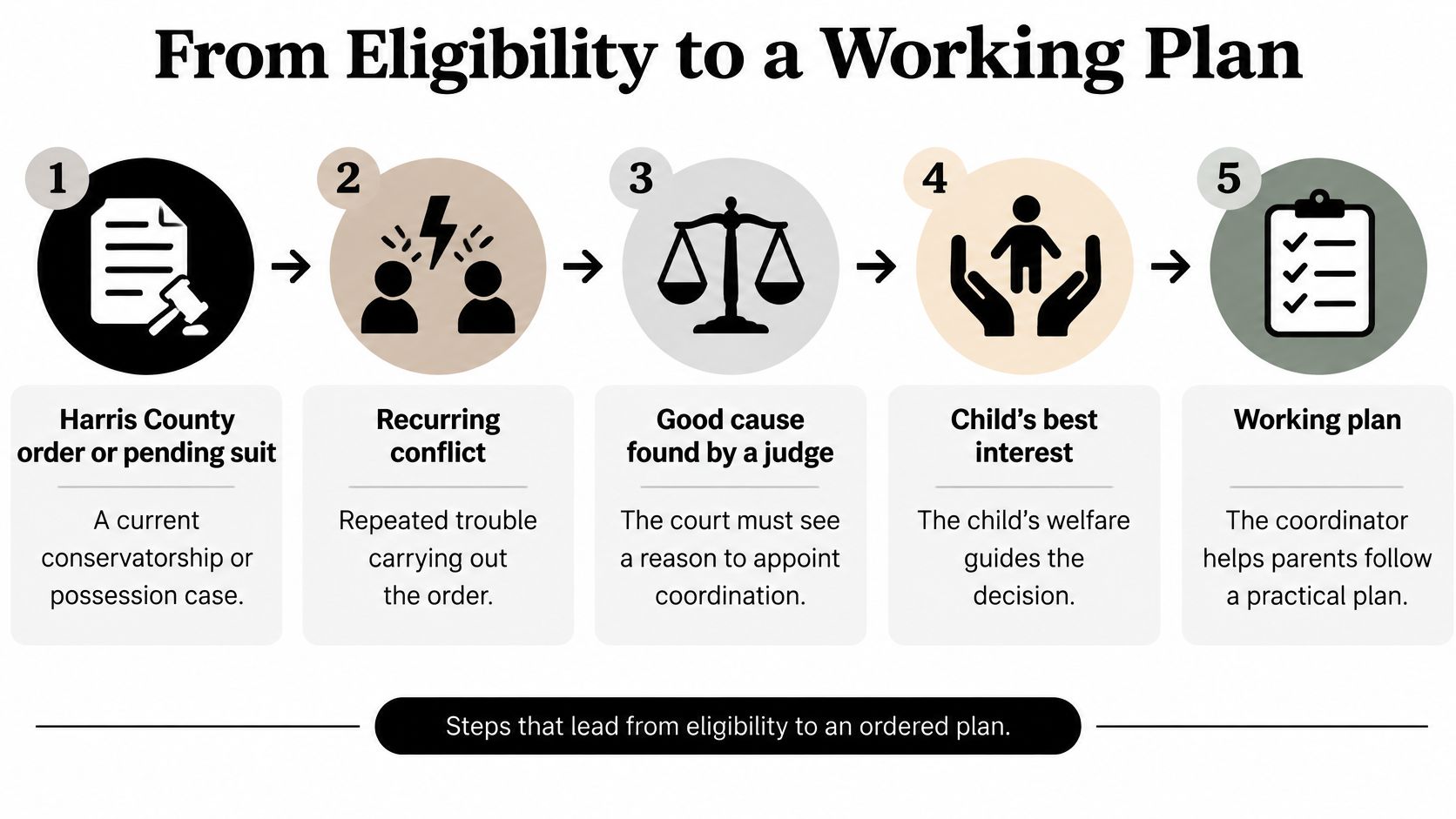
The starting questions are practical: Is there a Harris County conservatorship or possession case? Is there an existing order the parents repeatedly struggle to carry out? Can the judge make the findings needed for appointment?
A pending case alone does not establish that coordination is the right next step. Parents beginning a divorce without an operative parenting arrangement may first need temporary orders. A parent seeking permission to move outside a geographic restriction needs legal advice about court relief, not just a different exchange routine.
Safety concerns require separate attention. If family violence, threats, or coercion affect your ability to participate safely, tell your attorney before agreeing to a process that assumes ordinary cooperative problem-solving.
This checklist illustrates the path from a parenting dispute to an ordered working process.
Before the appointment
- Read the current order. List the logistics that keep failing, with a brief example for each. Separate transportation, communication, and scheduling issues from requests to change parental rights.
- Raise the proposed solution appropriately. Discuss coordination with the other parent if doing so is safe and useful. Otherwise, address the request through counsel or a motion in the family court hearing the case.
- Request defined duties. Ask for appointment language that identifies concrete tasks within the statutory categories. Avoid a broad instruction to resolve anything the parents disagree about.
- Clarify the operating terms. Request clear language about attendance, duration, reporting, and allocation of any cost.
A parent cannot self-appoint a court-ordered coordinator. Even when both parents support the idea, the court's appointment and the written duties matter.
Before you sign: Read the duty paragraph separately from the rest of the proposed order. You should be able to explain each assigned task in everyday language.
After the judge signs
The signed appointment order should be your starting document for intake. Check who is appointed, what that person may do, how the appointment ends, and what payment provisions apply.
Contact Family Court Services to confirm the actual intake process. Ask for the session schedule and any required preparation in writing. There's no reliable universal calendar to assume for appointment, intake, or completion, so plan around confirmed instructions rather than another family's experience.
Early sessions should narrow the work to specific recurring disputes. A focused agenda might address the exchange location, the communication channel, and transportation responsibilities. The coordinator can then help parents clarify priorities and consider solutions that fit the order.
For your own preparation, our guide to writing a parenting plan offers a useful way to think through routines and responsibilities. Bring proposed language as a discussion aid, not as a replacement order.
Turn discussion into usable instructions
Expect practical follow-up, such as updating a shared calendar or drafting a neutral exchange message. Write down any proposed routine clearly enough that both parents can carry it out without another argument about its meaning.
Keep legal changes separate from operational agreements. If a discussion shifts toward reducing possession or reallocating decision-making authority, pause that issue and take it to counsel.
For additional context as you prepare questions about parenting arrangements, this video is available to watch.
Forms Contacts and What to Bring
Build a compact intake packet before contacting Family Court Services. Bring documents that explain both the legal arrangement and the recurring practical problem, rather than an unsorted archive of every disagreement.
Documents and contacts for first intake
| Item | Source or contact | Notes |
|---|---|---|
| Signed possession and conservatorship order | Clerk or your attorney | Bring every page and any temporary orders |
| Parenting coordination order, if appointed | Family court hearing the case | Check duties, term, and cost split |
| School calendar | Your school district | Mark holidays and exchange dates |
| Family Court Services intake | Harris County Domestic Relations Office | Confirm current phone number, intake location, and hours directly |
| Official intake forms | Harris County DRO or the court order | Confirm current form titles and approved access instructions before completing forms |
Add a short issue list ranked by how frequently each problem occurs. Beside each issue, note what the parents have already tried and why it didn't resolve the disagreement.
Keep the packet usable
- Preserve complete records. Keep original message threads even if you prepare a shorter summary for discussion.
- Use neutral descriptions. Record the scheduled exchange, what happened, and the effect on the child's routine.
- Confirm deadlines. Ask which intake deadline the order establishes and obtain written clarification if the language is unclear.
- Check communication instructions. When safe and consistent with your order, keep parenting messages short and in a single written channel.
Don't assume every Family Court Services program uses the same intake requirements. A social study serves a different purpose, as explained in our Harris County DRO social study process guide.
Use the appointment order and the office's current instructions to identify the correct process. Don't send sensitive documents to an unconfirmed address or complete a form merely because another parent used it.
Session Costs and a Local Exchange Example
The county materials discussed here don't establish a public dollar amount for this service. Don't budget around a neighbor's recollection or assume that a court-connected program is automatically free.
Read the appointment order's payment provisions and request current program information before the first meeting. Ask whether the order divides costs equally, allocates them differently, or requires clarification from the court.
Ask what the charge covers
- Rate or program charge. Request the applicable fee information in writing, including whether there is any charge at all.
- Session length. Confirm how meetings are scheduled and billed.
- Between-session communication. Ask whether emails, telephone calls, or document review generate charges.
- Missed appointments. Learn the cancellation and nonattendance policy.
- Payment responsibility. Confirm each parent's share and how billing disagreements should be raised.
The professional's mental-health and mediation background helps explain why you should distinguish coordination services from a clerk's filing fee. However, don't assume a particular billing model without confirmation.
This meeting image illustrates the kind of structured conversation parents may envision, not a promise about a particular session format.

A Friday exchange between Kingwood and Atascocita
Say divorced parents in Kingwood and Atascocita follow a standard possession schedule. Friday pickups repeatedly fail because one parent works late in Northeast Houston.
Start with the actual possession language. Does it specify the time, place, or person responsible for transportation? A coordinator can help the parents consider an authorized exchange arrangement, an arrival-confirmation message, and a backup procedure that honors the order.
A backup time isn't automatically permissible just because it's convenient. If it would replace a mandatory possession provision, the parents need legal advice about how to handle the proposed change.
The session also isn't the place for the coordinator to independently move the child to another school, eliminate possession weekends, or change child support. A contested school decision may require review of the existing allocation of educational rights and court action.
If money becomes part of the argument, separate support questions from pickup logistics rather than bargaining away one obligation for another. Our firm can explain the relevant court procedure and help identify the next practical step.
Save the governing order, the proposed exchange routine, and a simple log of what was tried. Those documents help distinguish an unsuccessful experiment from a disagreement requiring judicial attention.
Parenting Coordination Questions Answered
Can I refuse to attend?
Participation follows a court order, so skipping a session can create compliance problems. If you have a safety concern, scheduling obstacle, or objection to the appointment, ask counsel how to address it rather than refusing to appear.
Does the coordinator testify in court?
Don't assume the coordinator will serve as your witness. The county describes the process as privileged, but reporting and testimony questions require review of the appointment order and applicable Texas law before you disclose sensitive information.
Can the coordinator change the schedule on the spot?
Ask whether the proposal implements the written schedule or alters possession rights. A coordinator's suggestion doesn't become a judicial modification merely because it was discussed during a session.
Can I still go to court while coordination continues?
Coordination doesn't replace access to the court for a material legal issue. Have counsel review how the appointment order addresses litigation and whether your situation calls for a motion while sessions continue.
Can coordination handle a safety case?
Coordination isn't a substitute for emergency assistance, protective orders, or other court protection. Disclose family violence and threats promptly so safety and the appropriateness of the process can be evaluated.
What if the other parent ignores the coordinator?
Keep a factual record of missed appointments, unanswered requests, and uncompleted tasks. Give that record to counsel and ask what the order permits the coordinator to report and what compliance issue should be presented to the court.
Keep children out of the reporting role. Adults should document missed steps through records and direct communication, not by asking the child to collect information or deliver complaints.
Decide Whether to Call a Humble Lawyer
Stay with coordination when the order is clear and the disagreement concerns how to follow it. Call a lawyer when someone seeks different rights, the appointment language is vague, or safety is involved.
A pickup procedure or communication habit may fit the coordinator's work. A proposed change to conservatorship, possession, support, or a geographic restriction calls for legal review. A missing child, refusal to return a child, or family violence deserves prompt attention rather than waiting for the next session.
Bring the disputed language
For parents in Humble, Atascocita, Kingwood, and Northeast Houston, asking for advice isn't a failure at co-parenting. It can prevent you from treating a legal dispute as a scheduling problem or accepting an appointment that gives unclear authority.
Bring these materials to the conversation:
- Your current order, including temporary orders and later modifications.
- The draft appointment, with the proposed duty paragraph highlighted.
- A short factual summary, identifying the immediate problem and the outcome you're seeking.
For support-specific concerns, a Child Support Attorney in Humble addresses establishing, modifying, and enforcing child support in Harris County.
Our firm serves Harris County and the Houston area. During a confidential case review, we provide honest feedback about legal options and potential outcomes, guidance relevant to your situation, and clear direction about next steps. Our family-law attorneys develop personalized strategies that prioritize clients and their children.
This week, highlight the coordinator's proposed duties and mark anything you can't explain plainly.
The Law Office of Bryan Fagan offers a free consultation to review your parenting order, distinguish coordination issues from matters requiring a judge, and help you identify the next practical step. Visit Law Office of Bryan Fagan or call (281) 817-1827 to schedule with our Humble office, and bring your current order and highlighted draft appointment.