The Harris County Dispute Resolution Center mediation fee is free for Harris County residents in eligible cases, and income, asset, claim value, and party limits decide whether your case qualifies. If mediation can be free, why do two Humble families with similar divorces sometimes receive very different answers about cost?
The answer usually isn't the mediator. It's eligibility. A case inside the Dispute Resolution Center, or DRC, limits may cost you nothing for the session itself. A case just outside those limits may require a private mediator, plus attorney preparation and other case expenses. Checking the limits before you budget saves you from planning around a fee that was never available to you.
Harris County Mediation Fees at a Glance
The Harris County Dispute Resolution Center states that its mediation services are free to Harris County residents, unlike private providers that commonly charge hourly rates or retainers. The DRC is sponsored by the Houston Bar Association and funded through the Harris County Courts System, so eligible parties aren't paying a market rate for the mediator's time.
Free doesn't mean your whole dispute costs nothing. You may still pay filing fees, attorney time, discovery costs, transportation, or court-ordered costs. Think of the DRC fee and your total case cost as two separate budgets.
| Service | Cost to party | Key limit | Where to start |
|---|---|---|---|
| Divorce mediation through the DRC | Free | No significant financial or real-property holdings; combined gross annual income $100,000 or less | DRC divorce mediation request page |
| Active civil case mediation | Free | Claim valued at $100,000 or less; no more than three named parties | DRC active civil cases request page |
| Domestic Relations Office mediation | No mediation fee | Temporary and final orders; $100 charges for late cancellation or procedural failures | Harris County Domestic Relations Office |
| Private mediator | Hourly rate or retainer set by the mediator | Rates set by each mediator | Mediator's office |
How to Read Your Row
Find your case type first, not the price. Divorce and active civil cases use different request pathways and different screening questions, so using the wrong pathway can delay an otherwise eligible case.
The Domestic Relations Office row is separate from the DRC. Its session can carry no mediation fee, but missed procedural deadlines can create charges. Mediator training costs aren't listed in this table because they're education fees for students, not fees charged to parties in a case.
Budget rule: Confirm residency and program eligibility before you assume your mediation fee is zero.
For Humble and Northeast Houston residents, that one check controls the rest of your planning. If your row says free and you meet its limit, budget for the surrounding case costs. If you don't meet the limit, get private pricing in writing before you commit to a date.
Who Qualifies for Free Mediation in Harris County
Does "free" still describe your case once Harris County applies its screening rules? For many Humble families, the answer depends on whether you sit inside the program's limits. Outside those limits, the session is no longer the no-cost option people expect.
The DRC divorce mediation request page limits divorce and family law mediation to parties with no significant financial or real-property holdings and combined gross annual income of $100,000 or less. That is a screening rule. Miss either piece and the free divorce program can decline the case.
Add both spouses' gross incomes, then list homes, land, and significant financial accounts. A Kingwood couple whose combined earnings land just over that income line may need another route even when the property issues feel simple. Substantial property can do the same thing when the income looks modest.
The Civil Case Test
Active civil cases use a different pair of limits: the value of the claim and the number of named parties. A landlord-tenant dispute may fit. A Northeast Houston case with four defendants can fall outside the program even when the dollar amount is modest.
Count every person or business named in the lawsuit, and state the claim in dollars before you request a date. A general description such as "a small dispute" will not show whether the program will take the case.
Income That Needs a Closer Look
Self-employment, a small business in Humble or Atascocita, or commission pay can make the income test harder than a W-2 paycheck. Gross income on a tax return may not match the figure you are using in your head. Use the return, not a rough monthly average, when you decide whether you are under the cutoff.
If you're outside a limit, ask the DRC directly whether any reduced fee option exists before you conclude that a private mediator is your only choice. I would make that call before you price private mediation. A family just over the line and a family far outside it do not face the same practical choice.
Paperwork and Costs to Plan For Before Mediation
Good paperwork does two jobs. It proves whether you qualify, and it helps you negotiate from real numbers instead of memory. Start collecting it before you submit a request, not the night before your session.
Documents to Gather
- Divorce income records: Recent pay stubs or tax returns for both spouses.
- Property and debt records: A list of real property, significant accounts, loans, and credit balances.
- Civil case papers: The contract or agreement, the claim amount in writing, and full names of every party.
- Identification and residency: Photo identification and proof of Harris County residence. Ask the DRC which proofs it accepts.
Our guide on how to prepare for divorce mediation can help you organize these materials by issue, so you're not searching through a folder while the mediator is waiting.
Costs That Can Remain
A free session doesn't erase court filing fees. You may also pay an attorney to prepare you, attend, or review a proposed agreement before you sign it. Discovery, transportation, time away from work, and court-ordered costs can also remain part of your budget.
That's why I recommend asking any private professional for a written estimate before you agree to services. Separate the mediator's charge from attorney time and court costs, so you can see what's driving the total.
If a payment request doesn't clearly identify who is charging you and why, pause and ask before you pay.
Training fees cause a common mix-up. The DRC mediation training page lists $600 per student for one mediation training program and $500 per student for a 30-hour family mediation training program. Those are educational registration fees, not charges for parties seeking mediation.
You can confirm which program fits your dispute by calling the DRC during its weekday hours. A short call can tell you whether a request came from the DRC referral process, a private mediator, an attorney, or a training program.
How to Request DRC Mediation Step by Step
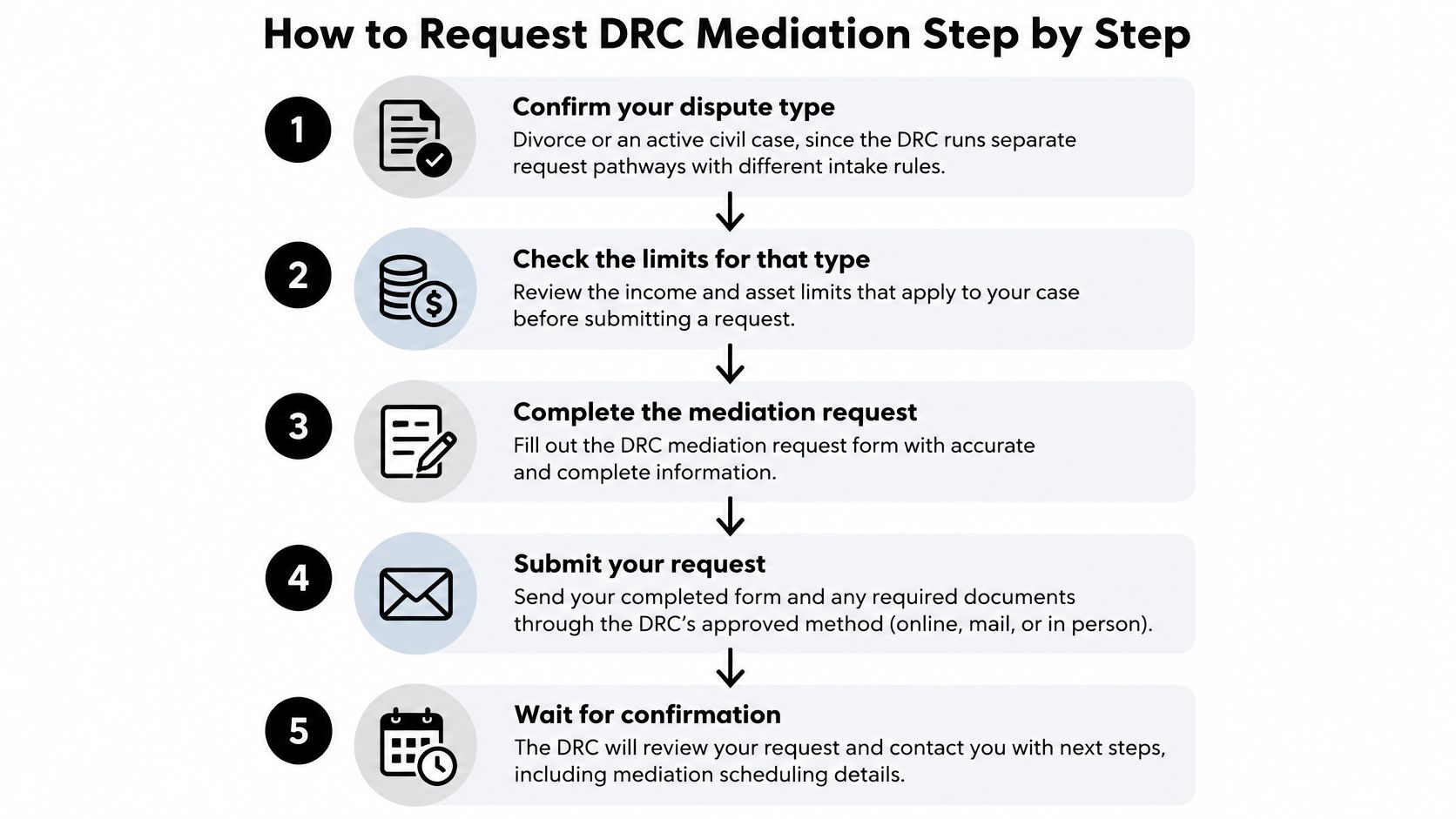
Confirm your dispute type. Decide whether you're requesting divorce mediation or mediation for an active civil case. Separate pathways have separate intake rules, and choosing the wrong one wastes time.
Check the limits for that type. Review income and assets for divorce, or claim value and party count for a civil case. Doing this first reduces the chance of a denied request.
Submit the matching request. Open the correct DRC request page and use the figures from your documents. Consistent numbers matter because intake may compare your request with the records you provide.
Call if you're unsure. The DRC can be reached at (713) 274-7100 on weekdays from 8:30 a.m. to 5:00 p.m. A brief eligibility question is easier to fix before submission than after rejection.
Choose a workable session time. According to the DRC active civil cases page, those mediations are held at 9:30 a.m. and 1:30 p.m. Monday through Thursday, and 9:30 a.m. on Friday. Pick a slot that gives you travel time and a quiet place to focus.
Confirm and keep records. Write down the date, time, location or format, and items you're told to bring. Keep emails and notes from each contact in one file.
If you're new to the process, our explanation of what mediation means in family court explains the mediator's neutral role in plain English. The mediator helps both sides explore settlement, but doesn't decide your case like a judge.
Don't wait until scheduling to think about your priorities. Know which terms you can accept, which ones need attorney review, and which issues would require a court hearing if mediation doesn't resolve them.
Domestic Relations Office Mediation Fees and Deadlines
Harris County Domestic Relations Office mediation is a separate option for family cases involving temporary and final orders. The session itself may have no mediation fee, but missing a procedural requirement can turn that no-cost appointment into a charge.
The Harris County Domestic Relations Office mediation process page requires at least 72 business hours' notice to cancel, and a late cancellation brings a nonrefundable $100 rescheduling fee that must be paid before the matter can be reset. That deadline is measured in business hours, so weekends can make the calendar less forgiving than families expect.
Three Procedural Triggers to Calendar
Cancel in writing and on time. Don't rely on a voicemail or assume the other party will notify the office. Keep proof that you sent timely written notice.
Reserve enough time. Parties and their attorneys must devote at least five hours to mediation. Clearing only two hours between work meetings isn't a realistic plan.
Use a private space. Failure to conduct the session in a private space can result in a $100 termination fee and notice to the court. A shared room, open workplace, or car with other people listening creates both privacy and compliance problems.
Say a Humble parent learns on Tuesday evening that a Thursday session conflicts with work. By then, the cancellation window may already have closed. The family could owe the rescheduling charge and still need to wait for a new date.
Calendar habit: Enter the cancellation deadline on the same day you accept the mediation date, not when the session gets close.
Families in Humble, Atascocita, Kingwood, and Northeast Houston should also test technology, arrange childcare, and confirm who will attend. If a fee does arise, ask which payment methods the office accepts and keep your receipt with your case file.
Alternatives When the DRC Program Does Not Fit
The free route ends when income, assets, or claim value pushes a case outside program limits. At that point the question changes from eligibility to what the case will cost, and the answer depends on which alternative fits.
| Option | Typical cost | Best for | Limitation |
|---|---|---|---|
| DRC mediation | Free if eligible | Divorce or civil cases within program limits | Income, asset, claim value, and party limits apply |
| Private mediator | Hourly rate or retainer set by the mediator | Cases outside DRC limits, or parties who want a private schedule | Parties pay the full cost |
| Court-ordered or court-referred mediation | Amount stated in the court order | Cases a judge refers to mediation | Rules and cost set by the court; confirm with the clerk |
| Pro bono or legal aid services | No fee for qualifying households | Households that meet income guidelines | Availability is limited; ask early |

A private mediator is often the practical choice when a divorce involves significant property, self-employment income, or a dispute that needs a schedule the county cannot offer. Ask for the hourly rate, minimum charge, expected session length, cancellation terms, and whether each side pays a share. Get those answers in writing before signing an engagement agreement. A retainer may look manageable until a second session is needed, so budget for more than one meeting.
Court-ordered mediation works differently because the judge's order controls the referral. Read the order, note any deadline to schedule, and ask the clerk or your attorney how the mediator is selected and paid. A court referral does not automatically send you to a free county program, and the order may set a rate or a payment split that the parties cannot change.
Legal aid and pro bono services can help households that meet income guidelines, but openings are limited and timing matters. Apply early, keep proof of your application, and keep a private option in reserve if a court deadline is approaching. A late start can make an affordable option unusable.
Preparation affects cost as much as the mediator's rate. Organizing your goals, listening for interests behind positions, and using Be Your Best Self & Thrive techniques can make a session more productive, especially when emotions run high. If you want an attorney involved in choosing and preparing for the right route, learn about our Humble family law and divorce services before you schedule.
Local Planning Tips for Humble and Northeast Houston Families
Picture your mediation morning before it arrives. You're leaving Humble, Atascocita, Kingwood, or Northeast Houston, trying to reach a weekday session while Houston traffic builds. The location is confirmed during scheduling, so map the route as soon as you receive it and add more buffer than you think you need.
Weekday sessions also affect ordinary family logistics. Arrange time away from work, school pickup, and childcare in advance. Tell your employer you may be unavailable longer than the scheduled start time suggests, because rushing out can pressure you into decisions you haven't fully considered.
Protect the Agreement After the Session
A settlement can feel fair in the room and still create problems later if the wording is vague. Terms about children, support, possession schedules, debts, or property should be reviewed by a family law attorney before you sign whenever possible. Clear drafting now can prevent an enforcement or clarification fight later.
The Law Office of Bryan Fagan in Humble handles divorce, custody, child support, and property division for local families. You can learn more about the firm at humbletxlawyers.com, including how we explain Harris County court procedure in plain English and help clients choose the next practical step.
Bring a short list of questions to any review. Ask what happens if the other party doesn't follow the agreement, when court approval is needed, and which deadlines begin once the document is signed.
Next Steps and a Free Consultation in Humble
If your case fits the DRC limits, submit the matching request and confirm the details directly with the program. If it falls outside the limits, or you're being asked to sign a settlement, have a local attorney review your options before you commit.

Our free consultation includes a confidential review of your case details, honest feedback about legal options and potential outcomes, guidance on Texas family law, and clear direction on what to do next. Call (281) 817-1827 to schedule, or visit us at 414 E Main St, Humble, TX 77338.
This short video offers another way to get familiar with our Humble team and approach before you call.
You don't have to sort out eligibility, paperwork, and settlement terms alone. Schedule your free consultation with our Humble office and leave with a practical plan for your next step.
If you're weighing free DRC mediation against a private mediator, the Law Office of Bryan Fagan can review your eligibility, prepare you for the session, and examine any proposed agreement before you sign. Schedule a free, confidential consultation today by visiting Law Office of Bryan Fagan or calling our Humble office.