 Skip to content
When divorce becomes real, Humble residents don't start by thinking about mediation. They think about the house, the children, the bills, and how awkward it will feel to sit across from a spouse they can barely talk to right now. If you're in Humble, Atascocita, Kingwood, or Northeast Houston, you may also be wondering whether you're headed into a long court fight you can't control.
For many Harris County families, mediation becomes part of that path whether they expected it or not. A contested divorce often can't move to trial until mediation happens first, according to Harris County mediation rules for contested divorce cases. That surprises a lot of people.
A local divorce mediation lawyer in Humble, TX helps you understand what mediation is, what it isn't, and how to protect yourself before you walk into the room. That matters because mediation can be productive and practical, but only when you prepare for it with a clear head and the right legal support.
Navigating Divorce in Humble TX
A common situation looks like this. One spouse is still living in the family home near Kingwood. The other has moved in with a relative in Atascocita. They're arguing about parenting time, who keeps which accounts, and whether the house should be sold. Neither person wants a public courtroom fight, but neither trusts the other enough to "just work it out."
That's where mediation often enters the picture. In Harris County, mediation isn't only a nice idea for couples who get along. In many contested divorce cases, it's a required step before a judge will allow the case to proceed to trial. The local rule applies to disputes over property or custody, which means many families in Humble and Northeast Houston will face mediation even when emotions are running high.
Why local families often feel stuck
People usually get overwhelmed for practical reasons, not legal ones. They don't know who speaks first, whether the mediator decides anything, or whether they can say no to a proposal that feels unfair. They also worry that showing up for mediation means giving in.
It doesn't.
Mediation is a place to negotiate from an informed position, not a place where you lose your right to advocate for yourself.
For some couples, mediation becomes the first setting where the divorce starts to feel manageable. Instead of waiting for scattered hearings, they begin working through parenting issues, property division, and unresolved disputes in a more focused setting.
Why this matters in Harris County
If your case is contested, you need to prepare for mediation as part of the legal process, not as an optional side conversation. That means having documents organized, goals defined, and a lawyer who understands how Harris County practice affects your next step.
Families in Humble often tell me they feel better once they understand that mediation has structure. It isn't casual. It isn't therapy. It isn't a surprise meeting where you're expected to solve years of conflict without help. It's part of how many divorces move forward here.
What Is Divorce Mediation in Texas
Texas divorce mediation is best understood as a structured negotiation. It isn't couples counseling. It isn't an attempt to fix the marriage. It's a formal process where a neutral mediator helps both sides work through disputed issues and try to reach an agreement.
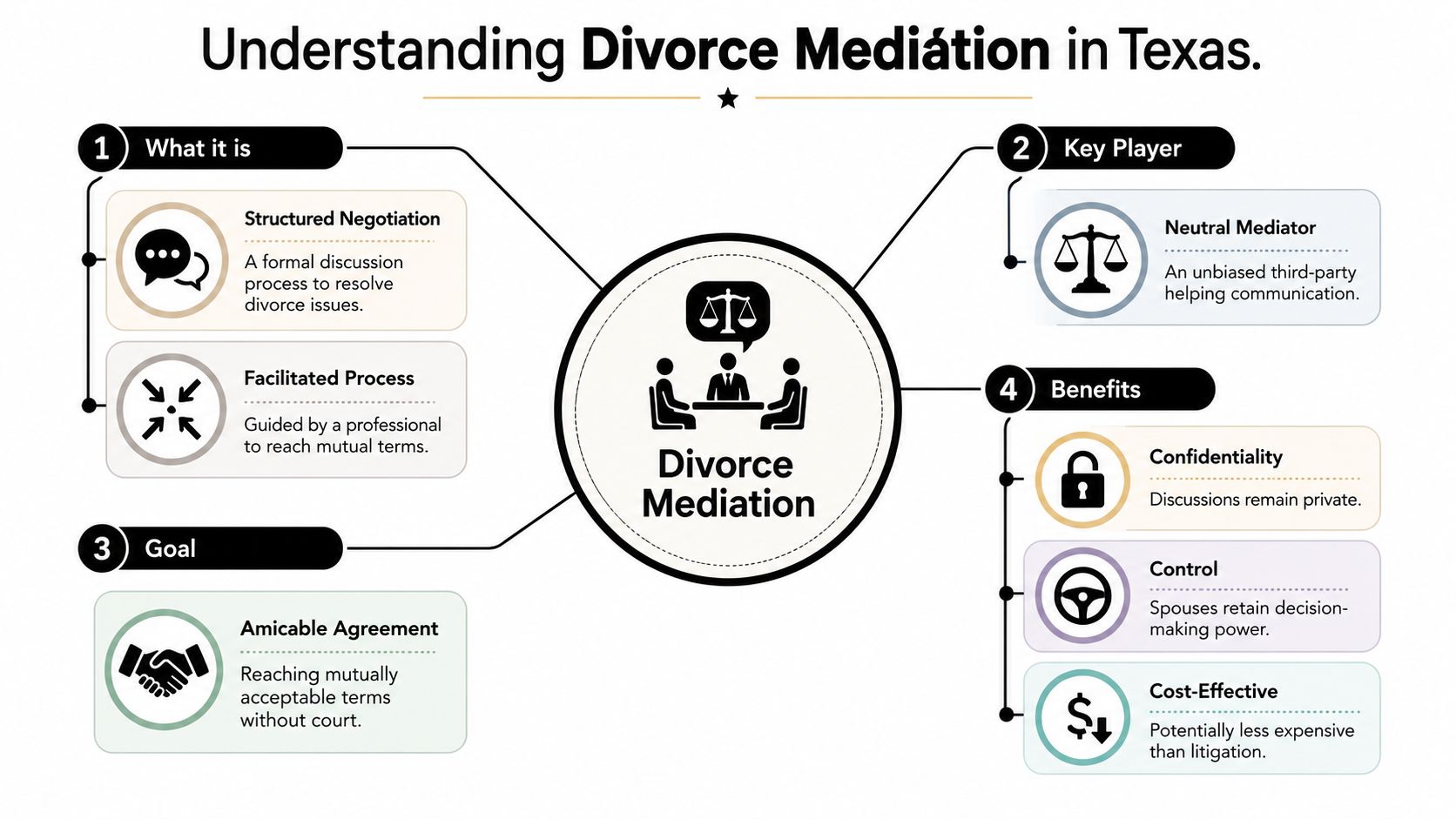
A simple way to think about it is this. Mediation works more like a guided business negotiation than a counseling session. Each spouse has interests, concerns, and positions. The mediator helps move the discussion forward, but the mediator does not become either person's lawyer and does not give either side personal legal advice. In Texas, mediation is a highly structured, non-counseling negotiation where the parties trade the risk of a judge's ruling for the requirement to actively participate in their own outcome, resolving all contested issues in one full session, as described in this Texas mediation overview video.
Who does what in mediation
Three roles matter most:
- The mediator helps manage negotiation and communication while staying neutral.
- Your lawyer protects your legal interests and advises you on whether a proposal is wise.
- You decide what terms you can accept and what you can't.
That's why support around the process matters. Some people also use outside organizational help, such as paralegal support for mediation, to stay on top of paperwork and preparation tasks before the session.
What mediation can cover
In a Texas divorce, mediation may address:
- Parenting issues such as conservatorship, possession schedules, and decision-making.
- Property questions including the home, accounts, debts, and personal property.
- Related disputes that keep the case from moving toward final orders.
If you want a plain-language overview of how family court mediation works locally, this guide on what mediation means in family court is a helpful starting point. Some people also begin by talking with a Divorce Lawyer in Humble, TX for divorce representation in Humble and Harris County before deciding how to approach negotiation.
Practical rule: The mediator manages the process. Your attorney protects your position. Those are different jobs.
Mediation vs Litigation The Two Paths for Your Divorce
Some divorces settle through mediation. Others continue into courtroom litigation. Clients don't need a lecture on legal theory. They need a side-by-side picture of how these paths feel in real life.
Divorce Mediation vs Court Litigation in Harris County
| Factor | Divorce Mediation | Court Litigation |
|---|---|---|
| Decision-making | Spouses negotiate terms with help from a neutral mediator | A judge decides unresolved issues |
| Process style | Private settlement discussions | Formal hearings and trial preparation |
| Scheduling | Can often be scheduled around the parties and attorneys | Driven by court calendars and docket availability |
| Privacy | More private discussion setting | Court proceedings are generally more public |
| Emotional tone | Often more focused on problem-solving | Often more adversarial |
| Co-parenting impact | Can support more workable communication for future parenting | Conflict may deepen when every issue is contested |
| Control over outcome | Parties have direct input into proposed terms | Final contested rulings come from the court |
| If no agreement is reached | The case can still continue in court | The court process continues until issues are decided |
For many families in Atascocita and Northeast Houston, the key dividing line is control. In mediation, you stay involved in shaping the outcome. In litigation, you present evidence and argument, but a judge makes the final call on whatever remains disputed.
When mediation fits better
Mediation often makes sense when:
- Parents want a workable future because they'll still be raising children together after the divorce.
- Privacy matters and they prefer discussing finances and parenting concerns outside a courtroom.
- There are several moving parts and they want one focused setting to negotiate them together.
When litigation may still be necessary
Litigation may be the better fit when:
- One spouse refuses to negotiate in good faith.
- Urgent court intervention is needed for temporary orders or protection.
- The case involves serious safety concerns or major factual disputes that can't be settled by agreement.
Lawyers also prepare for mediation differently than they prepare for trial. If you're curious how formal legal arguments are built, this step-by-step guide for legal practitioners gives useful background on structured legal writing. Even if your divorce settles, understanding how lawyers think can make the process feel less mysterious.
Some couples start in mediation and finish there. Others use mediation to narrow the issues, then ask the court to decide the rest.
The Step-by-Step Mediation Process in Harris County
A lot of Humble clients ask the same question after the case is filed. What happens on mediation day, and why is everyone treating it like a required stop in the process?
In Harris County, mediation is often not optional in practice. Courts commonly expect parties to attempt it before asking the judge to decide disputed issues. There is one major exception that families should hear clearly. If family violence, coercive control, or safety concerns are part of your case, the usual mediation path may need to change. Safety comes first, and the court can address that.
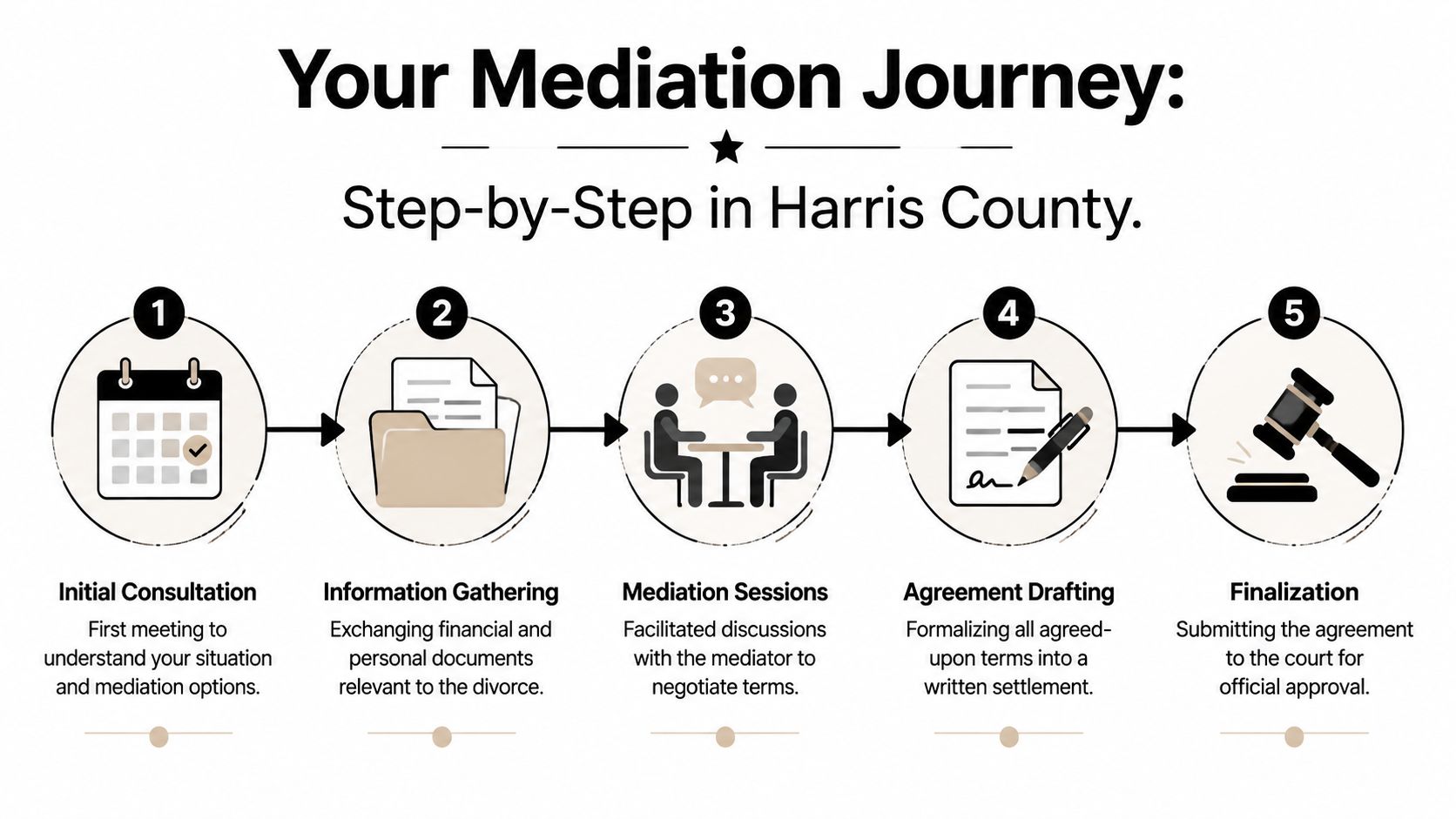
Step 1 The court sets the expectation, then the lawyers set the plan
For many Harris County divorces, mediation comes up early. Sometimes the court orders it. Other times, the attorneys schedule it because everyone knows the judge will likely want that effort made before a final hearing.
That does not mean every case should proceed in the same way. If there has been family violence, threats, stalking, intimidation, or a strong power imbalance, tell your lawyer immediately. Some cases need protective orders, temporary orders, shuttle-style mediation, or no mediation at all. A process designed to settle disputes should not place someone in danger.
Step 2 Choose the mediator
The mediator is a neutral professional who helps both sides work toward an agreement. The mediator does not act as the judge and does not force a result.
Choosing the right mediator matters. Some are better with business valuations and property tracing. Others are known for helping parents work through possession schedules and school-year logistics. Your lawyer should explain why a particular mediator fits your case, much like choosing the right contractor for a specific repair. The right skills make the day more productive.
Step 3 Exchange the information needed to negotiate
Mediation works best when neither side is guessing. Before the session, the lawyers usually gather pay stubs, tax returns, bank records, retirement information, debt balances, and documents related to the children.
This stage is where many cases either gain traction or stall out. If one spouse has incomplete records or unrealistic expectations, the session can turn into a long argument about missing facts. If you want a practical local checklist before the session, this guide to preparing for divorce mediation in Humble can help you organize what to bring and what to discuss with your lawyer.
Step 4 Attend the mediation session
Most divorce mediations in Texas last several hours and often take half a day or more, according to this explanation of Texas divorce mediation timing and settlement practice. In real life, that means you should clear your schedule, bring patience, and expect periods of waiting between offers.
Many Harris County mediations use separate rooms. Your spouse stays in one room with their lawyer. You stay in another with yours. The mediator walks back and forth, carrying proposals, questions, and counteroffers. It works a lot like a go-between in a difficult business deal. That structure often lowers the temperature and gives people space to think before responding.
Some sessions settle every issue. Some settle only a few. Both outcomes can still help.
Step 5 Review the Mediated Settlement Agreement with care
If you reach an agreement, the terms are written into a Mediated Settlement Agreement, or MSA. This is the part of the day when fatigue can cause expensive mistakes.
Slow down. Read every paragraph. Check dates, dollar amounts, account names, possession terms, holiday schedules, and who is responsible for each next step. If a sentence feels vague, ask for it to be rewritten. A good MSA should read like clear instructions, not a rough summary scribbled at the end of a long day.
Step 6 Turn the MSA into final court orders
After the MSA is signed, the lawyers use it to prepare the final divorce papers. In many cases, the signed agreement strongly shapes what goes into the Final Decree of Divorce, so signing should never be treated lightly.
A few practical rules help on mediation day:
- Keep your long-term goals in front of you. A parenting schedule has to work on ordinary Tuesdays, not just in the conference room.
- Ask questions before you agree. Confusion is a warning sign, not something to ignore.
- Expect movement in stages. Offers often change little by little.
- Speak up about safety concerns. If you do not feel safe, your lawyer and the court need to know.
For many families in Humble, mediation feels less intimidating once you see the order of events. It is a structured negotiation, not a courtroom surprise.
How to Prepare for Your Divorce Mediation
Preparation can change the entire tone of mediation. People who prepare usually feel less cornered, less emotional, and more able to make good decisions under stress.
Start with the filing basics
Before any divorce moves forward in Texas, one spouse must have lived in the state for at least six months and in the county for at least 90 days before filing, according to this Texas divorce residency explanation. For families in Humble, that usually means confirming Harris County residency before building the rest of the strategy.
After that, practical preparation becomes the focus.
Build your mediation file
A strong pre-mediation file usually includes:
- Financial records such as account statements, debt information, and income documents.
- Property details including lists of vehicles, real estate, and valuable personal items.
- Parenting notes if child-related issues are disputed.
- Questions for your lawyer so you don't rely on memory during a stressful meeting.
If you'd like a more detailed local checklist, this guide on how to prepare for divorce mediation can help you organize the process.
Know your goals before the day begins
Don't walk into mediation with only a general hope that "it works out." Define your priorities ahead of time.
Try breaking them into three categories:
- Must protect items, such as a parenting concern or a key financial issue.
- Open to negotiation items where several solutions might work.
- Emotionally charged but legally secondary issues that may feel important in the moment but shouldn't control the outcome.
The people who do best in mediation usually know the difference between a deal they dislike and a deal they can't safely or legally accept.
The safety exception many people miss
This part is critical for Humble and Northeast Houston families. Mediation is not always the right setting. Texas law permits a party to object to and bypass mandatory mediation if there's a proven history of family violence, but the written objection must be filed before the mediation order is final, as explained by TexasLawHelp on divorce and mediation.
If you've experienced threats, physical violence, coercion, or a pattern of intimidation, don't assume you must attend mediation just because someone told you it's required. Safety concerns need legal attention early. Waiting too long can limit your options.
Choosing the Right Divorce Mediation Lawyer in Humble
The mediator is neutral. Your lawyer isn't. That's the point.
For a divorce mediation lawyer in Humble, TX, individuals are typically looking for someone who can do two things simultaneously. First, keep the process steady and practical. Second, step in when a proposed agreement would put them at risk financially or as a parent.

What your lawyer does during mediation
A mediation lawyer helps you prepare positions, review options, spot legal problems, and evaluate settlement language before you sign anything. In Texas, it's standard for each spouse to retain their own attorney for independent legal advice, while both parties typically split the cost of the neutral mediator equally, as described in this overview of mediating divorce with separate attorneys.
That arrangement matters because neutrality and advocacy shouldn't be confused. A mediator can help move the conversation. Your lawyer helps protect your rights.
Questions worth asking before you hire anyone
Ask direct questions. You don't need to impress the lawyer. You need useful answers.
- How do you prepare clients for Harris County mediation?
- What's your approach when the other side uses delay or pressure tactics?
- How do you help clients evaluate a proposed parenting plan?
- What happens if mediation ends without a full agreement?
- How do you handle cases involving safety concerns or a history of family violence?
Some people compare several firms before deciding. A local guide on how to choose a divorce lawyer in Humble Texas can help you frame that decision.
One local option people consider is the Law Office of Bryan Fagan through its Contested Divorce Attorney in Humble page, which addresses advocacy for high-conflict divorces in Harris County courts.
A short video can also help you think through the attorney's role before you commit to representation.
Signs the lawyer may be a better fit
Look for someone who can explain legal risk in plain English. You also want a lawyer who understands local practice in Humble, Kingwood, Atascocita, and the broader Harris County system, because local procedure affects timing, expectations, and negotiation strategy.
A good consultation should leave you clearer, not more confused.
Your Next Step A Path Forward in Humble
Divorce changes daily life fast. Mediation can slow the chaos down enough for you to make careful decisions about your children, your finances, and your next chapter. For many families in Humble, Kingwood, Atascocita, and Northeast Houston, that's a much healthier starting point than walking blindly into a courtroom fight.

The key is getting guidance early. If mediation is likely in your case, you need to know how Harris County handles contested divorce, how to prepare your documents, and whether any safety issue changes the path entirely. If family violence is part of your history, that concern needs attention before the case gets pushed into a setting that doesn't protect you.
You don't have to solve every part of your divorce today. You do need a clear first move. A confidential conversation with a local lawyer can help you understand whether mediation is appropriate, what to expect from the process, and how to protect what matters most.
If you're ready to talk through your divorce options with a local team that serves Humble, Atascocita, Kingwood, and Northeast Houston, schedule a free consultation with the Law Office of Bryan Fagan. A private conversation can help you understand your rights, prepare for mediation, and choose a path forward that fits your family.


