An approved surety is a bail bond company or agent licensed by the Harris County Bail Bond Board to post bail in a criminal case. The Board's Approved Bonding List identifies who currently has county authorization. Texas requires bail bond boards in populous counties, so Harris County families can use the official list rather than a flyer passed around a jail waiting room to check who may write a bond.
The call often comes at night. Someone you love is in custody, the jail website shows a bond amount, and a cousin has found a bondsman promising a quick release. The family wants to bring that person home without putting the house at risk.
An approved listing answers one specific question: whether a company or agent is authorized by the county. It does not settle what the bond will cost, how the company will treat your family, or what its forfeiture history looks like. Check the listing first, then ask direct questions about those matters before signing or paying. That turns a panicked scramble into a short list of practical questions.
What an Approved Surety Means in Harris County
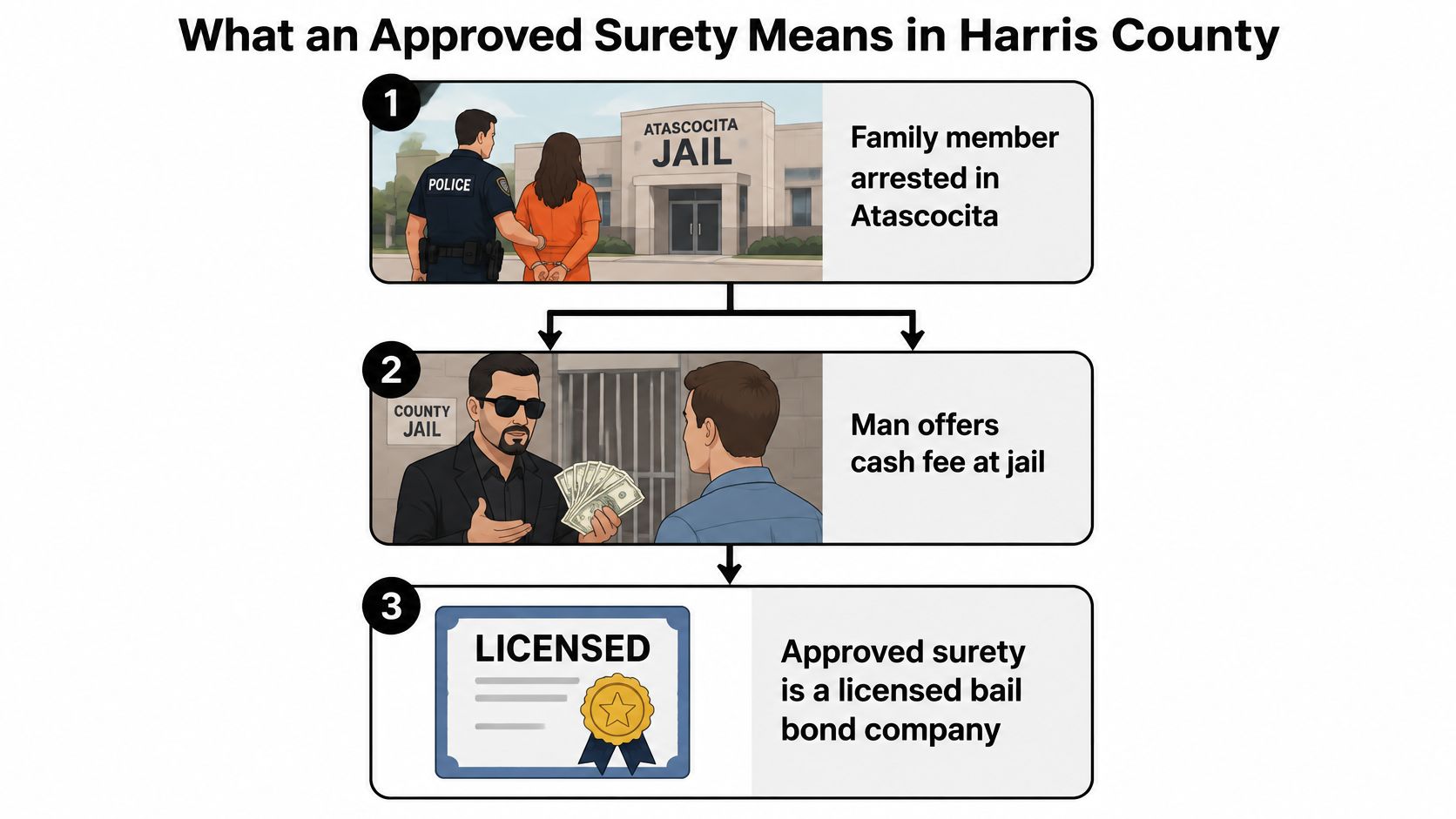
Say your nephew is booked into the Harris County jail after an arrest on the north side near Atascocita. By midnight the family group chat holds three offers of help, and one of them comes from a man who says he works at the jail and wants cash in hand tonight. Before anyone drives to a bond desk with an envelope, the family needs one fact settled.
Approved status has a fixed legal meaning. It describes a company or agent the Harris County Bail Bond Board has licensed to post bail for a defendant in a criminal case.
The Board isn't a trade association or a paid referral directory. According to the Harris County Bail Bond Board, it is the county agency that regulates the local commercial bail-bond industry. Its statutory work includes supervising each phase of the bonding business, adopting and posting rules that implement Texas Occupations Code Chapter 1704, holding hearings and investigations on the issuance, denial or renewal of licenses, and issuing or denying licenses to Harris County sureties. A company must be licensed by the Board before it posts bail for a defendant in a criminal case here.
County size explains why the Board exists at all. The Texas Department of Insurance explains that Texas creates a mandatory bail bond board in every county with a population of at least 110,000, and that state law generally prohibits a person from acting as a bail bond surety or a corporate-surety agent in that county without a license. Harris County clears that threshold many times over, which makes the Board the gatekeeper for families in Humble, Kingwood, Atascocita and Northeast Houston.
What the approval actually proves
Think about a roofing contractor. A neighbor's assurance that the crew does good work is worth something. The inspector's stamp in the permit file is worth more, because a government office checked the license before the first shingle went down. The Board's list works the same way. It confirms that a named business cleared a county licensing process. It doesn't rank that business against its competitors.
Families often get confused. A person who offers to guarantee release for cash can be helpful, well known on the block, and still not licensed to execute a bond. The Texas Department of Insurance notes that Board oversight applies whether an agent posts a bond secured by nonexempt real property or acts for a corporate surety such as an insurance company.
Practical rule: No license, no bond. If a name isn't on the Board's list, don't hand over cash, collateral or a signature.
One sentence covers it. Approved status means the county has authorized that company to write bail here, and that's the question to answer before any money moves.
Who Qualifies as an Approved Surety in Harris County
Approval rests on a license, and the license rests on the applicant. The eligibility framework in Texas Occupations Code Section 1704.152 is specific enough that a family can see exactly what a legitimate surety cleared before its name ever reached the county list.
What an individual applicant must clear
An individual surety must be a Texas resident and a United States citizen, must be at least 18 years old, and must satisfy the documentation and education requirements the statute sets. One requirement is easy to remember because it's concrete. The framework identifies at least eight hours of in-person continuing legal education in approved criminal-law or bail-bond-law courses offered by an accredited Texas institution.
A corporation takes a different route to the same gate. It must be chartered or admitted to do business in Texas and must pay a $500 filing fee. Whether the applicant is a single agent working for himself or a company fielding a dozen bondsmen, the licensing process examines security, solvency and credit, and a license holder must keep the required security in place for as long as the license stays active.
| Requirement | Individual Bail Bond Surety | Corporate Surety |
|---|---|---|
| Residency or business status | Texas resident | Chartered or admitted to do business in Texas |
| Citizenship | United States citizen | Business status governs; the entity test is charter or admission to do business in Texas |
| Minimum age | 18 or older | Not an age test; the entity qualifies through its charter or admission |
| Education | At least eight hours of in-person continuing legal education in approved criminal-law or bail-bond-law courses from an accredited Texas institution | The licensed agents who act for the corporate surety carry the individual education requirement |
| Filing fee | No separate individual figure appears in the eligibility framework; the $500 fee is stated for corporations | $500 |
| Financial review | Security, solvency and credit examined, with required security maintained while licensed | Security and solvency reviewed, with required security maintained while licensed |
Why the paper trail matters on FM 1960
Read that table as a filter, not a ranking. A company that clears every line has proven it can meet the county's baseline. It has not proven it will quote you a fair premium, answer the phone at 2 a.m., or handle a forfeiture well.
For a family in Humble or Northeast Houston, the practical value sits in comparing an advertisement to a license. An online ad, a sponsored search result or a friend's recommendation tells you a company exists and markets itself. The license tells you the county checked residency, citizenship, age, education, security and solvency before that company could sign a bond. When the two conflict, the license wins.
That's why a verified listing is more reliable than a slick landing page. Pull the exact company name off the paperwork, then match it against the county record.
These requirements confirm eligibility only. They tell you nothing about price, service quality or a company's track record with the courts.
Keep that boundary in mind as you read any bonding company's marketing. Approval answers one question well, and the next section covers how to check it.
How to Verify a Surety Is Approved Step by Step
Your goal is narrow. Before you pay a premium, sign a bond or hand over a car title as collateral, confirm that the exact company in front of you is approved today. These steps take about ten minutes and cost nothing.
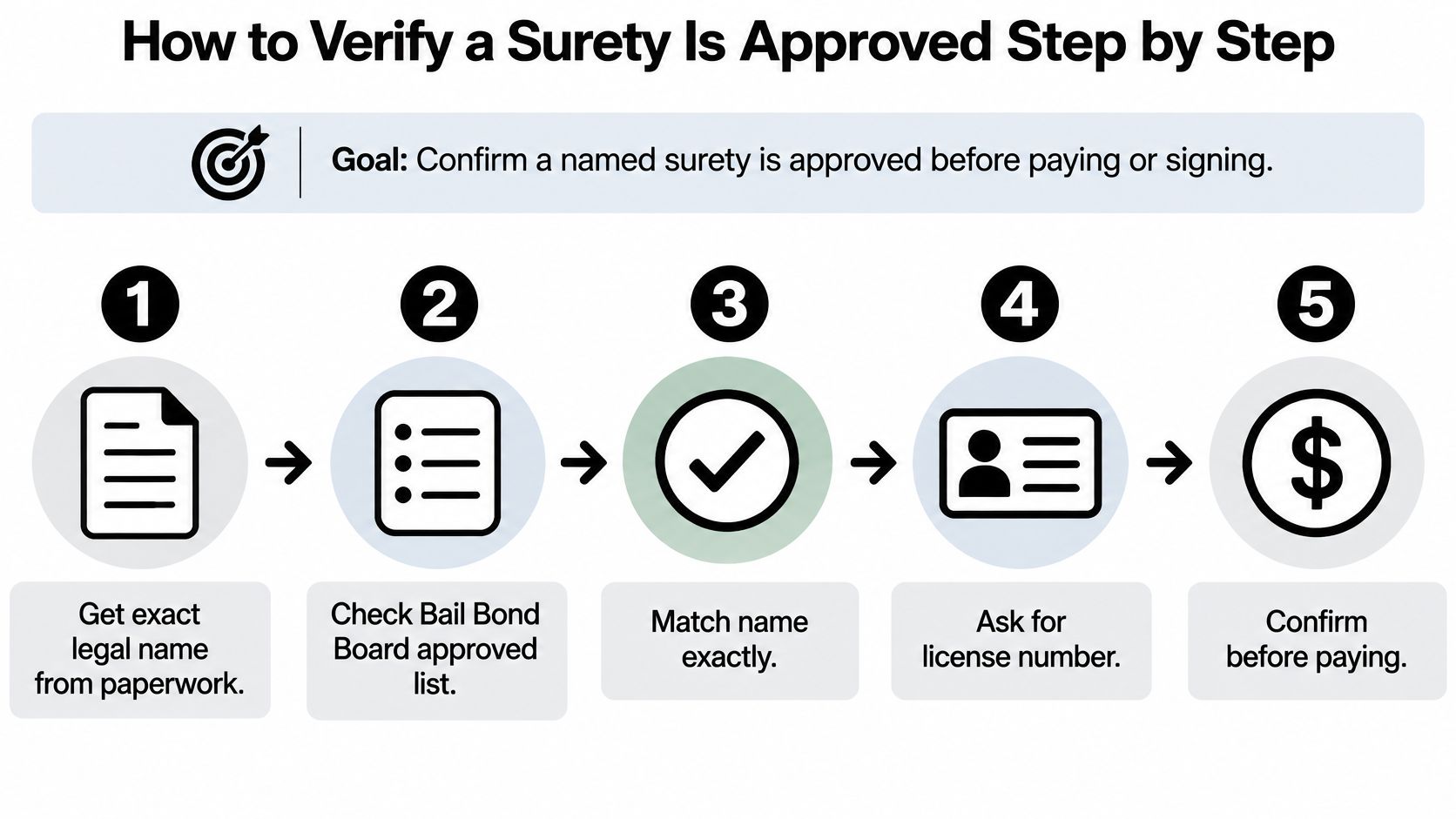
1. Get the exact legal name. Pull it from the bond paperwork, the written offer or a receipt, not from a business card. The name on the card is often a trade name, while the licensed entity may read something like "XYZ Bail Bonds LLC" or "XYZ Insurance Agency Inc."
2. Open the Board's Approved Bonding List. The Board publishes an Approved Bonding List and an Approved Attorneys list on its own site, alongside its rules, licensing information and forms.
3. Search the full name and match every character. Check spelling, punctuation and the corporate suffix. A result that matches only the first word of a company name is not a match, and a similar name is exactly what a false listing relies on.
4. Write down the date of the list you checked. Keep that note with your bond paperwork. If a dispute comes up later, you can show what the record said on the day you looked.
5. If the name is missing, check the archive. The Board's archived documents page holds at least 11 distinct approved-bonding-company document periods for 2024, covering January 20, 2024 through January 18, 2025. A company that appears only in an older period is not confirmed as currently approved.
6. Ask the agent to show the listing. A licensed company produces this without drama. A runaround is an answer too.
7. If you still can't confirm, stop. Don't pay, don't sign and don't hand over collateral. Call an attorney and let someone with the standing to ask the question ask it.
Reading the official resources side by side
Harris County publishes more than one bail-related resource, and each answers a different question. The county's Dashboards and Datasets Hub files the County Bail Dashboard under its Justice and Safety category, and that dashboard presents county bail statistics rather than a roster of who may write bonds.
| Resource | What It Confirms | What It Does Not Confirm |
|---|---|---|
| Approved Bonding List | The surety is currently authorized by the Harris County Bail Bond Board | Pricing, service quality, forfeiture history or case outcomes |
| Approved Attorneys | That a named attorney appears on the Board's approved attorney listing | Whether any bonding company is authorized to post bail |
| County Bail Dashboard | Statistical information about bail in Harris County | Whether a specific surety is approved |
| Archived documents | Earlier approved-bonding periods, including at least 11 document periods in 2024 | Current status of any surety |
Three rules for reading the lists
Current, archived or absent. A name on the current list is authorized to write bail in Harris County today. A name found only in an archive is not confirmed as approved now. A name on no list, current or archived, should never be trusted with your money.
Approval confirms authorization and stops there. It does not tell you the premium, whether the company returns calls on a weekend, or how it has handled past forfeitures. Those answers come from the written agreement, from a second company's quote and, when something looks wrong, from a lawyer.
You've passed the check when three things line up: an exact name match, a current listing dated the day you looked, and a bond amount the surety can cover under its posted capacity.
Bond Limits and Common Pitfalls to Avoid
A number makes this concrete, and it matters in Humble as much as anywhere else in the county.
The Harris County Bail Bond Board local rules require each new or renewing applicant to show it can indemnify the county against loss. A deposit of $50,000 in cash, qualifying certificates of deposit or acceptable real property satisfies that financial-responsibility requirement. The same rules carry a limit families rarely hear about. A licensee may not execute a single bond that exceeds the amount deposited with the Board.
Run the arithmetic. A surety holding a $50,000 deposit cannot lawfully write a $75,000 bond. Confidence at the counter doesn't change that math. If the bond in your case is larger than the surety's posted capacity, the family needs a second company or a written explanation of how the bond will be handled.
The review behind those numbers isn't casual. Applicants submit current financial statements, profit-and-loss statements and asset-liability balance sheets, and the information generally must be no more than 90 days old. An applicant may have to confirm its continuing accuracy under oath. A new application also carries a 31-day filing lead time before the Board considers it, so capacity can lag behind a sudden need.
Three pitfalls and the fix for each
- Treating approval as a quality rating. Fix it by pricing the bond with two approved companies and comparing premium, collateral and payment terms in writing before you choose.
- Taking a large bond to a small surety. Fix it by asking what the company has on deposit with the Board, then checking whether the bond amount fits under that ceiling.
- Signing before the fee terms are clear. Fix it by reading the agreement first, keeping a receipt for every payment, and refusing any deal that only exists in conversation.
- Forgetting what follows an arrest online. Booking photos travel farther than the case does, so households should also know how to remove arrest photos from Google once the release is settled.
When the bail amount itself is the fight, the hearing is where it gets argued. Our explanation of what happens at a bond hearing walks through who speaks, what the judge can change and what the family should bring.
What to Gather and Ask Before You Post Bail
Once the name checks out, the work shifts to documents. Collect these before anyone pays.
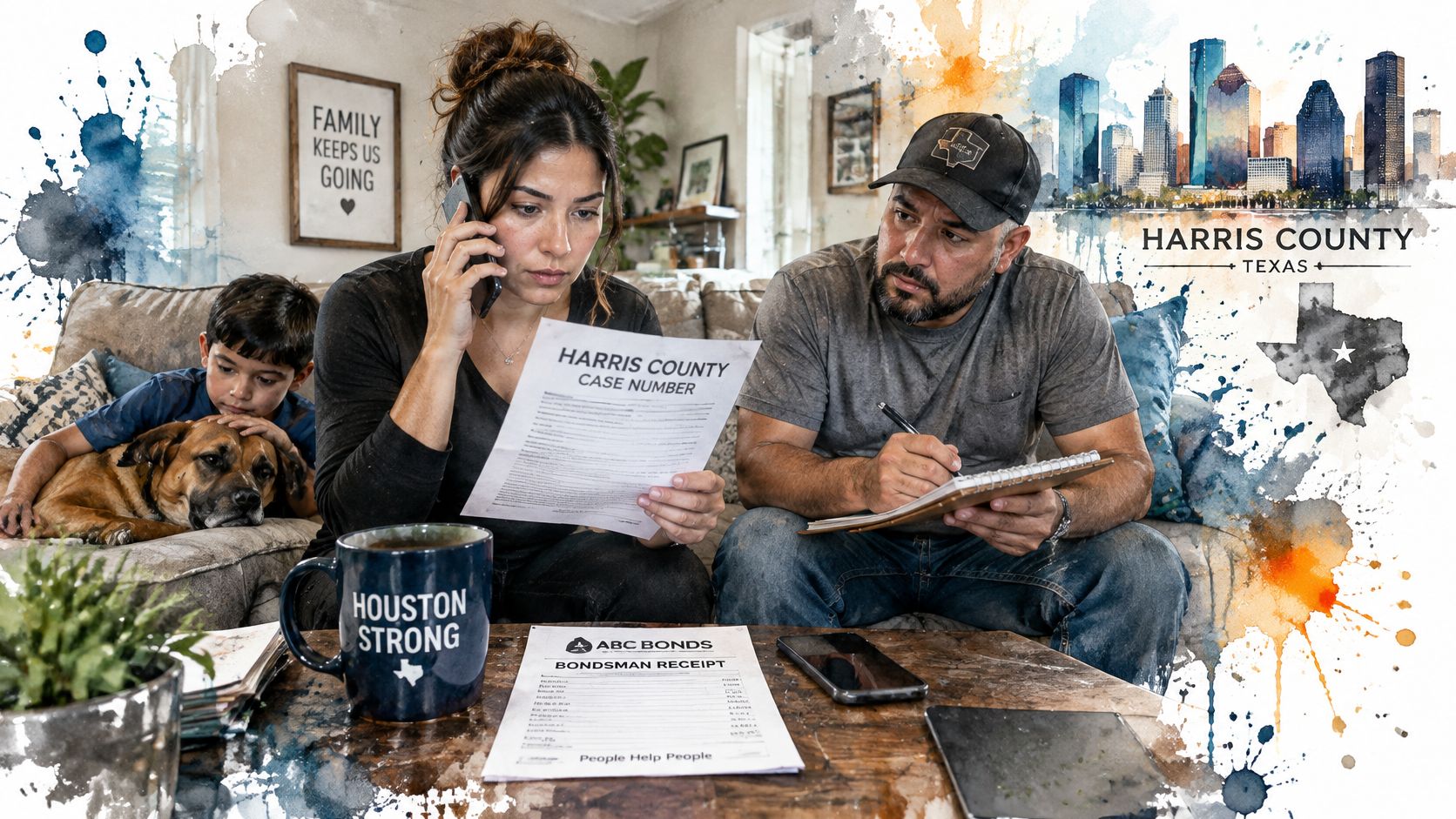
- The case number, charges and booking details. Pull them from the bond paperwork or the court notice. Every call, payment and court date later refers back to those identifiers, and a wrong case number sends money to the wrong file.
- The bond amount and every printed condition. Read the court and the date the defendant must appear. A condition nobody read is a condition nobody keeps.
- The exact legal name you verified, plus the date you checked it. Write both on the folder. If the company later disputes anything, your note shows what the record said.
- The premium, collateral and payment schedule in writing. Verbal promises about refunds or installment plans are hard to prove three months later.
- The name of everyone who signs, and what each signer guarantees. A parent who co-signs may be pledging far more than the premium.
- A receipt for every payment and a copy of every signed document. Paper trails end arguments that memory can't settle.
- A shared calendar with every court date. A missed appearance is where a manageable case turns into a forfeiture and a new set of problems.
If you're still working out the mechanics of release, our walkthrough on how to bail someone out covers the order of events from booking to the bond desk.
If a video is easier to follow than a checklist, the overview above covers the process in plain terms. By the end, a family should be able to show four things: a verified name, a written fee agreement, a copy of the bond, and a calendar of court dates.
When to Call a Humble Attorney Before You Sign
A surety listing can confirm county authorization, but it does not settle every question about your case or the terms in front of you. Call an attorney before signing if the surety's name is missing from the approved list, the bond amount exceeds its posted capacity, or someone offers to guarantee release without a license. Get advice if the fee terms are unclear or you feel pressured to decide quickly.
A prior missed court date or serious charge may also affect what the family should consider next. The surety's approval status, the bond terms, and the court case are separate pieces of the decision. Understanding the case can help you weigh the next step before you sign.
The Law Office of Bryan Fagan serves clients in Humble and surrounding areas, including Atascocita, Kingwood, and Northeast Houston. Its office is at 414 E Main St, Humble, TX 77338, and the firm serves clients throughout Harris County and the Houston metropolitan area. Call (281) 817-1827 to discuss scheduling a consultation.
What the free consultation covers
During a free consultation, you receive a confidential review of your case details, honest feedback about your legal options and potential outcomes, guidance on relevant Texas criminal law, and clear direction on what to do next. Bring the case number and any documents you have so the discussion can focus on your situation.
An attorney can explain Harris County court procedure in plain English and help you decide on a practical next step. For guidance about a bond hearing, contact Humble bond hearing lawyers.
Call early. Speaking with counsel before the next court date gives you time to understand your options.
You do not have to make a difficult decision alone or under pressure. A consultation can help you separate what the surety listing confirms from what remains to be understood about your case.