Skip to content

A late-night call can leave a Humble family with more questions than answers. A loved one has been arrested, the family doesn't know which Harris County facility has custody, and everyone wants to know the same thing: When can they come home, and what will it take?
A bond hearing is one of the first opportunities to address that question. It doesn't decide guilt or innocence. It determines whether the defendant can be released while the criminal case continues, and what financial or supervision requirements will apply. For families in Humble, Atascocita, Kingwood, and Northeast Houston, preparation during the first hours can affect employment, housing, childcare, and the ability to work with a defense lawyer outside jail.
What a Bond Hearing Really Means for Humble Families
Suppose a spouse in Atascocita receives a call after midnight. Their partner was arrested in Humble and transported into the Harris County jail system. The spouse knows the charge only in general terms, has no idea whether bond has been set, and is trying to decide whether to contact a bondsman or a lawyer first.
The immediate issue is the bond hearing. A magistrate reviews the arrest and decides the terms under which the accused person may be released before trial. The hearing usually addresses the bond amount, the type of bond, and conditions such as monitoring, testing, curfew, or no contact with an alleged victim.
Bond isn't a finding that someone committed a crime. The criminal case still requires the State to prove the charge. At this stage, the court is focused on practical concerns, including whether the person will return for court and whether release can protect the alleged victim and the community.
Practical rule: Treat the bond hearing as a release and safety hearing, not as a miniature trial.
The timing matters because Texas jails hold many people who haven't been convicted. In 2024, Texas county jails held more than 53,000 people on any given day who had not been convicted, representing more than 70% of the overall jail population, with an estimated taxpayer cost of about $1.2 billion, according to the ACLU of Texas report on bail in Texas. The same source reports that the pretrial population grew 119% between 2000 and 2024, from 24,168 to 53,048 people.
For a family in Kingwood or Northeast Houston, remaining in custody can quickly disrupt a job, lease, medical care, or family responsibilities. A bond hearing lawyer in Humble, TX, focuses on presenting reliable information early, before assumptions about flight risk, safety, or ability to pay become difficult to correct.
How the Texas and Harris County Bond Process Works
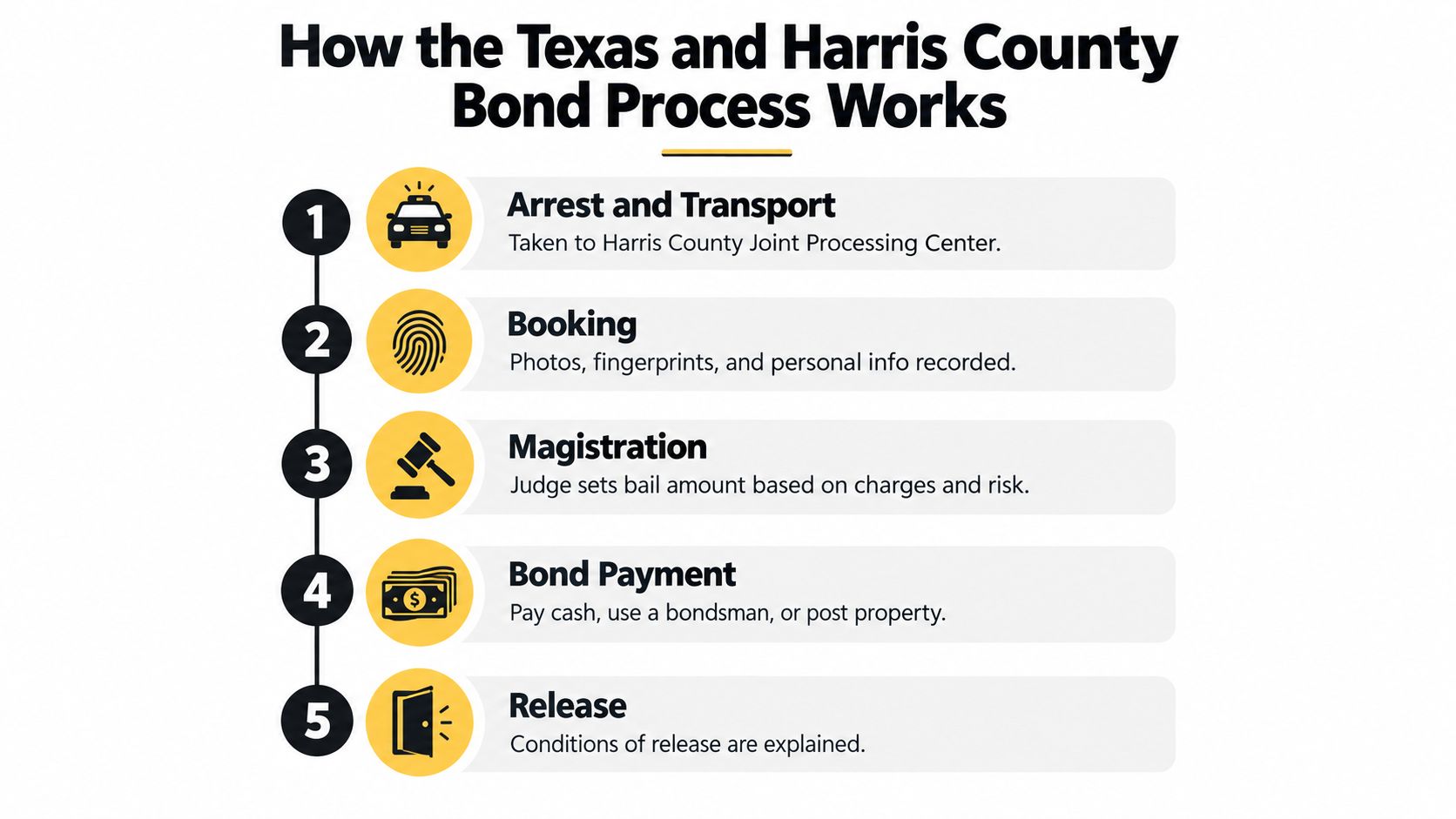
The process generally follows a sequence. Each stage gives the defense a reason to gather information and act promptly.
Arrest and booking
After arrest, the defendant is transported into the Harris County system, commonly through the Harris County Joint Processing Center. Booking records identifying information, fingerprints, photographs, the alleged charge, and other case details. Families should obtain the person's full name, date of birth, booking information, and current location as soon as possible.
Magistration
Texas law requires an arrested person to be brought before a magistrate without unnecessary delay and no later than 48 hours after arrest, according to Texas Senate Bill 6 materials concerning magistration and bail procedures. At this appearance, the magistrate explains rights, reviews probable cause information, and addresses bail.
The magistrate may be a Harris County deputy or associate judge rather than the trial judge who will later handle the criminal case. A prosecutor may appear or provide the State's position. The defendant is present, often remotely or in a jail courtroom setting, while defense counsel argues for release or more manageable terms.
What the magistrate decides
The magistrate may consider probable cause, the accusation, criminal-history information, prior failures to appear, warrant information, and available protective-order information. Under the newer Texas bail framework, qualifying cases can involve more structured detention procedures, public-safety information, prosecutorial participation, and formal findings.
The court also decides the bond amount and conditions. Texas law requires the court to use the least restrictive conditions reasonably necessary to ensure appearance and protect the community, law enforcement, and the alleged victim. Conditions can include home curfew and electronic monitoring under Texas Code of Criminal Procedure Article 17.028.
Posting bond and later review
Once bond is set, the family may use cash, a licensed bondsman, or property when permitted by the order. Release still requires jail processing, so a favorable ruling doesn't always mean immediate discharge.
If the amount or conditions are unworkable, counsel can request review or reduction in the assigned criminal court. Felony cases and bond review motions generally move through the Harris County Criminal Justice Center, while the initial setting occurs through the jail and magistrate process. Families should prepare for the first appearance within the statutory 48-hour benchmark, while practical release timing can vary with booking, weekends, holidays, paperwork, and court workload.
For a plain-language explanation of a later court stage, review what happens at an arraignment hearing.
Types of Bond a Humble Defendant Can Request
Texas bond options differ in who assumes the financial obligation and what the defendant must do to remain free. The magistrate makes the final decision, but a defense lawyer can advocate for the option that matches the person's residence, employment, family support, and history.
Texas Bond Types at a Glance
| Bond Type | How It Works | Who Pays What | Best Fit For |
|---|---|---|---|
| Personal recognizance bond | The defendant promises to appear and follow court conditions | Usually no financial payment is posted upfront, though conditions may still carry consequences | A person with strong local ties and a workable appearance plan |
| Surety bond | A licensed bondsman posts the required amount | The family pays the bondsman's required fee and complies with the agreement | Families who can't post the full amount directly |
| Cash bond | The full ordered amount is posted with the court or jail system | The person posting the bond provides the cash required by the order | Families able to access the full amount |
| Condition bond | Release includes specific requirements such as testing, curfew, monitoring, or no contact | Financial responsibility depends on the underlying bond type, while the defendant must follow every condition | Cases where the court wants supervision tied to a particular concern |
A personal recognizance bond, often called a PR bond, is not automatic. The court may consider the charge, prior record, prior court attendance, safety concerns, and the strength of the defendant's release plan. New Texas bail procedures can also limit or complicate personal-bond eligibility in some cases, particularly where detention and public-safety findings are at issue.
A surety bond and a cash bond aren't interchangeable. A bondsman can help arrange release through a surety bond, but a defense lawyer serves a different role. The bondsman handles the financial transaction and contractual requirements. The lawyer argues why release should be granted, why the amount should be lower, or why conditions should be adjusted.
Conditions can affect family life even after release. Drug testing, treatment, travel limits, ignition-interlock requirements, curfew, GPS monitoring, and no-contact orders may affect work schedules, transportation, parenting exchanges, and residence arrangements. A parent dealing with a related Harris County support matter may separately need a Child Support Attorney in Humble for establishing, modifying, or enforcing child support.
How a Humble Defense Lawyer Argues for Lower Bond or Release
A strong bond argument is organized around Texas Code of Criminal Procedure Article 17.15. The court must balance the least burdensome release condition with appearance risk, offense severity, community and victim safety, and the defendant's ability to pay, as described in Article 17.15 of the Texas Code of Criminal Procedure.
Start with verified stability
A lawyer doesn't merely tell the magistrate that the defendant is a good person. Counsel presents evidence showing where the person lives, who depends on them, how they earn income, and why they have reasons to return to Harris County.
Useful information can include:
- Residence: A lease, utility record, or household member who can confirm where the defendant will live.
- Employment: Pay records, an employer letter, a scheduled shift, or other proof of a stable work routine.
- Family responsibilities: Childcare, elder care, medical support, or other duties that require the person to return.
- Court history: Accurate information about prior cases, appearances, and any explanation for missed dates.
- Treatment and health records: Documents that clarify mental health, substance use, or medical issues the State may otherwise interpret as risk.
Address safety concerns with workable conditions
If the State raises concerns about alcohol, drugs, contact with an alleged victim, or location, the defense can propose conditions that directly respond. Possible requests include GPS monitoring, testing, curfew, treatment, a no-contact order, or a specific residence.
Texas law permits personal-bond conditions involving alcohol or drug testing and treatment when the magistrate reasonably believes controlled substances or substance abuse relate to the alleged offense, as provided in Article 17.03. The point isn't to accept every restriction without question. It's to offer a realistic plan that protects safety without making release impossible.
A concise, document-driven presentation is usually more useful than a long emotional argument. Lawyers preparing written material may benefit from the practical organization principles in this Voice Control Pro brief writing guide, particularly the focus on clear structure and supported points.
Identify the right legal remedy
Some cases call for a PR bond request. Others require advocacy for a reduced surety bond, a cash-bond review, or modified conditions. The 2021 reforms and later Texas changes mean counsel must examine the exact charge, the applicable detention framework, and the State's evidence rather than rely on a preset expectation.
A lawyer may also review the charging documents for procedural problems or missing information that affects the bond argument. That review doesn't decide the criminal case, but it can help counsel challenge an unsupported risk assessment and request a more individualized ruling.
Preparing for the Bond Hearing Step by Step
Families can help before the case is called. The goal isn't to deliver a large stack of papers. It's to assemble a focused packet that answers the magistrate's likely questions.
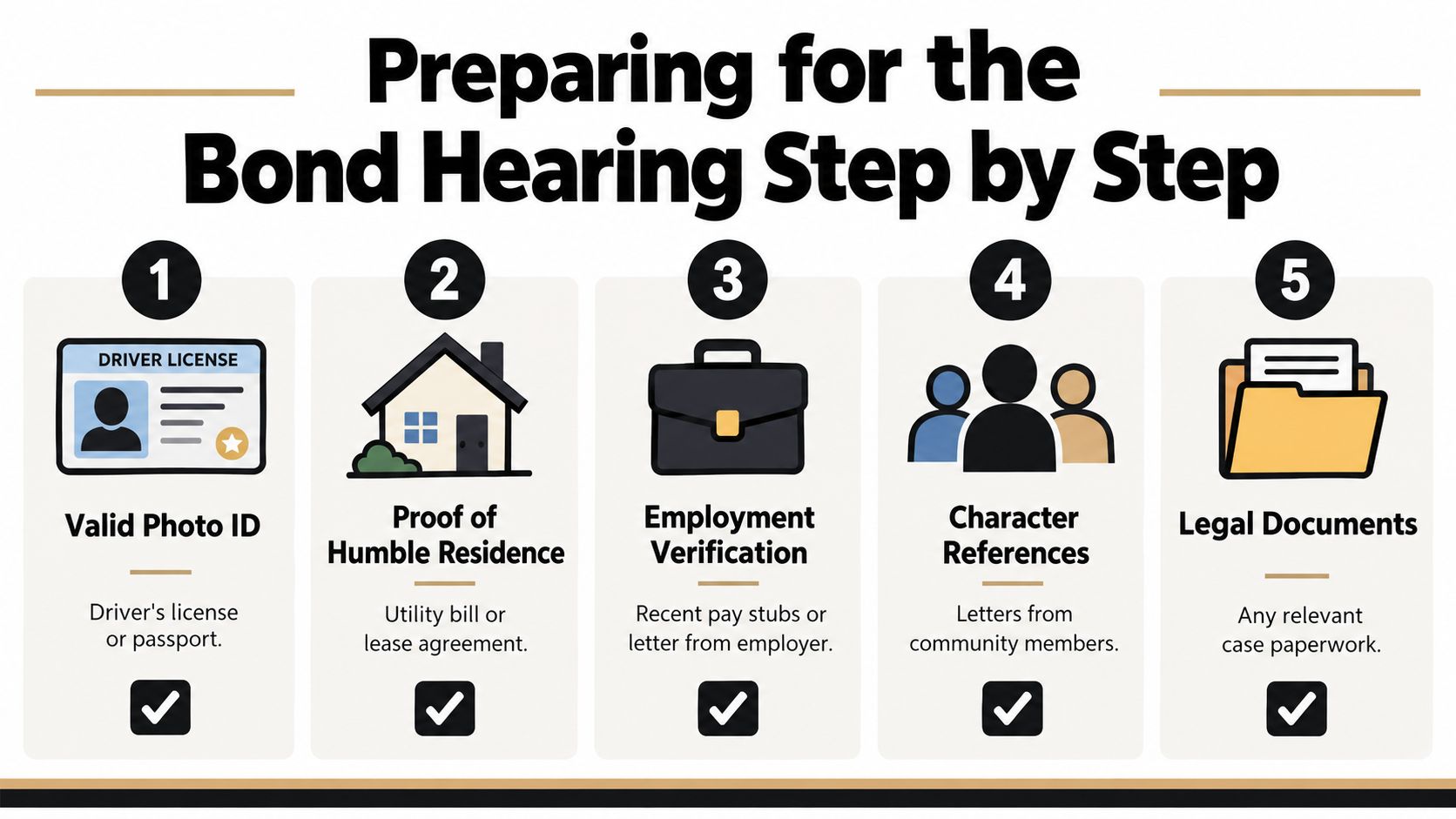
Gather the core documents
Start with materials that establish identity, residence, employment, and support:
- Valid photo identification: A driver's license, passport, or other government-issued ID.
- Proof of local residence: A lease, utility bill, mortgage record, or other document showing a Humble, Atascocita, Kingwood, or Harris County address.
- Employment verification: Recent pay records, a supervisor's letter, a work schedule, or business records for a self-employed person.
- Character references: Short letters from an employer, pastor, neighbor, coach, or other person who can describe reliability with specific examples.
- Relevant legal documents: Prior court paperwork, current bond paperwork, protective orders, probation information, or anything else counsel needs to review.
Medical, mental-health, and treatment records can be important when they explain circumstances that might otherwise look like instability or noncompliance. Share them with counsel securely, and don't edit, summarize, or hide unfavorable information. A lawyer can decide what belongs in the presentation and how to address weaknesses accurately.
Build a release plan
The packet should show how release will work in daily life. Identify the address, transportation, household support, work schedule, treatment appointments, and any conditions the defendant can realistically follow.
Families often want to speak directly to the magistrate. Usually, the more useful role is helping counsel verify facts and staying calm in the courtroom. Appropriate clothing, respectful behavior, and careful attention to instructions matter. Keep children home when possible, and don't discuss the facts of the case on recorded jail calls.
For practical information about arranging release, review how to bail someone out. The family should still speak with defense counsel before making decisions that could affect conditions, evidence, or communication with the State.
Local Court Details for Humble, Atascocita, and Kingwood
A person arrested in Humble usually won't begin the bond process at a neighborhood courthouse. Misdemeanor arrests from Humble, Atascocita, Kingwood, and nearby Northeast Houston communities commonly move through the Harris County Jail system, including the facility at 1200 Baker Street, with the initial magistrate appearance handled through the joint processing process.
For a family driving from Kingwood or Atascocita, downtown Houston can feel unfamiliar and challenging, especially after a late-night arrest. The Harris County Criminal Justice Center at 1201 Franklin Street is generally associated with felony proceedings, bond review motions, and later criminal-court settings rather than the initial jail magistration.
What families should plan for
A practical plan includes:
- Confirm the facility: Jail records and booking information can change as processing continues.
- Expect a short first appearance: The initial hearing is focused on rights, probable cause, bond, and conditions.
- Plan transportation: Morning dockets, downtown traffic, parking, and courthouse security can add stress.
- Account for weekends and holidays: Processing and magistration timing can shift when normal court operations change.
- Ask about later review: If the initial bond is too high, counsel can pursue review in the assigned criminal court.
Families shouldn't assume the first hearing will happen at a courthouse near home. Local familiarity helps a Humble defense lawyer explain where the defendant is likely to appear, what documents matter, and which court can address a later reduction or modification.
Frequently Asked Questions About Bond Hearings in Humble
How much does a bond hearing lawyer cost?
Attorney fees depend on the charge, the urgency, the amount of preparation required, and whether later bond litigation is needed. There isn't one responsible fee that applies to every Humble or Harris County case. Ask what representation includes, whether the lawyer will appear for the initial hearing, and what additional work may be necessary if the first ruling is unfavorable.
How quickly will the hearing happen?
Texas requires magistration without unnecessary delay and no later than 48 hours after arrest, as addressed in the Texas procedure discussed earlier. Booking, weekends, holidays, court workload, and the location of the arrest can affect the practical sequence. Families should start gathering information immediately rather than waiting for a formal notice.
What if bond is denied or set too high?
A lawyer can evaluate whether the ruling can be reviewed, modified, or challenged. New information about residence, employment, medical needs, family support, or an achievable supervision plan may help. Don't try to solve the problem by violating the existing order or contacting an alleged victim.
Can someone accused of a qualifying offense still seek release?
Yes, the answer can be nuanced. Recent Texas bail changes create more structured detention procedures for qualifying offenses, require consideration of public-safety information and formal findings in some circumstances, and can allow the State to appeal certain bail decisions. Denial isn't automatically required in every case. Counsel should examine the exact offense, the State's evidence, alternatives to detention, and the findings the court must make.
Does Article 17.15 apply to DWI and felony cases?
Article 17.15 provides the general balancing framework for bond decisions. The court may consider the seriousness of the accusation, safety, appearance risk, prior failures to appear, criminal history, and ability to pay. The practical weight of each factor changes with the facts, so a DWI with treatment and testing concerns may call for a different release plan than a felony involving alleged violence.
What's the difference between a bondsman and a defense lawyer?
A bondsman helps arrange the financial side of a surety bond. A defense lawyer represents the accused person, protects legal rights, challenges excessive bail, presents evidence, and argues for release or workable conditions. One role doesn't replace the other.
What should a family avoid before speaking with counsel?
Don't discuss the facts casually on jail calls, social media, or with potential witnesses. Don't contact an alleged victim in violation of an order, and don't promise the court facts that can't be verified. Preserve paperwork and communicate accurate information to the lawyer.
Schedule a Free Consultation With a Humble Bond Hearing Lawyer
The first hours after arrest are difficult, but families don't have to manage them without a plan. A Humble defense lawyer can work to identify the defendant's location, review the accusation, gather the Article 17.15 materials, and present a release plan to the Harris County magistrate.
Early representation also helps separate the roles of the people involved. A bondsman may handle a surety transaction, while defense counsel addresses the legal argument, bond type, conditions, and later review. That distinction matters when a family is deciding what to do first.
The Law Office of Bryan Fagan serves residents of Humble, Atascocita, Kingwood, and Northeast Houston in criminal-defense matters, including DWI, assault, theft, drug possession, and other misdemeanor or felony charges. The office also assists local families with family-law and estate-planning needs, including divorce, custody, wills, trusts, and probate.
When choosing counsel, families should ask about availability during the first 48 hours, experience with Harris County magistrate proceedings, communication expectations, and the lawyer's approach to documentation and release conditions. This guide on how to choose a criminal defense attorney can help organize those questions before the consultation.
A free, confidential consultation gives you a chance to explain what happened, identify the immediate deadline, and learn what information counsel needs. If someone you love is in custody, don't wait for confusion to resolve itself. Contact the Humble office and begin preparing the release strategy now.
The Law Office of Bryan Fagan offers local criminal-defense guidance for bond hearings, bond reductions, and release conditions affecting families in Humble, Atascocita, Kingwood, and Northeast Houston. Visit Law Office of Bryan Fagan to request a free consultation and discuss the next practical step for your loved one's case.