A slick floor near a yellow caution sign at a Humble grocery store, a broken stair in an apartment complex, or a dark parking area can change an ordinary day in seconds. After the fall, you may be dealing with medical appointments, missed work, insurance calls, and a basic question that isn't easy to answer: does Texas law treat this as a premises defect, or as ordinary negligence?
That distinction matters. A property owner isn't automatically responsible every time someone gets hurt on the property. Your visitor status, what caused the injury, what the owner knew, how long the condition existed, and whether another person or business controlled the area can all affect the claim.
For families in Humble, Atascocita, Kingwood, and Northeast Houston, the next steps should be practical rather than overwhelming. This guide explains the Texas rules, the evidence that can support a claim, how Harris County procedures may affect the process, and when speaking with a premises liability lawyer in Humble, TX can help protect your options.
When an Unsafe Property in Humble Turns Into an Injury
You stop at a store near FM 1960 after work. A refrigeration unit has leaked near an aisle, but the water blends into the floor. You don't see it, your foot slides, and you land hard. An employee helps you up, someone brings a warning sign, and you leave with pain in your wrist and questions about what happened.
That scenario may support a premises liability claim, but the answer depends on more than the injury itself. Texas law focuses on the dangerous condition, the owner's knowledge, the duty owed to you, and whether the failure to address the condition caused your damages.
The same concern can arise in an apartment stairwell in Humble, a poorly maintained walkway in Atascocita, or a parking lot in Kingwood with inadequate lighting. A property owner, occupier, manager, or business may have responsibilities to people who are lawfully present. But the specific responsibility changes based on why you were there and what the property controller knew.

First priority: Get medical care, report the incident, and preserve evidence before the condition changes or disappears.
Don't discard the shoes or clothing you wore. Photograph the hazard from several angles, write down where you were standing, and note the names of anyone who saw the fall. If the incident happened at home, a resource explaining how to prevent falls at home can also help your household reduce future risks, although prevention advice doesn't replace legal guidance about an injury that already happened.
This article won't assume that every fall is a winning case. Instead, it will help you identify the legal category, understand constructive notice, evaluate comparative fault, and act within Texas's filing deadline. Early attention matters because surveillance footage may be overwritten, witnesses may become difficult to locate, and the condition may be repaired before anyone documents it.
How Texas Premises Liability Works for Humble Residents
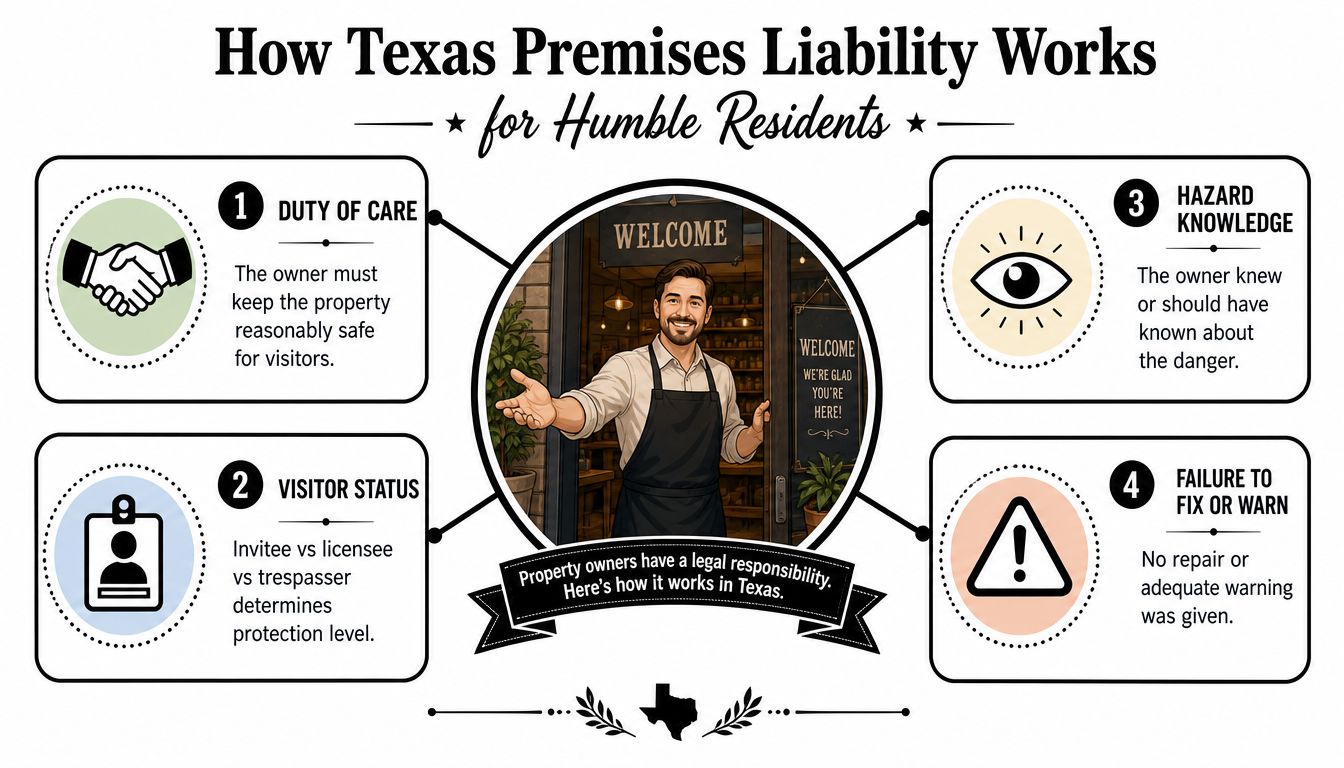
Think of a property owner as a host. A host who invites customers into a store, welcomes a guest into a home, or allows someone onto a business property owes responsibilities shaped by the visitor's relationship to the property. Texas doesn't apply one identical duty to everyone who enters.
The main categories are invitees, licensees, and trespassers:
- Invitees enter for a purpose connected to the owner's business or mutual benefit, such as customers shopping at a Humble store. Texas guidance generally requires the owner to inspect for concealed, unreasonably dangerous conditions and warn about them or make them reasonably safe. Texas premises liability guidance describes this higher level of protection for invitees.
- Licensees have permission to enter but generally do so for their own purposes, such as a social guest. Texas authorities generally don't impose a duty to inspect for licensees, but once the owner knows about a dangerous condition that the licensee doesn't know about, the owner must warn or make the area reasonably safe. Texas guidance concerning licensees explains that important difference.
- Trespassers enter without legal permission. Texas law generally limits the landowner's duty, and Civil Practice and Remedies Code section 75.007 defines a trespasser as someone who enters land without an express or implied legal right. The statute preserves only limited duties in that setting. Texas trespasser rules provide additional context.
Texas's framework comes from a historical common-law system in which duties depended on status and the hazard's nature. American law has gradually moved away from rigid visitor categories, with a major turning point in 1968, when the California Supreme Court's decision in Rowland v. Christian weakened traditional invitee, licensee, and trespasser distinctions. Texas still relies heavily on the status analysis, especially because Texas law distinguishes ordinary premises defects from special defects.
Government property creates another limitation. Under Section 101.022 of the Texas Civil Practice and Remedies Code, a governmental unit generally owes only the duty owed to a licensee for a premise defect, unless a toll road or another statutory exception applies. That can make a claim against a public entity different from a claim involving a private store or apartment complex.
For a related housing issue, residents can review the landlord-tenant law resources for Humble, but a landlord dispute and an injury claim may involve different legal questions.
What You Must Prove to Have a Valid Texas Premises Claim
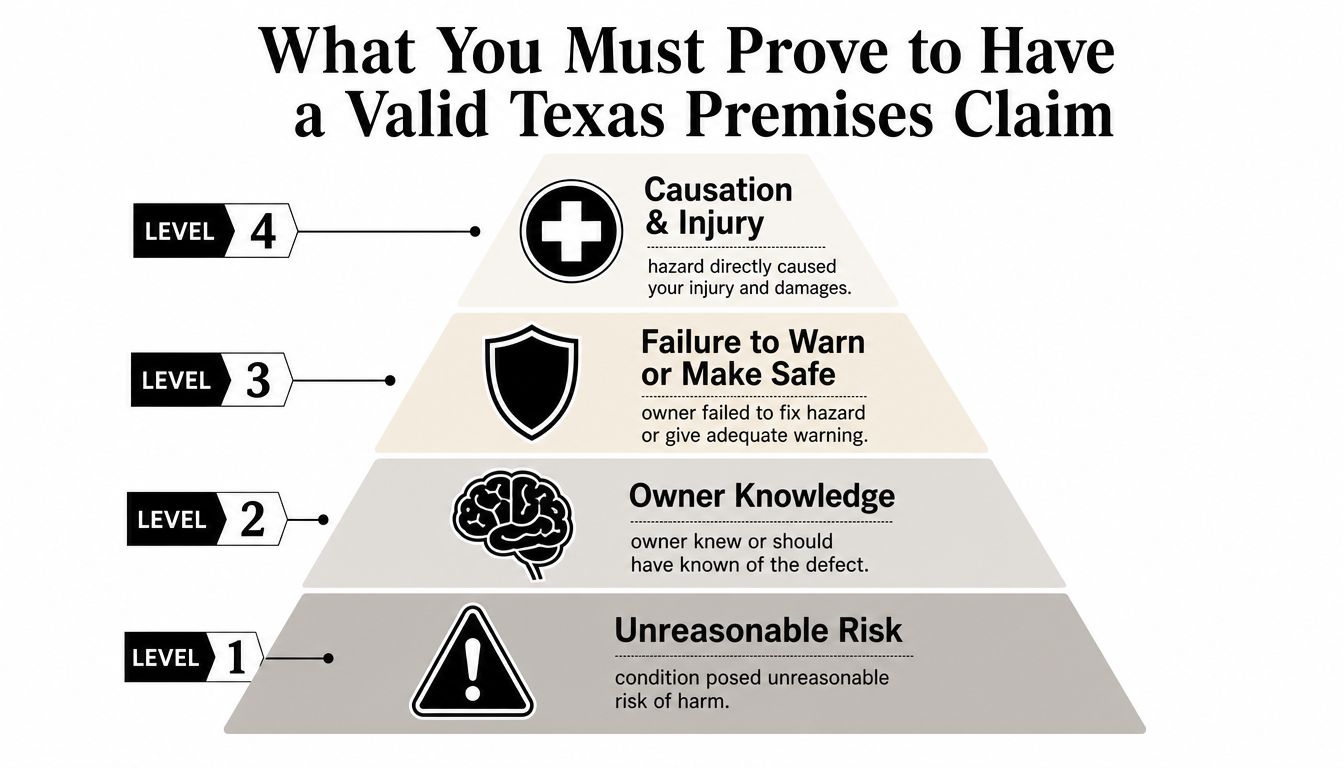
A dangerous condition alone doesn't establish liability. A successful Texas premises defect claim generally requires proof of several connected facts, much like building a bridge. If one support is missing, the claim may not carry the weight of the injury and damages.
The hazard must create an unreasonable risk
Start with the condition itself. It might be a wet floor, uneven pavement, loose mat, broken stair, exposed construction area, or another property condition. The question isn't whether the condition existed. The evidence must show that it posed an unreasonable risk of harm under the circumstances.
Location matters. So do lighting, visibility, traffic patterns, warnings, and the way the property was being used. A small surface change in a well-lit area may raise different questions from a concealed defect in a busy walkway.
Knowledge must connect to the exact condition
Texas premises claims often turn on constructive notice. You may need to show that the owner knew about the specific hazard, or that the hazard existed long enough that the owner had a reasonable opportunity to discover it. Recent Texas Supreme Court guidance on constructive notice emphasizes the need for temporal proof tied to the particular condition at the injury site.
A general inspection policy doesn't prove that an employee inspected this precise spot. A prior leak in another part of the building doesn't establish how long the water existed where you fell. Speculation about what may have happened can't replace photographs, video, records, or testimony showing timing.
The owner must have failed to respond reasonably
Even when knowledge exists, the claim still requires evidence that the property controller failed to warn, repair, block off, or otherwise address the danger. A warning sign may affect the analysis, but its location, visibility, and adequacy matter.
Finally, the condition must have proximately caused the injury and resulting damages. Medical records, treatment recommendations, wage information, and testimony can help connect the fall to the harm. Texas premises defect guidance identifies photographs, video, and prompt preservation as important evidence in evaluating both viability and value.
Evidence principle: The strongest claim usually tells a precise story about what the hazard was, how long it existed, who could have discovered it, and how it caused the injury.
Who Can Be Held Liable and How Texas Measures Fault
The responsible party isn't always the deed holder. An occupier, tenant, property manager, maintenance company, or business may have controlled the area or undertaken responsibility for inspections and repairs. The investigation should identify who controlled the hazard, not just who owned the building.
Your legal status changes the duty. A customer in a Humble store is commonly an invitee because the visit serves a business purpose. A friend visiting your home is more likely to be a licensee. Someone entering without permission may be a trespasser. Those labels can affect inspection duties, warning obligations, and the defenses available to the property controller.
| Visitor Type | Example in Humble | Duty Owed by Owner |
|---|---|---|
| Invitee | Customer shopping at a store | Inspect for concealed, unreasonably dangerous conditions, then warn or make the property reasonably safe |
| Licensee | Social guest visiting a home | Generally no duty to inspect, but the owner must warn or make safe a known danger the guest doesn't know about |
| Trespasser | Person entering land without legal right | Limited duty, generally focused on avoiding willful, wanton, or grossly negligent harm |
Texas also uses modified comparative negligence. Under Chapter 33 of the Texas Civil Practice and Remedies Code, a claimant can't recover damages if their percentage of responsibility is greater than 50 percent. Texas comparative negligence information explains why fault allocation matters in slip-and-fall claims.
If you were looking at your phone, ignored a visible warning, wore footwear that affected traction, or entered an area clearly closed to the public, the defense may argue that you share responsibility. An open-and-obvious condition can become especially important because it may affect whether the owner had a duty to warn and how a jury assigns fault.
Premises defect or ordinary negligence
The distinction many local pages skip is whether the injury came from a condition of the property or from someone's conduct. A broken stair, pooled water, or uneven walkway points toward a premises defect analysis. A careless employee who drops an object or causes an accident through active conduct may raise ordinary negligence questions instead.
Independent contractor status can complicate workplace injuries. A contractor may argue that the claim is governed by premises rules, while the injured person may contend that negligent work or active conduct caused the harm. The correct category depends on the facts, not the label placed on the claim.
For a separate type of serious injury involving a fatality, families may need information about a wrongful death lawyer in Humble. Family-law procedures are a different subject, and Harris County Family Courts: A Humble Resident's Guide addresses how family law cases proceed in the Harris County courts serving Humble.
Evidence to Collect and What the Humble Claim Timeline Looks Like
The first hours after an injury can affect what evidence remains available. A wet floor may be dried, a broken stair may be repaired, and a surveillance system may overwrite footage. Work through the following checklist as soon as your health permits.
- At the scene: Take photographs of the hazard, surrounding area, lighting, warning signs, and your position relative to the condition. Ask witnesses for their names and contact information.
- During the first day: Seek medical care, report the incident to the store, apartment manager, or property representative, and request the incident report. Write your own account while the details are fresh.
- During the following weeks: Preserve the shoes and clothing involved. Request surveillance video in writing, keep medical records and receipts, and save messages from insurers or property representatives.
- During the claim stage: A demand may present the facts and damages to the property owner or insurer. The evidence should support the hazard, notice, causation, and financial impact.
- During resolution: Negotiation or mediation may resolve the matter. If settlement isn't reached, a lawsuit may proceed through Harris County court procedures, including information exchange and other litigation steps.

A prompt preservation request can matter because the owner or business may control the video, inspection records, maintenance logs, employee schedules, and prior incident reports. Don't assume a verbal request will preserve everything. A lawyer can evaluate whether a formal spoliation-preservation letter is appropriate.
Texas also imposes a strict two-year statute of limitations for negligence-based premises claims. The Texas premises liability overview identifies that deadline and explains why prompt investigation and filing are especially important in major markets such as Harris County and the Houston metro area.
Medical treatment comes first, but waiting without documenting the legal facts can weaken a claim. If a dog caused the injury rather than a structural or surface condition, the analysis changes, and a Humble dog bite lawyer may address the different issues involved.
How a Premises Liability Lawyer in Humble TX Helps Your Case
A local attorney's first job isn't to promise an outcome. It's to determine what kind of claim you have and whether the available evidence supports each required element.
That evaluation may involve comparing premises liability with ordinary negligence, identifying the person or company that controlled the area, reviewing your visitor status, and testing the notice evidence. Cameras, maintenance logs, inspection records, employee statements, photographs, and medical records can reveal whether the owner had a reasonable opportunity to discover and address the condition.
A lawyer can also deal with insurer communications while you focus on treatment. The insurer may ask for a recorded statement, emphasize an alternative cause, question whether the hazard existed long enough, or argue that your own conduct caused the fall. Your representative can organize the facts, assess medical and wage-related damages, and respond to comparative-fault arguments without treating the case as a routine accident.
Choosing help that fits your situation
When comparing a premises liability lawyer in Humble, TX, ask practical questions:
- Local familiarity: Does the attorney understand Harris County filing and scheduling procedures and the communities of Humble, Atascocita, Kingwood, and Northeast Houston?
- Investigation capacity: Can the firm pursue video, logs, photographs, witness information, and preservation issues promptly?
- Clear communication: Will the attorney explain whether your facts involve a premises defect, ordinary negligence, or another theory?
- Case fit: Does the lawyer understand the difference between business invitees, licensees, trespassers, contractors, and property managers?
The Child Support Attorney in Humble resource addresses establishing, modifying, and enforcing child support in Harris County, which is separate from a premises injury claim but may matter to families managing several legal concerns at once.
The Law Office of Bryan Fagan is one local option for residents seeking legal information and representation through its Humble office. A consultation should help you understand your options, not pressure you into making an immediate decision.
Take the Next Step Toward Protection and Recovery in Humble
An injury on someone else's property can create more than a medical problem. You may face medical bills, lost wages, continuing pain, changes to daily activities, and uncertainty about whether the owner or insurer will accept responsibility. Texas law may allow compensation for those losses when the required facts are proven, but the case depends on evidence rather than the injury label alone.
Start with a simple action plan:
- Get appropriate medical attention and follow the treatment plan.
- Photograph the condition and preserve shoes, clothing, records, and receipts.
- Identify witnesses and request incident or surveillance information.
- Avoid guessing about facts when speaking with an insurer.
- Discuss the claim promptly because Texas generally gives you two years to file a negligence-based premises claim, as explained in the Texas premises liability overview.
The legal analysis can be especially fact-specific in Harris County. A fall at a store may involve invitee duties and constructive notice. A social visit may involve licensee rules. A government-property claim may involve Section 101.022, while a contractor injury may require careful classification between premises liability and ordinary negligence.
Families in Humble, Atascocita, Kingwood, and Northeast Houston deserve an explanation that connects the law to what happened. Prompt legal advice can help preserve options, identify the right responsible party, and evaluate fault before important evidence disappears.
The Law Office of Bryan Fagan offers local legal consultations and practical guidance for Humble residents evaluating an injury claim, including questions about premises defects, notice, and comparative fault. Visit the Law Office of Bryan Fagan to schedule a free consultation with the downtown Humble office and discuss your next step.