Skip to content

A tenant in a Humble duplex calls after work because the lease renewed, the air conditioner stopped cooling, and the landlord says the security deposit will cover “whatever is needed.” A small landlord in Atascocita calls with the opposite problem, a tenant stopped paying, a partial payment was accepted, and an eviction notice may now be harder to enforce. These disputes rarely turn on who sounds more convincing. They turn on written notice, dates, lease language, proof, and the correct Harris County court procedure.
Texas landlord tenant law in Humble, TX, follows statewide rules, but local geography matters. A renter in Kingwood, a family near FM 1960, and a property owner in Northeast Houston may all need to deal with different managers, maintenance vendors, constables, and Justice of the Peace procedures. The practical rule is simple: document the problem early, read the lease carefully, and get advice before a missed deadline becomes a court judgment.
How Texas Landlord Tenant Law Works in Humble
A tenant in a Humble duplex discovers that the lease renewed, the air conditioner stopped cooling, and the landlord plans to charge the security deposit for the repair. Across town, a small landlord faces a tenant who stopped paying, accepted partial rent, and may now challenge the eviction notice. In both disputes, the first-day record matters more than either side's frustration: written notice, dates, lease language, proof, and the correct Harris County court procedure usually control the result.
Texas Property Code Chapters 91 and 92 govern residential rentals in Humble, Spring, Kingwood, Atascocita, and the Northeast Houston area. The lease supplies the working details, including rent, late charges, notice methods, utilities, pets, repairs, and renewal terms. Texas law fills gaps when the lease is silent, and some protections, including habitability, security deposits, and lockouts, cannot be waived by contract.
The Texas State Law Library's Texas landlord laws guide offers a useful statewide starting point. Small property owners should also review this practical guide for Texas landlords to organize notices, records, and recurring duties.
Identify the parties before sending notice
A landlord is usually the owner or an authorized representative. A property manager may collect rent, arrange repairs, and deliver notices without owning the home. The tenant is the person entitled to occupy the property under the lease, but adult occupants may have different rights depending on who signed it.
Send repair demands and other notices to the person or office named in the lease. A tenant who reports a problem only to a maintenance technician may create a proof issue. A landlord who addresses an eviction notice to one occupant while ignoring another named tenant may create a separate defect. Use the lease's notice address, email address, and delivery method, and preserve confirmation of delivery.
Learn the vocabulary that controls the dispute
A lease grants the right to possess the property. An addendum modifies that agreement. A demand for compliance identifies the correction required. A notice to vacate demands that the tenant leave. After an eviction judgment, a writ of possession authorizes the court process for returning possession to the landlord.
Humble-area cases commonly proceed through Harris County Justice Courts. The judge will focus on possession, rent, notice, lease terms, and admissible evidence. Bring the lease, payment history, photographs, notices, and delivery records. A text message, accepted payment, or oral promise may affect the case, but none automatically resolves the legal issue.
Security Deposits and the 30-Day Refund Rule
A tenant in Humble moves out on June 30 after paying a $1,400 deposit. The tenant sends a written forwarding address on July 5. Under Texas Property Code § 92.103, the landlord's refund deadline runs through August 4, assuming the tenant has surrendered the property and met the address requirement. The tenant should send that address by a trackable written method and keep delivery proof. Without evidence that the landlord received it, the landlord may dispute when the refund duty was triggered.
Texas law requires the landlord to return the deposit within the statutory period after surrender, subject to lawful deductions. The Texas security-deposit refund requirements also explain why the tenant's written forwarding address matters.
Separate legitimate damage from ordinary turnover
A landlord may generally deduct documented losses for unpaid rent, cleaning beyond ordinary turnover, broken blinds, or pet stains. The deduction must connect to a tenant-caused condition. Routine carpet cleaning, repainting required by ordinary occupancy, and charges that ignore the item's age and condition are generally improper.
The landlord should provide an itemized accounting when making deductions and preserve photographs, invoices, the move-in checklist, and move-out records. Carpet, paint, appliances, and fixtures do not have unlimited useful lives. A property needing preparation for the next renter is not automatically evidence of tenant damage.
| Deduction Category | Generally Allowed | Generally Not Allowed |
|---|---|---|
| Rent | Unpaid rent supported by the ledger | Amounts already paid or waived |
| Cleaning | Excess cleaning tied to tenant-caused condition | Routine turnover cleaning |
| Walls and paint | Repair of unusual tenant damage | Full repainting from ordinary use |
| Fixtures | Broken blinds or damaged items | Replacement without proof of tenant responsibility |
| Pets | Documented pet stains or damage | Automatic pet-related charges without actual loss |
Protect the record before the keys change hands
Before leaving, tenants should photograph every room, appliance, wall, floor, and exterior area. Return the keys in a way that creates proof, pay undisputed rent, provide the written forwarding address, and save every message, receipt, and delivery confirmation.
Landlords should photograph the property promptly, preserve the move-in checklist, obtain repair estimates, and avoid unsupported flat charges. A clear file often resolves the dispute before either side files in Harris County Justice Court.
If the deposit is not returned or the accounting is disputed, the tenant may need a demand letter and a civil claim. A Houston small-claims lawyer can help assess the evidence, damages, and filing strategy. Texas law also gives a tenant's deposit claim priority over claims by the landlord's creditors, including a bankruptcy trustee. That priority can matter when the money remains disputed or the owner faces financial trouble.
Repairs, Habitability, and the Repair-and-Deduct Remedy
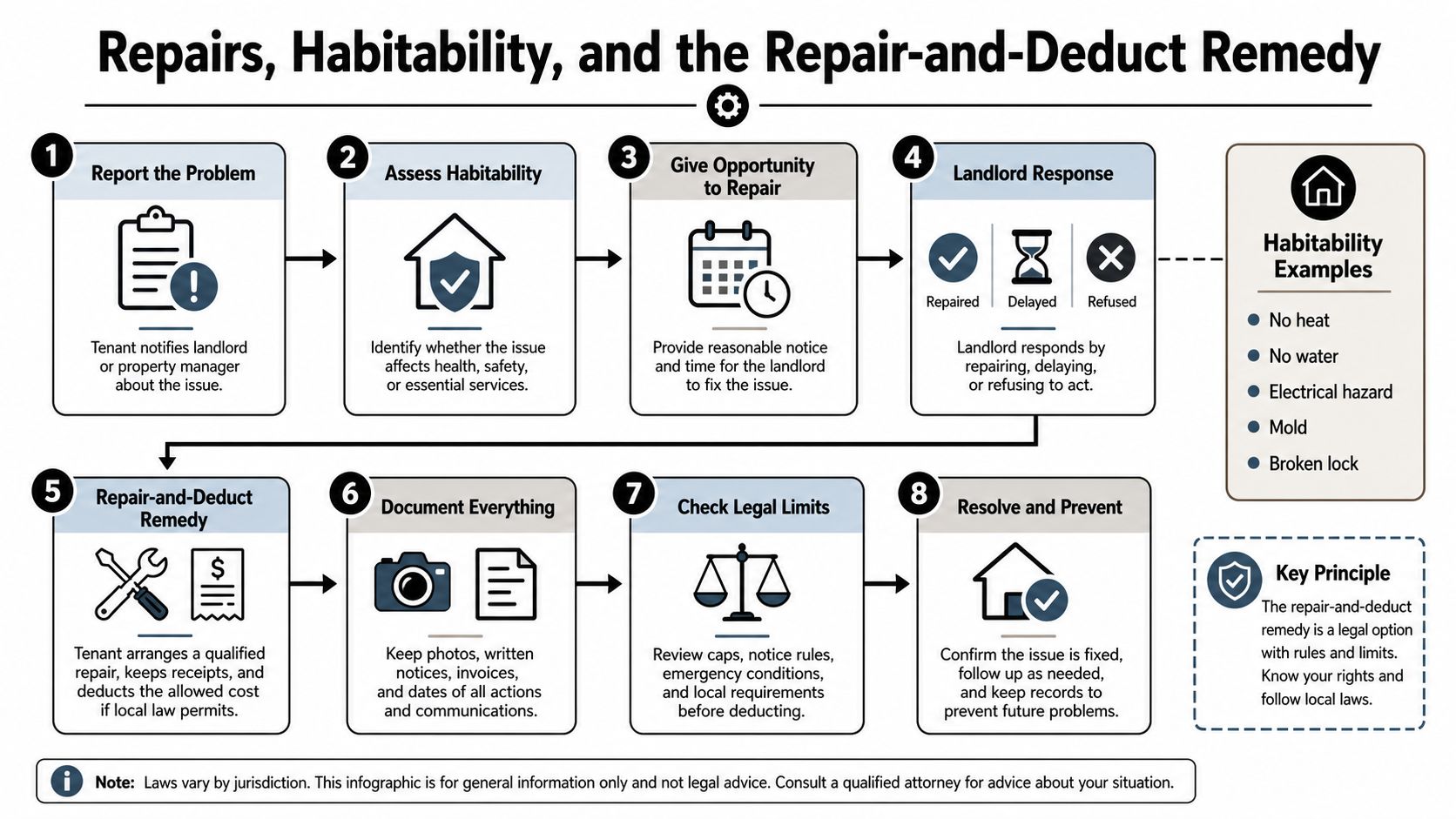
A broken air conditioner in an August Humble rental isn't handled the same way as a loose cabinet handle. Texas repair law focuses on conditions that materially affect physical health or safety, and the strongest remedies generally depend on written notice followed by a reasonable opportunity to cure. The Texas Attorney General describes seven days as a presumed reasonable repair period, although the circumstances can support a different period. See the Texas Attorney General's renters' rights guidance.
Follow the escalation path
Send written notice. Describe the condition, when it began, how it affects the home, and what access the landlord has for repairs. Certified mail, registered mail, or tracked delivery creates stronger proof than an oral complaint.
Allow the reasonable repair period. Seven days is the statutory benchmark commonly used in Texas guidance, but a court can consider severity, availability of parts, labor, utilities, and the landlord's actual receipt of notice.
Send the follow-up notice when needed. If the first notice wasn't sent through certified, registered, or tracked delivery, a second written notice may be required after the reasonable period. If the first notice used one of those documented methods, the second notice isn't required under the cited guidance.
Consider the remedy carefully. A tenant may be able to terminate the lease, seek a repair order, pursue damages, or use repair-and-deduct procedures. Don't deduct rent casually.
Suppose a tenant reports a failed A/C compressor, sends certified notice, and obtains a $480 repair invoice after the landlord fails to act. If monthly rent is $1,200, the invoice is below both $500 and one month's rent, so it falls under the stated statutory ceiling. The tenant still needs to confirm that the condition qualifies, the notice was proper, the work was necessary, and the contractor and documentation are defensible.
Practical rule: Never treat repair-and-deduct as permission to stop paying rent. Preserve the notice, invoice, photographs, proof of payment, and lease before making the deduction.
Texas law limits the self-help deduction to one month's rent or $500, whichever is greater. Judicial remedies may include rent abatement from the first notice, a civil penalty of one month's rent plus $500, actual damages, and attorney's fees. A landlord who retaliates instead of repairing can make the dispute substantially worse.
Eviction Notices and the 3-Day Compliance Window
An eviction in Humble generally begins with a written notice, not with a constable arriving at the door. Texas law requires a landlord to give a notice to vacate or a notice to pay rent or vacate, and the tenant generally must receive at least three days to comply unless the lease sets a different period. The Texas tenant eviction overview describes that baseline notice mechanic.
The counting rules deserve attention. The delivery day is generally excluded, along with weekends and most holidays under the commonly applied notice calculation. The lease may provide a longer or different notice period, and the reason for eviction can affect the language and timing. A landlord should identify the rent due, the amount claimed, the action required, the deadline, and the property address. A tenant should compare every sentence of the notice to the lease and payment history.
What happens after the notice
If the tenant pays the amount demanded, vacates, or reaches a documented agreement, the immediate possession dispute may end. If the tenant does nothing, the landlord may file a forcible detainer case in the appropriate Harris County Justice Court. The court then addresses possession, notice, the lease, and the parties' evidence.
After a judgment, the constable may post a writ of execution giving the tenant a narrow period to leave before physical removal. Appeals also operate on tight deadlines. A tenant who receives a citation shouldn't wait for the hearing to gather documents. A landlord who files with an inaccurate ledger or defective notice can lose the case despite being owed rent.
For owners who need a broader procedural overview, how to evict a tenant legally can provide additional context, but it doesn't replace review of the specific lease and notice. Humble parties facing an active filing can also review the eviction process in Humble before deciding whether to negotiate, answer, or seek counsel.
One important landlord mistake is accepting partial rent after serving a notice without understanding the consequences. Acceptance can create waiver arguments or alter the basis for possession, especially when the payment is inconsistent with the notice. Put every payment arrangement in writing and have counsel review the next step before filing.
Retaliation, Discrimination, and Utility Shutoff Protections
A Humble tenant reports unsafe conditions to the City of Humble, sends a written repair complaint, and then receives an eviction notice. Timing alone doesn't prove retaliation, but it can become important evidence. Texas law may presume retaliation when a landlord files an eviction within 90 days of a tenant's good-faith complaint, shifting the burden to the landlord to establish a lawful reason. The tenant should preserve the complaint, photographs, inspection records, rent receipts, and every communication.
Retaliation protection doesn't excuse unpaid rent or unrelated lease violations. It does mean a landlord should separate legitimate enforcement from a response to protected activity. A landlord should document the rent ledger, prior warnings, repair history, and business reason for any notice before serving it.
Fair housing rules apply to local advertising
The federal Fair Housing Act and Texas fair housing protections reach rental advertising and screening. A Humble landlord posting on Zillow, Facebook, or Craigslist shouldn't use language that steers applicants based on familial status, disability, or national origin. The same concern applies to different rules for families with children, inconsistent treatment of accommodation requests, or selective enforcement of occupancy policies.
Keep screening criteria written, apply them consistently, and preserve the records used to make the decision. A tenant who believes an application, renewal, accommodation, or eviction decision was discriminatory should write down what happened while the evidence is fresh.
Utility shutoffs can create a separate claim
If the landlord agreed to furnish and pay for water, gas, or electric service and the utility is disconnected because of the landlord's nonpayment, Texas law may permit lease termination, rent offsets, security-deposit application, and recovery of actual damages. Those damages can include practical losses tied to displacement, but the tenant must prove them.
A landlord cannot use a utility shutoff to force a tenant out, even when rent is disputed. A tenant should photograph the meter or notice, contact the utility, send written notice to the landlord, preserve receipts for temporary expenses, and avoid abandoning the property without legal advice. Utility problems often arise before a formal eviction case, so early proof preservation can protect the tenant's options.
When to Call a Humble Landlord Tenant Attorney
Self-help stops making financial sense when the other side has already threatened possession, money, or a counterclaim. For a tenant, that point may arrive with a wrongful three-day notice, a repair refusal involving health or safety, a missing itemized deposit accounting, or a landlord's refusal to return keys and the last month's rent. Waiting for a court date can leave too little time to correct a defective notice or organize evidence.
For a landlord, the warning signs look different. Accepting partial rent after serving notice, discovering a prohibited sublet, receiving a discrimination complaint, or relying on an unusual lease clause can change the risk quickly. A property owner should pause before sending another message that could be read as retaliation or waiver.
Treat the file as a business decision
The cost of counsel isn't just the hourly invoice. Depending on the claim and governing provision, fee-shifting may allow a successful party to recover reasonable attorney's fees. That possibility can make early legal review a rational business expense, particularly when possession, a substantial deposit, repair damages, or a discrimination defense is at stake. The underlying Texas deposit and repair rules are summarized in the Texas State Law Library and Attorney General materials linked earlier.
Bring the actual file, not a verbal summary:
- The lease: Include every addendum, renewal, pet agreement, and utility provision.
- The timeline: List rent payments, repair requests, notices, inspections, and move-out dates.
- The proof: Gather photographs, videos, receipts, bank records, emails, and text-message exchanges.
- The court papers: Include the citation, petition, hearing date, judgment, or writ.
Harris County Justice of the Peace courts handle forcible detainer cases, including those affecting Humble, Atascocita, Kingwood, and Northeast Houston. The appropriate precinct and place depend on the property location. A consultation can clarify whether negotiation, a counterclaim, an appeal, or trial preparation makes sense. Contact the Humble office before a deadline passes.
Local Resources for Humble Renters and Landlords
A landlord-tenant dispute can require more than a letter. Humble residents should identify the correct court, municipal office, legal-aid provider, or federal agency before making a filing. Confirm current phone numbers, hours, and intake rules directly with each organization because local procedures can change.
Court and municipal contacts
The Harris County Justice of the Peace Precinct 4 Place 1 courthouse on Wilson Road handles local eviction matters and small-claims filings up to $20,000, as well as protective-order matters. Bring the lease, notices, payment records, photographs, identification, and any service or delivery confirmation. Court staff can explain filing logistics, but they can't provide legal advice or predict the result.
The City of Humble Code Enforcement and Neighborhood Services division is the appropriate place to ask about habitability conditions, code violations, and illegal-lockout complaints involving city jurisdiction. Bring a written timeline, photographs, the property address, and copies of your communications with the landlord. Code enforcement involvement doesn't automatically decide a private damages claim, so preserve your own evidence.
Legal aid and dispute resolution
Income-eligible tenants may seek help through Lone Star Legal Aid's Houston regional office or the BakerRipley Humble intake site. The Houston Bar Association's Renters' Rights hotline may assist self-represented callers with general information. Tenants should have their lease, eviction papers, rent ledger, and repair documentation ready before calling.
The HUD Fort Worth regional office handles federal Fair Housing complaints affecting Northeast Harris County. A tenant should describe the protected characteristic, the conduct, the dates, the property, and any supporting messages or advertisements. The Harris County Dispute Resolution Center can help landlords and tenants explore mediation, which may resolve payment, repairs, move-out, or deposit issues without a trial.
Property owners can also review operational tools for physical access management, including apartment access control, but technology can't replace lawful notice or a court-issued possession process. Never change locks, block entry, or shut off essential services as a substitute for filing the correct case.
Next Steps and Your Free Consultation
The strongest landlord-tenant files are built before anyone enters a courtroom. A tenant should make every repair request and rent payment traceable, photograph the home at move-in and move-out, and send the forwarding address in a documented written form. A landlord should calendar lease renewal dates, document each deduction with receipts and photographs, and serve notices at the property and through a delivery method that creates proof.
Use this immediate checklist
For tenants
- Write first: Send repair requests and payment confirmations in writing.
- Preserve condition evidence: Photograph rooms, fixtures, leaks, locks, appliances, and exterior areas.
- Protect the deposit deadline: Provide the forwarding address in a documented written form and keep delivery proof.
- React to court papers: Read the citation immediately, note the hearing date, and collect the lease and payment ledger.
For landlords
- Review the lease: Check notice periods, utility obligations, repair duties, and renewal language.
- Build the inspection file: Keep move-in records, move-out photographs, invoices, and receipts.
- Calculate before serving: Confirm the rent balance, notice language, delivery method, and deadline.
- Avoid informal shortcuts: Don't accept money, threaten a lockout, or change utility arrangements without understanding the legal effect.

Before meeting an attorney, gather the signed lease, every addendum, payment ledger, photographs, notices, receipts, inspection reports, and text-message exchanges. Put the events in date order and identify what outcome you need, whether that's possession, repairs, deposit recovery, a negotiated move-out, or a defense in Harris County Justice Court.
The Law Office of Bryan Fagan offers free consultations and personalized legal guidance for Humble-area landlord-tenant disputes, including eviction defense, notice review, repair conflicts, and deposit claims. Visit Law Office of Bryan Fagan to schedule a consultation at the Humble office on First Street and bring your complete file so an attorney can outline realistic options.