Skip to content
You're driving home through Humble after a routine stop on Highway 59, or leaving the area near Deerbrook Mall, when an officer notices a small baggie or pill bottle. Within minutes, a traffic encounter becomes an arrest for possession of a controlled substance. The questions arrive immediately: Will you go to jail? Will you lose your job or housing? Will your family see a permanent record?
A possession charge is not an automatic conviction. Texas law provides defenses, diversion possibilities, negotiated resolutions, and challenges to the evidence. The right first move is to understand the substance, the alleged weight, the search, and the Harris County court process before making statements or decisions about a plea.
Facing a Possession Charge in Humble
A Humble resident may not know whether the item belonged to them, whether the officer had lawful grounds to search, or whether the laboratory will identify the substance as alleged. A borrowed vehicle, a shared apartment, or a passenger's belongings can create confusion about who had care, custody, or control of the item. That confusion matters because prosecutors must prove knowing possession, not merely proximity.

The charge can still feel overwhelming even when the alleged amount seems small. Texas uses specific drug groups and weight thresholds, so the precise substance and laboratory measurement can affect whether a case remains in a lower court or becomes a serious felony. A defense lawyer should examine the stop, search, statements, packaging, testing, and chain of custody before advising you about a resolution.
Why local knowledge matters
Humble cases generally move through Harris County's criminal justice system, where local procedures, prosecutors, assigned courts, and release practices influence what happens after arrest. Residents of Atascocita, Kingwood, and Northeast Houston can face the same statewide statutes but very different practical questions based on the arresting agency, court assignment, prior record, and diversion eligibility.
A possession of controlled substance lawyer in Humble, TX can identify the decisions that need attention early. That may include seeking a workable bond, preserving video evidence, reviewing the probable-cause information, requesting testing information, and communicating with prosecutors before you make an avoidable admission.
Practical rule: Don't explain the facts of the case to police, friends on recorded jail calls, or anyone online before speaking with counsel.
Families also need reliable information during a stressful search for legal help. Resources such as by X8 Web Design can help people understand how legal service providers present information online, but your case still requires a direct, confidential evaluation by a lawyer.
What Possession of a Controlled Substance Means in Texas
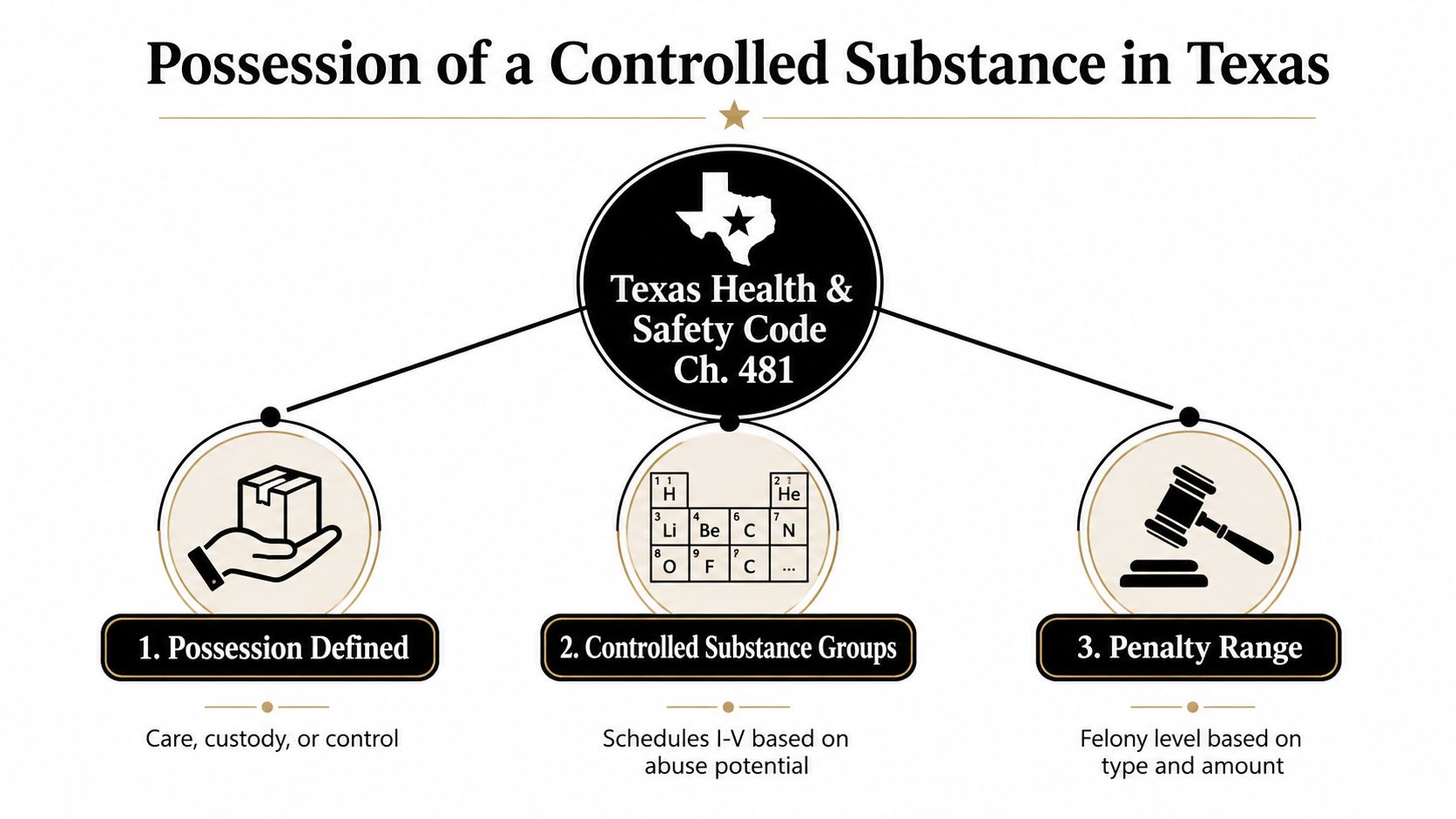
Texas Health and Safety Code Chapter 481 governs controlled substances and organizes offenses by drug group and quantity, rather than placing every substance into one punishment category. In plain language, possession generally involves having care, custody, control, or management of a substance listed under the Texas Controlled Substances Act.
The prosecution must prove that you knowingly and intentionally possessed the substance. Finding a bag in a home, car, or room doesn't automatically establish that the bag belonged to you. The State must connect you to the item and show that you knew what it was.
Actual and constructive possession
Actual possession is the easiest concept to understand. The substance is found on your person, such as in a pocket, hand, or wallet. Even then, the State must still establish knowledge and identify the substance properly.
Constructive possession means the State claims the substance was not physically on you but was within your control. For example, an officer might find a pill bottle in a borrowed car, a baggie under a seat during a stop on FM 1960, or a substance in a shared apartment. Multiple people may have had access to the location, which can make the connection to one person uncertain.
A constructive-possession case often turns on surrounding facts. Who owned the vehicle? Who occupied the room? Was the item visible? Were there fingerprints, statements, personal documents, or other evidence linking you to it? A lawyer should test each claimed connection rather than accept the officer's conclusion.
Penalty groups and classification
Texas uses Penalty Group 1, Penalty Group 2, Penalty Group 3, and Penalty Group 4 classifications. Cocaine, methamphetamine, heroin, and fentanyl may fall within Penalty Group 1 depending on the precise substance and statutory listing. Marijuana and prescription medications require careful classification because the legal analysis depends on the applicable statute, formulation, and alleged quantity. Xanax, for example, isn't analyzed simply because it is a pill. The State must establish what the pill contains and whether possession was authorized.
For families trying to understand the local court system, Harris County Family Courts: A Humble Resident's Guide addresses how family law cases proceed in the Harris County courts serving Humble. That process is separate from a criminal possession case, so don't assume family court information answers criminal-court questions.
How Texas Weight Thresholds Determine Your Penalties
Weight can change the entire legal posture of a Penalty Group 1 possession case. Under Texas Health and Safety Code § 481.115, the law measures aggregate weight, including adulterants or dilutants. That means the relevant figure may include material mixed with the controlled substance, not only the amount of pure drug. The statute and its cited framework are available through Texas Health and Safety Code § 481.115.
| Weight of substance | Offense level | Prison sentence range | Maximum fine |
|---|---|---|---|
| Less than 1 gram | State-jail felony | State-jail felony range under Texas law | The applicable statutory fine |
| 1 to less than 4 grams | Third-degree felony | 2 to 10 years | Up to $10,000 |
| 4 to less than 200 grams | Second-degree felony | 2 to 20 years | Up to $10,000 |
| 200 to less than 400 grams | First-degree felony | 5 to 99 years | Up to $10,000 |
| 400 grams or more | First-degree felony with life-imprisonment exposure | Life, or 10 to 99 years | Up to $100,000 |
The first row is a state-jail felony, while the next ranges move through third-degree, second-degree, and first-degree felony levels. At 400 grams or more, the statute provides for life imprisonment or 10 to 99 years and a fine of up to $100,000. These figures come from the statutory framework described in the verified Texas law reference.
Why the measurement deserves scrutiny
A small difference near a statutory breakpoint can affect bail arguments, plea negotiations, and sentencing strategy. Counsel should not treat the police report's weight as the final answer. The defense should examine how officers packaged and weighed the material, whether the scale was reliable, whether the submitted sample matches the described evidence, and whether the laboratory followed accepted procedures.
The chain of custody matters because the State must connect the tested sample to the item allegedly seized from you. A missing transfer record, inconsistent description, or unexplained discrepancy can create a meaningful evidentiary issue. Laboratory analysis also matters. The State must prove the identity of the substance, not merely rely on an officer's visual impression or field-test result.
Other penalty groups
Penalty Group 3 illustrates why the group itself matters. Under § 481.117, less than 28 grams can be a Class A misdemeanor, while amounts above 28 grams, above 200 grams, and above 400 grams can escalate through felony levels, with more than 400 grams carrying life-imprisonment or 5 to 99 years exposure. The statutory overview is summarized in this Texas controlled-substance penalty guide.
Don't assume a lower weight automatically means a minor case. The substance, group, aggregate measurement, prior record, and admissibility of the evidence all matter. A local defense lawyer should work from the tested evidence and statute, not the initial label on the booking paperwork.
The Arrest and Charging Process in Harris County
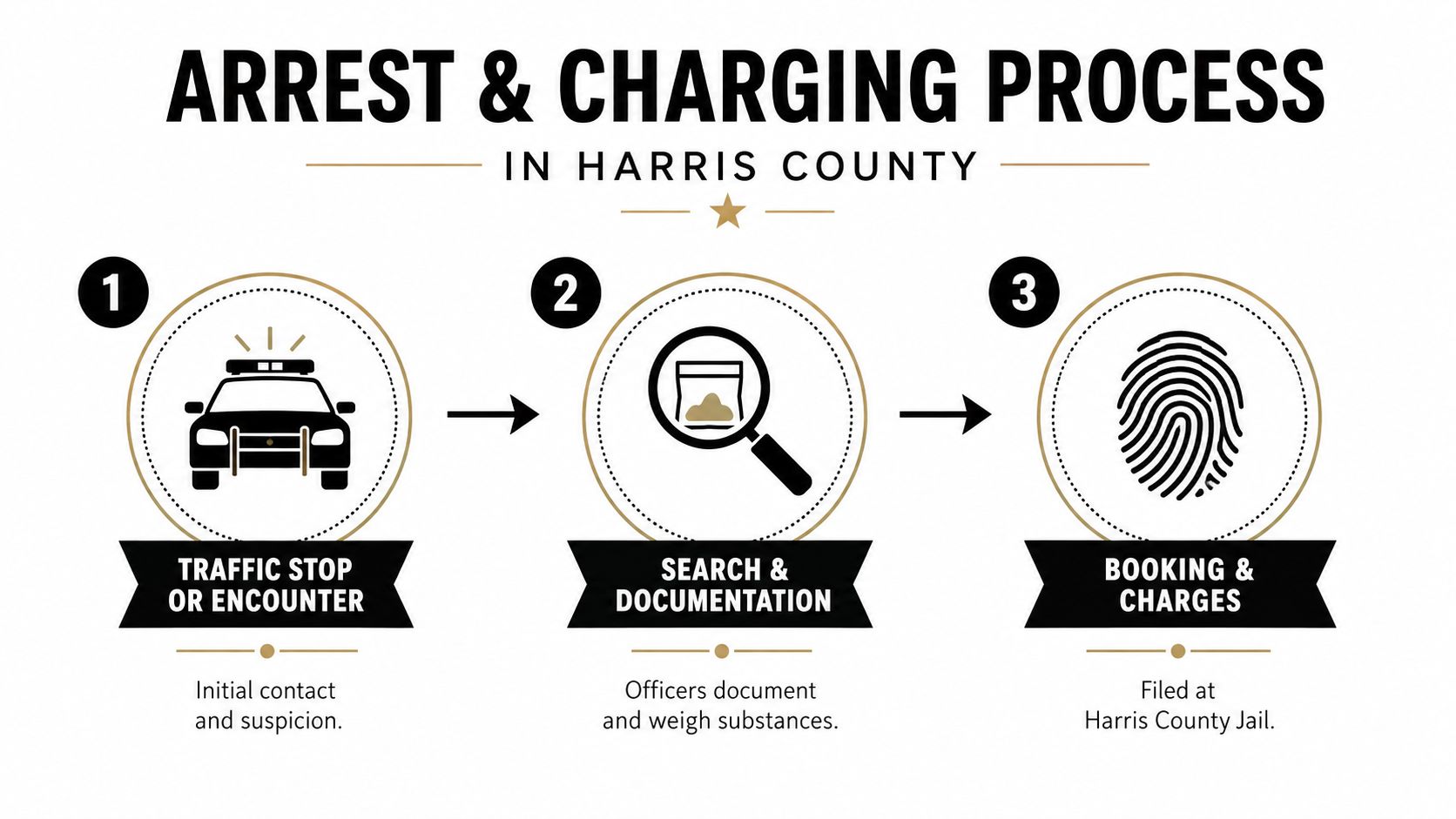
After an arrest in Humble, the process usually begins with the encounter itself. An officer may initiate a traffic stop, speak with a person in a public place, or investigate a report. The officer then documents the alleged discovery, collects the item, and prepares information that can support booking and a charge.
What happens after the arrest
A typical sequence includes:
Initial contact and search. The officer records the reason for the encounter and the circumstances of any search or seizure. The legality of that search can become central to the case.
Documentation and booking. The alleged substance and other property are documented, and the person is processed through the Harris County Jail system. The initial description may be based on field observations before laboratory confirmation.
Magistrate review and bond. A magistrate considers the allegations and release conditions. A lawyer can present information relevant to a personal recognizance request, bond amount, residence, employment, family responsibilities, and compliance with court requirements.
Prosecutorial review. The case may be reviewed by the Harris County District Attorney's intake process. The final direction can depend on the evidence, alleged substance, weight, criminal history, and court assignment.
A case may be filed by information or proceed through an indictment, depending on the charge and procedural posture. Felony matters generally require close attention to the indictment and the court's jurisdiction. The first setting is not the place to guess about the evidence or accept a plea just to end the uncertainty.
For a plain-language explanation of that early court appearance, review what happens at an arraignment hearing. The exact schedule and setting depend on the case, so the arrest paperwork and court records should be checked directly.
Where counsel can intervene
Early representation can affect how the defense preserves evidence and communicates with the State. Counsel may request records, identify body-camera or dash-camera evidence, review the search, assess bond conditions, and determine whether laboratory retesting is appropriate. In some cases, the defense can engage prosecutors before formal charging decisions are complete.
The criminal process is separate from family proceedings. For example, Child Support Attorney in Humble addresses establishing, modifying, and enforcing child support in Harris County. A criminal arrest can create family stress, but child-support questions require their own legal analysis.
Common Defenses and Legal Strategies for Possession Cases
The strongest defense isn't always a dramatic courtroom argument. It is often a disciplined review of every link between the person, the search, the substance, and the alleged weight.
Challenge the search first
The Fourth Amendment can protect against an unreasonable stop, search, or seizure. If officers lacked lawful grounds for the stop or exceeded the scope of a permitted search, the defense may seek to suppress the controlled-substance evidence. If the central evidence is excluded, the prosecution may face difficulty proving the charge.
The lawyer should compare the officer's report, dispatch records, body-camera footage, consent language, and any warrant paperwork. A person's nervousness, presence in a vehicle, or association with another person doesn't automatically resolve whether the search was lawful.
Separate proximity from possession
The State may claim constructive possession when drugs are found in a location shared with other people. The defense should ask whether you had exclusive control, whether the item was hidden or visible, whether it was connected to your belongings, and whether another occupant had equal access.
A borrowed car containing a passenger's pill bottle presents a different factual problem from a substance found in a locked container belonging to the driver. The phrase “not my drugs” is not a complete legal strategy by itself, but the underlying facts can undermine the State's proof of knowing control.
Test the evidence
Defense counsel should examine:
- Chain of custody: Whether each transfer from seizure to testing is documented and consistent.
- Laboratory identification: Whether the analysis establishes the specific controlled substance.
- Aggregate weight: Whether the reported weight includes packaging, adulterants, or dilutants correctly.
- Field-test limits: Whether an initial test was treated as conclusive when laboratory confirmation was required.
The State's allegation is the starting point, not the proof.
Consider resolution options
Negotiation may involve a reduced charge, deferred adjudication, or another outcome supported by the facts and eligibility rules. Diversion and drug-treatment options can be important, especially for eligible first-time or misdemeanor marijuana cases. Harris County's Misdemeanor Marijuana Diversion Program is voluntary and is designed to divert eligible adult misdemeanor marijuana-possession cases from jail.
Eligibility isn't automatic, and a person should not enroll or make admissions without understanding the record consequences. If you want to examine dismissal possibilities and procedural options, review how to get charges dismissed. The assigned court, substance, weight, prior history, and evidence determine which strategy makes sense.
Steps to Take Immediately After an Arrest
The first hours after an arrest are not the time to solve the case yourself. They're the time to protect your rights and prevent avoidable damage.
Stay silent about the facts. Provide basic identifying information when required, then clearly request a lawyer. Don't try to persuade the officer that the substance belonged to someone else or explain why it was in the vehicle.
Don't consent to another search. State calmly that you don't consent. Never physically resist, argue, or interfere with officers. A lawyer can challenge the search later through the proper court process.
Contact counsel before making decisions. A defense lawyer can review bond conditions, preserve evidence, and identify whether the arrest report contains immediate problems. If a family member is coordinating calls and documents, an experienced Hire intake specialist resource explains how legal intake work can organize information for a law office.
Preserve documents and names. Gather the booking paperwork, bond documents, citation, court notice, witness names, vehicle information, prescription records, and any messages that may establish ownership or access. Tell counsel about body-camera, dash-camera, surveillance, or phone evidence before it disappears.
Avoid public discussion. Jail calls may be recorded. Social-media posts, direct messages, and conversations with acquaintances can later become evidence or create contradictions.
Track every court date. Missing a setting can create new problems even when the underlying possession allegation is defensible. Families seeking information about release procedures can consult how to bail someone out, then confirm the exact requirements with the jail and court.
Bring a clear timeline to the consultation. Include where the stop occurred, who was present, what officers said, what was searched, and what paperwork you received. Ask which court has the case, whether laboratory testing is complete, whether a suppression motion is appropriate, and whether diversion should be evaluated before any plea discussion.
Frequently Asked Questions and Next Steps
Can a first-time offender avoid jail? Sometimes. The answer depends on the substance, alleged weight, evidence, criminal history, assigned court, and available programs. A lawyer should evaluate diversion, treatment-based options, negotiated supervision, and dismissal possibilities rather than assuming jail is inevitable.
What is Harris County's marijuana diversion program? The Harris County Sheriff's Office describes its misdemeanor marijuana diversion program as voluntary and designed to divert eligible adult misdemeanor marijuana-possession cases from jail. Eligibility and record consequences require careful review before participation.
Will the charge affect employment or housing? It can. An arrest or pending charge may create practical problems even before a final outcome, so counsel should discuss disclosure issues, case status, and whether a later record-clearing remedy may be available.
Can the charge be reduced or dismissed? It may be possible when the State cannot prove knowing possession, the search was unlawful, the substance was misidentified, the chain of custody is incomplete, or a diversion or negotiated resolution applies. No lawyer should promise a result before reviewing the evidence.
The Law Office of Bryan Fagan serves Humble, Atascocita, Kingwood, and Northeast Houston with criminal defense representation and free consultations. During an initial consultation, you should expect to discuss the arrest, alleged substance, weight, court status, evidence, and immediate decisions in a confidential setting.
If you or a family member is facing a controlled-substance possession charge, contact the Law Office of Bryan Fagan to schedule a free consultation. The firm can review the search, laboratory evidence, weight threshold, bond, and Harris County resolution options so you can make a deliberate decision before the case moves further.