Skip to content

In Texas, criminal mischief punishment follows the dollar value of the damage, from a Class C misdemeanor carrying a maximum $500 fine for damage under $100 to potential first-degree felony exposure at the highest loss levels. A Humble-area charge can change dramatically based on the repair estimate and the type of property involved.
A kicked apartment door in Deerbrook, spray paint across a fence in Atascocita, or a keyed car in a Kingwood parking lot can turn a heated argument into handcuffs. The call may start with a neighbor, landlord, former partner, or property owner contacting the Precinct 4 Constable's Office or the Humble Police Department. Once officers see visible damage and identify a suspected person, a disagreement that felt personal can become a Harris County criminal case.
That moment is frightening. You may be embarrassed in front of family, worried about work, or unsure whether “pressing charges” means the other person controls the case. They don't. The prosecutor decides whether to pursue the charge, while the alleged victim may provide statements, photographs, repair documents, and testimony. You need a defense plan before an emotional property dispute defines your record.
When a Property Dispute Becomes a Criminal Mischief Charge
A broken mailbox, slashed tire, thrown rock, or damaged fence may also create a civil claim for repair costs. But Texas can treat the same conduct as a crime when the State can prove that you intentionally or knowingly damaged, destroyed, or tampered with another person's property without consent.
Consider a late-night argument outside a Deerbrook apartment complex. One person kicks a door, a tenant calls police, and officers document the damage before making an arrest. In Atascocita, a dispute between neighbors may lead to allegations that someone spray-painted a fence. In Kingwood, a vehicle owner may report a keyed door or scratched hood after a parking-lot confrontation.
Practical rule: Don't try to explain the entire dispute at the scene. Once officers suspect criminal conduct, additional statements can become evidence against you.
“Pressing charges” is common language, but it doesn't give the complaining witness the power to dismiss the case. The report goes to the appropriate Harris County prosecutor, who evaluates the evidence and decides whether to file or continue the accusation. A later request to drop the matter may help your lawyer negotiate, but it doesn't automatically end the prosecution.
Why small damage can create a serious problem
The first question isn't only whether something broke. It's what the State says the damage is worth, whether the property belongs to someone else, and whether the evidence proves your mental state. A repair estimate can become the dividing line between a fine-only misdemeanor and a charge carrying possible jail or felony consequences.
That's why you shouldn't contact the alleged victim to apologize, offer payment, or demand a retraction. A message intended to calm things down may be presented as an admission. If the dispute arose during a divorce or separation, property ownership can also become complicated. A Property Division Lawyer in Humble handles division of community property and complex assets for Humble divorces, but criminal defense counsel should address the criminal allegation itself.
The embarrassment will pass. The police report, photographs, recorded calls, and repair estimates may remain in the case. Treat the charge seriously from the first day.
How Texas Defines Criminal Mischief and Penalizes It
Texas Penal Code § 28.03 generally covers conduct involving intentional or knowing damage, destruction, tampering, or unauthorized markings on tangible property belonging to another person. In plain English, the State must connect you to the property, show that you acted with the required mental state, and prove the relevant damage or conduct category.
The ordinary punishment structure uses a damage-value ladder. Under the statute, damage under $100 is typically a Class C misdemeanor with a maximum $500 fine. Damage from $100 to under $750 is generally a Class B misdemeanor, while damage from $750 to under $2,500 is generally a Class A misdemeanor. The statute places damage from $2,500 to under $30,000 in the state jail felony range, with higher values reaching third-degree and second-degree felony levels. The statutory framework is available in the Texas Penal Code text for Section 28.03.
The penalty ladder
| Damage Value | Offense Level | Maximum Punishment |
|---|---|---|
| Under $100 | Class C misdemeanor | Maximum $500 fine |
| $100 to under $750 | Class B misdemeanor | Up to 180 days in jail and a $2,000 fine |
| $750 to under $2,500 | Class A misdemeanor | Up to one year in jail and a $4,000 fine |
| $2,500 to under $30,000 | State jail felony | 180 days to 2 years and up to a $10,000 fine |
| $30,000 to under $150,000 | Third-degree felony | Felony punishment under Texas law |
| $150,000 or more | Second-degree felony under the value ladder | Felony punishment under Texas law |
| Higher loss levels, including the statutory first-degree range | First-degree felony exposure | The most serious felony exposure |
The statute's broader structure also identifies $150,000 to under $300,000 as a second-degree felony range and $300,000 or more as a first-degree felony range. Those figures come from the statutory penalty ladder, not from how dramatic the incident looked to a witness. A single act that seems morally minor can become a felony if the State accepts an inflated repair or replacement valuation.
Restitution may be ordered in addition to a fine or other punishment. The court may also consider prior convictions when evaluating charging and disposition issues. That makes the estimate worth challenging early. A prosecutor may rely on an owner's statement, an invoice, a contractor's proposal, or replacement-cost evidence, but your lawyer can examine whether the amount reflects actual damage, necessary work, depreciation, unrelated repairs, or improvements.
For a Humble resident, the practical lesson is simple: don't plead guilty before reviewing the valuation evidence. A dispute over one estimate can affect the offense level, possible plea range, court handling, and long-term record consequences.
The 2025 Texas Changes That Can Increase Penalties for Minor Cases
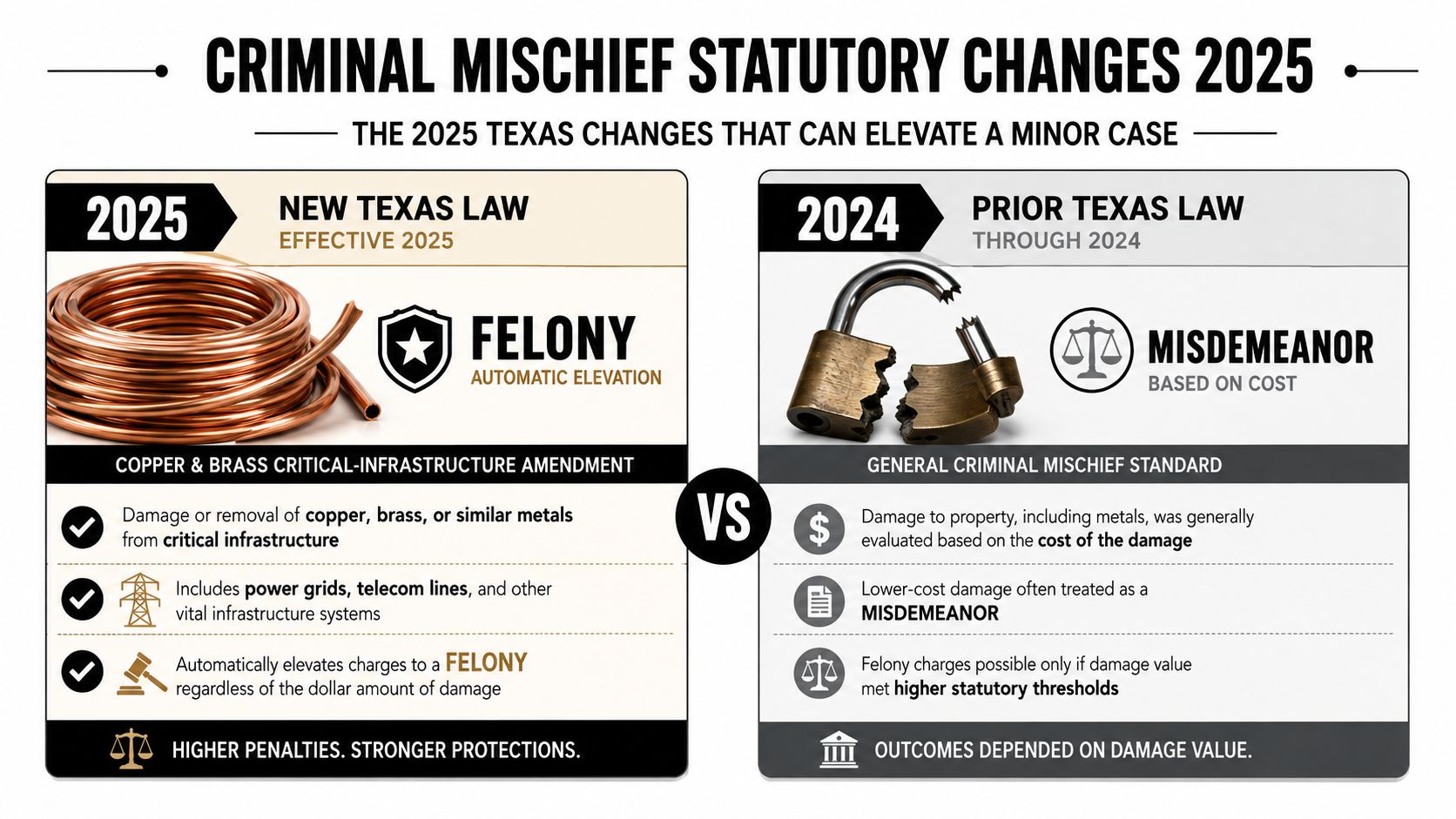
A small repair bill does not always mean a minor criminal mischief case in Humble. The 2025 Texas statutory update added conduct-based felony rules, so the property involved and the setting can matter as much as the dollar value. The statute still covers intentional or knowing property damage, tampering, and unauthorized markings, but those facts now require closer review.
The first change involves copper or brass components connected to critical infrastructure. If the covered conduct impairs operations, the amended statute provides for a third-degree felony. Around Lake Houston, that rule may apply to allegations involving utility facilities, water-treatment operations, pipeline equipment, power infrastructure, or related systems. Cutting wire or removing conduit is not treated solely as ordinary property damage when the facility and operational-impact requirements are satisfied.
The second change involves certain damage to a habitation during criminal trespass. A home, apartment, or attached structure may support a second-degree felony charge when the statutory conditions are present. A damaged door, wall, window, or attached structure with a relatively low repair cost can therefore create a more serious charging issue than older summaries based only on value thresholds suggest.
Why the first charge may change
The arresting agency's description is only an initial account, not the final legal analysis. The State still must prove the required property category, the alleged conduct, operational impairment when required, trespass circumstances, intent, and the connection between the accused and the damage.
A spray-painted wall, damaged fence, or cut wire deserves a statutory review before you discuss a plea. Your lawyer should determine whether the property qualifies, whether the alleged damage occurred in the required setting, and whether prosecutors used the correct valuation or enhancement. In a Humble case, those questions should be addressed before the first Harris County court setting. The 2025 update makes early review more important, because a charge that appears minor on the report may carry felony consequences under the new rules.
What Happens After an Arrest in Harris County
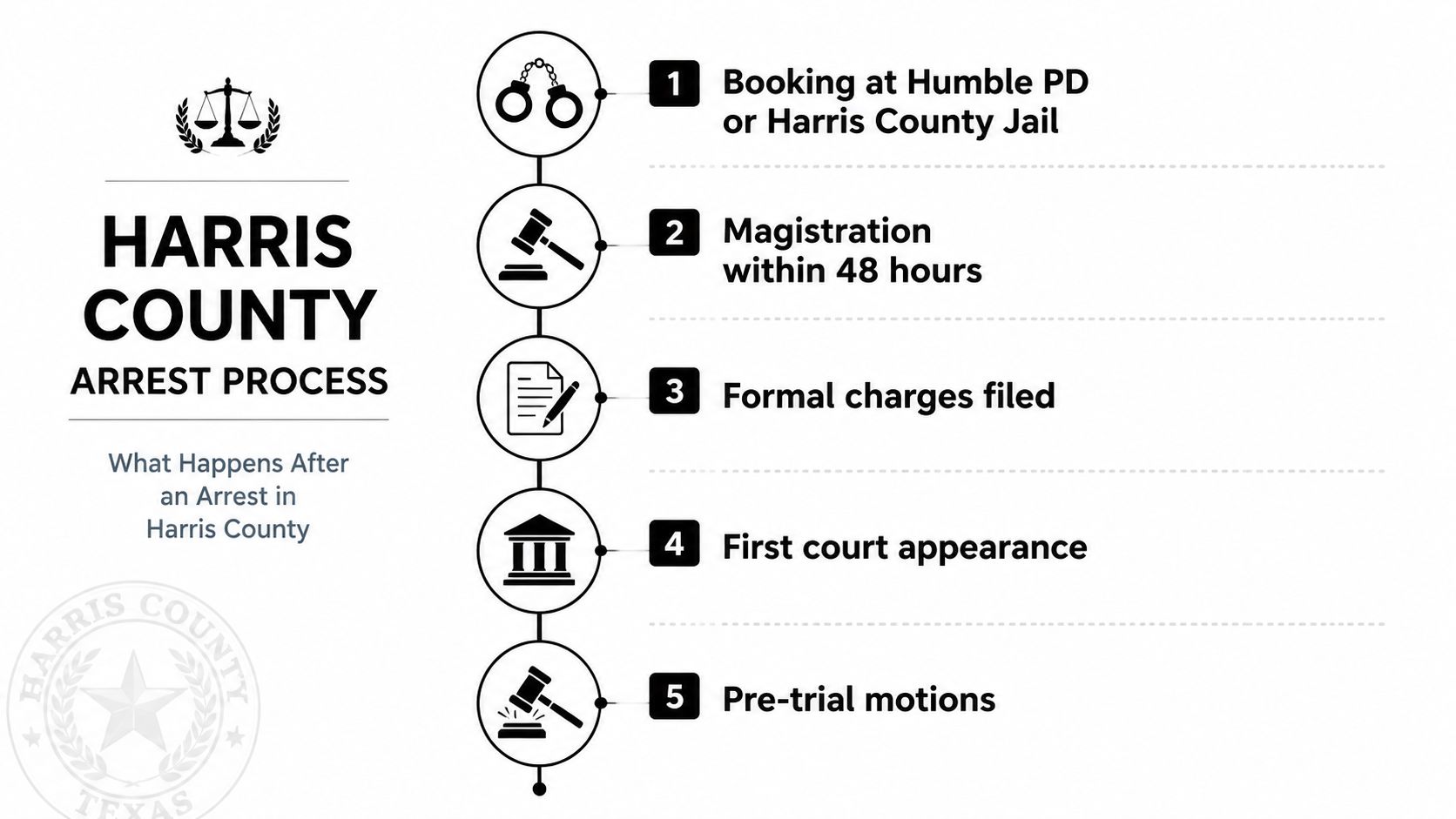
A Humble-area arrest usually creates a sequence of custody, bond, charging, and court settings. The exact path depends on the charge and facts, but you should expect the case to move through Harris County procedures rather than end with the arrest itself.
The immediate custody steps
Booking may occur through the Humble Police Department or the Harris County Jail. During magistration, a magistrate addresses probable cause, bond, and release conditions. That process generally occurs within 48 hours, and conditions may include restrictions on contact with the alleged victim or return to a location.
After release, gather every document you received. Write down the officer's name, agency, report number, bond terms, and the court listed on your paperwork. Violating a no-contact order can create a separate problem even if the underlying property allegation is weak.
You can also review the general Humble arrest process and what happens after an arrest before your first setting. Don't assume that release means the case is over.
First setting and arraignment
Harris County Criminal Courts at Law rules treat the first setting as the arraignment setting. For cases filed Monday through Thursday, the arraignment is set for the same day of the following week. Cases filed Friday through Sunday are set for the following Friday, according to the Harris County Criminal Courts at Law rules.
At the downtown criminal-justice complex, you may wait for your lawyer, stand with other defendants, and have only a short appearance before the court. Your attorney can confirm the formal accusation, address discovery, discuss bond conditions, and determine whether the case belongs in a county court at law or requires felony-court handling.
Pretrial settings involve evidence review, motions, negotiations, and possible trial scheduling. The State may discuss restitution, deferred disposition, or another resolution. You shouldn't accept an offer until counsel has reviewed the photographs, video, witness accounts, valuation documents, and any statements attributed to you.
Family-law litigation follows a separate path. The resource Harris County Family Courts: A Humble Resident's Guide addresses how family-law cases proceed in the Harris County courts serving Humble. Don't confuse those settings with a criminal mischief docket.
Defense Strategies a Humble Lawyer Can Build
A strong defense starts with the evidence, not a slogan. The right approach depends on whether the dispute involves graffiti, a vehicle, a fence, a landlord, a former partner, or an allegation involving infrastructure or a habitation.
| Defense Strategy | What It Challenges | Best Fact Pattern | Leverage Point |
|---|---|---|---|
| Damage-value review | Repair estimates and replacement claims | Vehicle scratches, broken doors, fence damage | A lower supported value may reduce the charge tier |
| Intent defense | Whether the act was intentional or knowing | Accident, accidental contact, mistaken identity | The State must prove the required mental state |
| Evidence challenge | Photos, video, chain of custody, and witness reliability | Grainy surveillance or conflicting accounts | Weak proof can support dismissal or negotiation |
| Ownership and consent review | Whether the property belonged to another person or whether consent existed | Shared homes, roommates, family disputes | Property rights may undermine the accusation |
| Constitutional challenge | Search, detention, statements, or identification procedures | Unlawful stop or unreliable identification | Suppression can remove important State evidence |
| Negotiated resolution | Jail exposure and record consequences | Strong restitution position with limited proof | Deferred disposition or another non-jail outcome may be possible |
Start with the valuation
The State may treat an owner's estimate as decisive. It shouldn't be accepted automatically. Your lawyer can compare the alleged damage with photographs, prior condition, repair invoices, competing estimates, depreciation, and unrelated work included in the claim.
For a damaged car, that might mean separating a fresh scratch from old body damage. For a fence, it may mean testing whether the estimate covers only the affected section or a broader replacement. In a landlord-tenant case, the lease and move-in documentation may matter as much as the repair invoice.
Test intent and identification
Criminal mischief requires more than proof that property ended up damaged. An accident, mistaken identity, self-defense-related property context, lack of consent issues, or an honest belief about ownership may change the defense. Witnesses who saw only the aftermath may not establish who caused the damage or what happened beforehand.
Your attorney should also examine surveillance footage, phone records, photographs, body-camera evidence, and the handling of physical items. If officers searched without lawful authority or detained you improperly, constitutional litigation may provide an advantage. Don't give up those issues by making an uninformed plea.
Diversion, restitution, deferred disposition, and pretrial intervention may offer practical alternatives in an appropriate case. They're not automatic, and eligibility can depend on the charge, facts, history, prosecutor, and court. The best outcome usually comes from combining a credible evidentiary challenge with a realistic resolution proposal.
Why Hiring a Local Criminal Mischief Lawyer Matters
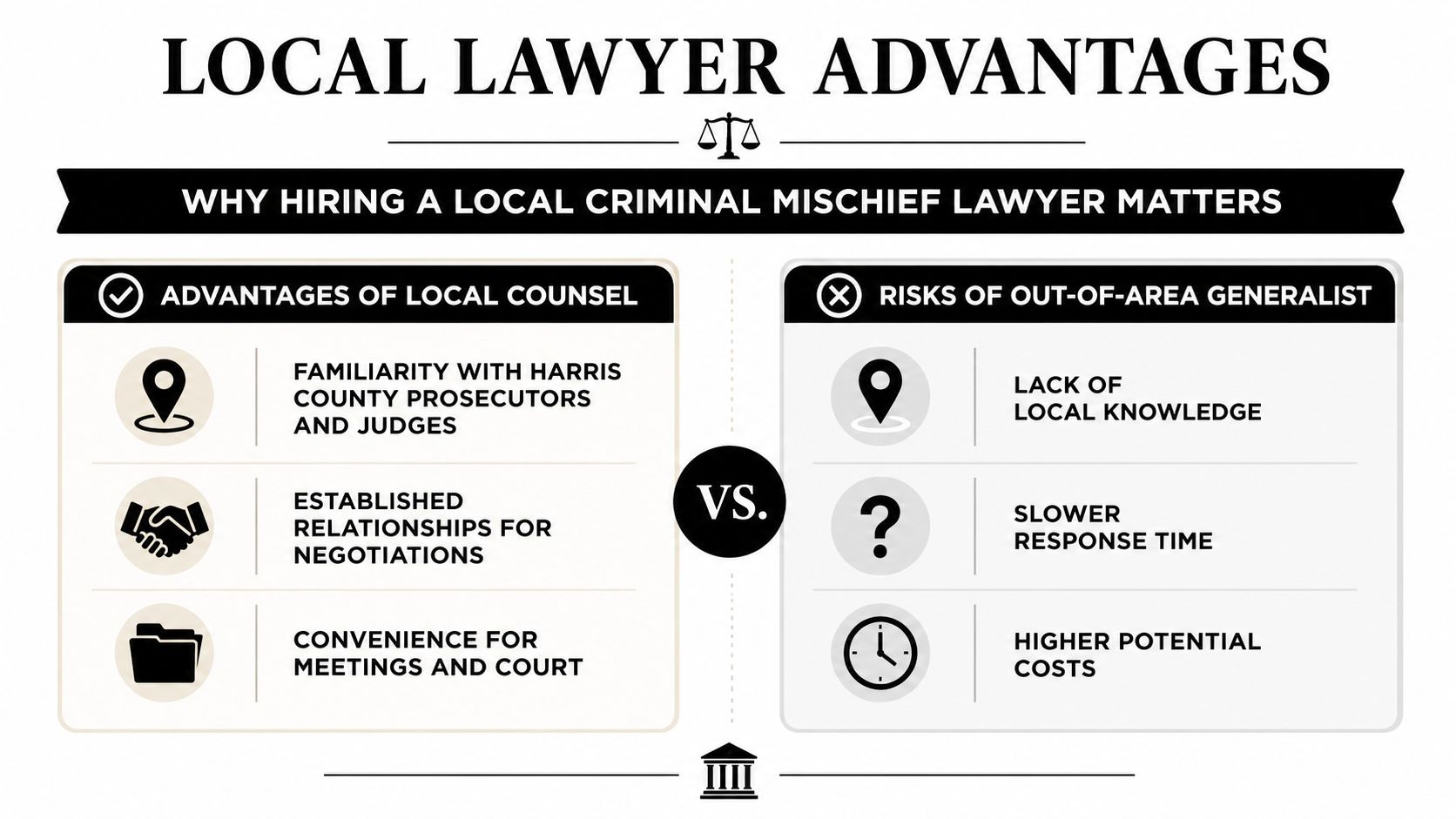
A local criminal mischief lawyer in Humble, TX understands that the case doesn't live only in the Penal Code. It moves through Harris County prosecutors, court coordinators, bond staff, and judges who handle recurring criminal dockets. Local familiarity can help counsel respond quickly when bond conditions, no-contact orders, discovery delays, or an unexpected charging upgrade create immediate pressure.
That doesn't mean geography replaces skill. It means a lawyer who regularly works in the relevant courthouse can build a practical plan around local scheduling, filing practices, prosecutor communication, and courtroom expectations. For a person in Humble, Atascocita, Kingwood, or Northeast Houston, that can make meetings and document collection easier during a stressful period.
The early-intervention trade-off
Waiting may feel financially safer, but it can leave the first version of the facts unchallenged. Early counsel can preserve surveillance, contact witnesses through proper channels, review bond conditions, examine the valuation, and discuss restitution without turning your own messages into evidence. Those steps may also matter later if you seek deferred disposition, dismissal, nondisclosure, or expunction.
Ask any lawyer what a flat fee covers before signing. Clarify whether representation includes the bond issue, arraignment, discovery review, negotiations, motions, trial preparation, trial, and post-resolution record-clearing advice. A low initial quote may not cover every stage, while a broader arrangement may provide more predictable planning.
A law firm also needs a reliable way to capture urgent calls and preserve the caller's details. A Voicedial.ai legal intake solution can help a firm organize incoming legal inquiries so a potential client's basic information and urgency don't disappear during a busy docket day.
Before retaining counsel, ask direct questions about experience with criminal mischief, Harris County courts, valuation disputes, diversion, and felony enhancements. The guide on how to choose a criminal defense lawyer can help you compare those answers instead of choosing based only on advertising.
Your First Three Days After Being Charged
The first 24 to 72 hours should be controlled and deliberate. Your goal isn't to win the case through a text message. Your goal is to prevent avoidable damage while counsel investigates.
- Invoke silence: Don't discuss the facts with officers, investigators, prosecutors, the alleged victim, or the alleged victim's friends. Say that you want a lawyer, then stop explaining.
- Preserve evidence: Save photographs, videos, receipts, repair records, location information, texts, emails, and relevant call logs. Don't edit, delete, or overwrite files.
- Protect witnesses: Write down the names and contact information of people who saw the incident or the property's condition. Don't coach them or ask them to coordinate stories.
- Secure paperwork: Keep the bond documents, charging papers, court notice, officer's name, agency, report number, and setting date together.
- Lock down social media: Don't post about the arrest, the alleged victim, the property, or your defense. Ask friends not to tag you in related material.
- Avoid contact: Don't send an apology, payment offer, threat, explanation, or request to drop the case. Follow every no-contact condition exactly.

Contact a criminal defense lawyer promptly and ask counsel to request discovery. The State's evidence should be reviewed as part of a defense investigation, not guessed at from a police summary. Early organization gives your lawyer more room to challenge the estimate, test identification, negotiate restitution, or pursue dismissal and diversion where appropriate.
Expunction Options and Your Next Step With a Humble Attorney
A criminal mischief case doesn't necessarily define your future after resolution. Texas law provides different record-clearing routes, but eligibility depends on the exact outcome, offense level, waiting rules, prior history, and statutory requirements.
An acquittal or qualifying dismissal may support expunction under Article 55.01. Certain completed deferred-disposition outcomes and some Class C misdemeanor situations may also qualify, but the details matter. Nondisclosure under Article 411.071 is narrower and generally concerns successfully completed misdemeanors that meet the applicable conditions.
Compare the possible remedies
| Outcome | Best Remedy | Statute | Typical Timeline | What It Covers |
|---|---|---|---|---|
| Acquittal | Expunction review | Article 55.01 | After final disposition and required procedural steps | Qualifying records held by DPS, courts, and local police |
| Qualifying dismissal | Expunction review | Article 55.01 | Depends on dismissal terms and waiting requirements | Eligible government criminal records |
| Completed deferred disposition | Expunction or nondisclosure review | Applicable Texas record-clearing provisions | Depends on offense and statutory waiting requirements | Relief varies by eligibility and record type |
| Qualifying misdemeanor resolution | Nondisclosure review | Article 411.071 | Depends on completion and statutory requirements | Generally narrower protection than expunction |
| Ineligible record | No automatic clearing | Case-specific analysis | Requires legal review | Private and federal databases may remain outside the remedy |
A petition can remove or restrict eligible records held by the Department of Public Safety, courts, and local police agencies. Expunction doesn't erase every private background database, federal record, or occupational licensing disclosure requirement. Employers, schools, landlords, and licensing bodies may also apply rules that require careful advice before you answer a background question.
For Harris County residents, practical timing depends on the final disposition, statutory eligibility, filing, service, and court scheduling. Plan the review after the case ends rather than assuming the record disappears automatically. The Texas criminal record expunction service page explains the next legal review to request.
Bring the charging document, bond paperwork, court notices, dismissal or disposition paperwork, and any deferred-disposition order to a free consultation. A Humble-area attorney can assess the charge, identify the strongest defense issue, and determine whether a later expunction or nondisclosure path is realistic.
The Law Office of Bryan Fagan offers criminal defense guidance for Humble, Atascocita, Kingwood, and Northeast Houston residents facing criminal mischief allegations, including help reviewing damage estimates, bond conditions, evidence, and possible resolutions. Visit Law Office of Bryan Fagan to schedule a free consultation with the Humble office and discuss your next step.