Your work schedule changed, your child's school calendar no longer matches the old exchange plan, or your co-parent moved from Humble to another part of Harris County. You may be following an order that made sense at the time but now creates missed exchanges, long drives, late school arrivals, or conflict every week. For parents in Humble, Atascocita, Kingwood, and Northeast Houston, these problems often become impossible to ignore once school, work, sports, and transportation all compete for the same hours.
A parenting time modification can give the court a way to adjust possession and visitation when circumstances have materially changed. It doesn't automatically change conservatorship, erase the existing order, or give either parent permission to create a new schedule alone. Until a judge signs a new order, the current order remains enforceable.
When Life Changes and Your Custody Order Cannot Keep Up
A parent in Atascocita may have worked a predictable weekday schedule when the original order was signed. Later, an employer may move that parent to rotating shifts. A child who once attended a nearby elementary school may move to a Humble ISD campus with different dismissal times. A co-parent in Kingwood may relocate, turning a short exchange into a trip that interferes with homework and bedtime.
Those changes don't necessarily mean either parent has done something wrong. They may mean the existing possession schedule no longer reflects the child's actual routine. Texas courts can modify parenting time to address that mismatch, but the requested schedule still has to serve the best interest of the child.
Parenting time is not the same as conservatorship
Parenting time generally concerns when and how a parent spends time with the child, including weekends, weekdays, holidays, school breaks, transportation, and exchanges. Conservatorship addresses broader rights and duties, such as making decisions about education, medical care, and other important matters. A request to adjust weekends because of a work shift is different from asking to change the parent with the exclusive right to determine the child's primary residence.
That distinction matters. A parent who wants a more workable schedule may not need to ask the court to change the entire custody structure. A narrower request can be easier to understand and may reduce unnecessary disruption.
Practical rule: Don't treat a modification case as a second divorce trial. Show what changed, explain how the current order affects your child, and propose a workable alternative.
The old order controls until a new order is signed. A parent shouldn't withhold possession, change schools, or refuse exchanges just because a modification case has been filed. If the parents can agree, they can ask the court to approve an agreed order. If they can't, one parent must file and prove the legal basis for relief.
Children also need an age-appropriate explanation that doesn't make them responsible for the dispute. Parents looking for calm, practical language can use these age-specific divorce conversation scripts as a starting point. The conversation should reassure the child that adults are handling the legal process and that the child isn't being asked to choose sides.
The Legal Standard Texas Courts Apply to Parenting Time
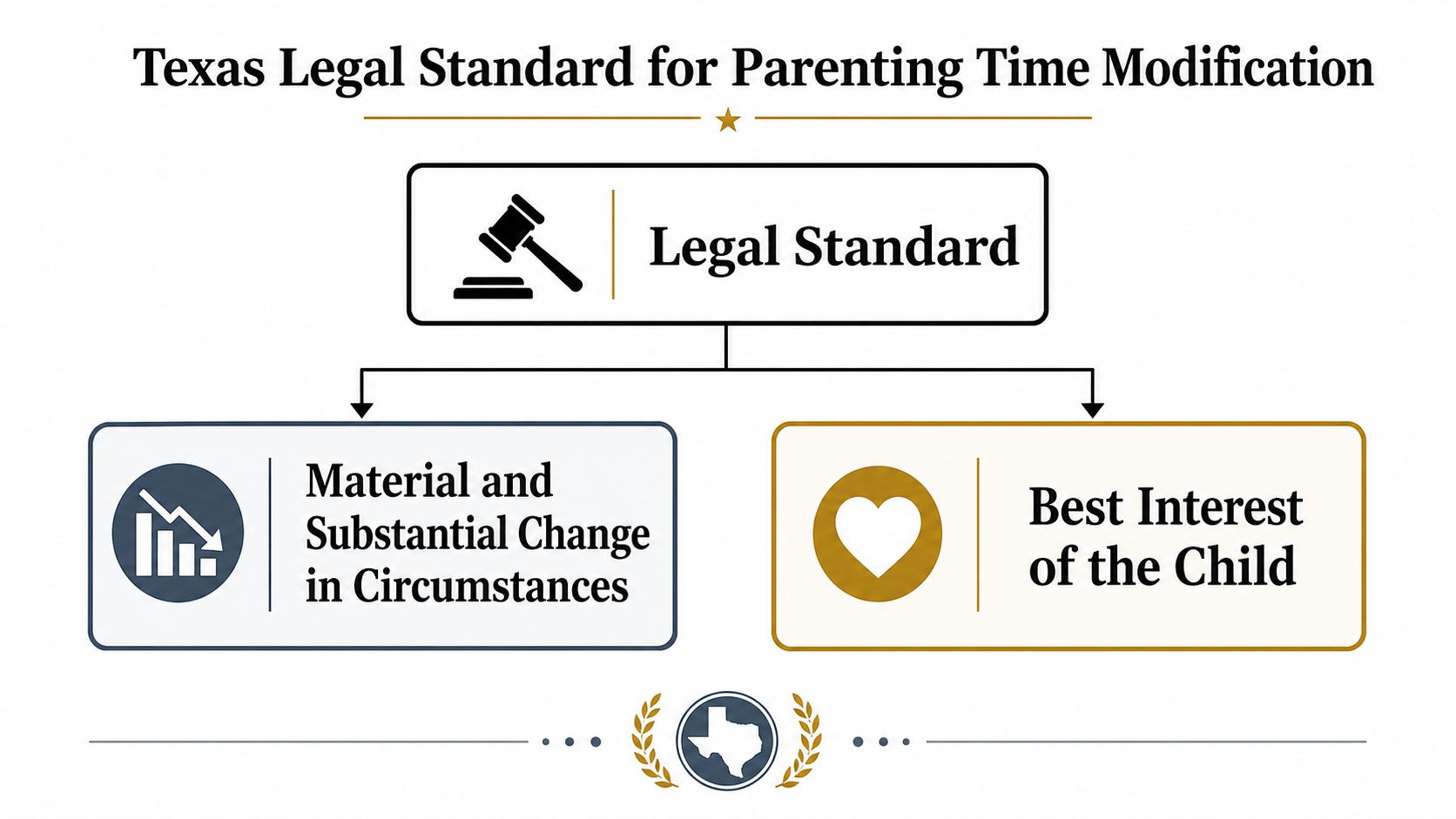
Texas courts don't modify a possession schedule merely because a parent prefers a different arrangement. The filing parent generally must establish a material and substantial change in circumstances since the prior order and show that the requested change is in the child's best interest. The facts must connect to the child's life, not just to an adult's frustration with the other parent.
A useful way to evaluate your situation is to ask three questions.
Identify the change
Start with the event or development that occurred after the current order. Common examples include a relocation, a school change, a new work schedule, transportation problems, or a safety concern. A general statement that “the schedule doesn't work” is weaker than a documented explanation showing which exchanges fail, why they fail, and how the child is affected.
Connect the change to the child
The court needs more than proof that your life became inconvenient. Explain the effect on school attendance, homework, sleep, medical care, activities, emotional stability, or the child's relationship with each parent. Texas courts focus on the child's welfare rather than rewarding the parent who files first.
Offer a safer and more workable plan
A proposed schedule should answer practical questions. Who handles transportation? Where will exchanges occur? How will holidays work? What happens when a shift changes? Does the plan preserve school-night stability while protecting meaningful time with both parents?
When a parent seeks to change the child's primary residence, the case can involve a more significant custody restructuring than a request to adjust exchanges or weekends. The requested relief should match the evidence. A parent who has strong proof that a Wednesday exchange is impossible may not have proof supporting a change in primary residence.
For families dealing with distance, the practical details of a standard schedule matter. Review the Texas standard possession order distance rules for Humble families before proposing a schedule that ignores travel time or school obligations.
A routine calendar can help document the problem. Parents may also find a neutral overview of best parenting apps for routines useful for tracking exchanges, school events, and communications. A parent considering formal divorce representation may also review Divorce Lawyer in Humble, TX, which provides divorce representation for clients in Humble and Harris County.
Common Grounds Harris County Families Actually Use
The strongest modification requests usually begin with a concrete change and end with a detailed proposal. Harris County families may face different versions of the same problem, but the court still needs evidence that the requested adjustment benefits the child.
Relocation within the county
A move from Humble to Kingwood, Atascocita, or another Northeast Houston community can alter school transportation and exchange times even when both homes remain in Harris County. Evidence may include a lease, utility record, school assignment, driving-time documentation, and a proposed exchange location. A complaint that the other parent “moved too far” without showing the effect on the child is less persuasive.
School and activity changes
A child may transfer to a Humble ISD campus, begin a demanding activity, or follow a school calendar that conflicts with the old midweek possession period. Bring attendance records, bell schedules, activity calendars, and messages showing repeated conflicts. Courts are more likely to understand the request when the proposed schedule protects school performance rather than just increasing one parent's overnights.
Work and shift changes
A parent moving from a regular schedule to rotating or on-call work may need a schedule built around actual availability. Research on precarious work links unpredictable hours and schedule volatility with work-family conflict, childcare problems, and missed work, as discussed in this study of unstable work schedules and family life. Use employer schedules, time records, childcare arrangements, and a realistic backup plan. Don't promise possession that your job repeatedly prevents you from exercising.
A child's expressed preference
Texas courts may consider a child's wishes within the legal framework, but a child doesn't become the decision-maker. A parent should never coach a child, ask the child to collect evidence, or present a preference as proof that the other parent is unfit. The court will consider the broader circumstances, including maturity, stability, relationships, and the reason for the preference.
Safety or substance concerns
Documented safety issues require focused proof. Relevant materials may include police records, medical records, treatment information, protective-order documents, school communications, or witness testimony. Social-media accusations, angry texts, and unsupported labels such as “unsafe” or “addicted” won't substitute for admissible evidence.
A useful Harris County file separates facts from conclusions. Write down dates, missed exchanges, school effects, and direct observations. Preserve original messages and avoid editing screenshots in a way that removes context.
Documents and Forms You Need Before You File
A modification petition is not a personal letter to the judge. It is a legal pleading supported by records that show what changed and why the requested schedule serves the child. Before filing in Harris County, organize the file so the clerk, opposing parent, mediator, and court can understand the issue without reconstructing your story.
Build the legal file first
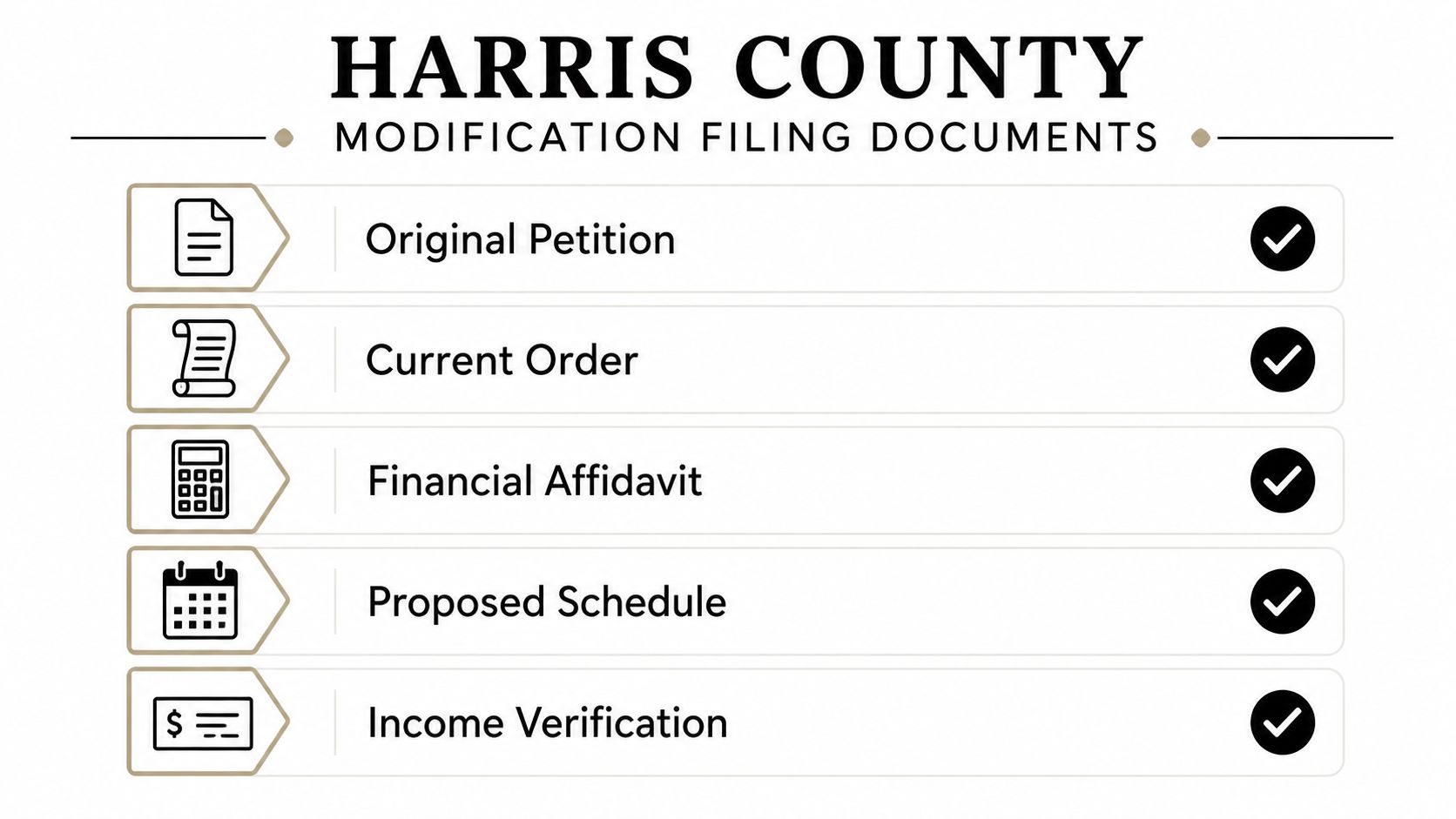
Gather the current order and every later agreed order, enforcement order, or modification that affects possession. Then locate the Texas Supreme Court forms that apply to your case, including the Original Petition to Modify the Parent-Child Relationship and required confidential information filings. The exact forms and local filing requirements can depend on the relief requested, so review the current court instructions rather than relying on an old packet.
Add documents that establish the change:
- School records: Keep calendars, attendance information, dismissal times, and activity schedules.
- Employment records: Save shift calendars, employer notices, and records showing recurring schedule changes.
- Exchange documentation: Maintain a dated log of arrivals, cancellations, travel problems, and missed possession.
- Communications: Preserve complete text and email threads, not isolated lines that could be misleading.
- Safety records: Organize police, medical, treatment, or protective-order documents if safety is part of the request.
- Proposed schedule: Draft regular periods, holidays, school breaks, transportation terms, and a method for handling predictable schedule changes.
The evidence needed for a custody case in Harris County can help you think beyond emotional testimony and focus on records tied to the child's daily life.
Use a final readiness check
Before submitting anything, confirm that the names and cause number match the existing case, the requested relief is stated clearly, and the proposed schedule is internally consistent. Check that confidential information is filed through the required form and isn't unnecessarily exposed in public pleadings.
Parents often forget prior agreed orders or assume school records will speak for themselves. Label each exhibit, keep the original file, and prepare a short chronology that shows the change in order.
The following video offers general orientation about the modification process. It isn't a substitute for advice about your specific Harris County case.
Filing Your Petition in Harris County Step by Step
Harris County procedure starts with identifying the court that has authority over the existing case. A modification suit is generally filed in the court with continuing, exclusive jurisdiction, usually the court that issued the prior order, unless a statutory transfer applies. Confirm the court, cause number, parties, and current order before preparing the filing.
Confirm the case and prepare the pleading
Read the order carefully. Identify the exact provision you want changed, whether you seek temporary relief, and whether your request affects possession, conservatorship, support, or another part of the parent-child relationship. Use the applicable Texas Supreme Court forms and complete every required section accurately.
Your petition should explain the material and substantial change in plain factual terms. It should also state the requested schedule and any additional relief. Avoid turning the pleading into a long history of every disagreement. Allegations that don't support a legal request can distract from the strongest facts.
File through the Harris County system
Harris County family courts use electronic filing procedures through the Odyssey system. Upload the petition, civil case information, confidential forms, and supporting documents in the formats and categories required by the e-filing portal. Review the submission before sending it because a rejected filing can delay service and the next procedural step.
A filing fee may apply. If you can't afford it, ask about a statement of inability to afford payment of court costs or the current fee-waiver process. Don't assume a fee waiver is automatic. Complete the required financial information and wait for the clerk or court to process it.
Handle service correctly
After filing, the other parent generally must receive formal service unless that parent files a valid waiver or the parties use another procedure allowed by law. Service may involve a constable, sheriff, private process server, or other authorized method. If you don't know where the other parent lives, tell the court or your lawyer early. Alternative-service procedures require specific steps, and sending the petition by ordinary text message usually isn't enough.
The case may not move forward until service is completed or legally waived. Keep every return, waiver, and clerk notice. Don't rely on a verbal promise that the other parent knows about the case.
Temporary Orders Mediation and the Path to a Final Hearing
A filed petition doesn't instantly create a new parenting schedule. If the current arrangement is unworkable during the case, a parent may request temporary orders. Temporary relief can address possession, exchanges, transportation, communication, and other immediate needs while the court considers the final modification.
Harris County family cases may also involve mediation before a final hearing. In mediation, each parent presents a proposed resolution with the help of a neutral mediator. The mediator doesn't decide the case. The parents decide whether to reach an agreement, and any agreement should be reduced to a written order that the court can approve.
Make the process work for the child
Discovery may involve exchanging records, answering written questions, and identifying witnesses. The final hearing focuses on admissible evidence, credibility, the child's best interests, and whether the requested order is workable. A parent who arrives with a long list of grievances but no organized proof may struggle to make the central issue clear.
Mediation can be especially useful when the dispute is logistical rather than dangerous. Parents may agree to a school-based exchange, a revised holiday schedule, advance notice for shift changes, or a transportation rule that removes repeated arguments. The family-court mediation process can help parents understand what to expect before attending.
There isn't one guaranteed timeline for a Harris County modification. The length depends on service, temporary orders, discovery, mediation, court settings, contested evidence, and the court's docket. A negotiated agreed order may resolve the issue more efficiently, but settlement isn't appropriate when a child faces an immediate safety risk or one parent won't negotiate in good faith.
Working with a Humble Family Lawyer and What It Really Costs
The assumption that a modification is simple because it concerns “only visitation” often causes parents to underprepare. A contested parenting-time case can involve pleadings, service, evidence, temporary orders, mediation, discovery, hearings, and a final trial. A parent who handles the case without counsel may save legal fees but take on every procedural and evidentiary risk personally.
Compare the practical options
A cooperative case may be manageable with carefully prepared forms and a written agreement, especially when both parents agree on the schedule and the change is clear. A contested case is different. If the other parent disputes the facts, refuses service, raises safety allegations, or seeks a primary-residence change, legal guidance can help you identify the correct request and present proof in a focused way.
Lawyers commonly structure fees differently depending on the case. An uncontested agreed order may be handled through a flat fee, while a contested matter is often billed hourly. Court filing fees and service expenses may also apply in Harris County. The precise amount depends on the filing, service method, and representation arrangement, so ask for a written explanation before hiring counsel.
A lower upfront cost doesn't make a weak filing inexpensive. Rejected pleadings, missed deadlines, poor evidence, and an unrealistic schedule can create problems that are harder to fix later.
Local representation can also help a parent understand Harris County filing practices, court settings, mediation expectations, and the transportation realities between Humble, Atascocita, Kingwood, and Northeast Houston. The Child Custody Lawyer in Humble, TX page describes custody and conservatorship representation for Humble families.

The Law Office of Bryan Fagan offers family-law guidance for parents evaluating a parenting time modification, along with support for other legal needs such as divorce, criminal defense, estate planning, wills, trusts, and probate. Whether you're considering an agreed order or preparing for a contested Harris County case, bring your current order, calendar, and evidence to a consultation.
Schedule a free consultation with the Law Office of Bryan Fagan to discuss your parenting time modification with a local Humble legal team. Parents in Humble, Atascocita, Kingwood, and Northeast Houston can receive practical guidance on filing, evidence, mediation, and the schedule that best protects their child's stability.