Skip to content

A dismissed DWI arrest can still surface when a Humble employer runs a background check, a landlord reviews an application, or a licensing agency examines your history. The case may feel finished to you, but the record can continue creating practical problems in Atascocita, Kingwood, and Northeast Houston.
Texas gives qualifying residents two different forms of relief: expunction, which can destroy qualifying arrest records, and nondisclosure, which seals records from public view without destroying them. Choosing between them isn't a matter of picking the easier-sounding option. The result of your case, the type of offense, the waiting period, and any later criminal history control the answer.
What These Two Remedies Actually Do for Humble Residents
A dismissed DWI arrest can still cause trouble for a Humble resident. An employer, landlord, or licensing agency may see the arrest during a background check years after the case ended. A person who did nothing wrong may still have to explain a record that keeps surfacing in Harris County.
Start with the practical question: Can the record be destroyed, or will it remain available to authorized users after public access is restricted? The answer depends on the case outcome, the way the case ended, and the person's complete criminal history.
For a dismissed arrest or acquittal, expunction deserves the first review. If the law permits it and the court grants the petition, agencies can be ordered to destroy the covered records. That can address the arrest itself instead of leaving it available for later searches. A favorable result does not erase the record automatically. The resident still needs the proper court order and must identify the agencies and records covered by it.
A completed deferred-adjudication case presents a different problem. Consider a first-time possession case in Harris County. Successful completion may lead to dismissal, but dismissal alone does not necessarily qualify the arrest for expunction. Nondisclosure may restrict public access while allowing certain government entities to view the record.
That distinction matters for residents of Humble, Atascocita, and Kingwood who discover an old charge on a background check. Learn more about sealing a criminal record in Texas.
Local recommendation: Review expunction first after a dismissal or acquittal. After deferred adjudication, evaluate nondisclosure instead. Old charges that still appear in searches require a records review before either petition is filed.
The final disposition and complete case history should guide the filing. Choosing the wrong remedy can waste court costs, service expenses, and time without changing what appears in the record.
Defining Expunction and Nondisclosure in Plain English
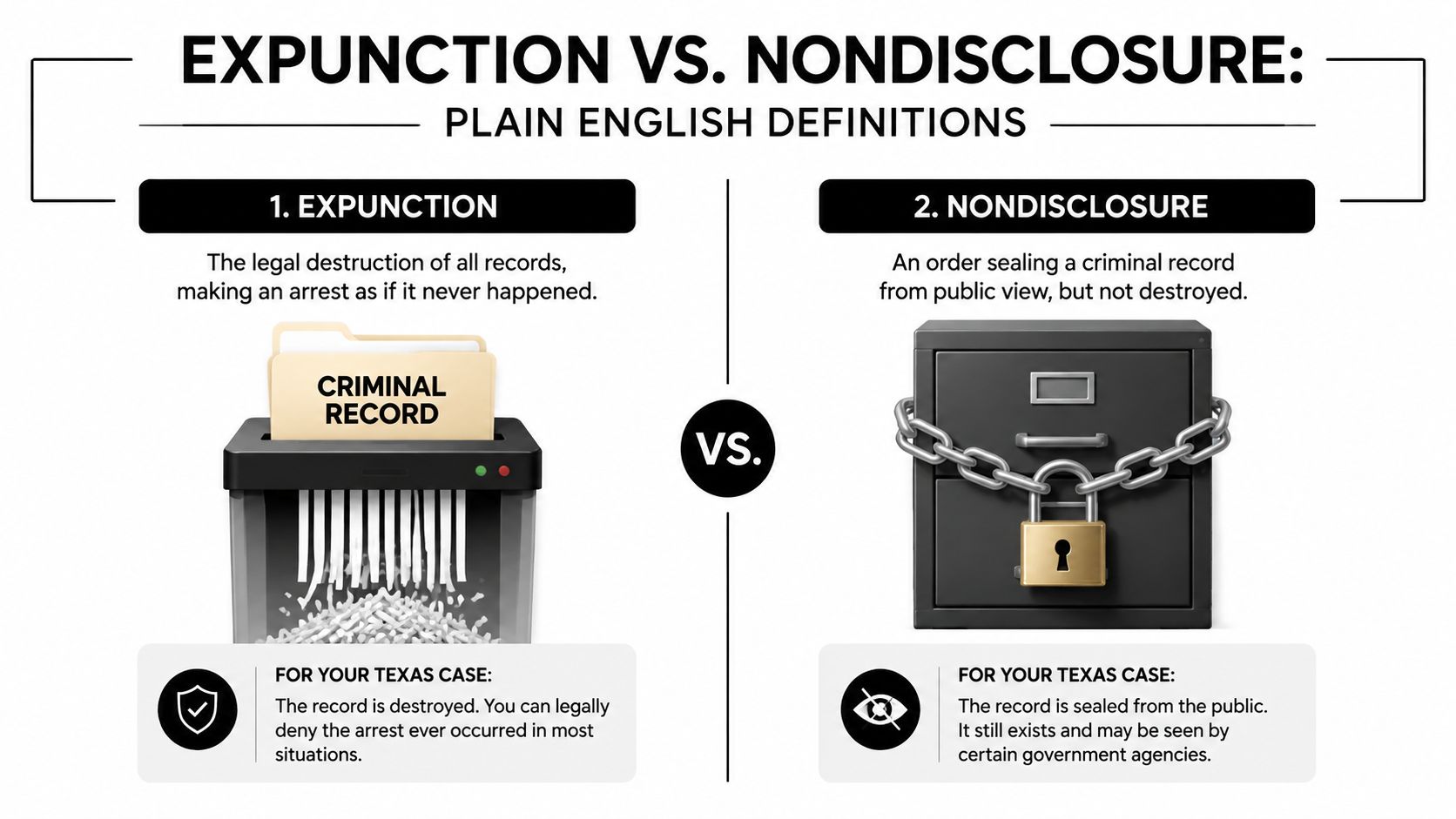
A Humble resident arrested for DWI may later receive a dismissal, yet the arrest does not disappear by itself. Expunction can provide the strongest form of relief when the person meets the statutory requirements. The judge issues an order directing the agencies named in the petition to destroy the covered arrest records. The resident must still file correctly and obtain that order.
Expunction generally fits favorable outcomes such as a dismissal, acquittal, no-bill, or pardon. The remedy addresses the records themselves, rather than merely limiting who can see them. The court order controls which agencies and records are covered, so a complete case history matters before filing. Texas Law Help's comparison of expunctions and nondisclosures explains the distinction.
Nondisclosure means sealing, not destruction. The order restricts public access, while certain government entities, licensing bodies, and law enforcement agencies may retain access under Texas law. Nondisclosure commonly becomes the practical option after successful completion of deferred adjudication and dismissal.
Consider a first-time possession case in Harris County. Successful deferred adjudication may lead to dismissal, but that dismissal alone does not make the arrest eligible for expunction. Nondisclosure may keep the record from most ordinary public searches while preserving access for authorized agencies.
The legal framework matters
Texas nondisclosure orders are governed by Chapter 411, Subchapter E-1 of the Texas Government Code. Expunction follows separate statutory rules. Both remedies can reduce the public effect of an old case, but their legal results differ.
After expunction, the person generally has the strongest ability to treat the arrest as removed, subject to narrow legal exceptions. After nondisclosure, the record remains available to specified government entities and regulated bodies. An ordinary private background check may therefore produce a different result from a government or professional licensing inquiry.
Residents should also distinguish criminal-record relief from unrelated Harris County procedures. Harris County Family Courts: A Humble Resident's Guide explains family-law proceedings in the courts serving Humble. Criminal filings follow different rules, but accurate petitions and proper notice still determine whether the court can act on the requested remedy.
Eligibility, Records Affected, and Waiting Periods Compared
The case outcome usually determines the starting point. Dismissals, acquittals, no-bills, and pardons point toward expunction, while successfully completed deferred adjudication commonly points toward nondisclosure. That split is especially important in Harris County, where a first-time deferred-adjudication case may qualify for sealing but not destruction.
| Criterion | Expunction | Nondisclosure |
|---|---|---|
| Main effect | Can destroy qualifying arrest records under a court order | Seals qualifying records from public view, but the records aren't destroyed |
| Common qualifying outcome | Dismissal, acquittal, no-bill, or pardon | Successful completion of deferred adjudication, subject to statutory rules |
| Public access | Qualifying records are removed through the expunction process | Public access is restricted |
| Government access | Narrow exceptions may apply | Certain government entities, licensing bodies, and law enforcement agencies may retain access |
| Waiting periods | Some cases require 180 days for Class C misdemeanors, one year for Class A or B misdemeanors, or three years for felonies when no indictment is filed | No waiting period for many nonviolent misdemeanors, two years for certain listed offenses, and five years for felonies |
| Major limitation | Eligibility is narrower and depends heavily on the case disposition | Certain offenses are excluded, and new criminal activity during the applicable period can block relief |
Texas guidance identifies expunction waiting milestones of 180 days for Class C misdemeanors, one year for Class A or B misdemeanors, and three years for felonies when no indictment is filed. Those periods are tied to specific eligibility circumstances, so never assume that a dismissal automatically means you can file immediately. Texas Law Help explains the comparison and timing rules.
Nondisclosure can involve a longer wait. Texas guidance commonly describes two years after dismissal and discharge for certain misdemeanor deferred adjudications and five years for felony deferred adjudications, while many nonviolent misdemeanors may have no waiting period. The applicable category depends on the offense and the governing statute. The Texas State Law Library outlines expunction and nondisclosure rules.
A second issue is later conduct. Texas court guidance states that a person generally can't seek nondisclosure unless the person received deferred adjudication for the offense and hasn't been convicted of, or placed on deferred adjudication for, a new criminal offense during the applicable period. Texas court guidance discusses this requirement.
For a practical overview of the deferred-adjudication connection, review what deferred adjudication means in Texas. The case paperwork, not the informal description someone remembers, should control the analysis.
Three Humble-Area Case Patterns and the Right Remedy for Each
Legal advice becomes clearer when attached to the cases residents recognize. These three patterns show why the resolution of the case matters more than the arrest label.
A dismissed Class B possession arrest
A resident is arrested in the Humble area for a Class B misdemeanor marijuana-possession charge. The prosecutor later dismisses the case, and the person has no conviction for that arrest.
The first remedy to investigate is expunction. A dismissal can place the case within the category of outcomes that support expunction, although the complete eligibility analysis still requires reviewing the disposition, waiting period, and related records. Nondisclosure isn't the natural first choice when the case ended without a conviction and may qualify for destruction.
Dismissed charge: Start with expunction. Sealing a record is a weaker result when the law may allow the record to be destroyed.
A first-time DWI resolved through deferred adjudication
A different resident faces a first-time DWI charge, completes deferred adjudication successfully, and receives dismissal and discharge. That dismissal doesn't automatically transform the case into an expunction case.
Here, nondisclosure is usually the practical path. Deferred adjudication is the key fact, and the person must satisfy the applicable waiting-period and criminal-history requirements. Depending on the offense category, Texas commonly uses no waiting period for many nonviolent misdemeanors, a two-year period for certain offenses, or a five-year period for felonies, measured from dismissal and discharge. A Texas nondisclosure overview explains these timing categories.
Completed deferred adjudication: Think nondisclosure first, not expunction. The record may be sealable even though it isn't eligible for destruction.
A felony acquittal at trial
Suppose a Harris County felony charge ends in an acquittal at trial. An acquittal is a powerful favorable outcome, and expunction may be available, subject to the statutory requirements and any applicable waiting rule.
Nondisclosure isn't the better substitute for an acquitted case. The resident should pursue the remedy designed for a case that ended without a conviction, rather than asking the court to seal a record that may qualify for destruction. Felony paperwork also tends to involve more agencies and more detailed petition requirements, so the filing must be precise.
A resident's next step is simple: obtain the certified disposition, identify whether the case ended in dismissal, acquittal, no-bill, pardon, or deferred adjudication, and then check the entire criminal history. That process won't decide every case by itself, but it quickly separates the strongest expunction candidates from the nondisclosure candidates.
Filing the Petition in Harris County Step by Step
Harris County residents should treat record relief as a formal court case, not as a database correction request. The court needs a legally sufficient petition, accurate identifying information, proper notice, and an order that reaches the agencies holding the records.
Verify the legal starting point
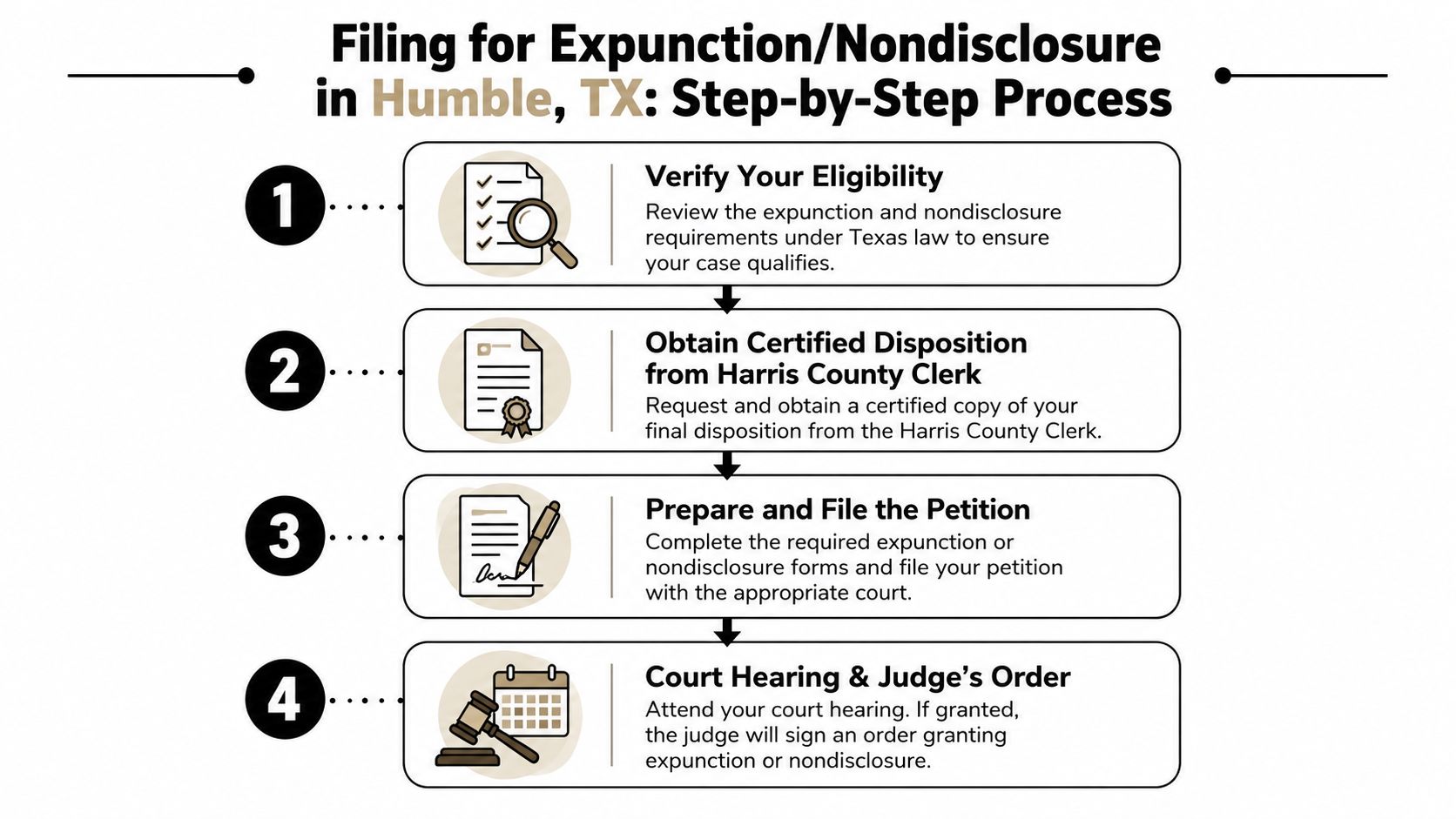
Begin with the final disposition and the complete case history. Confirm the cause number, offense classification, arrest date, dismissal or discharge date, and whether any later case affects nondisclosure eligibility.
A memory such as “the DWI was dropped” isn't enough. The certified court record may show dismissal after deferred adjudication, a different offense, or another resolution that changes the available remedy.
Obtain certified Harris County records
A certified disposition from the appropriate Harris County District Clerk gives the petition a reliable foundation. The document should show how the case ended and help identify the agencies that may possess arrest, booking, court, or prosecution records.
Residents often begin this process while handling other court matters. A separate resource, The Divorce Process in Humble: What to Expect, provides a step-by-step look at filing for divorce in Humble and Harris County. Criminal-record petitions remain distinct proceedings, but both require attention to the correct court and accurate paperwork.
Prepare, file, and serve the petition
The petition must identify the legal basis for relief and the agencies that should receive notice. Filing in the wrong court, misstating the case number, or omitting an agency can create avoidable problems.
After filing, the relevant parties must be served. The Harris County District Attorney's Office is often among the parties requiring notice, along with agencies that maintain records. Service isn't a courtesy email. It must comply with the court's procedural requirements so each recipient has a proper opportunity to respond.
Attend the hearing and obtain the order
The judge may review an uncontested petition or hear arguments if an agency objects. Bring the evidence supporting eligibility, including certified case records and documents showing compliance with the relevant requirements.
An uncontested expunction can move through the court process in a few months, but Harris County schedules and agency responses vary. Nondisclosure may take much longer before filing because the statutory waiting period can be measured in years. A service that helps law firms maintain useful legal communication, such as NewsletterAsAService for law firms, is separate from the legal filing itself, but organized follow-up is valuable when a case involves long-term deadlines.
Once signed, the order directs the appropriate agencies to carry out the relief. For expunction, that means destruction of covered records. For nondisclosure, it means restricting public access under the order. Texas expunction guidance for Humble residents can help you identify the questions to bring to a consultation.
Costs, Common Pitfalls, and What Disqualifies You
The cost of doing this correctly includes more than a court filing. A Harris County petitioner may need to account for filing fees, certified records, service costs, and attorney fees. The exact total varies by court, case type, service needs, and whether an agency contests the petition, so a responsible lawyer shouldn't quote a universal amount without reviewing the file.
The more expensive mistake is filing a petition that cannot succeed. Common problems include:
- Wrong case number: A single inaccurate digit can connect the petition to the wrong record or make the requested order impossible to process.
- Incomplete service: Every required agency must receive proper notice. Missing one can delay the case or leave records outside the order.
- Premature filing: Expunction and nondisclosure waiting periods must be calculated from the dates Texas law uses, not from the date that feels most logical.
- New criminal activity: A conviction or deferred-adjudication case during the applicable nondisclosure period can block eligibility, as Texas court guidance explains.
- Excluded offense: Some offenses cannot receive nondisclosure under the applicable rules.
Texas sources identify disqualifying nondisclosure categories that include family-violence-related cases, sex offenses, kidnapping, murder, injury to a child, elderly person, or disabled person, stalking, and offenses requiring sex-offender registration. The exact statutory analysis matters, especially when the charge was reduced or amended.
Before spending money: Get the certified disposition and have someone review the complete history. A free consultation can reveal an eligibility problem before you pay for a petition, service, and hearing that the court cannot grant.
Don't assume that an old case disappears because it has been inactive for years. Texas record relief is petition-based, and eligibility depends on the statutory requirements and the precise case outcome.
Choosing the Right Path and Taking the Next Step
My recommendation is direct. Pursue expunction first when the case ended in a dismissal, acquittal, no-bill, or qualifying pardon. Choose nondisclosure as the practical path when you successfully completed deferred adjudication and meet the waiting-period, offense, and criminal-history requirements.
Some cases won't qualify for either remedy. A conviction, an excluded offense, or a disqualifying later case may close both doors. In a narrow situation involving a wrongful arrest, a governor's pardon may be an alternative worth discussing, but it isn't a substitute for ordinary eligibility analysis.
Residents of Humble, Atascocita, Kingwood, and Northeast Houston don't need to guess which form to file. Bring your disposition, case number, arrest information, and any deferred-adjudication paperwork to a local criminal-defense attorney who can separate expunction questions from nondisclosure questions and explain the next step.
The Law Office of Bryan Fagan offers consultations for Humble residents seeking guidance on expunction, nondisclosure, criminal defense, family law, and estate planning. Visit Law Office of Bryan Fagan to schedule a free consultation and discuss the record-relief option that fits your Harris County case.