Skip to content

A stepparent adoption after termination usually starts in the middle of real life, not in a courtroom. Maybe you've already been doing the school drop-offs in Humble, making dinner in Atascocita, helping with homework in Kingwood, and showing up like a parent every single day, but the legal record still hasn't caught up with the family everyone already sees.
For blended families in Northeast Houston, the moment the other biological parent's rights are terminated can feel like the door finally opens. Texas treats that step as the legal turning point, because the court has to end the prior parent-child relationship before a stepparent can become the child's legal parent with full rights and duties. Children Psych divorce coping guide is a helpful resource for families helping a child process that kind of transition, especially when the emotional piece is moving alongside the legal one.
Understanding Stepparent Adoption After Termination in Humble
A lot of Humble parents think of adoption as the final signature. In practice, the more important milestone is usually the one before that, the termination of the other parent's rights. Texas law ties stepparent adoption to that event, and Texas Family Code Chapter 162 is the framework that controls the process (Texas Law Help on stepparent adoption in Texas).
That matters because termination doesn't just clear paperwork, it changes legal parentage. Once termination and adoption are both completed, the stepparent becomes the child's legal parent with the same rights and responsibilities as any other parent. For a child in Humble, Atascocita, or Kingwood, that can mean the difference between being the adult who picks up after school and being the adult whose name is on the legal order that says, plainly, this is your parent.
What families are really trying to finish
The families I see most often aren't chasing a title for its own sake. They want certainty, they want stability, and they want the law to match the home life they've already built. That's especially true when a child has already been living in a secure blended household and the stepparent has been acting in every meaningful way like a parent.
Practical rule: if the other parent's rights are still intact, the adoption can't move forward on its own. The court has to clear that legal relationship first.
That's why this phase feels different from the rest of family law. Divorce, custody, criminal defense, and estate planning all deal with important rights, but stepparent adoption after termination is unique because it replaces one legal parent-child structure with another. For many Northeast Houston families, that change is emotional as much as it is legal.
Eligibility Requirements and the Co-Residence Rule
The court must end the prior parent-child relationship before a stepparent can become the child's legal parent, and Texas Family Code § 162.001 sets out the path for that result in stepparent cases. It allows adoption when the living parent's rights have already been terminated, or when termination is handled together with the adoption, and it also recognizes the stepparent route when the nonterminated parent is the petitioner's spouse (Texas Family Code § 162.001).
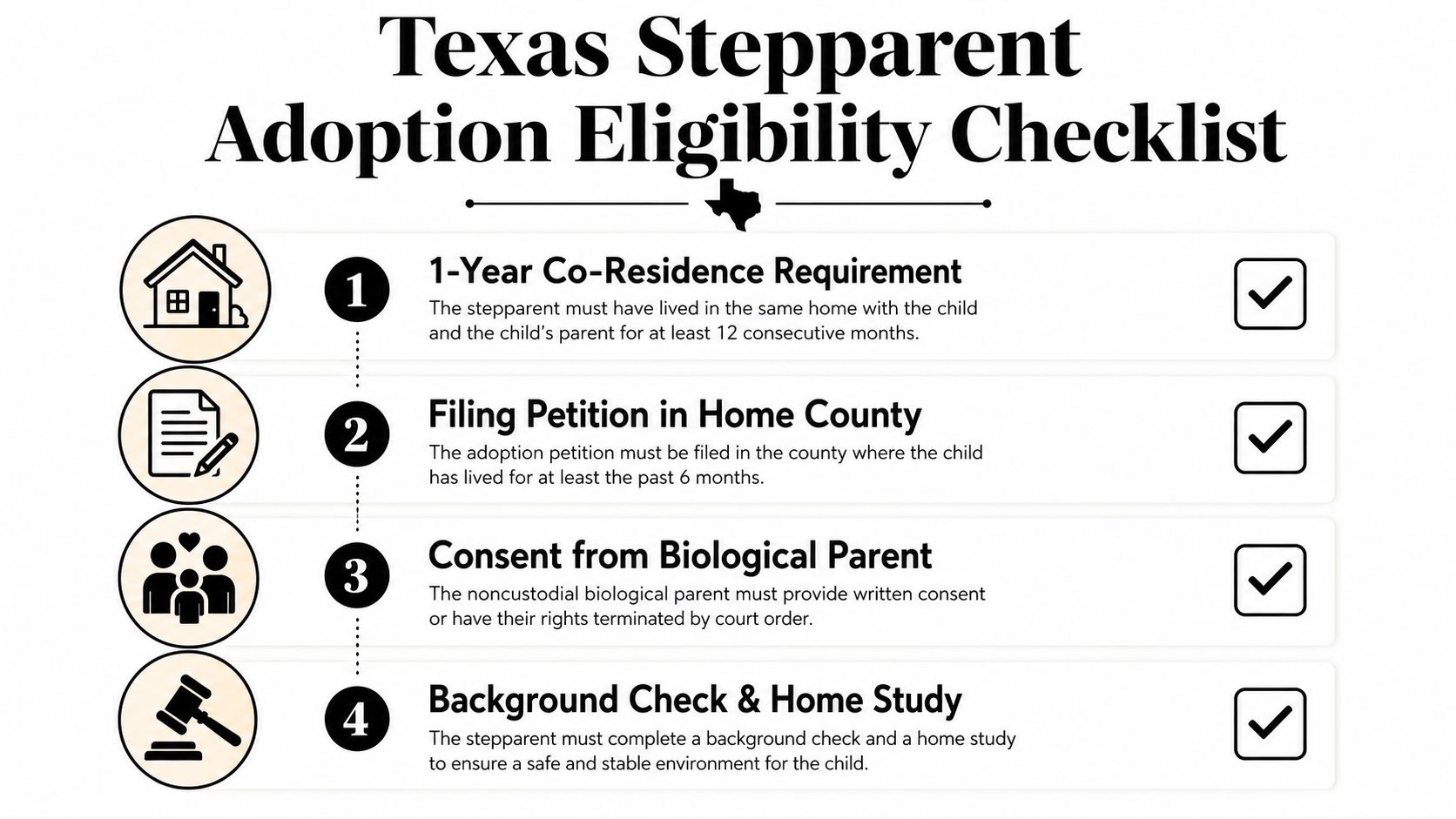
For many families, the next issue is the 6-month co-residence period described in Texas sources. The child must have lived with the stepparent and the biological-parent spouse long enough for the court to see an established home life. That residence history gives the judge a concrete basis to see the placement as stable rather than temporary.
What to gather before you file
A family in Humble should build the case with proof, not assumptions. Utility bills, lease records, school enrollment records, and mail showing the child's home address can all help support the residence facts. When the timeline is close, waiting to file until the paperwork is clean is usually better than rushing in with a petition that is not ready.
Texas practice also recognizes certain special pathways for former stepparents, including situations where the child is at least two years old and the former stepparent has had actual care, possession, and control for either six months or one year depending on the situation (Texas Family Code § 162.001). That rule does not fit every case, but it matters when a family's history does not follow the usual pattern.
If you want a local intake point for adoption questions, the firm's Adoption Attorney in Humble, TX page is a straightforward reference for families looking for adoption representation in the area.
If your household is changing addresses, schools, or care arrangements, document it now. The court cares less about what people intended and more about what the records show.
Filing Your Petition in Harris County Courts
A stepparent adoption after termination usually starts with the petition, and Texas law lets the spouse and stepparent file the adoption and termination together in the same case when the facts support that approach (Texas State Law Library FAQ on stepparent adoption). For families in Humble, that joint filing can save time and reduce avoidable trips to court, especially when the case will be heard in the Harris County family courts serving this part of the county. For a practical overview of how local family cases are handled, a resident's guide to Harris County family courts explains how these matters are processed in the courts that serve Humble, Atascocita, and Kingwood.
The filing packet has to be put together with care. The petition should identify the child, the marriage or parent-child relationship, the legal basis for termination, and the request for adoption. If the parent whose rights are being ended agrees to sign a relinquishment, the case can often move forward with an Affidavit of Voluntary Relinquishment of Parental Rights, which keeps the filing more coordinated than a contested case (Lundberg Law on stepparent adoption in Texas).
What usually slows the paperwork down
The problems I see most often are filing gaps, not legal arguments. Criminal history disclosures for the stepparent, any required home study or social study materials, and consent from a child who is 12 or older all need to be handled on time, because Harris County courts do not look kindly on a packet that is missing required pieces.
Service is another point families in Humble need to plan for early. When every adult involved is already cooperating, the process is usually smoother. If a parent must be formally served, the case becomes slower and more technical, and the filing has to be set up with that in mind.
A simple filing checklist
- Confirm the legal path: Make sure the termination has already happened, or is being filed with the adoption.
- Assemble the documents: Petition, supporting affidavits, and any termination paperwork.
- Check the child's age: If the child is 12 or older, address consent early.
- Prepare for county procedures: Harris County clerks and courts expect clean, complete filings.
Voluntary Versus Involuntary Termination Pathways
A Humble stepparent adoption usually starts to feel manageable once the termination side is clear. If the other parent is willing to sign, the case can proceed through a Voluntary Relinquishment of Parental Rights, and the termination and adoption can be coordinated instead of turned into a contested fight. That route often gives families fewer surprises, less courtroom tension, and a more predictable path to finalization.
Involuntary termination follows a different path. If the parent refuses consent or cannot be located, the case shifts into contested territory, which can bring service-of-process problems, appointment of counsel or an ad litem, and a court review focused on the child's best interests. Families in Humble, Atascocita, and Kingwood usually feel that shift quickly, because the matter stops being a paperwork process and becomes litigation.
Why the distinction matters early
If consent is likely, the termination and adoption can be prepared together from the outset. If consent is unlikely, the safer plan is to prepare for a longer court process rather than assume cooperation will hold. Misreading that part of the case creates more stress than the extra timeline itself.
A clear termination plan also helps the rest of the file stay organized. If you need help with the termination side before the adoption can move ahead, the local guidance on how to terminate parental rights in Texas is a useful place to start.
Texas child-welfare data show why the distinction matters beyond one family's case. In fiscal year 2024, Texas had 6,124 total waiting children, including 3,992 whose parents' rights had already been terminated. In earlier years, Texas finalized 4,546 adoptions in fiscal year 2021 and 5,168 in fiscal year 2020 (Texas child-welfare dashboard). Those numbers show that termination is a major step, but it does not finish the process by itself.
For families deciding which route fits their situation, a voluntary filing can reduce conflict, while an involuntary case requires more patience and more court oversight. I have seen both paths work, but they demand different preparation, and Harris County judges expect the paperwork and service history to match the path you choose.
Home Studies, Hearings, and Court Appearances
Once the petition is filed, the case usually shifts into evaluation and hearing territory. Many Harris County adoptions include a home study or social study, which gives the court a picture of the child's living environment and the stepparent's readiness. The evaluator looks for stability, safety, routines, and a real parent-child bond. Perfection is not the standard.
For families in Atascocita, Kingwood, or northeast Harris County, that usually means the home does not need to look staged. The house needs to look lived in, safe, and appropriate for a child. A clean space, a clear sleeping arrangement, and straightforward answers go a long way.
When a family is also sorting out the private adoption side of the case, the timing often runs smoother if the paperwork is organized early. Our guide to Texas private adoption explains the broader framework that can shape how a stepparent adoption file is assembled and presented.
What the hearing day usually focuses on
Children who are 12 or older may need to consent to the adoption, and the stepparent's criminal history reporting is one of the ordinary checks that can be part of the process. If the court asks for more documentation, that usually means something in the file needs clarification, not that the adoption has fallen apart.
The hearing itself is often shorter than families expect when the paperwork is complete. The judge is usually confirming that the legal requirements were met, the child's best interests are served, and the final order can be entered without unresolved issues.
Practical insight: show up with original documents, a calm child if the court wants the child present, and answers that are direct. Judges appreciate families who are prepared and honest.
The hearing phase is also where preparation matters most. A missing document can turn a final hearing into a reset, which is frustrating for children and adults alike. Harris County courts expect the file to be ready when the case is set, and a busy docket leaves little room for last-minute cleanup.
Timelines, Costs, and Avoiding Common Delays
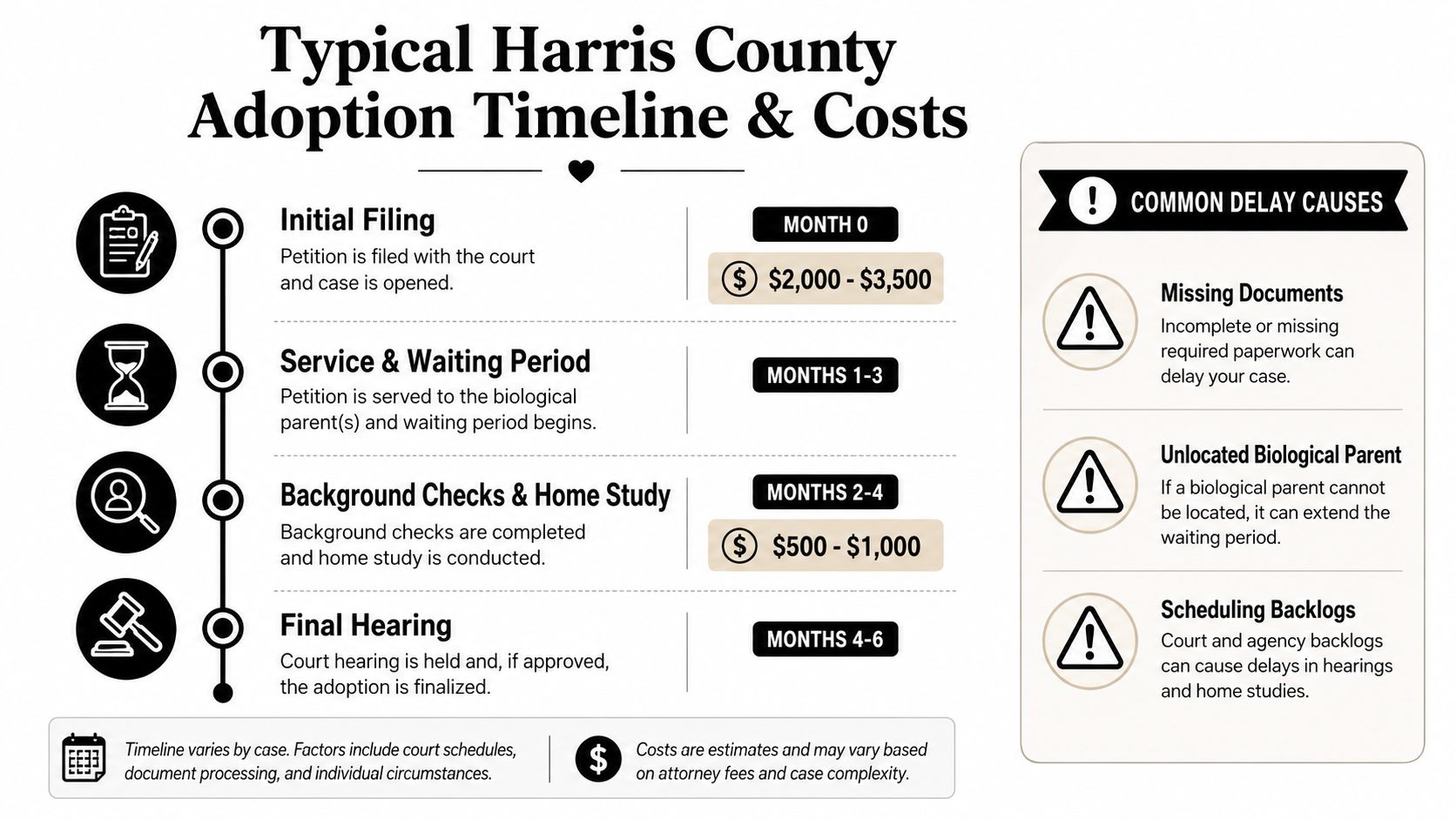
Families ask for a precise timeline because they're trying to plan school schedules, name changes, travel, and family celebrations. The honest answer is that stepparent adoption after termination moves faster when everything is cooperative and complete, and slower when any part turns contested or incomplete. Texas child-welfare data also reinforce that adoption is a separate legal step after termination, not a formality that happens automatically (Texas child-welfare dashboard).
The biggest delay sources are usually predictable. Missing documents, a parent who can't be located, late home study preparation, and consent issues with an older child can all slow a case down. Harris County scheduling can add its own lag when the court calendar is crowded.
How to keep the case moving
- Finish termination cleanly: The adoption can't finish until the legal parentage issue is resolved.
- Line up the child consent issue early: Don't wait until the hearing is set.
- Organize the proof of residence: Keep records in one folder so you can hand them over fast.
- Respond quickly to court requests: A small delay in returning documents can become a big delay in finalization.
The statewide data also show that Texas had a 31.0% adoption time-to-permanency rate in 2024, up from 27.6% in 2022 (Texas child-welfare dashboard). That doesn't set a local deadline for a stepparent case, but it does remind families that the road from legal freedom to finalized adoption still takes work.
The Law Office of Bryan Fagan's family-law team, along with its broader services in divorce, criminal defense, and estate planning, can be a practical fit when a family needs one office to coordinate multiple legal issues at once. That matters when adoption overlaps with other changes in the home, the parents' relationship, or a larger planning need.
Getting Personalized Legal Support for Your Family
No two stepparent adoptions in Humble look exactly the same. Some are smooth and fully voluntary, while others require a more careful termination strategy, extra documentation, or help navigating Harris County court procedure. A family with a child in Kingwood may need a different plan than one in Atascocita, even if both are pursuing the same legal outcome.
The point is simple. You don't need to guess your way through termination, filing, hearing preparation, and finalization. You need a plan that matches your facts, your timeline, and your child's best interests.
If you're ready to move forward, a free consultation can help you understand what's already in place and what still needs to happen before the adoption can be completed. That conversation can save time, reduce stress, and help you protect the legal permanency your family has already built in daily life.
If your family is working through a stepparent adoption after termination in Humble, the Law Office of Bryan Fagan can help you map out the next legal step with clear guidance and steady communication. Visit Law Office of Bryan Fagan to schedule a free consultation and get support customized to your family's situation in Humble, Atascocita, Kingwood, or Northeast Houston.