 Skip to content
If you're trying to handle a name change for a child in Humble TX, you're probably dealing with something bigger than paperwork. Maybe your child has started school under one name, your family situation has changed after divorce or remarriage, or you've noticed the birth certificate doesn't match the name everyone uses at home. In Humble, Atascocita, Kingwood, and Northeast Houston, that confusion is common, and Texas law doesn't make the change happen automatically just because a parent's life changed.
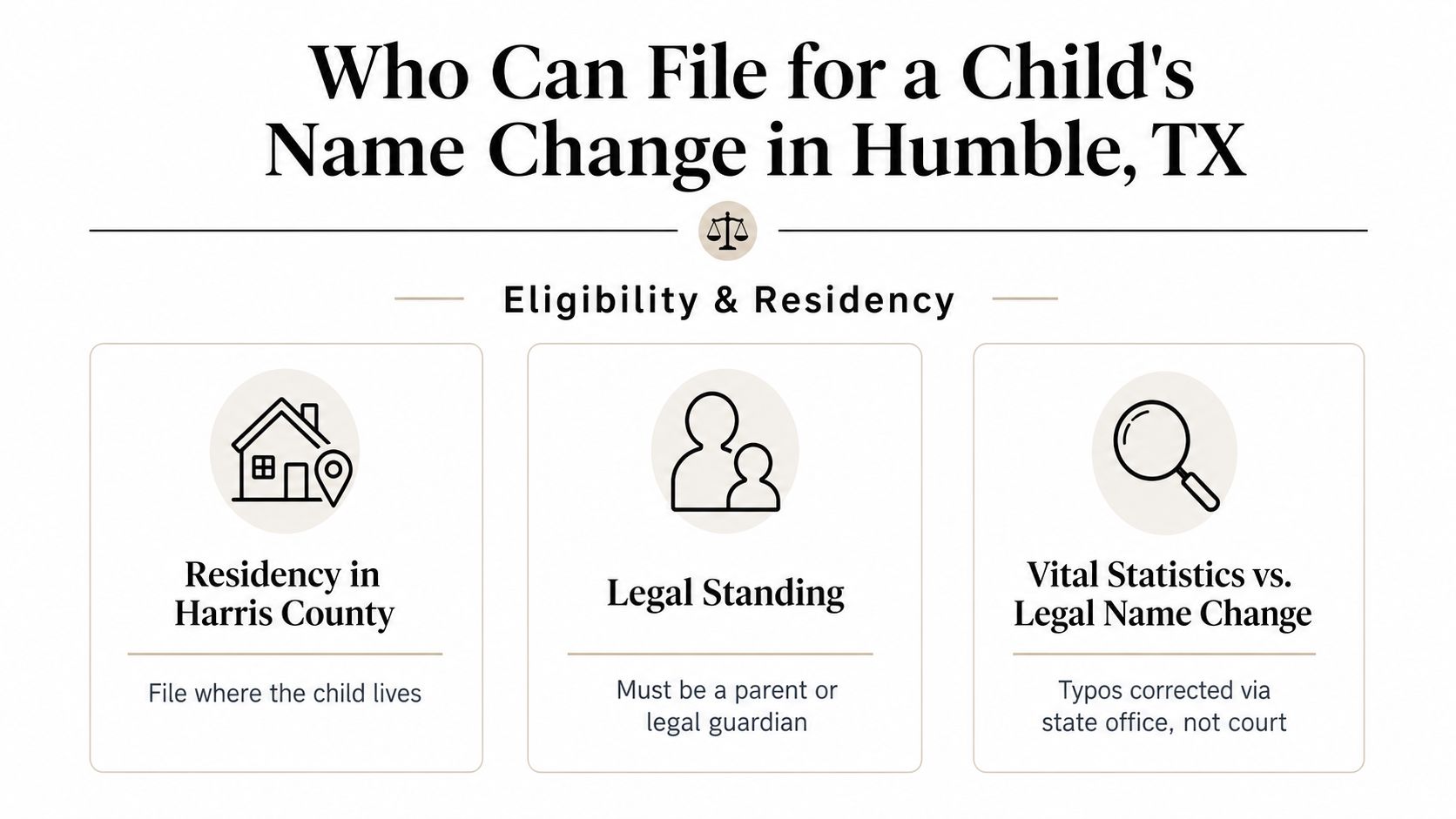
The important part is this, a child's legal name change in Texas usually needs a court order, not just a school form, a doctor's office update, or a parent's new marriage certificate. Texas also requires the petition to be filed in the county where the child lives, which matters for Humble families filing through Harris County. The process feels formal because it is formal, and the court treats it that way to protect the child's legal record and make sure the right people are involved.
That doesn't mean the process has to feel overwhelming. Once you understand the difference between a simple Vital Statistics correction and a true legal name change, the path becomes much clearer. From there, the questions usually turn to consent, filing location, certified copies, and what happens if the other parent agrees, objects, or cannot be found.
Introduction to Changing Your Childs Name in Humble and Harris County
A lot of parents first notice the issue when a school enrollment form, insurance card, or doctor's office record doesn't match what the family uses at home. A Humble parent may assume the name can be updated the same way an address or emergency contact gets changed, but Texas draws a sharp line between informal updates and a legal name change. A child's name does not change automatically after marriage or divorce, and Texas guidance says the case belongs in the county where the child lives. Texas Law Library guidance on child name changes
That county-based rule matters in Harris County because local filing habits, clerk procedures, and family court schedules shape the experience for families from Humble, Atascocita, Kingwood, and the surrounding Northeast Houston area. A parent who files in the wrong place or skips the clerk-filing step can slow everything down. Texas guidance also makes clear that the judge's signed order is not the end of the process by itself, because the signed order still has to be filed with the clerk before the case is treated as final. Texas Law Help child name-change guide
Practical rule: if you're trying to change a child's legal name, think in terms of court process first and record updates second. The court order comes first, then the agencies and records follow.
For Humble families, that distinction avoids a lot of wasted effort. A parent may already have updated school paperwork, but the legal name on the child's birth record still won't match until the right court and state steps are completed. If you've also been dealing with parentage, custody, or support questions, it can help to coordinate the name-change case with related family-law issues rather than treating each record separately. Our paternity guidance for Texas families is a useful place to start if parentage questions are part of the picture.
The same practical mindset helps in related support matters, which is why some parents also speak with a Child Support Attorney in Humble when a child's legal identity and financial support issues overlap. A name change does not replace support orders or custody rights, and it doesn't erase prior court history. It just gives the child a new legal name once the court signs off and the record is updated correctly.
Who Can File and What You Need Before You Start
Before a parent goes to the Harris County District Clerk, the first question is usually whether the situation calls for a court case at all. Texas distinguishes between a small correction and a legal change. A typo or misspelling on a birth certificate can be handled through Vital Statistics, but changing a child's last name generally requires a court order. Texas guidance also says a child's own name does not automatically change just because a parent changed their name after marriage or divorce. Texas State Law Library FAQ
Who has standing to file
Usually, a parent or legal guardian is the one who files. The petition belongs in the county where the child lives, so a Humble family typically looks to Harris County procedure. That filing location matters because the clerk, the judge, and the local recordkeeping all connect to the child's home county. If parentage has not been legally established yet, filing the name-change case without resolving that issue can create avoidable friction, which is why families often sort out foundational family-law questions first.
The court wants clear paperwork before it changes a child's legal name. If a parent can't show who has authority to act, the process gets harder, not easier.
What to gather before filing
Parents should assemble the basics before filing with the district clerk, including the child's identifying information, the proposed new name, and any paperwork showing existing family-law orders. Texas petition forms also require disclosure of criminal-history information, including offenses above Class C misdemeanor level and timing rules tied to felony history. That tells you something important about the process, it is a formal judicial proceeding, not a simple administrative update. Texas Law Help article on name change
If the child is 10 or older, Texas law requires the child's written consent to be attached to the petition. That age milestone catches many parents by surprise, especially when an older child is excited about the change but hasn't signed the required paper yet. The consent rule is one of the clearest places where age affects the process directly. Texas Law Library child name-change guidance
A practical document checklist
- Birth certificate and current records. Bring the child's existing birth record and any papers showing how the child's name appears now.
- Proof of where the child lives. The filing belongs in the child's county of residence.
- Written consent if the child is 10 or older. This needs to be attached to the petition.
- Court orders already in place. Custody, parentage, or support orders can matter to the judge's review.
- Any criminal-history details the forms ask for. Texas requires disclosure in the petition paperwork.
- A plan for certified copies. Texas Law Help says families should get at least five certified copies after the order is signed so agencies like Social Security and the state vital records office can update records. Texas Law Help on changing a child's name
If your family's situation also touches custody or conservatorship, it can help to look at a Child Custody Lawyer in Humble, TX before filing. A name change is often simple when the legal background is simple, but it becomes more complicated when prior orders, parenting rights, or contested issues are already in place.
Filing Your Petition and Preparing for Court in Harris County
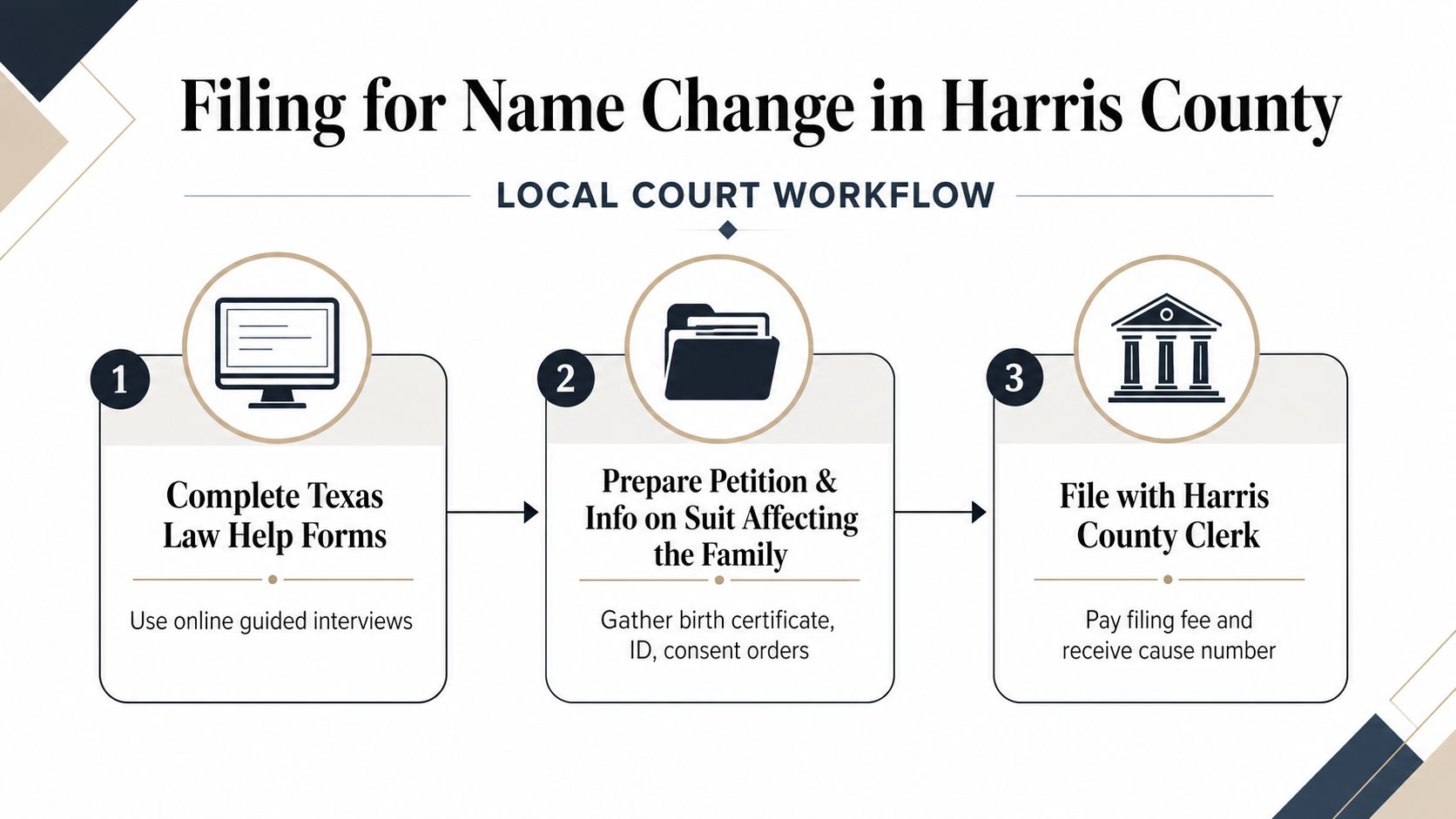
A Humble parent can have the forms ready and still get stopped by one missing step. In a child name change, the petition starts the case, but the clerk and the judge both have to do their part before the record is complete. The Texas Law Help child-name-change kit explains the filing sequence, including the petition, the supporting forms, and the judge-signed order that still has to be filed after the hearing so the case is not left half-finished. Texas Law Help child-name-change kit
How the paperwork usually moves
Most Humble families begin by completing the guided forms and filing them with the Harris County District Clerk. Some use e-filing, while others file in person, but the path is the same. The court needs the petition and the related papers before it can review the request or set the next step. If you want a local overview of how that courthouse process works, the page on Harris County family court in Humble helps connect the filing step to the county system families use. The packet usually includes the child's identifying information, the proposed new name, and any consent or family-law documents that apply.
After filing, the case moves to judicial review or a hearing. At that stage, a judge may want a clear reason why the change fits the child's best interests, especially if another family-law case already exists. Keep the explanation plain and specific. School records, household consistency, safety concerns, and making the legal record match the child's real-life name are the kinds of facts parents usually need to explain.
A simple rule helps here. The petition opens the door, but the court still has to walk the rest of the path with you.
What to bring to court
- A clean copy of the petition. Bring the filed version or a copy stamped by the clerk.
- The child's written consent, if needed. That matters for children 10 or older.
- Any existing orders. Prior custody, parentage, or support papers can help the judge see the full picture.
- The proposed order. The judge signs this if the request is approved.
- A respectful, short explanation. Focus on facts, not emotion.
Best practice: keep your answer centered on the child's daily life, records, and stability. Judges usually respond better to organized facts than to a long story.
Families often compare this process to other family-law cases because the court structure feels familiar. A parent who has read about The Divorce Process in Humble: What to Expect will recognize the same basic pattern, paperwork, filing, review, and signed orders all matter. A child name-change case is narrower, but the court still expects accurate forms and follow-through.
The Texas Law Help kit also tells families to get several certified copies of the signed order, because agencies like vital records and Social Security generally need certified proof before they update records.
That point is easy to miss. If the order is signed but never filed with the clerk, the case is still not complete. If the case is complete but nobody orders certified copies, the next steps can stall. For families in Humble and the surrounding Harris County suburbs, those details are what separate a smooth update from weeks of back-and-forth.
When Both Parents Agree Versus When a Parent Contests
A child name change in Humble can start as a simple paperwork problem and turn into a dispute if the parents are not on the same page. When both parents agree, the judge usually has less conflict to sort through, and the focus stays on whether the forms are correct and the child's records can be updated. Agreement does not remove the need for proper filing, signed orders, or certified copies.

The agreed case and the contested case
An agreed case usually means both parents understand why the requested name change matters and no one is fighting over the basic facts. That can save time and reduce tension later, because the court does not have to untangle a dispute before looking at the child's best interests. A contested case looks different. One parent may object, refuse to sign, be hard to find, or already have an order in place that affects the child's surname.
Texas law requires written consent from a child age 10 or older, and the petition forms also have to disclose whether the child is already under prior family-law jurisdiction or subject to sex-offender registration requirements. Texas Family Code, Chapter 45 Those disclosures are not background details. They tell the court whether another order already exists and whether the case carries extra legal context that may affect the judge's review.
A parent facing an objection should start saving records early. Text messages, emails, school paperwork, medical forms, and other daily records can show how the child is known in ordinary life. Keep the tone factual and calm. Judges usually respond better to organized documents than to a pile of accusations.
What the court tends to notice
- Whether both parents had notice. A missing parent or a missing service step can slow the case down.
- Whether the child's wishes matter under the statute. That becomes relevant at age 10 and older.
- Whether there are prior orders. A standing custody or family-law order can shape what the judge considers.
- Whether the request fits the child's best interests. The court looks at the child, not just the adults' preferences.
If the other parent objects, the issue is often larger than the name itself. The legal history around the child can determine whether the case stays straightforward or turns into a hearing with more moving parts.
Families sometimes also need to separate what can be corrected without a court fight from what requires a Harris County court order. If the problem is only an error or update in a state record, the Texas State Law Library FAQ on child name changes can help explain the general process at the Vital Statistics level. A full legal name change, especially when a parent contests it or no consent is available, still belongs in court.
That is the point where some parents want legal help instead of handling everything alone. The need is stronger when the parents share conservatorship, when prior orders already exist, or when safety concerns are part of the family's situation. If the family needs a place to start, the Law Office of Bryan Fagan's free family law consultation in Humble can help parents sort out whether the case is likely to stay cooperative or become contested.
After the Judge Signs What to Update and How Much It Costs
Once the judge signs the order, the work still isn't finished. Texas Law Help says parents should file the signed order with the clerk, and the child's name change is not treated as final until that step is completed. After that, certified copies become the practical tool that lets agencies and records offices recognize the new legal name. Texas Law Help on changing a child's name
Where the certified copies matter
The biggest mistake families make is assuming the court automatically notifies every agency. It doesn't. You'll usually need certified copies for records that sit outside the court system, especially the child's Social Security record and the birth certificate amendment process through the state. Texas Law Help specifically says to get at least five certified copies because multiple offices may need proof of the signed order. Texas Law Help child name-change guide
That same guide notes that a small fee is charged for each certified copy. Texas Law Help also explains that the birth-certificate amendment process and filing fees can add cost, and broader Texas practitioner guidance places child name-change filing fees around $200 to $300 in some counties, with the post-order birth-certificate amendment step adding another $20 to $25 in state processing fees. Texas Law Help article on name change
Typical post-order update checklist
| Post Order Updates and Typical Costs for Humble Families | ||
|---|---|---|
| Agency or Record | Action Required | Typical Fee |
| Social Security | Use a certified copy of the order to update the child's record | Not specified in the verified data |
| Texas vital records | Request the birth-certificate amendment after the court order | $20 to $25 state processing fee |
| Harris County court file | File the signed order so the case is final | Included in filing process, exact fee varies |
| Certified copies | Order several copies from the clerk for downstream updates | Small per-copy fee |
| School, pediatrician, insurance, and similar records | Update each record separately with certified proof | Not specified in the verified data |
Keep the records in the same folder
A simple folder, physical or digital, helps families move faster. Put the certified copies together with the child's birth certificate, the signed order, and a list of agencies that still need updates. That saves time when you're talking to Social Security, the school office, or the pediatrician's front desk.
The local part matters too. In Humble, Atascocita, Kingwood, and Northeast Houston, families often need to balance work, school, and commuting while fixing records one by one. A complete set of papers reduces repeat trips, which is why the certified-copy step is worth taking seriously.
Moving Forward Confidently With Local Help in Humble
A child name-change case in Texas comes down to a few core points. The petition needs to be filed in the child's county, a child who is 10 or older must give written consent, and the judge's signed order still has to be filed with the clerk before the case is final. If the change is just a spelling correction, Vital Statistics may be enough. If the change is a true legal name change, the court order controls.
That's why some Humble families can handle the process on their own, while others benefit from local legal help. If the other parent disagrees, if there are existing family-law orders, or if the child's history raises extra questions, the case gets more complicated fast. In those situations, it helps to speak with someone who knows Harris County procedure and can help organize the filing correctly the first time.
For families in Humble, Atascocita, Kingwood, and Northeast Houston, the right next step is usually a short conversation about the child's situation, the current records, and whether the case needs court intervention or just a Vital Statistics correction. If you want a local team that handles family law, custody, child support, criminal defense, and estate planning matters with the same practical attention, the Law Office of Bryan Fagan can help you understand your options and move forward with confidence.
If you're ready to take the next step on a child name change in Humble or anywhere in Harris County, the Law Office of Bryan Fagan can review your situation and help you understand whether you need a court order or a Vital Statistics correction. Visit Law Office of Bryan Fagan to schedule a free consultation and get clear guidance for your family's next move.


