Skip to content

You're driving home through Humble after a late shift when red and blue lights appear behind you on FM 1960. Your hands tighten on the wheel. The officer asks where you've been, whether you've been drinking, and whether you'll step out for testing. Within minutes, ordinary answers and roadside movements can become the foundation of a DWI prosecution.
For families in Humble, Atascocita, Kingwood, and Northeast Houston, the hardest part is often not understanding that the charge is serious. It's knowing which decisions matter immediately, which evidence can be challenged, and where those arguments belong in the Harris County process. The right DUI defense tactics depend on the stop, the arrest, the testing, the license case, and the records behind each step.
The First Moments After a DUI Arrest in Humble
A Humble Police Department stop usually develops quickly. The officer may ask about your destination, your work schedule, medications, or alcohol consumption. You may be asked to follow a pen or light with your eyes, walk heel-to-toe along a roadside shoulder, or stand on one leg. Later, at a station or other testing location, the officer may request an Intoxilyzer breath specimen.
The important point is that the prosecutor may later view each response as part of one continuous story. A statement such as “I only had two beers” can be repeated in the report, compared with the test result, and presented as an admission. A stumble may be described without the uneven pavement, darkness, injury, fatigue, or traffic noise that surrounded it.
Practical rule: Be respectful, but don't try to talk your way out of the investigation.
You should identify yourself and provide required documents, but you don't have to volunteer a narrative about the evening. Don't argue roadside, guess about timing, or make a casual statement because you think cooperation will end the stop. If you're arrested, ask to speak with a lawyer before answering investigative questions.
The next issues often separate into two tracks. The criminal case may be filed in a Harris County misdemeanor court or, depending on the allegations and history, proceed through a felony docket. The license case is separate and can move before the criminal case is resolved. Court assignments and dockets can change, so a lawyer needs to verify the actual filing court rather than rely on assumptions about a particular district court.
A plain-language explanation of the booking and release process is available through what happens when you get arrested. If someone in your family is also trying to understand release procedures in another state, a general resource on find Colorado bail bond relief may help with that separate issue.
The first hour doesn't determine guilt. It does determine what evidence counsel must investigate, what deadlines are already running, and whether the defense can challenge the State's story before it hardens into a plea demand.
Immediate Actions That Protect Your Case
The first forty-eight hours should be handled in order. Some steps require immediate attention, while others become more useful after counsel has reviewed the paperwork.
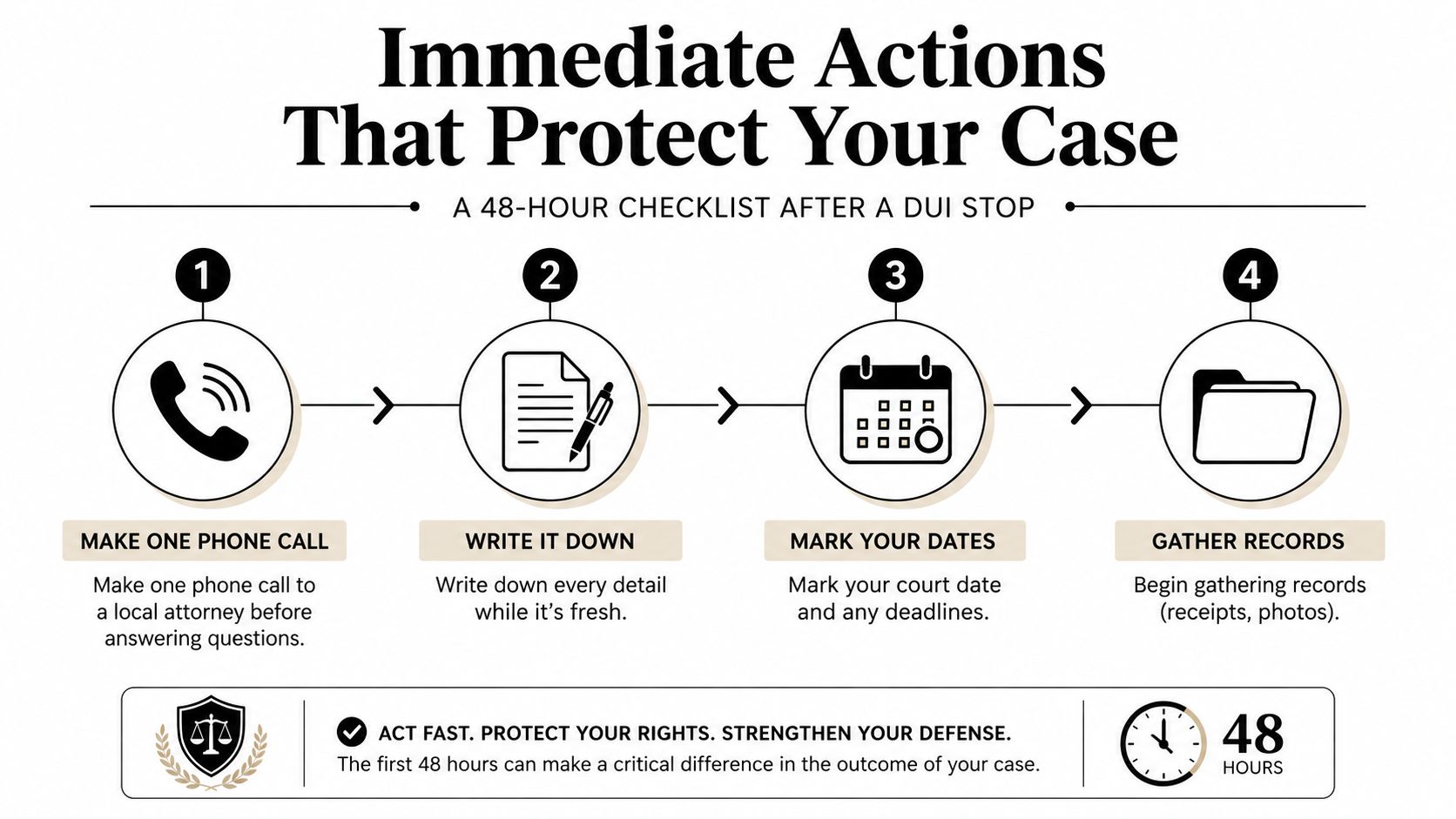
Make the call before giving a statement
Call a local criminal defense attorney before answering questions at the station or after release. Tell the lawyer whether you were arrested, whether an officer requested breath or blood testing, whether you received paperwork, and whether anyone was injured. Don't call repeatedly to explain every detail before you've had time to gather the documents.
Invoke your right to remain silent clearly and politely. “I want to remain silent, and I want to speak with a lawyer” is more useful than trying to negotiate with the officer. Even a seemingly harmless explanation about drinks, dinner, or your route can become the anchor for the prosecution's timeline.
Preserve the facts while they're still clear
Write down the stop from beginning to end. Include the road, lighting, weather, traffic, shoulder condition, officer statements, requests for tests, timing, transportation, and anything affecting balance or speech. Save dashcam footage, receipts, text messages, location information, and names of people who saw you before or after driving.
A written record isn't a substitute for discovery. It gives counsel leads before surveillance footage disappears, witnesses forget details, or your memory blends separate events together.
Protect the license deadline
If you receive a DIC-25 suspension notice, Texas guidance identifies a 15-day period to request an ALR hearing, and missing that period can forfeit the opportunity to challenge the administrative suspension. The Texas Department of Transportation explains that Texas treats 0.08 percent BAC as the legal intoxication threshold, while also allowing prosecution below that level when alcohol or drugs impair driving ability. See the Texas impaired-driving guidance for the statutory framework.
Don't assume the criminal defense lawyer automatically handles the ALR filing. Ask specifically who will make the request, when it will be filed, and what notice was served.
A family member dealing with a separate Harris County property issue may need a Property Division Lawyer in Humble. That work concerns division of community property and complex assets in Humble divorces, not the DWI case.
The video below offers additional general context, but it doesn't replace advice about your records or deadlines.
Challenging Field Sobriety Tests at Trial
Field sobriety tests can look persuasive in a police report because the report reduces a moving roadside interaction to a list of clues. A defense lawyer has to restore the missing setting and test whether the officer used the standardized method.
The three standardized tests with substantial validation data have reported accuracy rates of 77% for Horizontal Gaze Nystagmus, 68% for Walk-and-Turn, and 65% for One-Leg Stand. When combined, the tests reached about 82% accuracy, according to the NHTSA validation material. Those figures don't prove that a particular officer made a mistake. They do show why roadside observations can support probable cause without being definitive proof of impairment.
What each test can and cannot establish
Horizontal Gaze Nystagmus looks for involuntary eye movement as the eyes track a stimulus. The test can be affected by poor lighting, a moving object, distance, glasses, medical conditions, or an officer's failure to follow the required timing and positioning. The officer's conclusion depends heavily on how the test was administered and recorded.
Walk-and-Turn requires divided attention, balance, instructions, and a suitable surface. Uneven pavement on a dark shoulder, work boots, knee pain, arthritis, fatigue, or anxiety can affect performance without proving intoxication. Counsel should ask whether the officer demonstrated the test, explained the steps, checked the surface, and documented the conditions.
One-Leg Stand also depends on balance and instruction. A knee injury, weight, footwear, age, or a medical issue can matter. ADHD, nervousness, and the natural difficulty of performing a balance exercise beside traffic may provide context, though context isn't automatically a complete defense.
| Test | NHTSA Accuracy | Common Defense Angle |
|---|---|---|
| Horizontal Gaze Nystagmus | 77% | Lighting, stimulus movement, medical factors, and protocol |
| Walk-and-Turn | 68% | Surface, footwear, instructions, balance, and scoring |
| One-Leg Stand | 65% | Injury, fatigue, footwear, balance, and timing |
| Combined battery | About 82% | Whether all tests were properly administered and interpreted |
The NHTSA material also reports that officers identified motorists above the 0.08 BAC threshold with 91% accuracy, or as high as 94% under a different treatment of certain false positives. That is useful context, not a shortcut to conviction. Counsel can use the training standards to ask whether the officer followed the protocol or improvised.
Texas treats field sobriety tests differently from breath or blood testing. Refusing an FST carries no automatic license penalty, so the defense may argue that the roadside performance was voluntary and unreliable while separately challenging the officer's observations supporting probable cause.
A parent balancing a DWI case with a family dispute may also need a Child Support Attorney in Humble, whose work involves establishing, modifying, and enforcing child support in Harris County.
Attacking Breath and Blood Test Results
A chemical result isn't self-proving. The defense needs the records showing how the sample was requested, collected, handled, analyzed, and reported.
For an Intoxilyzer 5000 case, counsel commonly seeks the breath-test record, the Texas DPS breath-test operator affidavit, calibration and maintenance records, and related observation documentation. The record may reflect the testing sequence, slope information, ambient-air readings, and the required deprivation observation. Each item matters because a machine result is only as dependable as the procedure surrounding it.
A blood case raises different questions. Counsel examines the chain of custody from the phlebotomist to the laboratory, the analyst's GC-MS notes, preservative information, collection forms, and whether the draw occurred at a hospital or under a warrant. A hospital sample may have been collected for medical treatment, while a warrant draw follows a law-enforcement process. The legal and scientific questions aren't identical.
Documents that turn suspicion into a testable issue
A technical defect becomes useful when it's documented. Publicly reported litigation summarized in breathalyzer calibration defense materials describes a Massachusetts ruling that affected about 27,000 DUI cases after breathalyzer problems were identified. The same source discusses reported variation of as much as 15% from actual BAC under real-world conditions, along with calibration, mouth alcohol, observation-period, and operator issues.
That doesn't mean every Texas breath result is defective. It means counsel should request the underlying records rather than rely on a general argument that machines are imperfect. A defense expert can then connect a missing record or protocol violation to a specific reliability question.
| Attack Point | Breath Test, Intoxilyzer 5000 | Blood Test, GC-MS |
|---|---|---|
| Collection | Observation period, instructions, sample sequence | Phlebotomist, tubes, preservatives, and collection method |
| Instrument or lab | Calibration, maintenance, operator qualification | Analyst notes, instrument controls, and validation records |
| Contamination | Mouth alcohol and environmental conditions | Tube integrity, contamination, and laboratory handling |
| Timing | Driving, stop, arrest, and test times | Driving, draw, receipt, testing, and reporting times |
| Documentation | Affidavit, printout, logs, and certification | Chain-of-custody forms and laboratory file |
The Ticket Shield PLLC DUI defense discussion can provide general background on breath-test accuracy, but your attorney still needs the records from your actual test. Families should also keep DWI evidence separate from a Child Custody Lawyer in Humble, TX matter, which concerns custody and conservatorship representation for Humble families.
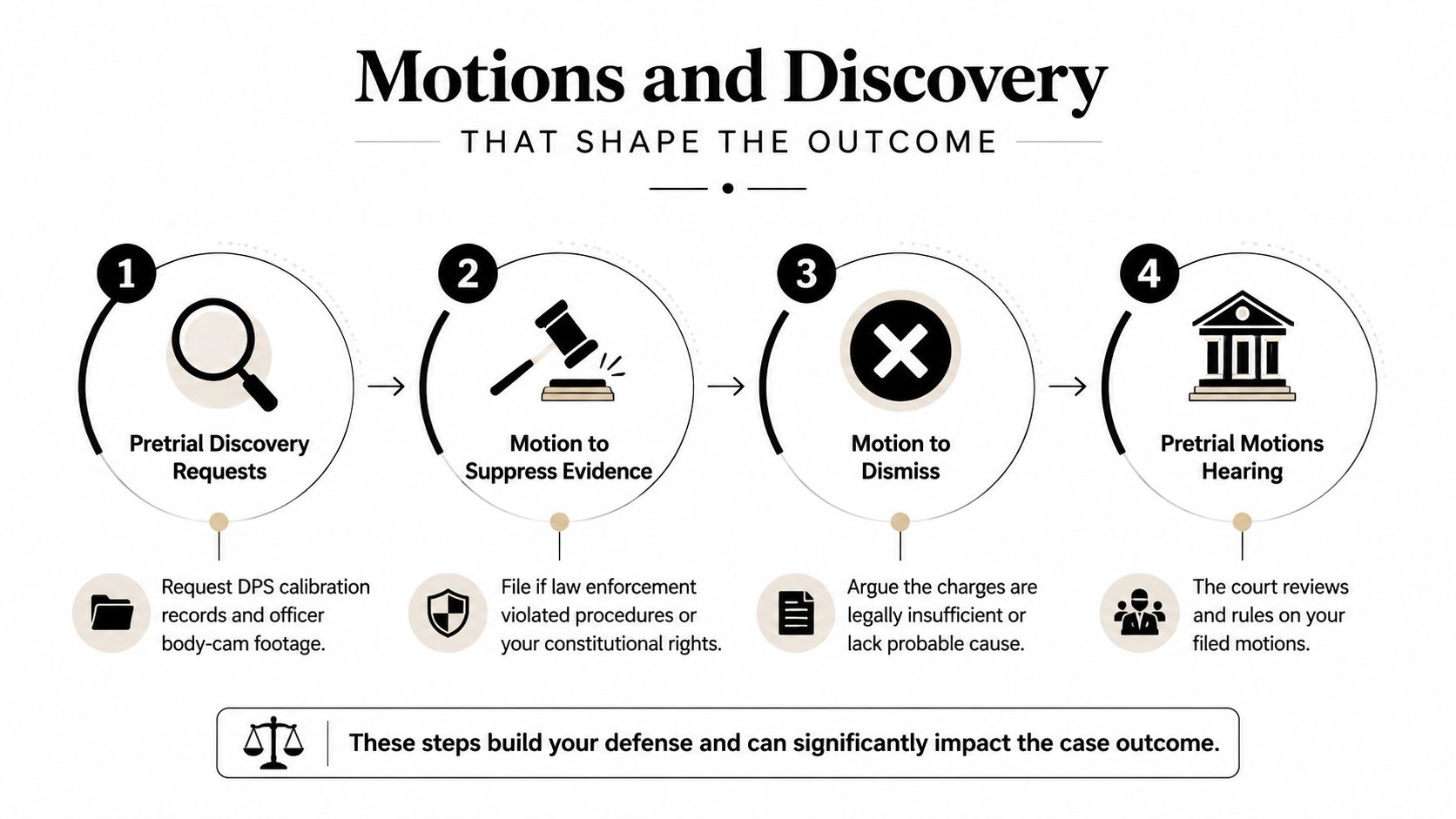
Motions and Discovery That Shape the Outcome
A strong defense often begins before anyone discusses a plea. Counsel requests the prosecution's workfile and tests whether the State can produce the evidence it plans to use.
Discovery exposes the missing pieces
Useful requests may include DPS calibration records, officer body-camera footage, dispatch audio, dashcam video, photographs, field notes, breath-test files, blood-laboratory materials, and officer training or certification records. Late or incomplete production can affect preparation, expert review, and the court's ability to decide whether evidence should be admitted.
A request is only the beginning. The lawyer must compare the report with video, audio, timestamps, and machine records. A report may say a person was unsteady, while video shows a different sequence. An affidavit may omit an important delay or condition. Those differences can shape cross-examination and suppression litigation.
Suppression separates the encounter into legal links
Texas Code of Criminal Procedure Article 38.23 provides the framework for excluding evidence obtained in violation of law. A suppression motion should identify the precise link under attack:
- The stop: Did the officer have reasonable suspicion for the traffic detention?
- The detention: Did the encounter last longer than the facts justified?
- The arrest: Was there probable cause based on lawful observations?
- The testing: Did officers comply with implied-consent and statutory requirements?
- The downstream evidence: Should statements, FST results, or chemical evidence be excluded as fruit of an unlawful encounter?
Real-world DUI pleadings commonly seek suppression of roadside observations, statements, and breath results when the initial encounter lacked legal justification. The Humble DWI dismissal information explains why the defense must examine the entire record rather than focus only on the final BAC number.
Other motions may become relevant. A Franks motion challenges material falsehoods or omissions in a warrant affidavit. Counsel may challenge the foundation for 1925 certifications when the State relies on them to establish business-record or machine-related facts. A motion in limine can seek to keep improper character evidence from reaching the jury.
A motion succeeds when it identifies a legal defect tied to evidence, not when it simply tells the judge that the case feels unfair.
One granted motion can change the case. If the court excludes the stop's central observations, a later breath or blood result may no longer carry the same weight. If the court limits a certification or orders missing discovery produced, the prosecution may need to reassess its trial theory.
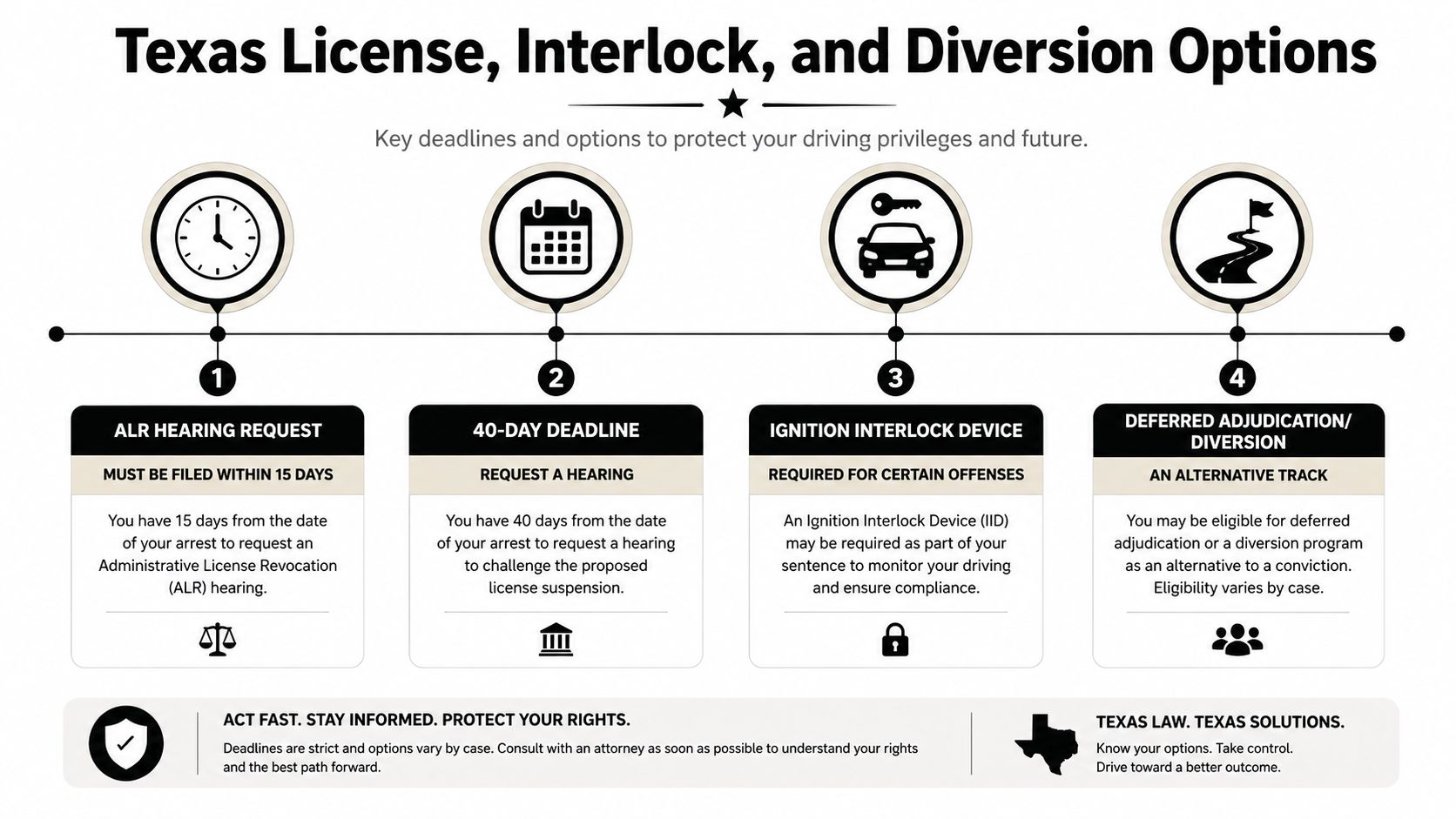
Texas License, Interlock, and Diversion Options
The criminal case is only one part of the damage a DWI arrest can create. A driver may also face an Administrative License Revocation proceeding, transportation problems, insurance consequences, ignition-interlock requirements, and employment pressure.
The ALR case needs its own plan
Texas implied-consent rules allow an Administrative License Revocation case after a lawful DWI arrest when a driver refuses a breath or blood specimen. A first refusal can trigger a 180-day license suspension, as described in the Texas implied-consent resource. The criminal case and ALR case involve related facts, but one doesn't automatically resolve the other.
The supplied Texas guidance identifies a 15-day request period after receiving the DIC-25 notice. Some materials and agency procedures may use different deadline descriptions in particular circumstances, so counsel should inspect the exact notice and calculate the applicable deadline rather than rely on a general calendar rule. At the hearing, the State may present an officer, and the defense can examine the legal basis for the stop, arrest, request, warning, and refusal.
Driving privileges and case resolution
An occupational license may help someone reach work, school, medical appointments, or essential household obligations. The process can involve a petition, a court order, proof of need, and compliance requirements. A restricted or hardship arrangement isn't the same as full reinstatement, and an SR-22 may be part of the reinstatement process.
Ignition interlock eligibility and requirements depend on the offense, order, and applicable law. Installation can affect daily life and may also matter during plea discussions, but accepting an interlock arrangement without understanding the criminal and administrative consequences can be a costly shortcut.
Harris County misdemeanor courts may offer diversion or pretrial intervention options in appropriate cases. Article 42A.111 deferred adjudication can be relevant to negotiations, but eligibility and terms depend on the facts, record, prosecutor, and court. No lawyer should promise diversion before reviewing the charging instrument and history.
For information about the separate occupational-license process, see occupational drivers license after DWI in Humble, Texas.
Working With a Local Humble Defense Attorney
Bring the paperwork, not just the fear. A lawyer can work with incomplete memories, but the DIC-24, release documents, citation number, tow-yard receipt, suspension notice, and any bond paperwork give counsel a starting point. Add the timeline you wrote while the stop is fresh, saved receipts, texts, dashcam files, and witness names.
A useful consultation should answer practical questions:
- Harris County experience: How many DWI cases does the lawyer try each year?
- ALR responsibility: Who handles the license hearing, and how will the deadline be protected?
- Motion practice: Does the lawyer evaluate suppression motions in every case, or only after a plea offer?
- Evidence review: Will counsel obtain body-camera footage, dispatch audio, breath records, blood records, and calibration materials?
- Fee structure: Is the fee flat, capped, or divided by stages, and what work does it include?
You can preserve evidence and avoid unnecessary statements tonight. You can't independently recreate the DPS file, cross-examine an analyst, litigate Article 38.23, or make a reliable decision about a plea without understanding the evidence. A local attorney familiar with Harris County District Clerk filings, the specific judges in the 113th and 176th courts, and prosecutors handling cases in the Humble area can explain which arguments belong in court, which belong in the ALR proceeding, and which are unlikely to help.
The Law Office of Bryan Fagan handles criminal defense for residents of Humble, Atascocita, Kingwood, and Northeast Houston, while also serving families with related legal needs. Schedule a free consultation, bring every document you have, and ask counsel to identify the deadlines and evidence that matter first.
The Law Office of Bryan Fagan offers local criminal defense guidance for DWI investigations, license issues, discovery, and suppression strategy in the Humble area. Visit the firm to schedule a free consultation and discuss the facts of your case before an avoidable deadline or statement makes the situation harder.