Skip to content

A phone rings late at night. Someone you love is being held after a fight near Atascocita, a road-rage confrontation on FM 1960, or an argument that ended with an object being treated as a weapon. The family usually knows only that the charge says aggravated assault, and that the person may be sitting in the Harris County Jail without understanding what happens next.
You need a lawyer who will slow the situation down and examine the facts instead of accepting the first version of events. For families in Humble, Atascocita, Kingwood, and Northeast Houston, the important questions begin immediately: Who started the confrontation? What did the object do? How serious was the injury? What do the video, medical records, and witness statements show?
When an Arrest Hits Home in Humble
A husband may be held after an argument at home. A teenager may be taken into custody after a fight near Atascocita High School. A driver may be arrested after a confrontation on FM 1960 because prosecutors believe a vehicle, tool, or other object was used as a weapon. In each situation, the family often hears a few alarming words before anyone has reviewed the evidence.
Under Texas Penal Code § 22.02, aggravated assault generally involves an assault that causes serious bodily injury or involves the use or exhibition of a deadly weapon. Texas law defines a deadly weapon broadly. It can include a firearm, but it can also include an ordinary object that, in the manner of its use or intended use, is capable of causing death or serious bodily injury. The statutory framework is available through the Texas aggravated assault statute.
That means a prosecutor might focus on a box cutter, a vehicle, a fence post, or another object even when the accused never thought of it as a weapon. The charge can also become more serious when the alleged victim is a family member, public servant, or witness, depending on the facts and statutory provisions involved.
The first hours can shape the case
The difference between an ordinary assault allegation and a felony charge may turn on details that seem minor at first:
- Who initiated contact: A person who was attacked may have a self-defense claim, but statements suggesting that person started or escalated the fight can damage it.
- What the object was and how it was used: Holding an object, throwing it, striking with it, or using a vehicle can create different factual disputes.
- What the injury was: A complaint may describe severe harm, while the medical records may tell a narrower story.
- What witnesses and video show: A short clip can omit the beginning of the encounter, which is often the most important part.
Bond also requires prompt attention. Families should review practical next steps through how to bail someone out, while counsel begins preserving evidence and preparing for the first court setting.
Practical rule: Don't let the first accusation become the final version of the case. Preserve the beginning of the incident before memories, video, and digital records disappear.
What Aggravated Assault Means Under Texas Law
Texas Penal Code § 22.02 starts with a simple distinction. The State must prove an assault, then prove an additional aggravating feature. That feature is usually serious bodily injury or the use or exhibition of a deadly weapon. The State must prove the required elements beyond a reasonable doubt.
Serious bodily injury is more than ordinary pain or a temporary bruise. The legal question concerns harm that creates a substantial risk of death, causes permanent disfigurement, or causes a protracted loss or impairment of a bodily function. Medical records, photographs, treatment history, and testimony can all matter when the defense challenges that allegation.
A deadly weapon doesn't have to be designed as a weapon. During an argument at a Waffle House, a box cutter may become central to the case if the State claims it was displayed or used in a way capable of causing serious bodily injury. In a parking lot, prosecutors may argue that a vehicle was used as a deadly weapon. In a fistfight, a broken jaw may become the basis for a serious-bodily-injury theory, but the diagnosis and long-term effect still require careful review.
Degree and exposure
Under the statute, aggravated assault is generally a second-degree felony. Specific aggravating circumstances can raise it to a first-degree felony, including certain family-violence cases involving a deadly weapon, assault on a public servant, witness retaliation, or a drive-by shooting. The penal code references for lawyers can help readers locate related Texas provisions, but a lawyer must apply those provisions to the actual allegations.
| Offense Level | Prison Range | Fine | Typical Triggering Facts |
|---|---|---|---|
| Second-degree felony | 2 to 20 years | Up to $10,000 | Serious bodily injury or a deadly-weapon allegation |
| First-degree felony | 5 to 99 years or life | Up to $10,000 | Certain family-violence, public-servant, witness-retaliation, or drive-by-shooting allegations |
The punishment ranges come from the statutory framework described in Texas Penal Code § 22.02. The charge itself isn't the verdict. After arrest, the Harris County District Attorney's office may investigate and present the case to a grand jury. The grand jury decides whether to return an indictment, which formally moves the felony case forward.
Family allegations can create another layer involving protective orders, no-contact terms, and family-court consequences. For a separate explanation of how family matters proceed in the Harris County courts serving Humble, see Harris County Family Courts: A Humble Resident's Guide.
How an Aggravated Assault Lawyer Builds the Defense
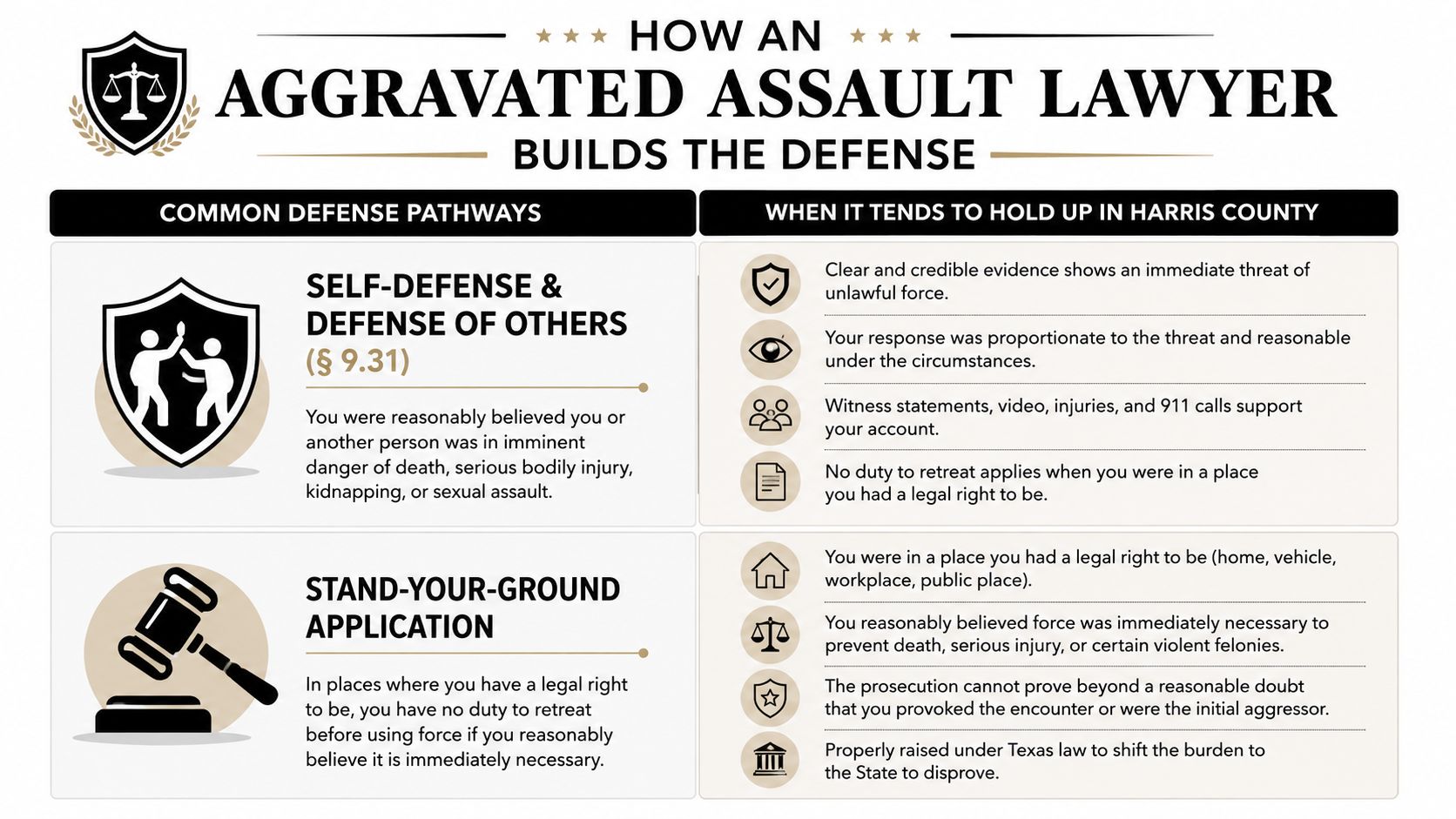
A strong defense doesn't begin with a favorite theory. It begins by matching the theory to the evidence. In a Harris County courtroom, self-defense may be powerful in one case and unusable in another because of a single fact, such as who followed whom, who made the first threat, or whether the accused had time to leave.
Self-defense and defense of others
Texas Penal Code § 9.31 permits force when a person reasonably believes it's immediately necessary to protect against another person's unlawful force. Texas stand-your-ground law can remove a duty to retreat in places where a person has a legal right to be, but it doesn't authorize unreasonable force, criminal provocation, or escalation.
The defense looks for 911 calls, injury photographs, eyewitness accounts, security video, and messages showing threats or fear before the confrontation. If the State claims the accused used deadly force, the analysis becomes more demanding because the response must be tied to a reasonable belief of an immediate deadly threat or another legally recognized circumstance.
Other routes to a better result
No deadly weapon: If the evidence shows bruising or a brief fight but doesn't establish serious bodily injury or a qualifying weapon theory, counsel may challenge the felony classification. A misdemeanor resolution may become possible if the State can't prove the required aggravating element.
Mistaken identity: Surveillance video, cellphone location records, and witness inconsistencies can show that the wrong person was identified. This defense is strongest when the identification happened quickly or under poor viewing conditions.
Injury dispute: Medical records and appropriate expert testimony can challenge whether the harm meets the statutory threshold. The defense should compare the initial complaint with EMS records, imaging, treatment, and the final diagnosis.
Consent or mutual combat: These arguments rarely win by themselves. They can still help explain the encounter, expose exaggeration, and present a more complete picture to a jury.
What Happens After Arrest in Harris County
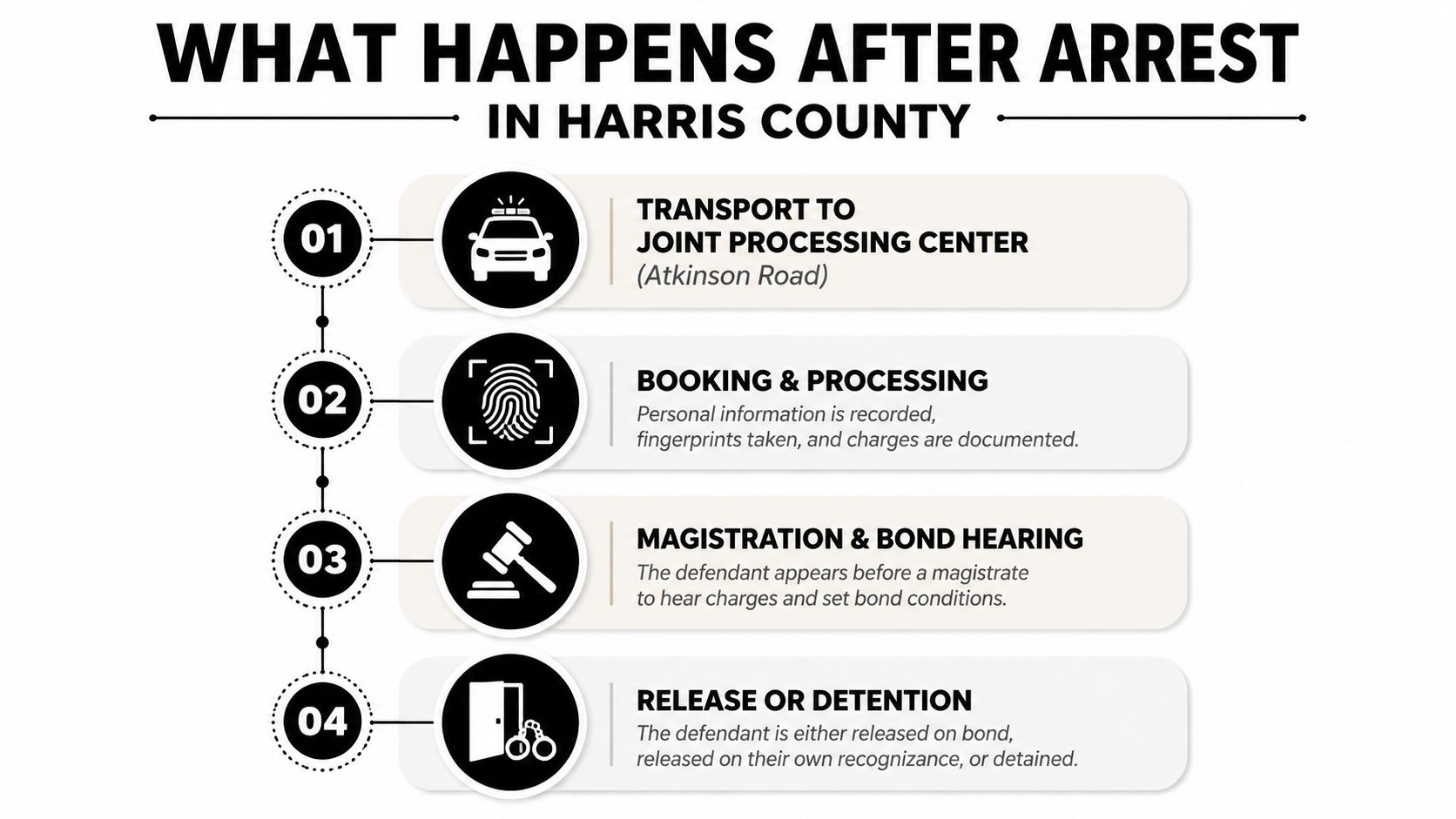
After an arrest in Humble or nearby communities, the accused may be transported to the Joint Processing Center on Atkinson Road in Houston. Booking includes identification, property procedures, records checks, and preparation for magistration. The family should avoid relying on guesses about release and should have counsel check the actual custody and bond status.
Harris County felony cases can involve an initial probable-cause review by a magistrate, followed by a bond hearing where counsel presents information about the accused, the allegations, community ties, and proposed release conditions. The goal isn't to argue the entire trial at bond. It's to address detention, safety concerns, and conditions in a focused way.
The early court calendar
Harris County's rules provide a predictable arraignment pattern. Cases filed Monday through Thursday are set for arraignment on the same day of the following week, according to the Harris County criminal court rules. That short timeline makes early preparation important. Counsel may need to review the probable-cause affidavit, request discovery, address bond conditions, and identify evidence that must be preserved.
Families comparing financial logistics may find general information about bail for assault battery charges, but bail rules and conditions vary by jurisdiction. The Harris County hearing controls the actual release terms.
The defense may later file motions concerning statements, searches, property inventories, and other constitutional issues. The District Attorney's Intake Division reviews cases, and some borderline cases may move toward a reduced charge, diversion-related discussion, or a grand-jury no-bill. Don't assume any of those results is automatic.
A family dealing with support obligations may also need separate guidance on Child Support Attorney in Humble, particularly where a criminal case affects household stability. That service concerns establishing, modifying, and enforcing child support in Harris County, not defending the criminal charge.
For a practical explanation of the hearing itself, review what happens at a bond hearing.
The Small Details That Change the Outcome
The probable-cause affidavit may call an object a deadly weapon. That label doesn't end the analysis. Texas law asks whether the object was capable of causing death or serious bodily injury in the manner of its use or intended use. Distance, force, target area, angle, speed, and the actual injury can all matter.
A vehicle allegedly used during a parking-lot confrontation deserves the same careful review as a knife or firearm. Did the vehicle move toward a person, or was it stationary? Did anyone suffer an injury? Did witnesses see the entire event? The defense should test the allegation against video, physical evidence, and the precise wording of witness statements.
Evidence worth preserving immediately
- Business surveillance: Ask businesses near the incident to preserve footage before routine systems overwrite it.
- Ring and doorbell video: Nearby residences may show the approach, first contact, or departure.
- 911 audio: The caller's first account may differ from a later written statement.
- EMS and medical records: The final diagnosis may be narrower than the original complaint.
- Digital records: Messages, social media posts, and location information may support identity, timing, or self-defense.
| Detail Reviewed | Why It Matters | Typical Impact |
|---|---|---|
| Alleged weapon | Determines whether the statutory deadly-weapon theory fits the facts | Can affect offense grade and negotiation posture |
| Injury documentation | Tests whether the harm qualifies as serious bodily injury | May support a charge reduction or trial defense |
| First account | Shows what a witness reported before later discussions | Can expose inconsistencies |
| Video and location data | Establishes sequence, identity, and movement | Can challenge probable cause or trial testimony |
| Protective-order allegations | Creates separate restrictions and collateral problems | Can affect contact, housing, custody, and weapons |
Prior inconsistent statements don't automatically win a case, and a recanting witness can create complications rather than solve them. Counsel should preserve original files, metadata, and full recordings instead of relying on screenshots or edited clips.
The evidence gathered early can influence bond conditions, plea discussions, and trial themes. If the case ends without a conviction, separate advice may be needed about how to seal a criminal record in Texas.
Working With a Humble Attorney From Start to Finish
The first consultation should produce a plan, not just reassurance. Whether it happens by phone or at a local Humble office, the lawyer should identify the charge, custody status, upcoming setting, known evidence, possible witnesses, and immediate risks. Bring the charging paperwork, bond documents, photographs, messages, and a written timeline if you have them.
After hiring counsel, the work becomes more concrete. The attorney may request the offense report, body-worn camera footage, and other discovery from the Harris County Sheriff's Office or Humble Police Department. The team should also send preservation requests for surveillance footage, identify witnesses, and examine whether digital evidence needs to be secured.
What the family should expect
A sensible working relationship includes:
- Court preparation: Meetings before bond hearings, arraignment, pretrial settings, and trial-related appearances.
- Evidence review: A candid explanation of what the report says, what it leaves out, and what still needs investigation.
- Communication rules: A clear method for updates, questions, documents, and urgent custody information.
- Family boundaries: Relatives can gather records and preserve evidence, but they shouldn't contact the complainant or pressure witnesses.
The lawyer should explain the retainer and fee structure before representation begins, including what work is covered and what may require separate arrangements. If a surety bond is needed, counsel can coordinate with the family and bondsman about conditions, but the court controls release terms.
Preparation changes as the case develops. A bond hearing requires mitigation and a release proposal. Arraignment requires attention to the formal charge and schedule. Pretrial work may involve discovery, statements, physical evidence, and negotiations. Trial preparation requires witness examination, exhibits, jury strategy, and a realistic assessment of the State's proof.
A reduction can be worth considering when the evidence supports it, but the decision belongs to the client after a direct conversation about immigration, employment, firearm consequences, family restrictions, and future record relief. If the offer doesn't protect the client's interests, the defense must be ready to continue toward trial.
Practical Questions Humble Families Ask Most
How is bond set in Harris County?
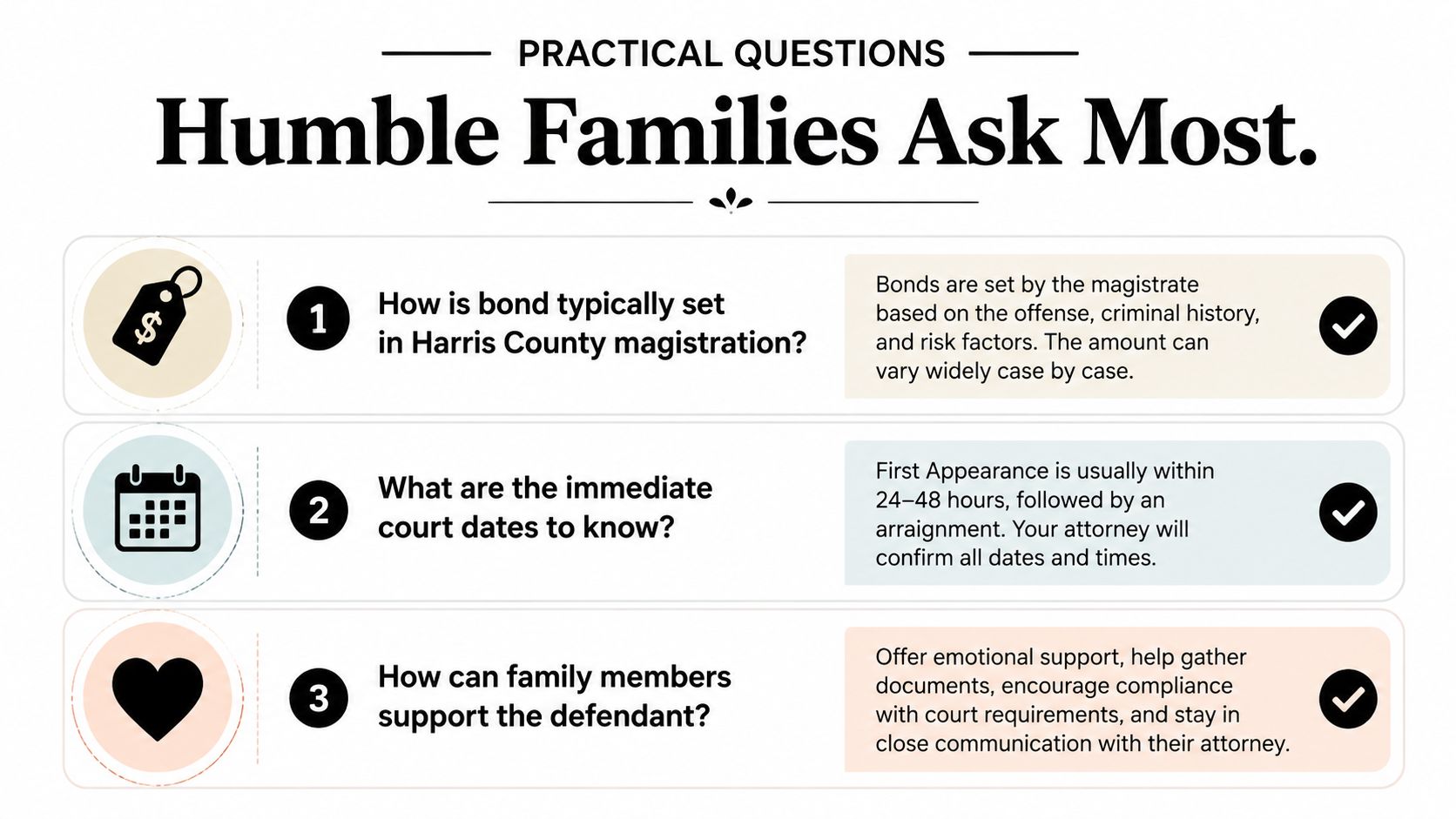
The court considers the allegations, available probable-cause information, prior history, community ties, safety concerns, and the conditions needed for release. Common conditions can include no-contact orders, geographic restrictions involving the complainant's home or workplace, GPS monitoring, reporting requirements, and restrictions on weapons.
A bond hearing isn't a mini-trial. Counsel's job is to give the judge reliable information and propose conditions the accused can follow. The family should gather proof of residence, employment, treatment, caregiving responsibilities, and reliable supervision when those facts are relevant.
What court dates matter first?
The first setting is usually the bond or magistration process, followed by arraignment and later pretrial settings. Harris County's scheduling rules state that cases filed Monday through Thursday are set for arraignment on the same day of the following week, which gives the defense a short period to prepare for that formal setting.
The indictment timeline varies with the investigation and grand-jury process. Don't treat the absence of an immediate indictment as a dismissal, and don't treat an indictment as proof of guilt. The defense should monitor the docket and investigate independently.
How do protective orders affect the criminal case?
A protective order can impose contact and location restrictions while the criminal case continues. It may affect where the accused can live, communicate, work, or retrieve property. Violating an order can create additional legal problems, so follow it exactly and ask counsel how to handle children, belongings, employment, and necessary communication.
Family-law issues may continue on a separate track. A criminal accusation can complicate custody discussions, but the family court and criminal court address different legal questions.
Can an adult felony conviction affect firearm rights?
Yes. Federal law can restrict firearm possession after certain felony convictions, and other restrictions may apply depending on the conviction and case facts. Anyone considering a plea should ask about firearm consequences before signing paperwork, not after the case ends.
What happens if the accused is a juvenile?
Juvenile records and sealing options depend on the record, the disposition, and applicable law. Parents should avoid assuming that a juvenile case disappears automatically. A lawyer should review the specific juvenile history and explain whether sealing or another form of relief may be available.
What if a college student at Lone Star College is charged?
The criminal case is only one concern. A student may also face school discipline, housing issues, loss of activities, or safety restrictions. The student shouldn't discuss the incident on social media or with school investigators without understanding the consequences. Counsel can help separate the criminal defense from school communications and preserve relevant evidence.
How can family members help?
Preserve text messages, photographs, doorbell video, receipts, location records, and full-length recordings. Don't delete, edit, or forward material casually. Don't contact the complainant, argue with witnesses, post about the case, or ask relatives to coordinate stories. A family member can write down what happened while memories are fresh, then give the information to counsel.
Families also search online for general legal marketing guidance, including actionable SEO for Indiana lawyers, but online information can't replace a review of the Harris County file. The useful next step is a confidential conversation about the actual arrest, bond, evidence, and upcoming court date.
The Law Office of Bryan Fagan provides criminal-defense consultations for Humble, Atascocita, Kingwood, and Northeast Houston residents facing aggravated assault allegations, with guidance from bond through investigation, negotiation, and trial preparation. Visit Law Office of Bryan Fagan to schedule a free consultation at the Humble office and discuss what needs to happen next.