A knock from the Harris County Sheriff's Office or Humble Police Department can turn an ordinary evening into a legal emergency. The children may still be finishing homework, dinner may be on the stove, and suddenly officers are separating household members, asking questions, and deciding whether someone will leave in handcuffs.
If you're facing an assault or family violence allegation in Humble, Atascocita, Kingwood, or Northeast Houston, the criminal charge is only one part of the problem. A magistrate's bond conditions, a criminal court protective order, or a separate civil protective order can affect your home, communication with your children, employment, and firearms long before the criminal case is resolved. The right response is calm, immediate, and coordinated.
When a Quiet Evening in Humble Turns Into a Legal Emergency
The first few minutes often feel unreal. An officer may ask one person to step outside while another remains inside with the children. A familiar living room becomes a place officers photograph, inspect, and treat as potential evidence. The urge to explain every detail is understandable, but arguing at the doorway rarely improves the situation.
Officers may separate the people involved because they're trying to determine what happened and whether anyone faces an immediate safety risk. Your concern about your spouse, former partner, roommate, or children matters, but you shouldn't assume that a request to “clear things up” will protect you. Statements made during those first minutes can become part of the report or probable cause affidavit.
Practical rule: Be respectful, identify yourself, and clearly invoke your right to remain silent and speak with a lawyer.
Two legal tracks may begin almost immediately. The criminal track involves arrest, booking, magistration, bond, evidence review, prosecution, and possibly trial. The protective-order track may restrict contact, residence access, movement, and firearm possession even though nobody has been convicted.
That separation creates practical problems. A person may think an alleged victim's later text message allows contact, while the bond order says otherwise. A parent may believe returning home is reasonable because the criminal charge hasn't been filed, while a magistrate's order prohibits entry. A missed protective-order hearing can create another crisis in family court.
Texas recorded 247,896 family violence offenses in 2023, compared with 254,339 in 2022 and 231,207 in 2021, according to the Texas Department of Public Safety's 2023 crime report. For Humble families, those figures don't decide an individual case, but they explain why law enforcement, prosecutors, and courts treat these allegations seriously.
The safest first move is to stop direct communication, preserve evidence, and get legal advice before trying to repair the situation yourself. What happens during the first 48 to 72 hours can shape the next several months.
How Texas Defines Assault and Family Violence
Texas law doesn't create one single offense called “domestic violence.” Prosecutors usually charge a specific assault offense and then rely on the relationship between the people involved to apply family-violence consequences.
Under Texas Penal Code Section 22.01, assault can involve:
- Bodily injury: Intentionally, knowingly, or recklessly causing bodily injury to another person.
- Threats: Intentionally or knowingly threatening someone with imminent bodily injury.
- Offensive contact: Intentionally or knowingly causing physical contact that the person knows or should reasonably know will be offensive or provocative.
Texas Family Code Section 71.004 defines family violence more broadly. It covers conduct by one family or household member against another that is intended to cause physical harm, bodily injury, assault, or sexual assault, as well as threats that reasonably place the other person in fear of imminent harm. The definition also includes abuse involving a child and dating violence.
The relationship may include a spouse, former spouse, family member, household member, dating partner, co-parent, or another person covered by the Family Code. A household relationship can matter even when the parties aren't related.
Why the charge level can change
A first domestic assault is commonly treated as a Class A misdemeanor, but the exact charge depends on the alleged conduct and the available history. A prior family-violence conviction can make a later offense a third-degree felony. Serious bodily injury, a deadly weapon allegation, or conduct involving choking or impeding breathing can produce much more serious felony exposure. The Texas assault and family violence penalties guide discusses these severity changes and their collateral consequences.
The distinction between a heated argument and an assault allegation also matters in ordinary community settings. Teachers, school staff, and parents may find the guide to verbal abuse for teachers useful for recognizing harmful communication patterns without confusing harsh language with the legal elements of assault.
| Charge Level | Statute | Typical Trigger | Max Penalty |
|---|---|---|---|
| Class C misdemeanor | Texas Penal Code assault provisions | Offensive physical contact without bodily injury | The applicable Class C limit depends on the charged offense |
| Class A misdemeanor | Texas Penal Code Section 22.01 | Bodily injury or qualifying threat in a family or household relationship | Up to one year in county jail and a fine of up to $4,000 |
| Third-degree felony | Texas Penal Code enhancement provisions | Prior family-violence conviction or qualifying repeated conduct | State-jail or prison consequences may apply, depending on the offense |
| Second- or first-degree felony | Aggravated assault provisions | Serious bodily injury or use or exhibition of a deadly weapon | State-jail or prison exposure, with the level depending on the alleged conduct |
The table is only a starting point. The police narrative, medical records, photographs, prior findings, relationship evidence, and the precise wording of the charging instrument can change the legal analysis.
What Happens After an Arrest in Harris County
An arrest by Humble Police Department or the Harris County Sheriff's Office usually leads to booking and processing through the Harris County criminal-justice system. The person arrested may then appear before a magistrate, who addresses probable cause, bond, and release conditions.
The first court decision
In a family-violence arrest, Harris County may issue a magistrate-ordered emergency protective measure, commonly called a MOEP, at the defendant's appearance before a magistrate. The Harris County Constable Precinct 7 domestic violence program explains that the measure is designed to stop abusive, threatening, or harassing conduct and contact with the alleged victim.
That first appearance matters because the order can affect where you live, whether you can communicate with someone, and how you handle parenting or property concerns. Bond conditions may also require you to stay away from the alleged victim's residence, workplace, school, or other locations. Texas law allows conditions such as GPS monitoring, an electronic receptor device for the alleged victim, and restrictions on tracking a person's vehicle or property, as described in Article 17.49 of the Texas Code of Criminal Procedure.
A lawyer can help organize a bond packet with residence information, employment details, treatment records, proposed alternate housing, and a workable plan for obeying every restriction. That doesn't guarantee release or favorable conditions, but it gives the magistrate something concrete to evaluate rather than leaving the record to an arrest narrative alone.
For a plain-language overview of the hearing process, review what happens at a bond hearing. Residents dealing with a related custody or divorce matter may also consult Harris County Family Courts: A Humble Resident's Guide, which addresses how family-law cases proceed in the Harris County courts serving Humble.
Why compliance starts immediately
The first 48 to 72 hours are operationally critical because the order may take effect before the underlying criminal charge is resolved. Don't assume a partner can waive a no-contact condition. Don't return to a shared residence to collect belongings unless the order permits it or your lawyer helps arrange a lawful process.
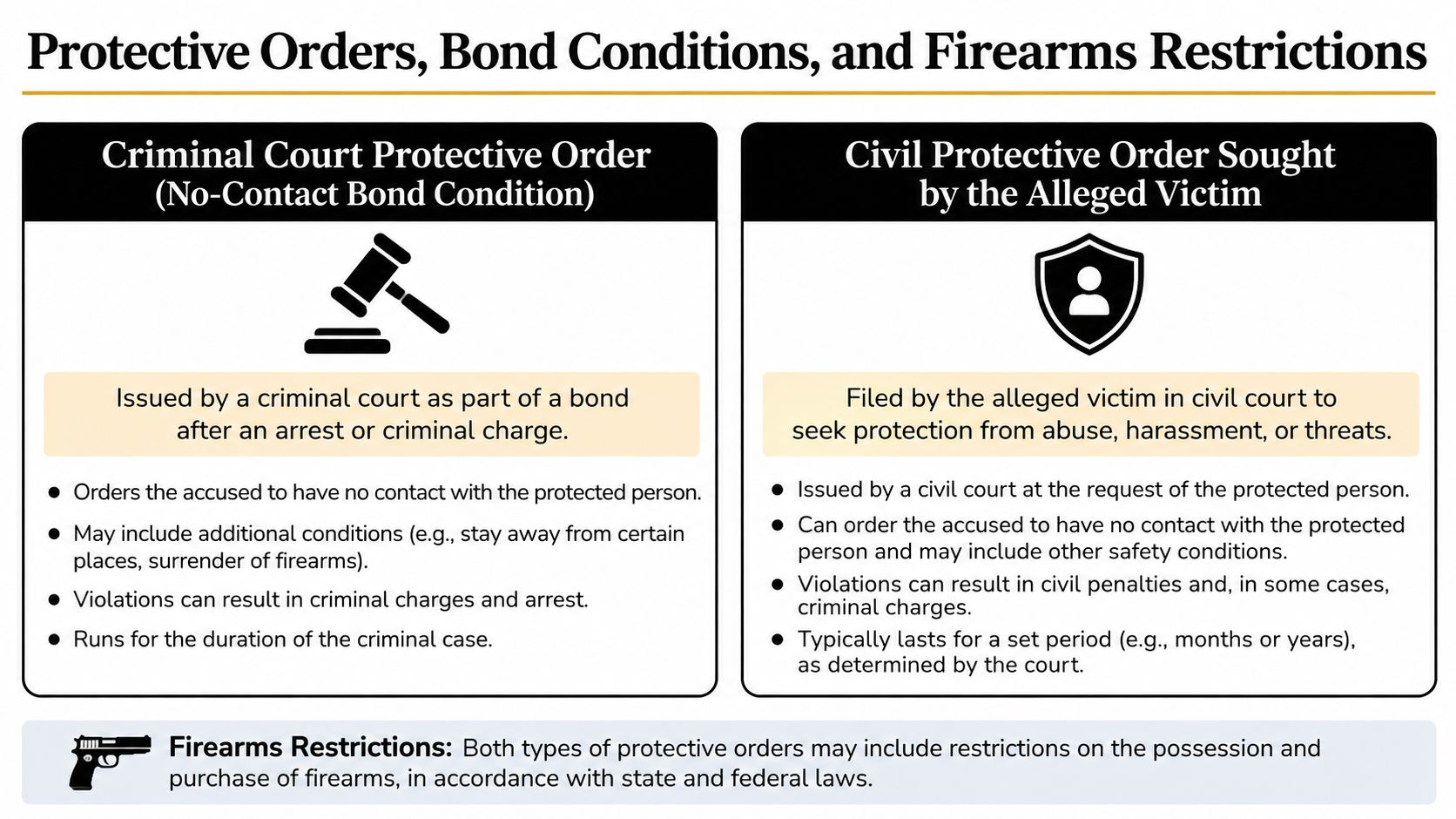
Protective Orders, Bond Conditions, and Firearms Restrictions
The criminal case and the civil protective-order case are related, but they aren't the same proceeding.
A criminal bond condition is imposed in the criminal case. It controls release while the prosecution is pending and may prohibit direct or indirect contact, require a person to stay away from a home or workplace, or impose monitoring. A criminal protective order may also be entered as part of the criminal matter.
A civil protective order is sought through a separate process, often by the alleged victim or another eligible applicant under the Texas Family Code. The Harris County District Attorney's Office explains that the county generally needs a local connection. Either the applicant or respondent must live in Harris County, or the violence must have occurred there. After review and approval, the application is filed in family court and a hearing date is set. Attendance matters because failure to appear may result in dismissal, according to Harris County's protective-order application information.
Contact, housing, and firearms
A civil order can restrict communication, proximity, stalking, harm to pets, and firearm possession. Eligibility can extend to family members, household members, dating partners, and certain other people covered by Texas law. Recent Texas materials also describe changes effective September 1, 2025, including longer durations for some emergency protective orders and expanded protection for certain burglary victims. The Texas protective-order fact sheet provides the applicable categories and restrictions.
Federal law can also restrict firearm possession while a qualifying family-violence protective order remains active. A conviction for a misdemeanor crime of domestic violence or a felony may create separate firearm consequences, so firearm questions should be addressed with counsel before transferring, storing, or attempting to retrieve a weapon.
Bond questions are separate from the amount of bond itself. A general assault bond guide may help explain broad bond concepts, but it can't tell you what a Harris County magistrate's conditions mean in your specific case.
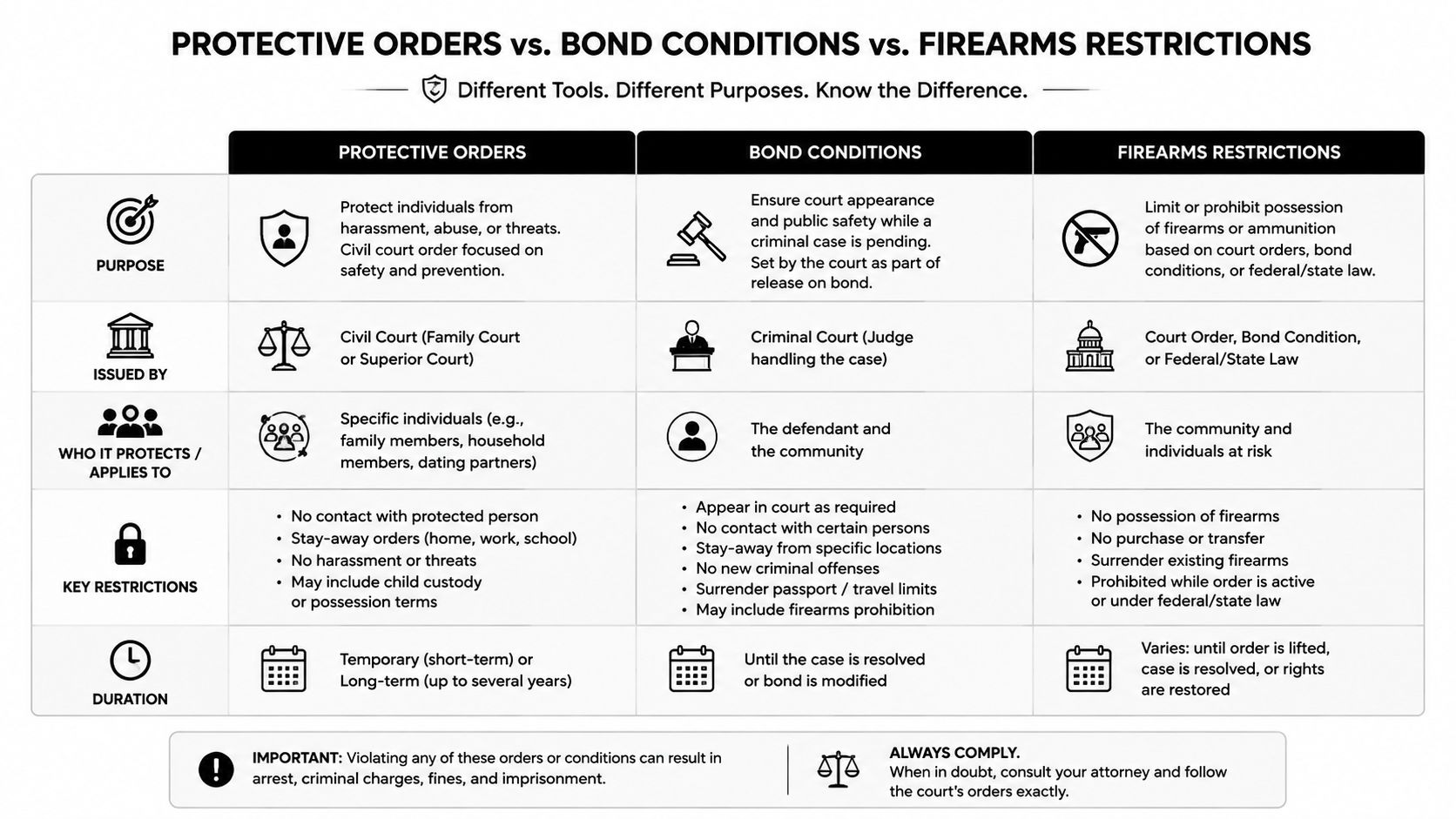
The practical mistake is treating the protective order as paperwork that can wait. A violation may create new criminal exposure under Texas Penal Code Section 25.07, as explained in the Humble protective order and restraining order comparison. Article 17.152 also permits denial of bail after a hearing if the court finds by a preponderance of the evidence that a person violated a bond condition related to victim or community safety, according to Article 17.152.
How a Family Violence Case Reaches Custody, Divorce, and Your Job
A family-violence allegation can enter a family-law case before the criminal matter is finished. In a Kingwood custody dispute, for example, a pending assault-family-member charge may become part of the evidence a judge considers when evaluating a child's best interest under Texas Family Code Section 153.002. The question isn't limited to whether a conviction exists. The court may examine allegations, records, protective orders, witness accounts, and the effect of contact restrictions on the child.
A spouse in Deerwood Estates may face a different kind of spillover. In a fault-based divorce, allegations of cruel treatment can affect the way each side presents the marriage and the requested relief under Texas Family Code Section 6.003. The criminal defense strategy should account for the divorce record, but the client still needs to avoid making admissions in one court that create unnecessary damage in the other.
Employment consequences can arrive before trial. A pipeline worker whose employer conducts background checks may face an internal review or suspension after a pending charge appears. Nurses and teachers may have licensing concerns under Texas Occupations Code Chapters 301 and 21, while noncitizens should obtain immigration advice before accepting a plea or making statements about the incident.
The home may become a legal issue
A no-contact or stay-away condition can prevent a parent from returning to the family home, retrieving personal property, or attending a child's school event. Those restrictions can affect child exchanges, transportation, rent, and work schedules even when the parties hope to reconcile.
A criminal case may end with a dismissal or another resolution, while the family court record and protective-order history continue to influence later decisions.
Firearm restrictions add another layer. A qualifying protective order or family-violence conviction can affect possession rights, and a felony can create broader consequences. That's why an assault family violence lawyer in Humble, TX should evaluate criminal, custody, divorce, employment, immigration, and firearm issues together instead of treating the arrest as an isolated event.
Smart First Steps After an Arrest or Allegation
The first 24 to 72 hours call for discipline, not improvisation. Use this order:
Stop direct contact. Don't call, text, email, send messages through relatives, or visit the alleged victim. If messages already exist, preserve them without responding. Don't delete social-media posts or alter devices.
Write down what you remember. Record the sequence of events, who was present, where each person stood, and what happened before and after the alleged incident. Memories change quickly, and a private chronology helps counsel test the police narrative.
Preserve physical evidence. Photograph visible injuries, damaged property, room layout, and relevant conditions. Save medical records, work schedules, school records, travel information, and names of witnesses, including neighbors who may have heard raised voices.
Address release conditions. If you aren't released on a personal recognizance bond, work with a Harris County bondsman and your lawyer. Read every condition carefully. “The other person invited me over” isn't a defense to violating an order that still prohibits contact.
Obtain the probable cause affidavit. Ask counsel to request and review the affidavit and available records through the Harris County District Clerk's office. Compare the narrative with photographs, call recordings, medical records, and witness accounts.
Schedule a confidential consultation. Bring information about prior family-violence findings, active protective orders, bond status, children, housing, employment, and any communication after the arrest.
A lawyer who regularly appears in Harris County Court at Law 1, 2, 4, and 5 and the 180th, 183rd, and 208th District Courts can help identify the next procedural decision. That local familiarity doesn't replace case preparation, but it helps counsel plan around the court handling the matter.
If you believe the allegation is false or exaggerated, avoid trying to prove that through angry messages. The safer approach is evidence preservation and a structured review, including the guidance in what to do if falsely accused.
Choosing the Right Humble TX Assault and Family Violence Lawyer
A website can't tell you whether a lawyer understands the practical problems that begin after a family-violence arrest. Ask how the attorney handles both the criminal case and any protective-order hearing. Splitting those matters between lawyers who don't communicate can leave gaps around contact, housing, children, and firearms.
Questions worth asking
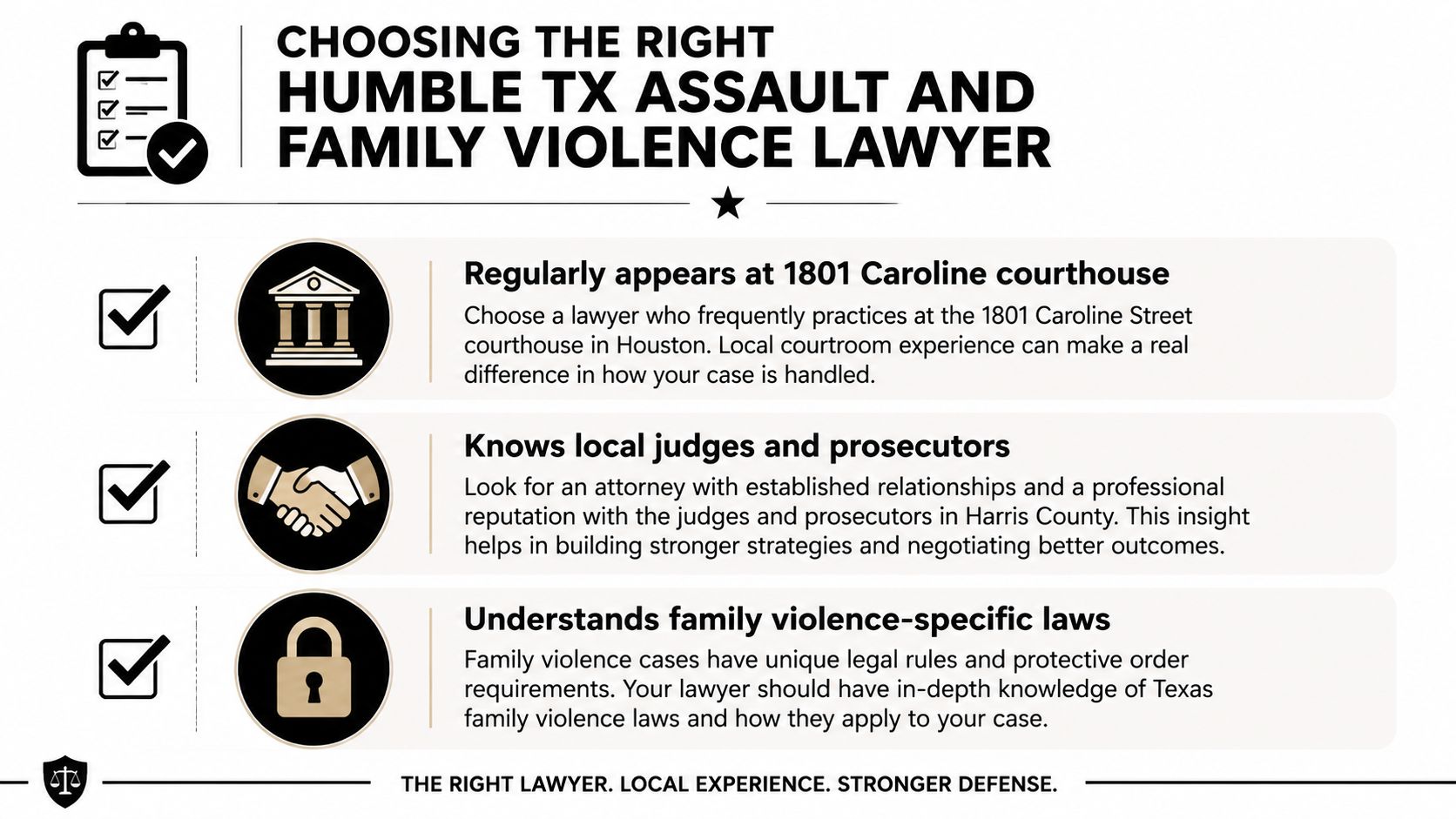
Local courtroom experience: Does the attorney regularly appear at the Harris County criminal courthouse at 1801 Caroline Street? Can the lawyer explain how the assigned court handles family-violence cases?
Parallel-track planning: Will the lawyer review bond conditions, criminal protective orders, civil protective orders, and the family-law consequences together? A defense plan that ignores custody or divorce can create avoidable problems.
Resolution options: Ask whether the facts may support pretrial intervention, counseling-based dispositions, negotiated reduction, dismissal, or trial. No lawyer can promise a result, and counseling may help some cases while creating strategic concerns in others.
Trial readiness: A plea discussion is only meaningful if counsel is prepared to challenge the State's evidence when negotiations fail. Ask what investigation, motion practice, and witness preparation the representation includes.
Written fee terms: Get the retainer, hourly billing, court appearances, motions, expert review, investigators, and other expected expenses in writing. Ask what happens if the case becomes more complicated.
Communication: Choose someone who explains strategy in plain English, gives you a reliable way to reach the office, and treats the family situation without judgment. You should understand what you're ordered to do before you leave the consultation.
Before hiring counsel: Ask who will appear in court, who will handle protective-order issues, and what information the lawyer needs from you immediately.
The Law Office of Bryan Fagan handles criminal defense along with family-law matters, including divorce and custody, for residents of Humble and nearby communities. The firm's criminal defense services can be considered alongside other local options, provided you compare scope, communication, experience, and written fees.

Key Takeaways and Local Resources for Humble Families
An assault-family-violence allegation is rarely just a single court file. The criminal case and protective-order process can move on parallel timelines, and either one may reshape housing, parenting, employment, communication, and firearm rights before a judge or jury decides the criminal charge.
Texas reported 247,896 family violence offenses in 2023, and current or former intimate partners accounted for 139,046 of those incidents reported through NIBRS, according to the Texas DPS report. Harris County reported 46,059 family violence incidents in 2022, equal to 961.4 incidents per 100,000 residents, according to the Harris County Violence Prevention Subcommittee report. The same local reporting noted that intimate-partner homicides rose from 60 in 2021 to 64 in 2022, while a separate summary recorded 38 family-violence-related fatalities in Harris County in 2023.
For a Humble, Atascocita, Kingwood, or Northeast Houston resident, the practical lessons are straightforward:
- Charge level matters: Injury, prior family-violence convictions, choking allegations, and deadly-weapon claims can change misdemeanor exposure into felony exposure.
- Orders matter now: A bond condition or protective order can control where you live and whom you contact before the criminal case ends.
- Compliance matters: Violating a protective order or family-violence bond condition can create new criminal and custody problems.
- Coordination matters: Criminal defense, custody, divorce, employment, immigration, and firearm concerns should be evaluated together.
For official case information, contact the Harris County Sheriff's Office records desk and use the Harris County District Clerk's office for case lookups. For a non-emergency police matter, contact the Humble Police Department through its current non-emergency channel. Civil-law questions may also be directed to the Family Law Hotline, while an attorney can help you determine which agency or court has authority over your immediate issue.
If you've been arrested, served with an order, or accused of assault family violence, don't contact the other person to negotiate your way out of the problem. Preserve the evidence, follow the written conditions, and seek confidential legal advice promptly.
The Law Office of Bryan Fagan provides practical criminal-defense and family-law guidance for Humble residents facing assault and family-violence allegations, including the related protective-order and custody concerns. Schedule a free consultation by visiting Law Office of Bryan Fagan so you can discuss your bond conditions, court status, and next steps with a local legal team.