You're driving home through Humble after a long day. A deputy stops you on US-59, asks where you're coming from, and the conversation quickly shifts from a traffic concern to field sobriety tests, questions about alcohol, and possibly a request for a breath or blood sample. You expected a DWI arrest. You didn't expect to hear the word felony.
That surprise is common in Humble, Atascocita, Kingwood, and Northeast Houston. A DWI isn't automatically a felony only because it's a third offense. Prior cases, a child passenger, a school crossing zone, or a high alcohol concentration can change the charge. A prior deferred adjudication can also affect enhancement analysis under Texas law.
If you're searching for a felony DWI lawyer in Humble, TX, treat the search as urgent. Don't give detailed explanations to investigators, don't miss license-related deadlines, and don't assume the charging language tells the whole story.
When a DWI Becomes a Felony in Humble
A routine stop in Humble can become a felony case because of facts discovered after the arrest. The officer may focus on your driving, speech, balance, and test performance. The prosecutor will examine additional details, including your criminal history, the stop's location, who was in the vehicle, and the reliability of chemical testing.

A driver stopped near Atascocita may view the case as a misdemeanor because no crash occurred and no prison sentence followed an earlier case. That conclusion can fail if the arrest happened in a school crossing zone, a child under 15 was in the vehicle, the alcohol concentration was high, or a prior DWI ended with deferred adjudication. Harris County prosecutors and law enforcement examine those aggravating facts closely. The defense must identify them before the State builds its enhancement theory.
The right question is not whether this was your first arrest. Ask which legally qualifying facts the State can prove and whether its records support them.
The prior-case problem
Texas Penal Code § 49.09 allows qualifying prior intoxication convictions to support enhancement. For enhancement purposes, an earlier case that ended in deferred adjudication community supervision may also count, as explained in the Texas Penal Code § 49.09 text.
Do not describe an old DWI as “dismissed” or “not a conviction” until counsel reviews the court file. The judgment, charging instrument, disposition, and supervision terms may control the analysis more than your recollection.
Practical rule: Treat deferred adjudication as potentially relevant. Have counsel verify the disposition and determine whether it qualifies for enhancement.
Why felony court changes the stakes
A felony DWI generally proceeds through district court instead of the county misdemeanor system. The case can involve indictment issues, enhancement disputes, felony punishment exposure, and consequences for employment, licensing, driving privileges, family stability, and reputation.
For Humble residents, felony DWI is a recurring category in Texas criminal courts. Your lawyer should challenge the testing evidence, investigate the stop location and passenger facts, and verify every alleged prior conviction at the start of the case. A charging document is an allegation, not proof.
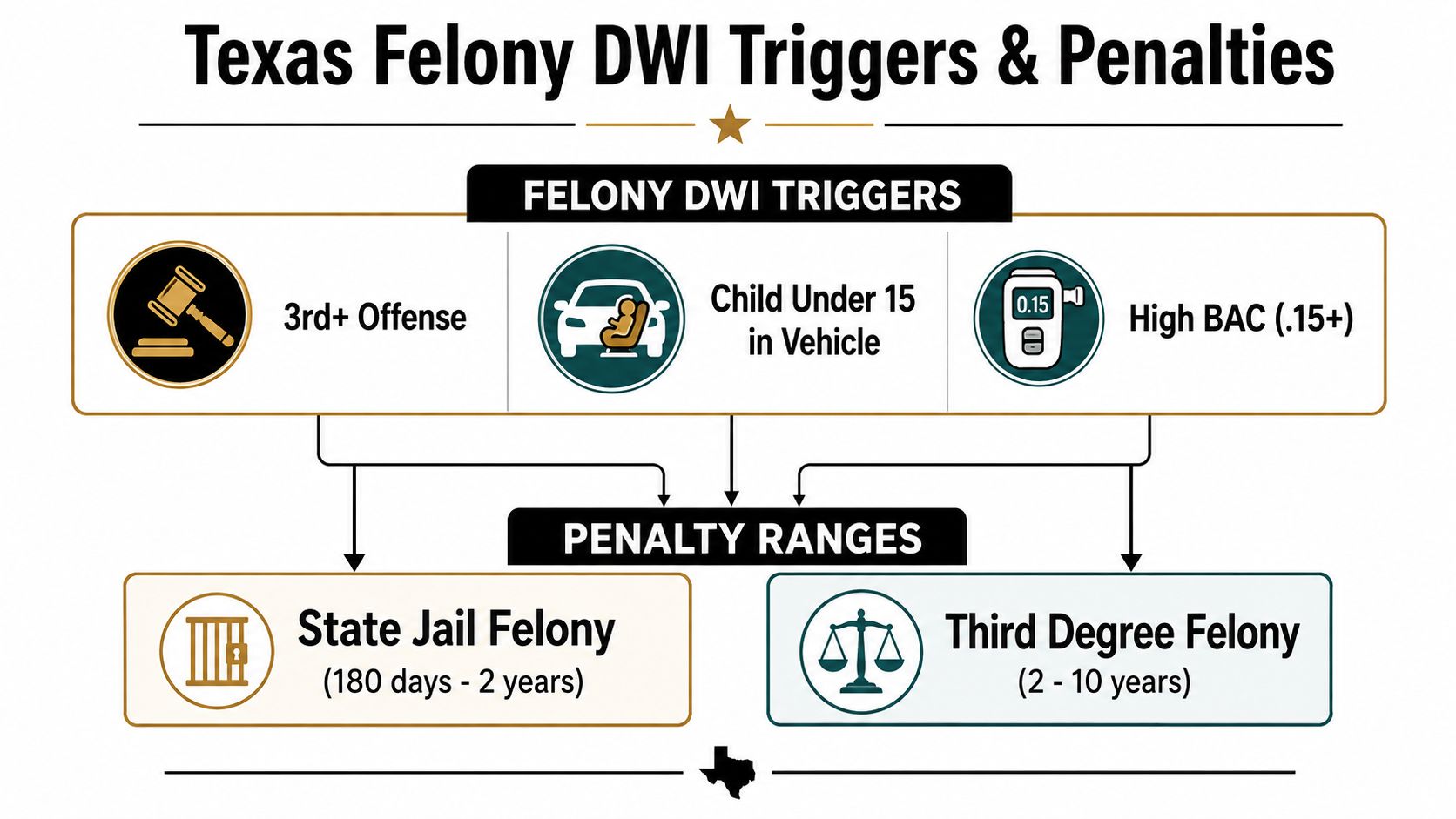
Texas Felony DWI Triggers and Penalty Ranges
A driver may expect a routine DWI case, then learn that a child passenger, school crossing zone, high alcohol concentration, or qualifying prior changes the charge. In Humble and elsewhere in Harris County, the defense must identify those facts early and test whether the State can prove each one.
Third DWI allegations
A third DWI offense is generally a third-degree felony in Texas, carrying 2 to 10 years in prison and a fine of up to $10,000. The State must prove the current DWI and establish the qualifying prior convictions.
That proof deserves close review. A prior conviction from another jurisdiction, an incorrectly described disposition, or a record that does not match the enhancement allegation can create a serious prosecution problem. Your lawyer should compare the charging documents, judgments, and court records instead of accepting the State's summary.
A child under 15 in the vehicle
A DWI can become a state jail felony when a child under 15 is in the vehicle. Texas reporting also describes a state jail felony pathway when the arrest occurs in a school crossing zone. The stated punishment is 180 days to 2 years, with a fine of up to $10,000, as described in Texas reporting on DWI law changes.
The passenger detail can decide the charge. Counsel should confirm who was present, the child's age, whether the child was inside the vehicle, and whether the evidence proves every required element. A report's brief reference to a child is not enough by itself.
School crossing zones
A location-based enhancement can surprise drivers. An officer's report may identify a general area without establishing that the stop occurred within the legally applicable school crossing zone. Defense counsel should inspect the roadway, signs, markings, zone boundaries, and legal basis for the allegation.
High BAC on a second offense
A DWI can become a felony on the second offense when blood, breath, or urine analysis shows an alcohol concentration of 0.15 or more. A 2025 Texas legislative supplement describing the high-BAC change identifies this circumstance as raising the offense from a Class A misdemeanor to a state jail felony.
The reported result is not automatically reliable. The defense should examine collection procedures, testing methods, calibration or maintenance records, documentation, and whether the evidence is admissible. A high result increases exposure, but the prosecution still must prove that the test is trustworthy.
The Criminal and Administrative Process in Harris County
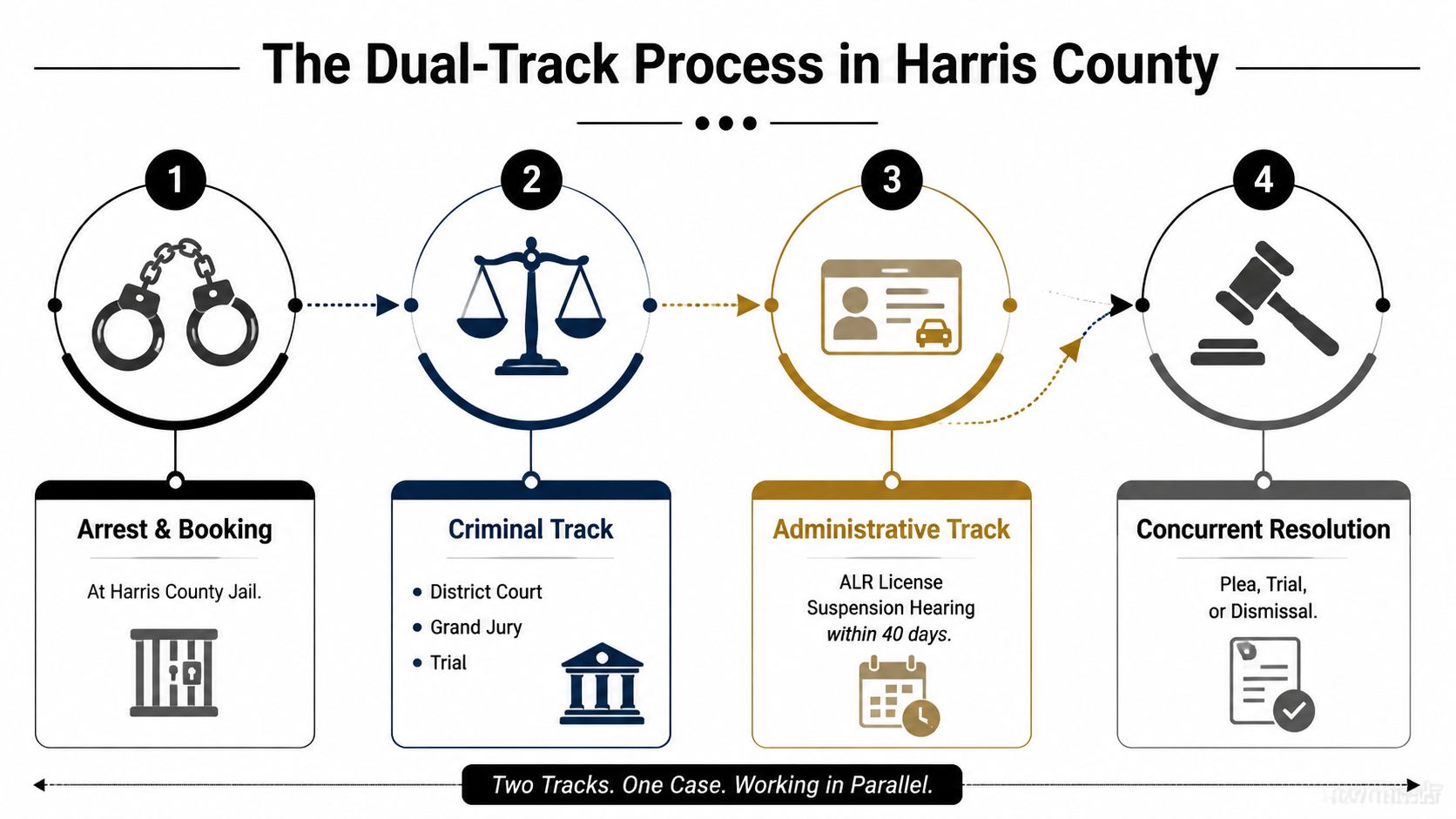
A felony DWI creates two related but separate tracks. The criminal case concerns guilt and punishment. The administrative license process concerns your driving privilege and proceeds through the Texas Department of Public Safety.
The criminal track
After arrest and booking, the case may move through probable-cause review, bond conditions, filing, and assignment to a Harris County district court. A felony prosecution may involve a grand jury indictment, arraignment, discovery, pretrial motions, negotiations, and trial preparation.
Your lawyer should obtain and review the arrest report, body-camera footage, dash-camera recordings, dispatch materials, test records, warrants, and prior-case documents. The defense shouldn't wait for a trial date before identifying defects. A weak stop, unreliable testing, or flawed enhancement allegation can affect negotiations and motion practice early.
The administrative track
The ALR process is separate from the criminal prosecution. The plan materials identify an ALR license suspension hearing within 40 days in the process illustration, while the practical instruction for arrested drivers is to protect the right to request an ALR hearing within 15 days of the relevant notice. Because deadlines depend on the notice and circumstances, contact counsel immediately and have the paperwork reviewed.
Missing the request deadline can cost you an opportunity to contest the administrative suspension. That result can affect commuting between Humble and Houston, getting children to school, and maintaining work, even while the criminal case remains unresolved. If driving is essential, review the occupational driver's license process after a Humble DWI promptly.
Why local volume matters
Precinct 4 deputies reported 1,082 suspected drunk-driver arrests in 2025 alone, according to Texas DPS crime records and statistical information. That volume helps explain why local defense counsel must be organized, responsive, and familiar with Harris County procedures.
The arrest and booking process can also raise practical bond questions. For general background on how DUI bond arrangements may work in another jurisdiction, you can review this Miami DUI bond guide, but don't treat an out-of-state explanation as a substitute for advice about Harris County bond conditions.
Common Defenses and Evidence Challenges
A felony accusation doesn't establish guilt. The State must prove the charged offense and any enhancement beyond a reasonable doubt, using evidence that survives constitutional and evidentiary challenges.
Stop and arrest legality
The first question is whether the officer had a lawful basis to stop your vehicle. Your attorney should compare the report with video, dispatch records, witness accounts, and the roadway conditions. If the stated reason for the stop doesn't match the recording, that inconsistency may matter.
The arrest requires its own analysis. The officer's observations, field sobriety tests, statements, and test results must be examined as separate pieces of evidence, not accepted as one package.
Field sobriety testing
Field sobriety tests can be affected by poor lighting, uneven pavement, footwear, fatigue, anxiety, medical conditions, injuries, and confusing instructions. A defense lawyer should review exactly how the officer gave the instructions and whether the video supports the written description.
That review may reveal that the test performance had an innocent explanation or that the officer overstated what happened. It doesn't guarantee dismissal, but it can weaken the State's interpretation.
Breath and blood evidence
Breath testing requires scrutiny of the machine, the operator, the procedure, and the records supporting the result. Blood evidence raises different questions, including warrant validity, sample collection, preservation, laboratory handling, and chain of custody.
Evidence is not self-proving. A number in a report still has to come from a lawful, reliable, and properly documented process.
Witnesses and video
Body-camera and vehicle-camera footage can support either side. Your attorney should compare what the video shows with the officer's report, including driving behavior, speech, balance, instructions, and timing. Passenger or bystander witnesses may also clarify what occurred before and during the stop.
If you want to understand the broader defense question of how DWI evidence can be challenged, review how to get a DUI dismissed. Family consequences can matter too. For example, Grandparents' Rights in Humble concerns custody and visitation rights for grandparents in Harris County, a separate family-law issue that may become important when a DWI affects household arrangements.
What a Local Felony DWI Attorney Actually Does
A local felony DWI lawyer should do much more than appear at arraignment and relay a plea offer. The attorney should build an evidence-based defense while the facts are still available and the administrative deadlines are still open.
The investigation starts immediately
Counsel should preserve body-camera footage, dashboard video, photographs, medical records, witness information, and documents from earlier cases. The lawyer should also examine where the stop occurred, whether a school crossing zone allegation is accurate, whether a child-passenger allegation fits the facts, and whether the alleged prior convictions qualify.
A Humble-based attorney understands that road conditions and traffic patterns can affect how an officer describes driving. US-59, Atascocita-area roads, Kingwood routes, and Northeast Houston corridors each produce different circumstances. Local knowledge doesn't replace legal analysis, but it helps counsel ask sharper questions about visibility, lane configuration, traffic flow, and the reason for the stop.
The lawyer tests the State's case
The defense should request discovery, review testing documentation, assess warrant issues, and identify contradictions. If the evidence supports it, counsel may file motions to suppress unlawfully obtained evidence. If the enhancement is disputed, counsel should force the State to prove the prior records rather than accepting a summary description.
A strong mitigation presentation can also address employment, family responsibilities, treatment efforts, medical issues, and the practical effect of the case. Those materials don't erase bad facts, but they give the court a complete picture and can influence negotiations or punishment decisions.
For a local overview of representation, visit the Humble DWI lawyer service page. The Law Office of Bryan Fagan handles criminal defense matters alongside its family-law and estate-planning services, which can matter when a DWI affects custody concerns, employment, or household planning.
Choosing the Right Lawyer and What to Expect
Use the consultation to test the lawyer's preparation, not just personality. A felony DWI requires someone who can evaluate scientific evidence, prior convictions, court procedure, and the consequences outside the courtroom.
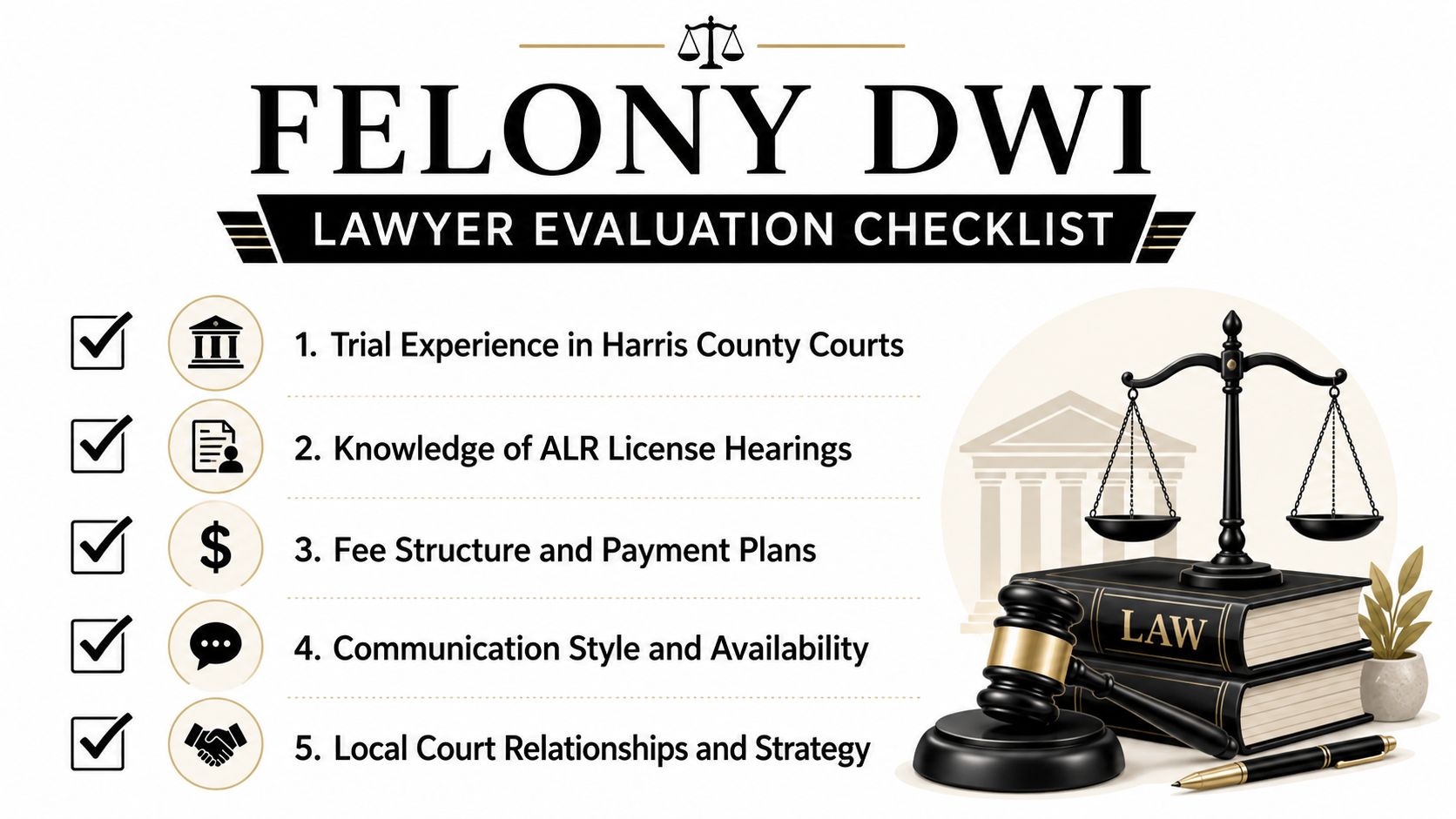
Ask these questions directly:
- Trial experience: How often does the lawyer handle felony DWI cases in Harris County courts, and what parts of the case will the lawyer personally handle?
- ALR knowledge: Will the firm review the driver's-license notice and protect the hearing request deadline?
- Evidence strategy: What records will the lawyer seek, and how will counsel evaluate breath, blood, or urine evidence?
- Fees and communication: What services are included, what costs are separate, and how will you receive updates?
- Local strategy: Does the attorney understand the Humble, Atascocita, Kingwood, and Northeast Houston communities and Harris County courtroom procedures?
A lawyer shouldn't promise a result. The right lawyer should explain the possible paths, identify missing information, and tell you what must happen next.
The timeline varies. Early work may include bond review, evidence preservation, discovery, prior-record verification, and ALR action. The criminal case may then proceed through indictment, arraignment, motions, negotiations, and trial preparation. Don't make financial decisions based only on the lowest quoted fee. Compare the scope of representation and the lawyer's plan for your specific facts.
Next Steps and Frequently Asked Questions
If you received a driver's-license suspension notice, address the ALR deadline before focusing only on the criminal case. Bring the notice, arrest paperwork, bond documents, charging records, and any blood, breath, or urine paperwork to your consultation. Include prior DWI dispositions, including cases that ended in deferred supervision, so counsel can assess hidden enhancement issues early.
Can a felony DWI be reduced? Sometimes. The result depends on the evidence, enhancement allegations, prior records, and negotiation posture. A lawyer should review the file before discussing realistic outcomes.
How does bond work in Harris County? Conditions depend on the case and court. Follow each condition, attend every setting, and ask counsel before traveling, driving, consuming alcohol, or contacting anyone connected to the case.
Can an out-of-state prior count? It may, if it qualifies under Texas enhancement law and the State proves the required facts. Counsel should obtain certified records rather than rely on database labels.
Does deferred adjudication count? A prior intoxication case that ended in deferred adjudication community supervision may be treated as a conviction for enhancement purposes under Texas law. That issue deserves a record-specific review, particularly when prosecutors evaluate an otherwise regular DWI as a felony.
Harris County practice makes early review more important. School-zone allegations, a child passenger, a high BAC allegation, or a disputed prior can change negotiations and evidence priorities. An arrest is not a conviction, but missed license deadlines and unexamined records can narrow your options.
The Law Office of Bryan Fagan provides criminal-defense guidance for felony DWI allegations, including evidence review, enhancement analysis, and license-related consequences for Humble-area residents. Schedule a consultation through the Law Office of Bryan Fagan for a case review serving Humble, Atascocita, Kingwood, and Northeast Houston.