Skip to content

A walk through a Humble, Atascocita, or Kingwood neighborhood can change in seconds. Your dog may be on a leash, your child may be beside you, and a loose dog can still rush from a yard, driveway, or open gate. After the bite, you're left with more than a wound. You may be wondering who's responsible, whether insurance will pay, and whether the property owner or manager ignored earlier warnings.
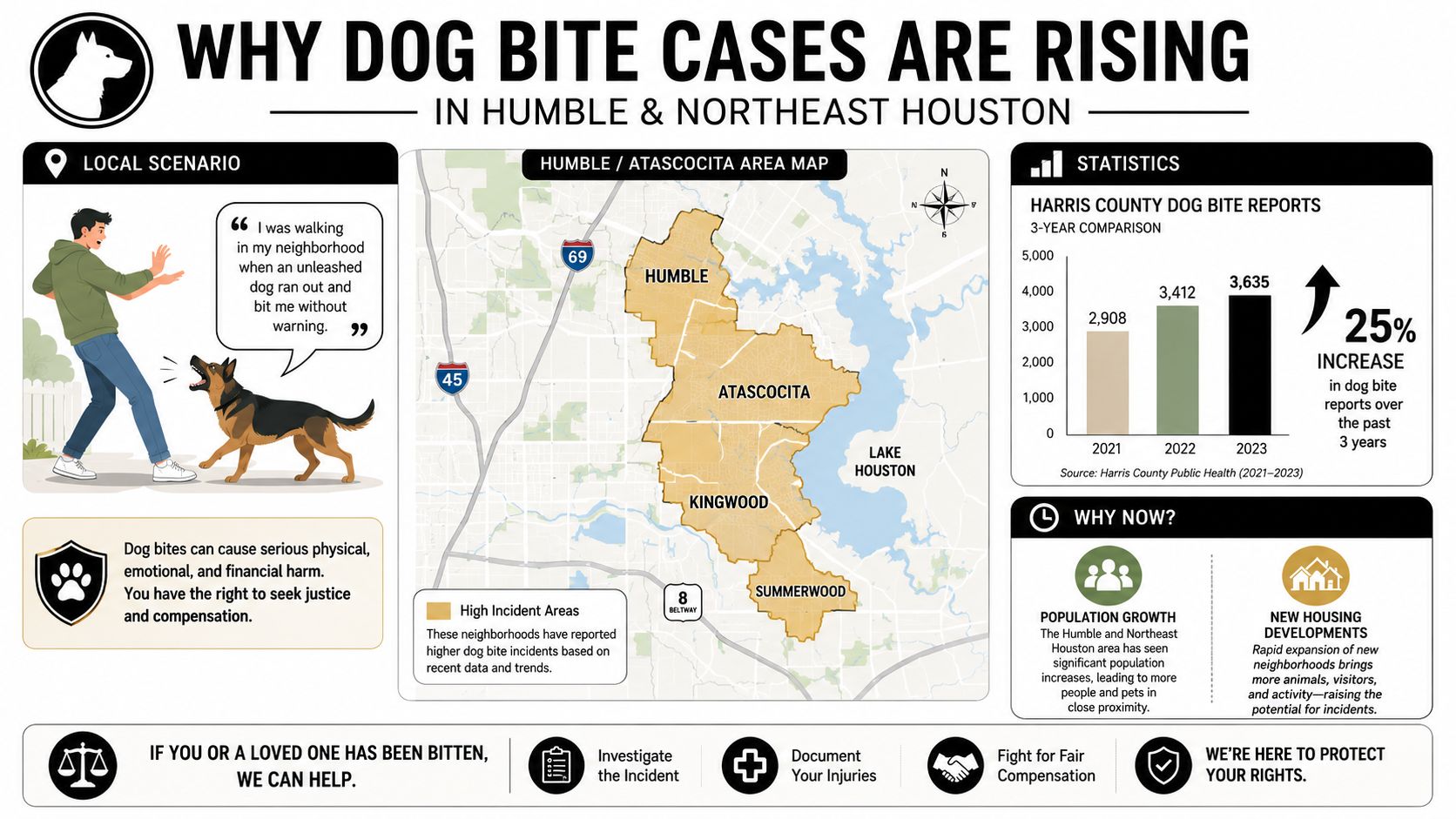
A dog bite lawyer in Humble, TX can help answer those questions, but your first decisions matter. Medical records, animal-control reports, witness accounts, prior complaints, and surveillance footage can determine whether a claim succeeds. The local numbers also show why Northeast Houston families shouldn't treat these incidents as isolated accidents.
Why Dog Bite Cases Are Rising Around Humble and Northeast Houston
A resident walking near a neighborhood in Atascocita might see a dog slip through a gate. The owner may claim it's the first time the animal has acted aggressively. A neighbor may know that residents have complained about the same loose dog for months. Those details can change the legal analysis, especially when the bite causes lasting scarring, missed work, or expensive medical care.
Harris County and greater Houston saw dog-bite cases rise from 2,464 in 2023 to 2,664 in 2024. Loose-dog bite cases increased from 1,288 to 1,407 during that period, according to local reporting on loose-dog incidents in the Houston area. Those figures give Humble, Kingwood, and Northeast Houston residents a practical reason to report incidents and preserve evidence promptly.
Why insurers take these claims seriously
In 2024, homeowners insurers paid about $1.57 billion for dog-bite and other dog-related injury liability claims based on 22,658 claims nationwide. The average cost per claim reached $69,272, compared with $58,545 in 2023, and the average cost per claim had increased 86.1% over the prior decade, according to the Insurance Journal's report on dog-related liability claims.
Those figures don't determine what your claim is worth. They do show why an insurer may investigate aggressively. Adjusters look at the dog's history, the owner's knowledge, the victim's conduct, medical treatment, and whether the victim was lawfully present. A quick settlement offer may not account for future treatment or permanent scarring.
Texas also accounted for 1,017 dog-related injury claims in 2022, placing it among the top states in one national summary. A Texas-focused public-health resource reports that severe bite injuries in Austin and San Antonio nearly tripled between 2018 and 2023, with Austin increasing 193% and San Antonio 169%, as reflected in Texas Department of State Health Services information on animal bites. The lesson for local families is straightforward. A bite in Humble may be part of a broader neighborhood-control problem, not merely an unfortunate encounter.
Local advice: Report the bite, obtain medical care, and preserve proof before memories fade or a loose dog disappears from the neighborhood.
What to Do Immediately After a Dog Bite
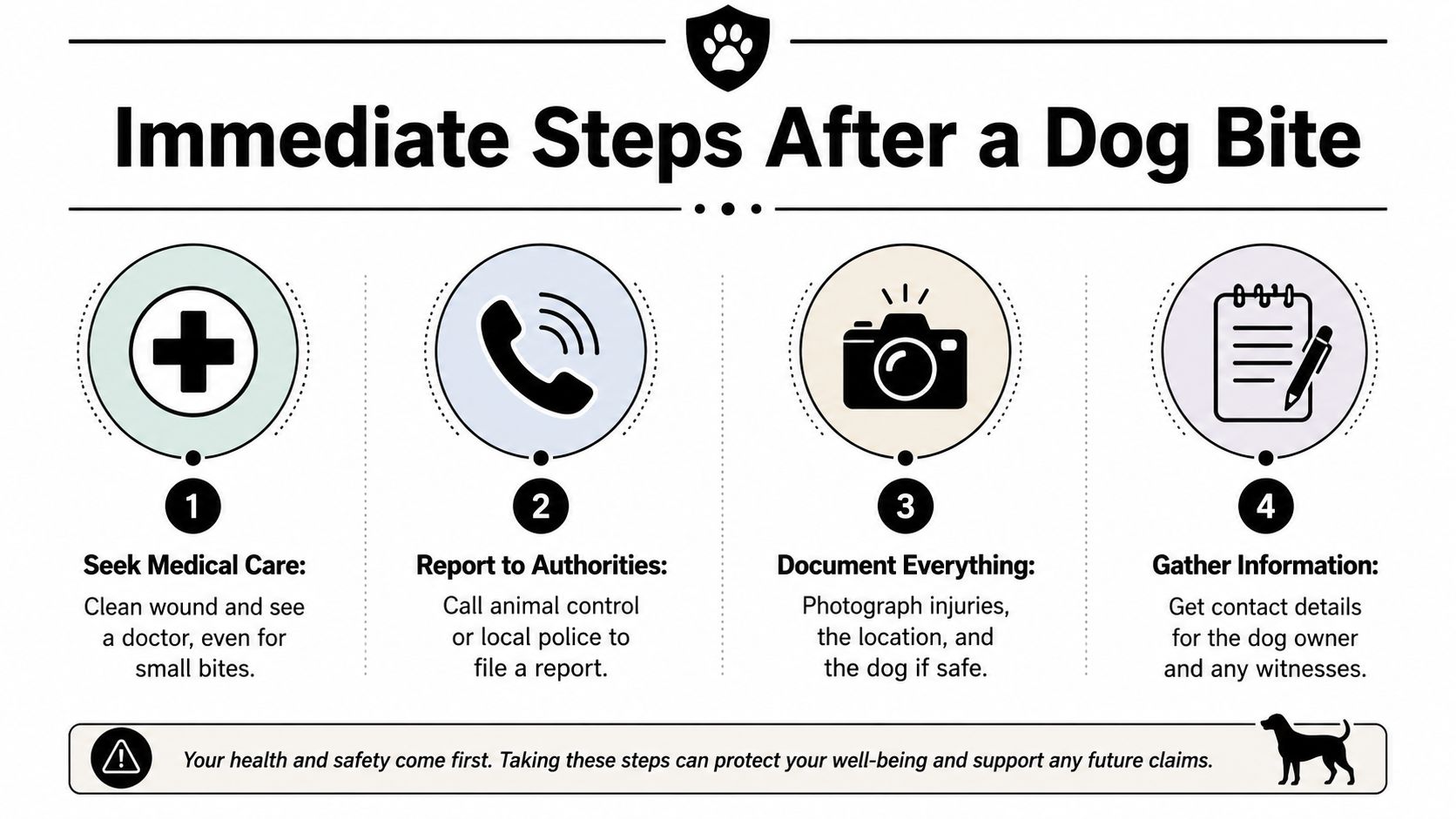
Your health comes first. Wash the wound carefully, apply appropriate first aid, and obtain professional medical attention, even if the injury looks minor. Punctures can hide tissue damage, and a physician's records establish the nature of the injury, treatment needs, prescriptions, and follow-up care.
Report the incident to the appropriate animal-control authority and, when necessary, local law enforcement. A report creates an independent record and may help identify the dog, its owner, vaccination information, and any prior complaints. Don't assume the owner's promise to “take care of it” protects you.
Preserve the facts while they're fresh
Take photographs of the wound, torn clothing, the location, broken gates, missing latches, warning signs, and any conditions that allowed the dog to reach you. Photograph the dog only if you can do so safely. Write down what happened in your own words, including where you were standing, whether the dog was loose, what the owner said, and who arrived afterward.
Ask witnesses for their names, phone numbers, and email addresses. Nearby homes or businesses may have security footage, but recordings can be overwritten. Identify cameras quickly and ask the property owner to preserve the relevant footage.
Keep every emergency-room record, follow-up note, prescription, bill, discharge instruction, and work-related record. Under-documenting injuries early is a serious pitfall, because insurers scrutinize objective medical proof, follow-up treatment, prescriptions, and gaps in care, as explained in the CDC material addressing dog-bite reporting and medical documentation.
Your immediate checklist: Get medical care, report the incident, identify the owner and witnesses, photograph the scene, preserve video, and keep every medical record.
You can also review related guidance about legal issues involving minors through the injury to a child lawyer Humble TX resource. If an insurance adjuster contacts you, be polite but careful. Don't give a recorded statement, sign a release, or accept payment before you understand the full extent of your injuries and legal options.
For a visual explanation of the immediate response, watch the following resource:
How Texas Dog Bite Law Works
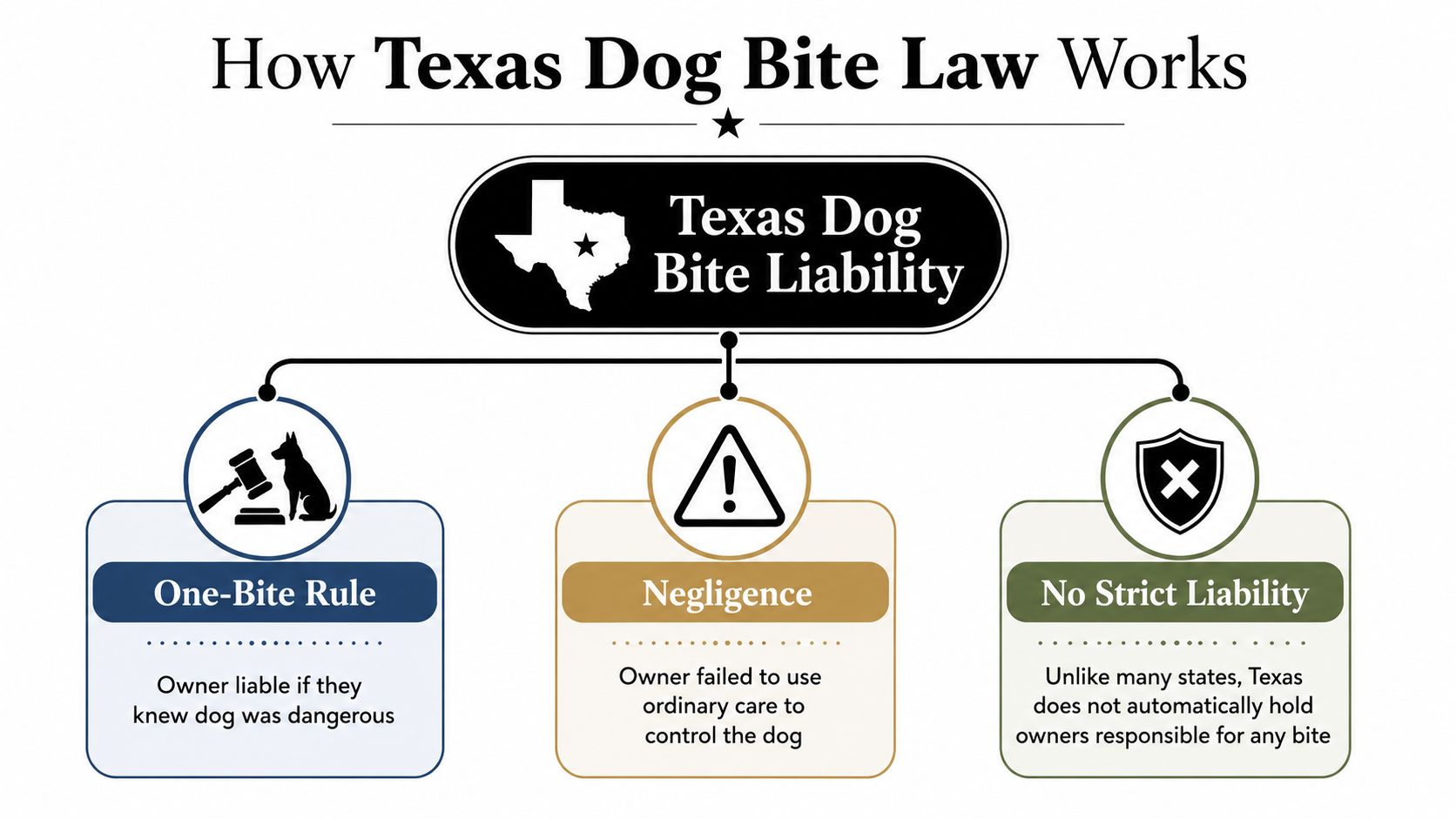
A bite in a Humble, Kingwood, or Atascocita neighborhood does not automatically make the dog's owner liable. Texas generally relies on the common-law one-bite rule and negligence rather than automatic strict liability, as explained in this overview of Texas dog-bite law.
The one-bite rule is best understood as a notice rule. An owner may face liability when the owner knew the dog had bitten someone or had shown dangerous behavior. Relevant proof can include an earlier bite, lunging, warnings to neighbors, growling or snapping at people, and prior complaints about the animal.
Negligence and the victim's conduct
Negligence asks whether the owner failed to use reasonable care under the circumstances. An unsecured gate, broken leash, unattended aggressive dog, or failure to follow known safety requirements may support that claim even without a previous bite.
For example, a dog that has never bitten anyone may still create a negligence case if its owner leaves it loose beside a sidewalk after repeated warnings about aggressive behavior. The insurer may respond that the injured person entered a clearly private area or provoked the dog. Those facts can affect both liability and settlement value.
Texas uses modified comparative negligence with a 51% bar. A claimant found more than 50% responsible generally recovers nothing. As a result, lawful presence, trespassing, warnings, and alleged provocation deserve careful attention from the start.
Strict-liability rules operate differently in some jurisdictions. This resource on winning your strict liability case offers background, but another state's rule does not determine a Humble claim.
Your evidence must connect the legal theory to the losses. Medical records support the injury, witnesses explain what happened, and photographs can document the wound and relevant conditions. A fatal incident calls for a separate analysis, including issues addressed in this wrongful death lawyer Humble TX resource.
Because dog-bite claims are civil matters, they do not enter the family-court system. If a custody or divorce matter exists alongside the injury claim, see Harris County Family Courts: A Humble Resident's Guide.
Who Can Be Held Responsible in a Harris County Dog Bite Case
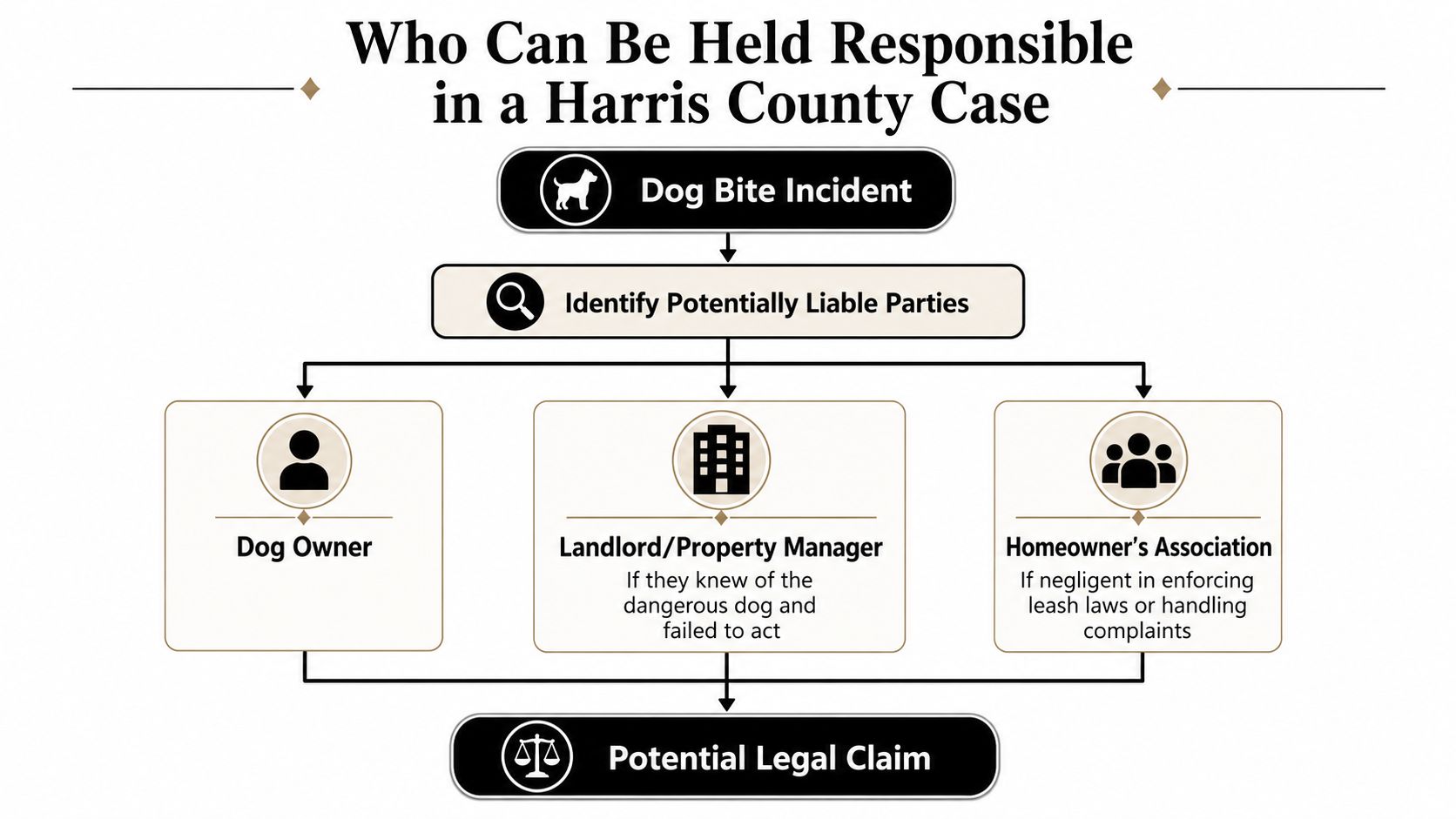
The dog owner is the obvious person to investigate, but the owner may not be the only potentially responsible party. In a Humble, Kingwood, or Atascocita neighborhood, the dog may live on a rental property, in a managed community, or behind a fence maintained by someone other than the animal's owner.
A landlord or property manager may deserve attention when they knew about a dangerous dog or repeated loose-dog complaints and failed to take reasonable action within their control. That doesn't mean every landlord becomes responsible for every tenant's pet. The facts matter, including notice, control over the property, lease terms, prior reports, and whether a dangerous condition was allowed to continue.
A homeowners' association may also require investigation when it has applicable leash or animal rules and receives repeated complaints but fails to enforce them. Again, an HOA isn't automatically liable. The question is whether its duty, knowledge, conduct, and control connect to the injury.
Build the evidence chain
Texas dog-bite claims are often developed through a sequence of duty, breach, causation, and damages. A Texas dog-bite negligence guide identifies the types of proof that can corroborate that chain.
| Question | Evidence to look for |
|---|---|
| Who owed a duty? | Ownership, possession, property control, or applicable community rules |
| What went wrong? | Loose-dog reports, broken gates, ignored complaints, or unsafe supervision |
| Did it cause the injury? | Witness accounts, photographs, animal-control records, and surveillance |
| What did the bite cost? | Medical records, prescriptions, bills, lost income, and injury documentation |
Prior complaints may be especially important in a loose-dog case. A neighbor's report, animal-control record, email to a property manager, or community message can show that someone had notice before your injury. Ask a lawyer to investigate all likely sources rather than accepting the first insurer's version of events.
Insurers also weigh the dog's history, the owner's prior knowledge of aggression, and whether you were lawfully present. That's why the question “Who pays?” can't be answered responsibly until the facts identify every person or entity connected to the danger.
How to Choose the Right Dog Bite Lawyer for Your Case
The right lawyer should do more than send a demand letter. You need someone who can investigate the dog's history, identify prior complaints, preserve video, obtain medical records, communicate with insurers, evaluate future consequences, and file suit when negotiation doesn't produce a fair result.
Start with local experience. A lawyer familiar with Harris County and the Humble area is better positioned to understand neighborhood conditions, local reporting channels, property-management relationships, and the practical difference between an owner-only claim and a claim involving a landlord or community association.
Compare lawyers by the questions they answer
Ask who will handle your case day to day. Some firms market through a lawyer but assign routine communication elsewhere. You should know who investigates the incident, who speaks with the adjuster, and how quickly you can get answers.
Ask these questions during a consultation:
- Investigation: Will you look for prior animal-control complaints, witness statements, and surveillance footage?
- Medical proof: How will you document treatment, scarring, follow-up care, and possible future needs?
- Potential defendants: Will you evaluate the owner, landlord, property manager, or HOA when the evidence supports it?
- Communication: Who is my contact, and how will updates be handled?
- Litigation: Will the firm file suit if the insurer refuses a reasonable resolution?
- Fees: What expenses may arise, and when is the attorney paid?
A contingency-fee agreement generally means no upfront attorney fee, with the attorney paid from a recovery. Read the agreement carefully and ask about case expenses, liens, and what happens if the claim doesn't resolve.
The guide from Digital Skyrocket offers background on how personal-injury law firms approach online visibility. That information may help you evaluate a firm's public communication, but marketing should never replace direct answers about your evidence, deadlines, strategy, and fees.
The Law Office of Bryan Fagan is one local option for residents seeking legal support from a downtown Humble office. The firm also handles family law, criminal defense, estate planning, wills, trusts, and probate, so ask directly whether its attorneys are the right fit for your injury matter and what referral or representation options apply.
Timelines, Compensation, and Getting Started With a Local Attorney
Texas generally gives an injured person two years from the injury date to file a personal-injury lawsuit, including a dog-bite claim, under Texas Civil Practice and Remedies Code § 16.003. The deadline is explained in this Texas dog-bite statute-of-limitations resource. Start early. Witnesses move, video disappears, memories change, and medical gaps become harder to explain.
Potential damages may include medical expenses, follow-up treatment, prescriptions, lost wages, scarring or disfigurement, physical pain, and emotional suffering. Recovery depends on the evidence, injury severity, available insurance, liability disputes, and comparative-fault arguments.
A claim usually starts with investigation and record collection. The lawyer may prepare a demand package covering responsibility, treatment, losses, and the requested compensation. An insurer can negotiate, seek more information, deny responsibility, or make an offer. If talks stall, a lawsuit may be needed to protect the claim and obtain evidence formally.
In a Harris County case, animal-control records and prior complaints can affect both responsibility and timing. A documented history of loose dogs or earlier warnings may strengthen the demand, while missing records can require more witness and property evidence. In a scarring case, the demand package should connect photographs, treatment records, follow-up care, lost income, and the effect of the injury to the amount requested.
Residents comparing an injury lawsuit with a lower-value civil dispute can review this small claims lawyer Houston resource. A consultation can clarify whether small claims, an insurance demand, or a personal-injury lawsuit fits the facts.
The Law Office of Bryan Fagan offers free consultations for Humble, Atascocita, Kingwood, and Northeast Houston residents. Visit Law Office of Bryan Fagan to discuss the incident, preserve options, and assess who may be responsible before evidence or deadlines become problems.