Skip to content

The red and blue lights are behind you again. You're released from custody in Humble, your family is asking what happens next, and you're staring at paperwork that mentions a prior DWI. A second arrest feels like the first emergency all over again, but the legal consequences have changed. The Harris County process, the license case, and the ignition-interlock requirement now demand immediate attention.
If you're dealing with a DWI second offense in Humble, Texas, don't wait for the first court date to get organized. An arrest isn't a conviction, but the deadlines begin immediately. The most practical move is to preserve your driving rights, avoid damaging statements or missed requirements, and have a criminal defense lawyer examine the stop, testing, arrest, and prior-record allegations.
What Changes When It Is Your Second DWI in Humble
At the Humble police holding facility, a second DWI arrest creates immediate questions about bond, release conditions, and driving privileges. The magistrate reviewing the paperwork can see the alleged prior offense. Your family may also wonder why the case is headed toward Harris County criminal court rather than remaining in a municipal setting.
The statewide legal change is direct. Texas classifies a second DWI as a Class A misdemeanor, carrying 30 days to 1 year in jail, a fine of up to $4,000, and possible driver's license loss of up to 2 years, according to TxDOT's impaired-driving guidance. Those rules apply in Humble and throughout Harris County. Local courts control the process, not a separate county penalty schedule.
Why the prior offense matters
The earlier conviction places the new case in a higher punishment category. Jail exposure becomes a central issue, and the prosecution must prove the prior offense qualifies for enhancement. A prior arrest alone does not establish a second DWI.
That record also shapes negotiations in the Harris County courts. Prosecutors and judges will examine whether community supervision is appropriate, whether a jail component applies, and which conditions address public-safety concerns. The court may require an ignition interlock as part of bond before the criminal case ends. It can also become a probation condition after resolution. Texas materials describe interlock use for a second or greater DWI as commonly connected to bond and probation requirements, with relevant restriction periods often lasting 6 months to 2 years (Texas ignition-interlock law summary).
The interlock requirement creates practical problems that many drivers discover late. You may need an approved device installed, pay installation and monitoring costs, and follow reporting or maintenance rules before driving is allowed under the court's terms. Missing a required appointment or driving a vehicle without the device can create another legal problem.
Practical rule: Handle the second DWI as two connected matters, the criminal prosecution and the driver's-license action. A decision in one can affect the other.
For residents of Humble, Atascocita, Kingwood, and Northeast Houston, start by controlling what happens next. Do not discuss the facts online, assume the prior case proves the new charge, or drive until you understand the restrictions attached to your release. Get the bond paperwork, identify every deadline, and have counsel review the stop, testing, arrest, and prior-record allegations.
Texas Second-Offense DWI Penalties Explained
A second DWI arrest can affect your freedom, money, and ability to drive in Humble. Texas classifies a second DWI as a Class A misdemeanor. Statewide consequences include 30 days to 1 year in jail, a maximum fine of $4,000, and driver's license loss of up to 2 years, as described in Texas impaired-driving law guidance.
These are legal limits, not a forecast of your sentence. The outcome depends on the evidence, the alleged facts, the validity of the prior conviction, the prosecutor's position, the judge, and the defense strategy. A Harris County court will examine the actual record, not just the label “second offense.”
The penalties in plain English
- Jail: The law provides 30 days to 1 year in jail. Community supervision may be available in a suitable case, but a second DWI receives more serious treatment than a first offense. The court can also impose conditions that affect your daily life.
- Fine: The court may impose up to $4,000, apart from court costs and other obligations. That fine represents only one part of the financial exposure.
- License loss: A conviction can lead to driver's license loss of up to 2 years. The criminal case and the separate administrative license process can create different deadlines and restrictions.
- State surcharge: A second-offense DWI may carry an annual surcharge of up to $2,000 for 3 years to maintain a driver's license, according to the Texas Impaired Driving Task Force's DWI consequences information.
For a Humble resident, these consequences can mean arranging rides to work, coordinating school pickups in Atascocita, and documenting every court or supervision requirement. A license problem can threaten employment even when the driver has never missed a shift.
Texas DWI penalties at a glance
| Penalty Category | First DWI | Second DWI |
|---|---|---|
| Classification | Lower misdemeanor category | Class A misdemeanor |
| Jail exposure | Lower than the second-offense range | 30 days to 1 year |
| Maximum fine | Up to $2,000 | Up to $4,000 |
| License consequence | Depends on the case and administrative action | Loss of up to 2 years |
| Ignition interlock | May depend on the order entered | Commonly tied to bond and probation, with restrictions often lasting 6 months to 2 years |
Specific aggravating facts can lead to more serious treatment, including allegations involving a child passenger. Do not rely on what someone told you at the jail about the charge level. Have counsel review the complaint, probable-cause affidavit, test records, and prior judgment before making decisions in the Harris County process.
License Suspension and the ALR Hearing Timeline
An Administrative License Revocation, or ALR, can begin while your criminal DWI case is still pending. It addresses your driving privilege, while the Harris County criminal court addresses whether the State can prove the DWI charge beyond a reasonable doubt. Treat the arrest paperwork as time-sensitive. It may state when a suspension begins and how to request a hearing.
Protect the deadline first
You generally have 15 days from the arrest to request an ALR hearing through the State Office of Administrative Hearings. Miss that deadline, and you may lose the chance to challenge the administrative suspension. Do not wait for the criminal case to develop before addressing the license issue.
A lawyer can file the hearing request, subpoena the officer when appropriate, and examine the evidence packet. That packet may contain the DSR, video, breath-test records, and other reports. The SOAH judge considers limited questions, including whether the officer had a lawful basis for the stop and arrest and whether the legal requirements for suspension were met. The ALR hearing is an administrative proceeding, not a smaller version of the criminal trial.
Driving during the suspension
An occupational driver's license may allow restricted driving for approved purposes, but the court does not grant it automatically. You may need a court filing, proof of financial responsibility, and compliance with the order's conditions. The occupational driver's license process for a Humble DWI can involve the Harris County District Clerk, an $125 reinstatement fee, and an SR-22 filing.
Read the order before driving. It controls where you may go, why you may drive, and which vehicle requirements apply. Driving outside those terms can create another legal problem and give the court a reason to question your compliance.
The ALR result does not decide the criminal case. The same video or officer testimony may appear in both proceedings, but each has a separate purpose and different rules. In a Humble case, counsel should track both matters so an administrative deadline does not disappear while attention stays on the Harris County criminal docket.
Ignition Interlock Requirements After a Second DWI
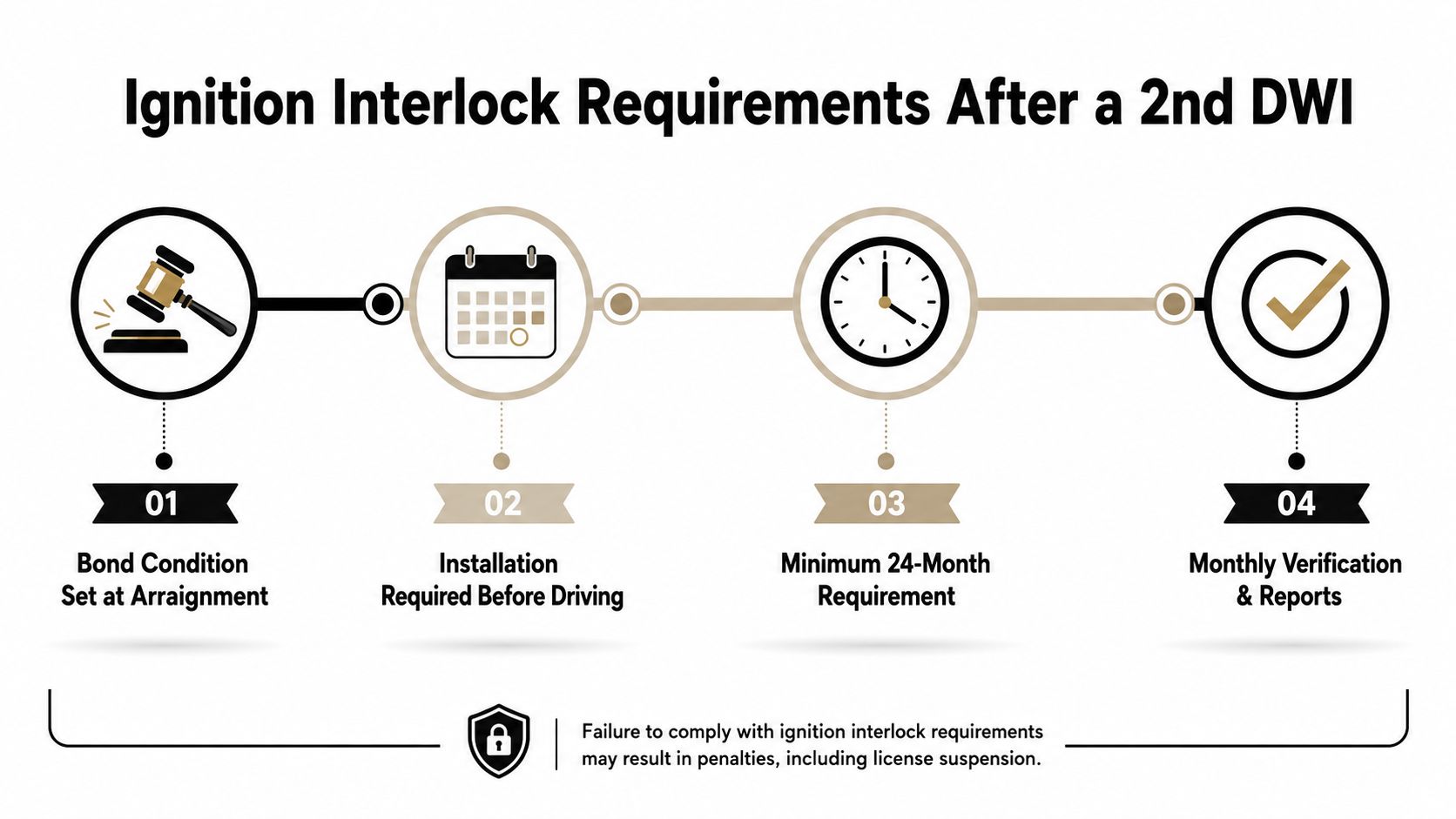
A second DWI can place an ignition interlock device, or IID, on the vehicle you are allowed to drive. The device tests your breath before the engine starts and may request additional samples during a trip. That turns driving into a documented compliance program, with records that can reach the court or supervision authority.
Texas requirements can connect interlock installation to bond conditions, license restrictions, or probation. Do not assume the device waits until final sentencing. The written order in your case controls the timing, covered vehicles, approved driving, and length of the requirement. Read that order with your lawyer before you operate a vehicle.
What daily compliance looks like
Use an approved installer and keep every receipt, service record, and calibration document. The device may require regular service and monitoring appointments. Reports can identify vehicle starts, failed samples, missed visits, or suspected tampering.
A failed or missed breath sample may cause a lockout or generate a compliance report. The proper response depends on the order and the circumstances. Contact your attorney promptly, document what happened, and follow the installer's instructions. Ignoring the report can lead to tighter supervision, additional driving limits, or an allegation that you violated bond or probation.
Common mistakes to avoid
- Driving another vehicle: If your order requires an interlock, operating a vehicle without one can create a serious compliance problem.
- Skipping service: Attend each appointment and retain proof of calibration or maintenance.
- Letting someone else provide a sample: Never ask another person to bypass the device. That may appear to be intentional circumvention.
- Ignoring rolling retests: Follow the device's instructions safely. Do not handle it recklessly while driving.
- Confusing licenses: An occupational license and IID-restricted driving are different arrangements. The written order determines what you may drive and where you may go.
The device is inconvenient, but the legal risk comes from unexplained compliance reports. One report can become part of a bond or probation dispute. Ask your attorney to review every condition before you drive in Humble or elsewhere in Harris County.
How a Humble DWI Case Moves Through Harris County Courts
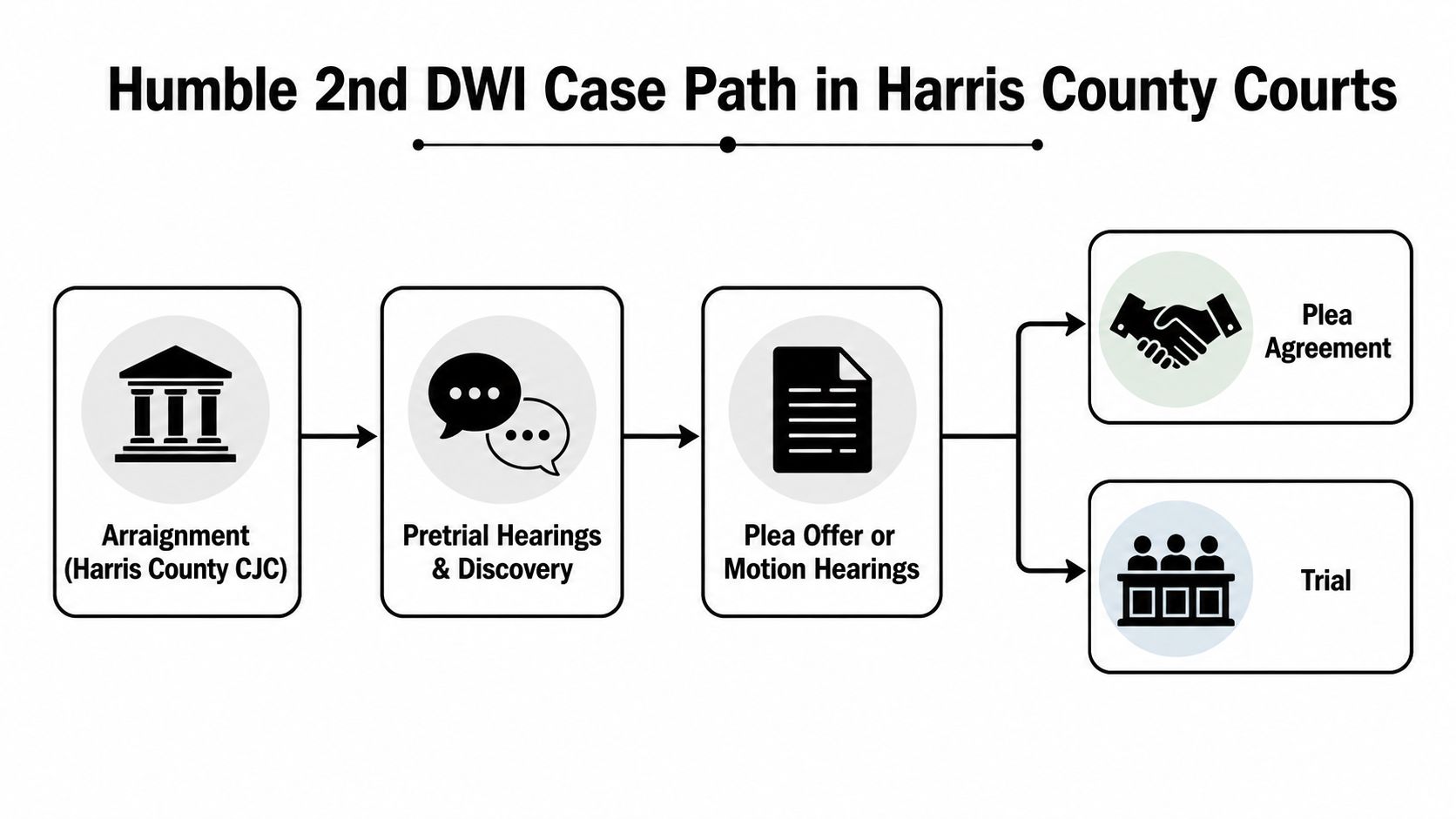
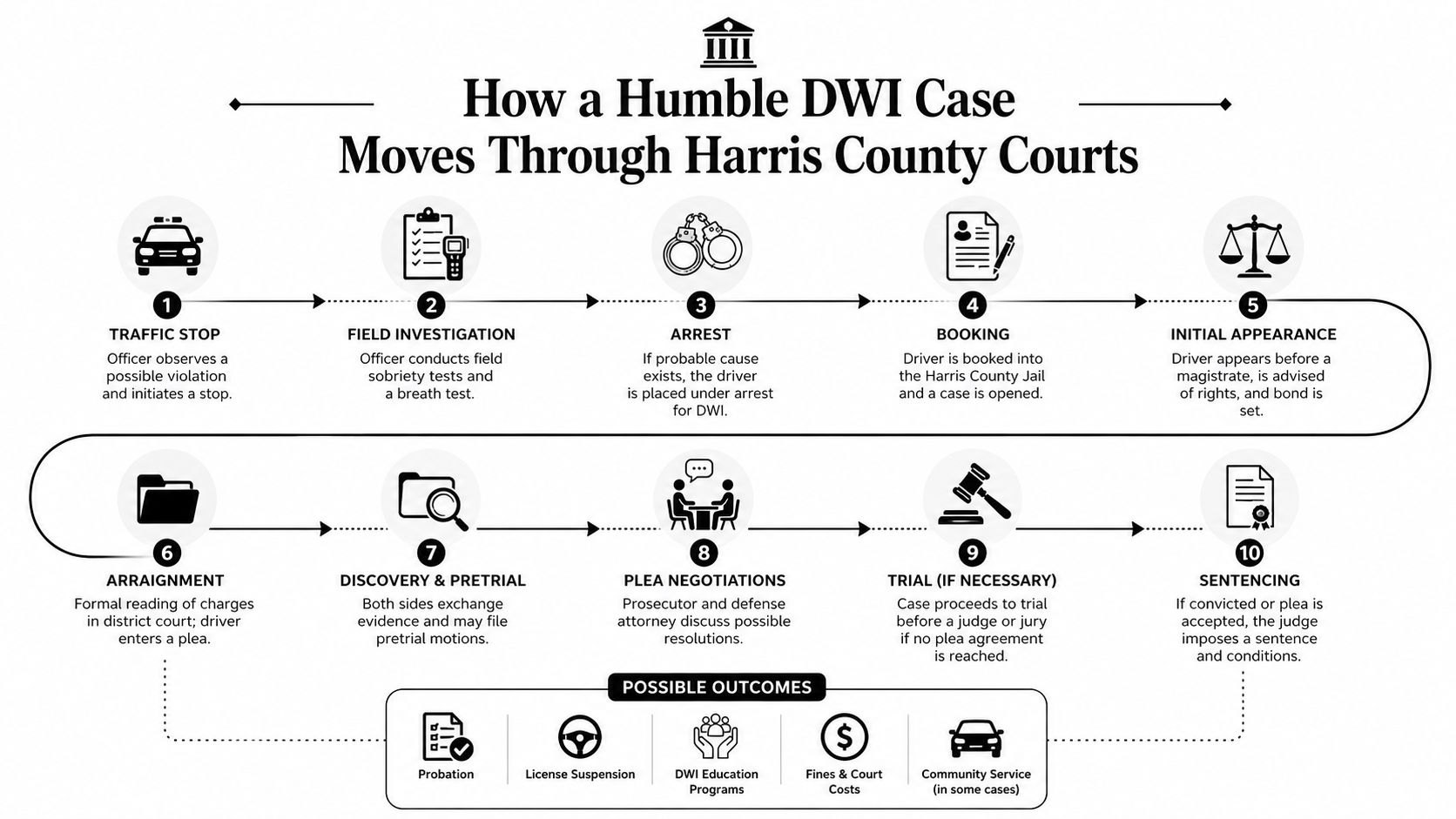
A DWI arrested by Humble police typically enters the Harris County criminal court system rather than ending in a city municipal courtroom. A standard second DWI is a county-level misdemeanor, so the case generally proceeds through a County Criminal Court at Law in Houston. A felony allegation or additional enhancement can change that path.
The first court appearance
Arraignment usually occurs after release, often within days, but the exact timing depends on custody status, charging paperwork, and docket availability. The judge addresses the charge, bond status, and conditions. Your lawyer can help ensure that you understand whether an IID, reporting condition, travel restriction, or other requirement applies.
The first appearance isn't the time to tell your story to the judge or negotiate directly with the prosecutor. Your attorney's role is to protect the record and begin obtaining the materials needed for a meaningful defense.
Pretrial settings and evidence review
The first pretrial setting may occur weeks after arraignment, depending on the Harris County docket. You may not need to speak at length. Often, the defense lawyer checks the case status, confirms discovery requests, discusses pending evidence, and addresses scheduling.
Discovery may include the offense report, body-camera footage, dash-camera footage, field-sobriety documentation, breath records, blood records when applicable, and information about the prior conviction. Counsel may then evaluate motions involving the traffic stop, detention, arrest, questioning, or scientific testing.
Negotiation or trial
Many cases resolve through negotiations, but you shouldn't accept an offer before the evidence is tested. A defense lawyer may discuss a plea agreement, request motion hearings, or prepare for trial. Each route has consequences for jail, community supervision, interlock requirements, fines, and your future record.
The right question isn't “Can this end quickly?” It's “What does this resolution require, and what evidence supports it?”
If the case involves prior felony allegations or other factors that increase the severity of the charge, it may move to felony court and take substantially longer. Your lawyer should confirm the court, cause number, charge level, and next setting rather than relying on an informal jail conversation.
Common Defenses and Mitigation Strategies
A second DWI defense should be evidence-driven. The strongest strategy may challenge the State's proof, reduce the impact of damaging evidence, or present concrete information that supports a manageable resolution. Promises to “do better” aren't enough by themselves.
Defense compared with mitigation
A defense attacks whether the State can prove the charge. Mitigation accepts the seriousness of the allegation while showing facts that may influence negotiations or sentencing. They serve different purposes.
| Strategy | Typical Strength | What Counsel Must Show |
|---|---|---|
| Stop challenge | Strong when the officer lacked reasonable suspicion or another lawful basis | Video, dispatch records, officer testimony, and the specific reason for the stop |
| Miranda issue | Useful when officers obtained statements after custodial questioning without proper warnings | The timing of custody, questioning, warnings, and the exact statements |
| Field-sobriety challenge | More persuasive when conditions affected performance | Medical limitations, uneven pavement, weather, lighting, instructions, and video |
| Breath-test review | Depends on technical documentation | Machine records, operator qualifications, testing procedure, and surrounding observations |
| Blood-test challenge | Can matter when handling or laboratory proof is incomplete | Chain of custody, collection records, storage, and laboratory documentation |
| Early counseling or evaluation | Mitigation, not a defense to the charge | Completion records, professional recommendations, and consistent follow-through |
| Employment and record evidence | May support a practical resolution | Stable employment documentation, family responsibilities, and a clean pre-arrest record |
A lawyer should review whether the traffic stop was lawful, whether the officer properly conducted field tests, and whether the chemical evidence is admissible and reliable. Medical conditions, uneven pavement, cold weather, anxiety, and poor instructions can affect how field-sobriety evidence should be interpreted.
Concrete mitigation matters
Early enrollment in counseling or a substance-use-disorder evaluation can show action rather than promises. Stable employment records and a clean pre-arrest record may help counsel argue for probation terms that preserve work and family responsibilities. That doesn't erase the charge, and it doesn't guarantee a particular result.
For information about one Texas DWI disposition, review the deferred adjudication information for Texas DWI cases, but understand that eligibility and available outcomes depend on the charge and current law. Don't assume a first-offense option carries over to a second offense.
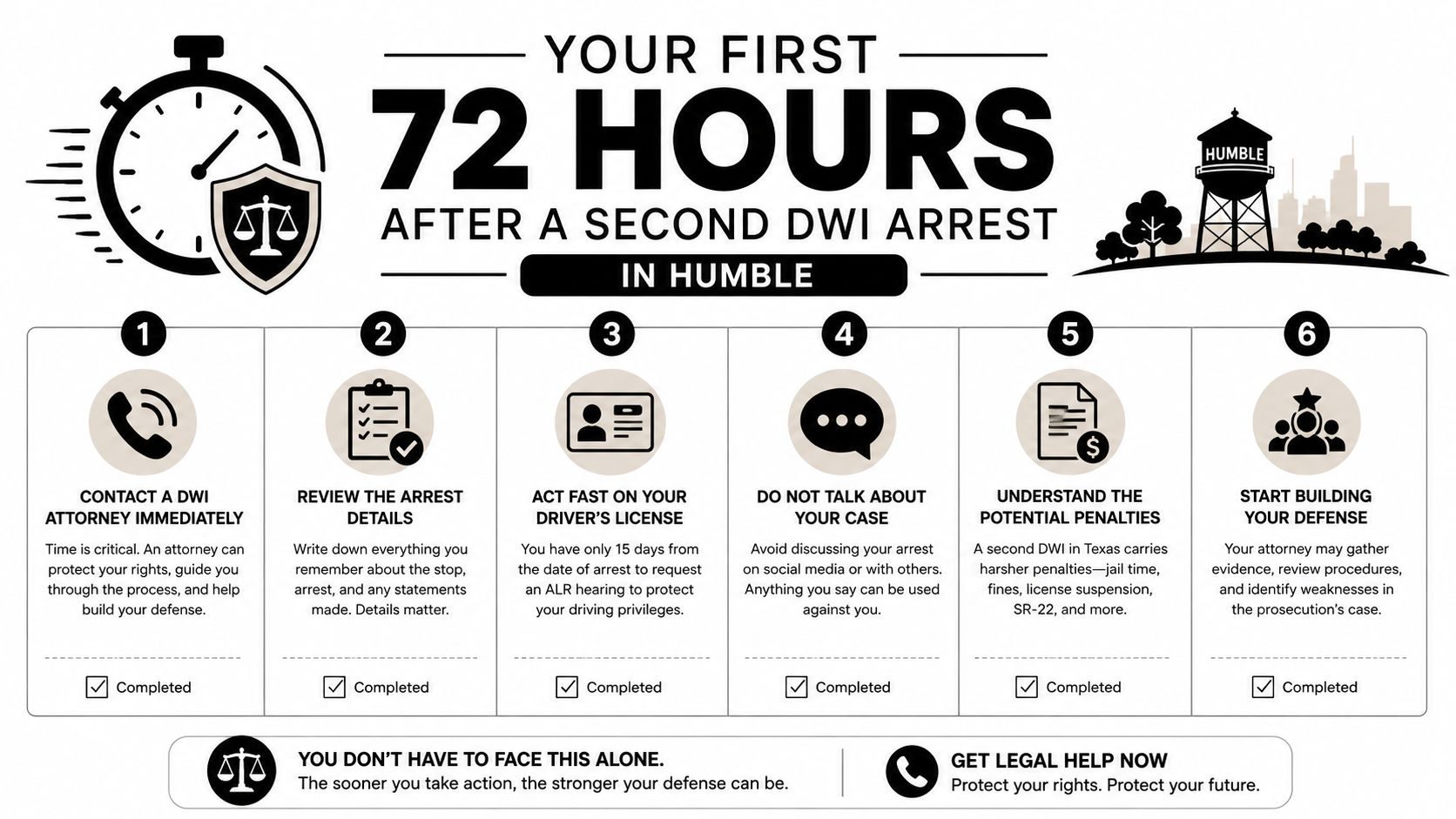
Your First 72 Hours After a Second DWI Arrest in Humble
The first three days after release set the direction for your case. Stay quiet, meet deadlines, and preserve documents. Do not try to explain the arrest to everyone around you. Your immediate job is to avoid new violations and give your lawyer accurate information.
Day 1
Make three calls. Contact a Humble DWI attorney, ask a trusted family member to help coordinate bond obligations, and decide whether your employer needs limited information about your absence or transportation problem. You do not need to disclose the facts of the case at work. Do not discuss it with coworkers.
Collect every document from the arrest and release:
- Criminal complaint: Keep the charging document and any probable-cause materials.
- Bond paperwork: Identify each condition, including interlock, reporting, travel, and court dates.
- Driving documents: Preserve the temporary driving receipt, notice, and information about any administrative suspension.
- Prior case information: Locate prior DWI cause numbers and Texas DPS records so counsel can verify what the State alleges.
Write down what you remember while the details remain fresh. Include the stop location, the officer's statements, requested tests, and what happened at the station. Do not guess or fill gaps. Mark uncertain details as uncertain.
Day 2
Confirm the ALR deadline. The 15-day hearing-request period matters because missing it can forfeit your opportunity to challenge the administrative suspension. Give your lawyer every page you received, especially documents with dates or signatures.
Avoid driving unless counsel confirms that you are legally permitted to do so. Do not post about the arrest, alcohol, the stop, or court on social media. Do not contact the prosecutor or arresting officer yourself.
Day 3
Create one calendar for the ALR deadline, court date, IID appointments, lawyer meetings, and bond requirements. Ask counsel which documents remain missing and whether an occupational-license filing fits your situation. Keep copies in a secure folder. A text message or memory is not a reliable system for legal deadlines.
Use these first 72 hours to prepare, not to argue your case online or explain it informally. In Harris County, the administrative license matter and criminal case can create separate obligations, so give counsel the complete paperwork early.
How a Humble DWI Attorney Protects Your Case
A local defense lawyer should do more than stand beside you at a plea setting. The attorney should manage the administrative deadline, investigate the criminal evidence, explain every condition, and give you a realistic assessment of risk.
Before the first Harris County setting
The first priority is the license case. Counsel should determine whether the ALR hearing can still be requested, submit the request within the deadline, and prepare to examine the officer and administrative evidence. This step matters even though the ALR case is separate from the criminal prosecution.
The criminal investigation should begin at the same time. Your attorney can request the body-camera and dash-camera recordings, review the offense report, examine breath or blood documentation, verify the alleged prior conviction, and identify inconsistencies between reports and video.
During the criminal case
In County Criminal Court at Law, counsel can evaluate motions to suppress evidence involving the stop, detention, arrest, statements, or testing. A motion to suppress asks the court to exclude evidence obtained in violation of the law. It doesn't guarantee dismissal, but it can change the evidence available to the prosecution.
Negotiations should be based on evidence and concrete mitigation. Counseling records, a substance-use-disorder evaluation, employment documentation, and proof of compliance may help counsel argue for probation or more manageable conditions. The defense may also address whether an interlock-only driving arrangement, reduced financial obligations, or a jail structure that protects employment is legally and practically available.
You should also understand the financial arrangement with your lawyer before representation begins. Ask what work is included, what court appearances are covered, which expenses are separate, and how the firm communicates deadlines. A focused resource on technology and legal practice is Recepta.ai for law firms, which may help readers understand how legal offices use specialized tools, but technology doesn't replace attorney judgment or client communication.
For local criminal-defense information, review the DWI lawyer services for Humble residents and bring your paperwork to the consultation. The Law Office of Bryan Fagan serves residents across Humble, Atascocita, Kingwood, and Northeast Houston in criminal defense and other legal matters. The attorney you choose should explain what happens next without making promises no lawyer can responsibly guarantee.
You don't need to predict the outcome today. You need to protect the deadline, preserve the evidence, and make the next decision with complete information.
The Law Office of Bryan Fagan offers free consultations for Humble residents facing a second DWI, including help with ALR deadlines, bond conditions, ignition interlock issues, and Harris County criminal-court strategy. Schedule a confidential consultation and bring your arrest, bond, driving, and prior-case paperwork so the office can help you identify your next practical step.