Skip to content

A Texas judge can grant a Temporary Restraining Order the same day you file in a true emergency, and that order can protect your child for up to 14 days. If your child is in immediate danger in Humble, Atascocita, Kingwood, or anywhere in Northeast Houston, speed is possible, but only if you move fast and bring the court specific sworn facts.
If you're reading this because your child just came back with injuries, the other parent is making threats, or you believe someone may disappear with your child, you do not need a lecture. You need a clear answer and a practical plan.
The short answer to how fast can a judge grant emergency custody in Texas is this: very fast when the facts are serious enough and the paperwork is done correctly. Texas courts can act quickly to stabilize a dangerous situation, but they won't do it based on fear alone. They need sworn evidence, a clear legal request, and facts that show the child faces an urgent safety risk.
Parents in Harris County often assume they have to wait weeks for a hearing before anything happens. That's usually wrong in a real emergency. The court has tools for immediate intervention. The problem is that many worried parents either wait too long or file without enough detail.
A Parent's Most Urgent Question
Friday afternoon in Humble. School is out, your phone rings, and your child is crying, refusing to go back to the other parent's home. In Kingwood, a parent finds out the other household may be using drugs around the child. In Atascocita, a grandparent hears someone may leave with the child before Monday.
That is when the legal question gets very simple. How fast can a judge in Harris County step in?
The answer is often faster than parents expect, but not because the court treats every custody dispute like an emergency. Harris County judges move quickly when the facts show immediate danger and the paperwork gives them a clear reason to act that day. Parents in Humble, Kingwood, and Atascocita often get this wrong in one of two ways. They either assume they must wait weeks for a hearing, or they rush into court with a story that feels urgent but is not specific enough to support emergency relief.
Both mistakes cost time.
What worried parents need to know right away
If your child faces a real safety threat, a judge can act very quickly. The first goal is short-term protection. The court wants sworn facts, clear dates, and concrete details showing why waiting would put the child at risk.
That means your focus should be evidence, not arguments with the other parent.
Save the texts. Photograph the injuries. Get the discharge papers. Write down what the child said, when it was said, and who heard it. If police were called in Harris County or a report was made to CPS, get that information together immediately. A calm, specific timeline carries far more weight than a panicked accusation.
Why Harris County parents often lose time at the start
The practical problem in Harris County is not usually whether a judge has the power to help. The problem is that local parents often underestimate how exact the court expects them to be, especially at the emergency stage. Saying "I do not feel safe sending my child back" is not enough by itself. Saying "the other parent was intoxicated during pickup on Thursday, drove away with the child, and HPD responded" gives the court something it can act on.
I see another local problem all the time. Parents in Northeast Harris County spend hours calling relatives, texting the other parent, or waiting for Monday because they assume nothing can happen before a regular hearing date. In a true emergency, that delay is a bad choice. If the facts support immediate action, treat it like an emergency from the start and prepare your proof for a Harris County judge, not for a family argument.
Be honest with yourself, too. Courts act on danger, not frustration. If the problem is rude messages, late exchanges, or ordinary co-parenting conflict, call it what it is. If the problem is violence, serious neglect, drug use around the child, abandonment, or a real threat that the child will be hidden or taken, act now.
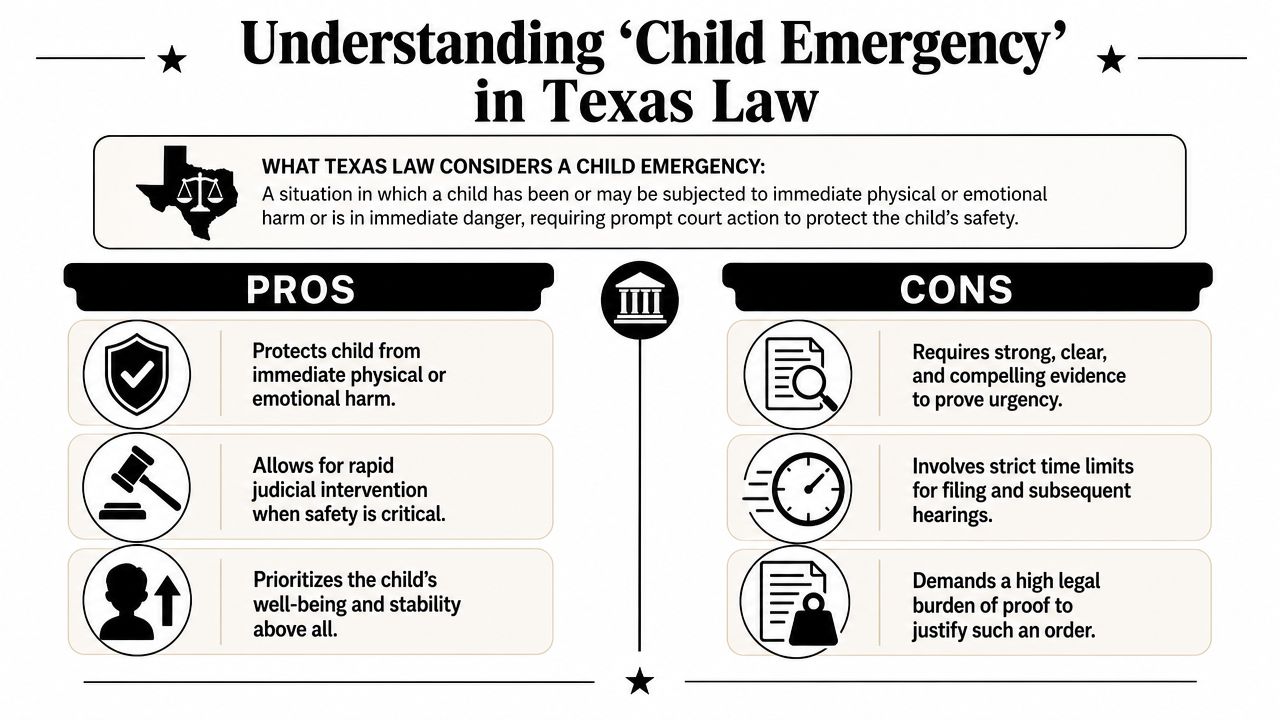
What Texas Law Considers a Child Emergency
A true emergency means the child faces an immediate threat of harm or a serious risk that waiting would make things worse. Texas courts don't use emergency orders to punish bad behavior, settle grudges, or referee every ugly exchange between parents.
They use them to protect children.
Situations that usually support emergency action
Judges are looking for facts that show urgent danger. That often includes situations like these:
- Family violence: credible threats, assaults, or violent conduct in the child's presence
- Serious neglect: leaving a child without proper supervision, food, medical care, or safe shelter
- Active substance abuse around the child: intoxication that puts the child's physical safety at risk
- Threats to flee with the child: statements or actions showing someone may hide or remove the child
- Unsafe living conditions: conditions that expose the child to immediate physical danger
The common thread is urgency. The court needs a reason to act now, not later.
Situations that usually do not qualify by themselves
Some problems are real, upsetting, and worth addressing, but they usually don't justify emergency relief on their own:
| Concern | Usually an emergency? | Better fit |
|---|---|---|
| Different parenting styles | No | Standard custody case |
| Late pickups or schedule drama | No | Enforcement or modification |
| A new boyfriend or girlfriend | No, unless there's a safety threat | Regular custody litigation |
| Harsh communication between parents | No | Co-parenting orders or mediation |
| Messy house without immediate danger | Usually no | Fact-specific custody review |
A lot of parents get tripped up here. Bad judgment isn't automatically an emergency. Unsafe conduct is.
What judges want from you
Judges in Harris County don't want conclusions. They want facts.
Instead of saying, “My ex is unstable,” say what happened. Did the child report being left alone? Did the other parent drive after drinking? Did someone threaten to take the child and disappear? Did police respond? Did a teacher, doctor, or neighbor witness something important?
Courts move fastest when a parent gives dates, names, texts, photos, medical records, and a sworn account that explains why the child can't safely wait.
If you're unsure whether your facts rise to the level of emergency custody, don't guess. Have a family law attorney evaluate them quickly. Calling everything an emergency weakens your credibility. Calling a real emergency “just a custody issue” can leave a child exposed.
The Fastest Legal Action A Temporary Restraining Order
If your child is with the other parent tonight and you believe something dangerous is happening, the fastest tool Texas family courts can use is a Temporary Restraining Order, or TRO. In Harris County, that can be the difference between waiting in fear and getting a judge to step in fast enough to stabilize the situation.
A TRO is short-term relief. It does not decide final custody. It gives the court a way to put immediate limits in place until a full temporary-orders hearing can happen.
For a plain-English explanation of how this order works, see what a temporary restraining order is in a Texas custody case.
Why the TRO moves faster than anything else
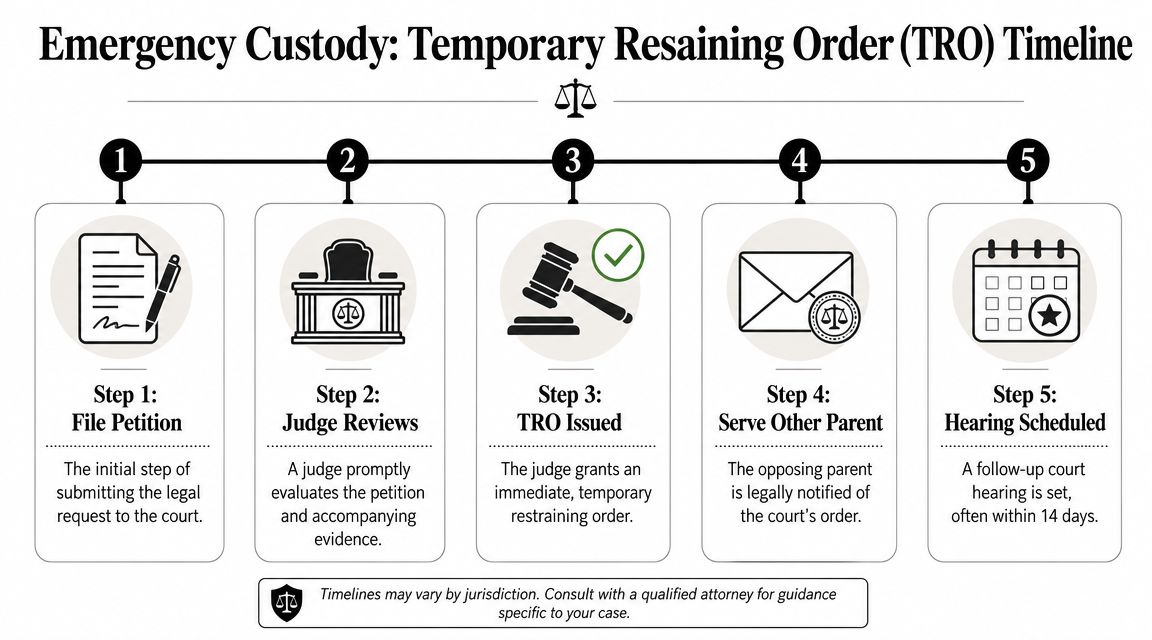
Texas family courts can review emergency requests very quickly because the point of a TRO is immediate protection. In real Harris County practice, a judge may review the request the same day it is filed if the paperwork is prepared correctly, filed early enough, and clearly shows a present danger to the child.
That said, parents in Humble, Kingwood, and Atascocita need to hear the hard truth. Speed depends on preparation. Judges do not grant emergency relief because a parent is scared, angry, or frustrated. They grant it because sworn facts show the child cannot safely wait for the ordinary court schedule.
A TRO usually lasts only until the short follow-up setting, often for a matter of days, not weeks of open-ended relief. That is why your first filing has to be sharp, specific, and credible.
What you actually have to file
Parents often assume they can call the courthouse, explain the danger, and get emergency custody. That is not how it works.
You need a proper filing. Depending on your situation, that usually means an original SAPCR or a petition to modify existing orders, plus a request for emergency temporary relief. The document that carries the most weight is usually your sworn affidavit or verified pleading.
That affidavit should answer five questions clearly:
- What happened
- When and where it happened
- Who witnessed it
- Why the child is in danger if the court waits
- What immediate order you want the judge to sign
In Harris County, weak affidavits get ignored fast. A weak affidavit says the other parent is “crazy,” “unstable,” or “unsafe” without facts. A strong affidavit gives dates, names, screenshots, police response details, medical information, or school concerns and ties those facts directly to the child's immediate safety.
What the judge looks at before the other parent responds
A judge can review an emergency TRO request ex parte, which means the court may consider your sworn papers before the other parent is present. That procedure exists for one reason. Delay can put a child at risk.
From the bench, the questions are practical:
- Is there a present and specific threat to this child?
- Are the facts sworn, organized, and believable?
- Does the requested TRO match the danger being described?
- Does the court need to preserve the child's safety until both sides can be heard?
This video gives a useful overview of how urgent custody requests can unfold in Texas family court.
In Harris County, the parents who get emergency relief fastest are usually the ones who show the judge a clean, fact-driven affidavit and ask for narrow, immediate protection the court can justify.
Navigating The Harris County Emergency Custody Process
You may be sitting in a parking lot in Humble, trying to figure out whether you can get a judge to act today while your child is still exposed to the problem. In Harris County, speed depends less on the law itself and more on whether your paperwork is ready, your facts are specific, and your case gets in front of the right family court quickly.

What filing looks like in Harris County
For parents in Kingwood, Atascocita, and Humble, the practical reality is usually a trip into downtown Houston, where Harris County family matters are handled through the civil courthouse system on Fannin Street. Emergency requests do not move by magic. They move because someone prepares the petition, gets the sworn affidavit right, files it in the proper court, and pushes for prompt review by the court or associate judge handling emergency matters.
That local process matters. A parent with a real emergency can still lose time if the filing is incomplete, filed too late in the day, or missing the documents the court expects to see immediately. If you want a clearer picture of the local court structure, this guide to Harris County family court for Humble residents is a useful starting point.
What usually slows cases down downtown
Parents are often told, "file fast." That advice is too vague. In Harris County, the common delays are more specific:
- filing late enough in the day that same-day review becomes harder
- submitting an affidavit with conclusions instead of facts
- asking for orders broader than the emergency supports
- arriving without proposed orders ready for the judge to sign
- assuming the clerk or court coordinator will fix a rushed filing
I tell parents the same thing every time. Treat the first filing like it may be your only chance to make the danger clear in five minutes.
The court acts fast, but the case keeps moving
If a judge signs an emergency temporary restraining order, the court will set a follow-up hearing quickly. Under standard Texas procedure, that emergency relief is short-term, and the court must bring both sides back before long. In Harris County, that means you should start preparing for the next hearing the same day the order is signed, not a week later.
That is where many parents in Northeast Harris County get caught flat-footed. They spend all their energy getting the immediate order, then show up to the follow-up hearing with disorganized records, no witnesses lined up, and no clean timeline.
What Harris County parents should do right away
The better approach is disciplined and local. If you live in Humble, Kingwood, or Atascocita, assume you may need to move between home, school, work, and downtown court on short notice. Get organized early.
| Right move | Why it matters in Harris County |
|---|---|
| Save every new text, call log, and email | Judges want current proof, especially if the risk is ongoing |
| Keep school and medical contacts informed | Records from local schools, counselors, and doctors often become key exhibits fast |
| Follow every term of the TRO exactly | Family court judges notice quickly when one parent ignores orders |
| Prepare a simple date-by-date timeline | Associate judges and courts under time pressure respond well to organized facts |
| Arrange reliable childcare and transportation | Hearings, filing issues, and courthouse delays can eat up a full day downtown |
The blunt truth is simple. Harris County can move very fast on a real emergency, but only for the parent who comes prepared for how this courthouse works.
What to Expect at Your Emergency Hearing
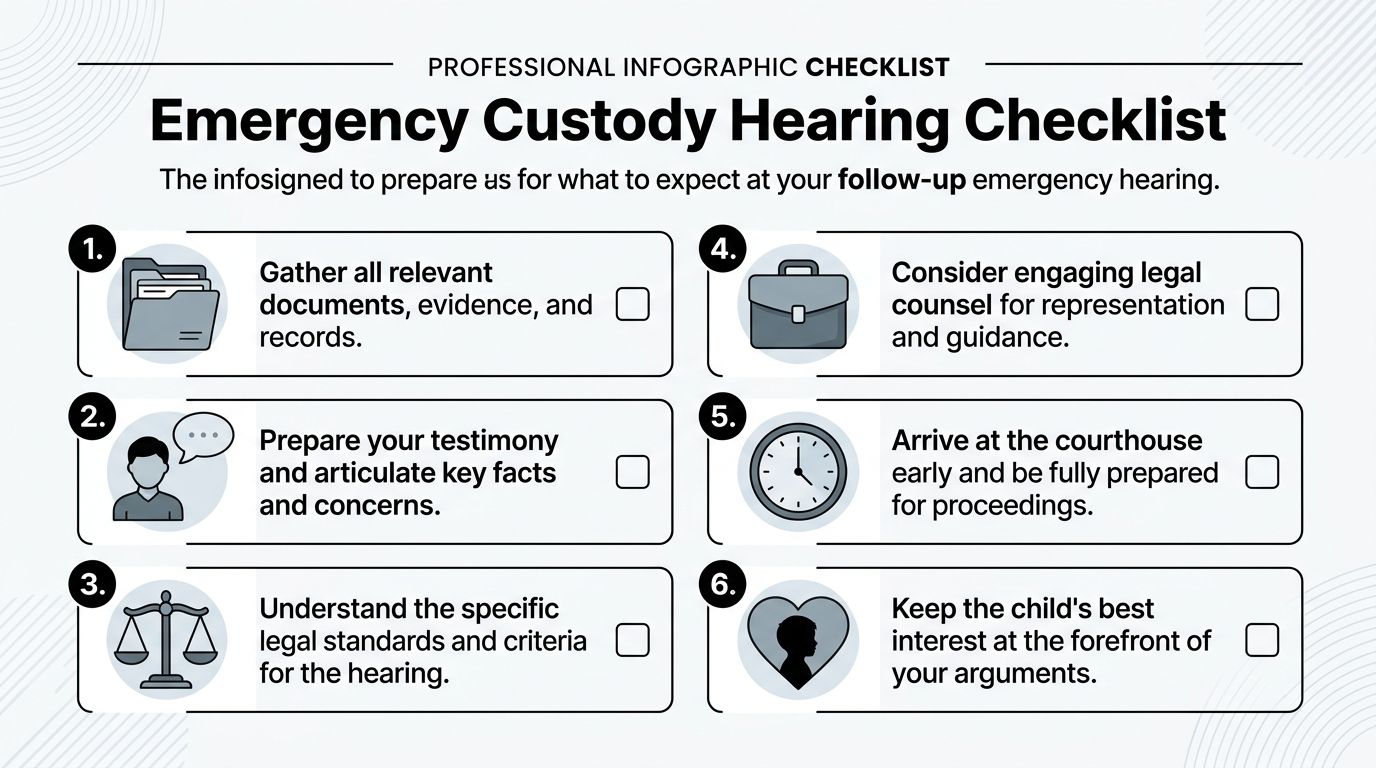
The follow-up hearing usually feels less dramatic than the emergency filing and more important than most parents expect. During this hearing, the judge hears both sides and decides what temporary arrangement should remain in place while the case continues.
What the courtroom is like
In Harris County family court, the setting is formal, but it isn't designed to trap you. The judge wants usable information. The lawyers speak. Witnesses testify. Documents matter. Credibility matters more.
Most parents are surprised by how focused the hearing is. Judges don't want long speeches about every problem in the relationship. They want to know what affects the child and what temporary orders are necessary now.
What evidence tends to help most
Bring proof that is concrete and easy to understand. Good evidence often includes:
- Texts and emails: especially threats, admissions, or plans to remove the child
- Photos: if they accurately show injuries or unsafe conditions
- Medical or school records: when they support your timeline
- Witness testimony: from people with firsthand knowledge
- Your testimony: clear, restrained, and focused on the child
What hurts you? Rambling. Guessing. Exaggerating. Talking more about your anger than your child's safety.
Speak to the judge as if you're explaining the situation to someone who wants to protect your child but wasn't there. Facts first. Drama never.
How to present yourself
You don't need to perform. You need to be credible.
A good hearing presentation usually looks like this:
- Start with the most urgent fact. Lead with the safety issue.
- Give the timeline. Keep it chronological.
- Tie each fact to the child. Show why it matters.
- Ask for practical relief. Be specific about possession, exchanges, or restrictions.
If you have legal counsel, your attorney should help narrow the story so the court hears the strongest points without clutter. One option for families seeking custody help in this area is the Law Office of Bryan Fagan, which handles family law matters for Humble-area residents and can assist with emergency filings, hearings, and temporary-orders strategy.
Your Immediate Action Plan to Protect Your Child
If your child may be in danger, don't wait for perfect clarity. Take controlled, smart action right now.
Do these things first
- Write a clean timeline: list what happened, who saw it, and when it happened.
- Save your evidence: screenshots, call logs, voicemails, school messages, medical documents, and photos.
- Protect the child without escalating conflict: keep communication brief and avoid inflammatory texts.
- Secure basic records: birth certificate, school records, insurance information, and any existing court orders.
Avoid these mistakes
- Don't coach your child: judges and professionals can spot rehearsed stories.
- Don't violate current orders casually: if you break an order without court approval, you may damage your case.
- Don't flood the court with irrelevant complaints: focus on danger, not personality conflicts.
- Don't argue your case on social media: it rarely helps and often hurts.
If there's immediate physical danger, call law enforcement first. If the danger is urgent but the issue belongs in family court, contact a lawyer immediately and start preparing sworn facts. The fastest cases are usually the best-prepared cases.
Frequently Asked Questions About Emergency Custody
What if I don't have police reports or photos?
You can still have a case. Police reports and photos help, but they aren't the only proof that matters. Judges can consider sworn testimony, text messages, emails, school communications, medical information, and witness statements.
What matters most is whether you can present a believable, specific account of urgent danger. If you don't have documents yet, start preserving what you do have today.
Can the other parent take the child before the judge signs the order?
That depends on your current orders and the facts on the ground. If there is no order restricting the other parent, legal options can be limited until the court acts. That's one reason emergency filings need to happen fast when there's a real risk of flight or harm.
If you're worried the other parent may disappear with the child, tell your lawyer immediately and include every fact that supports that concern. Threats, packed bags, withdrawn funds, sudden school withdrawal, or messages about leaving can all matter qualitatively.
How much does it cost to file for emergency custody?
Costs vary based on the case, whether you already have an existing order, filing requirements, service issues, and whether the matter turns into a contested hearing. I won't guess at a number, and you shouldn't trust anyone who casually throws one out without knowing your facts.
Ask for a clear breakdown of likely court costs, service fees, and attorney fees before filing. In an emergency, speed matters, but so does understanding the process you're stepping into.
Do I need a lawyer, or can I file this myself?
You can file on your own, but emergency custody is not a good place to learn by trial and error. The timeline is tight. The legal standard is high. The paperwork needs to be precise.
If you file without enough sworn detail, you may lose valuable time. If you ask for relief the court can't grant based on your evidence, you can weaken your position before the hearing even starts.
You Are Not Alone We Are Here to Help
When a child is at risk, time matters. Texas courts can act quickly in a true emergency, and the first step is often a TRO that gives immediate short-term protection. But speed only helps when the facts are presented clearly and the case is handled with urgency.
Parents in Humble, Atascocita, Kingwood, and across Northeast Houston don't need abstract answers. They need a plan that fits the local court process and the facts of their family. If you're facing a child-safety emergency, you need to move now, document carefully, and prepare for the hearing that follows almost immediately.
If you need help with that process, learn more about working with an emergency child custody lawyer in Humble, TX. The right legal guidance can help you frame the facts correctly, file fast, and protect your child without creating avoidable mistakes.
If your child may be in danger, contact the Law Office of Bryan Fagan for a free, confidential consultation with our Humble office. We help families in Humble, Kingwood, Atascocita, and Northeast Houston take immediate legal action when custody problems become safety emergencies.