Skip to content

At 2:15 p.m., your phone rings. The school says your child is upset and does not want to leave with the other parent. An hour later, a relative sends photos from a home in Humble that show drugs within reach of a toddler. By evening, you are not asking a general custody question. You are asking whether you can get a judge to act before more harm happens.
That is the point where parents need clear advice, not panic. I have handled emergency custody matters for families in Humble, Atascocita, Kingwood, and the greater Harris County area, and the first issue is usually the same. Is this serious enough for immediate court action, or do you risk filing too early with too little proof?
Texas courts can issue emergency relief in the right case, but judges do not grant it just because a parent is frightened or angry. They look for specific facts showing a child faces an immediate risk of harm, and they expect those facts to be presented fast and in a form the court can act on. In Harris County, speed matters, but so does accuracy. A rushed filing with weak details can create problems that are hard to fix later.
This guide focuses on what Humble parents need to know before the next school pickup, exchange, or overnight visit. It explains how local emergency custody cases are handled, what evidence helps, and what steps protect your child without putting your case at risk.
Your Child's Safety is Everything A Humble Parent's First Thoughts
A Humble parent usually calls my office after the fear has already set in. The child missed a pickup. A school staff member says something felt off at dismissal. A teenager sends a text from Atascocita or Kingwood saying they do not want to go back to the other house. At that point, the legal question is tied to a much more immediate one. What protects your child tonight?
The first hours matter because parents often make understandable mistakes under pressure. They drive to the other parent's home and create a confrontation. They send angry texts that later distract from the safety issue. They wait too long because they are afraid a judge will think they are overreacting. In Harris County emergency custody work, timing matters, but so does judgment.

What parents usually know before they know the law
Parents usually see the problem before they know how to describe it in court. A younger child may come home withdrawn, hungry, or unusually scared. An older child may report drug use in the home, violence between adults, or threats about being taken out of town. Sometimes there is one obvious event. Often it is a pattern that has been building for weeks.
In this part of Harris County, I also see complicated family arrangements that generic custody articles ignore. A child may split time between a parent, a grandparent in Humble, and a stepparent in Kingwood. One household may be stable while another has a new boyfriend, a relapse, or repeated police calls. Those details matter because the court needs a clear picture of who is around the child, who is making decisions, and where the immediate risk is coming from.
Parents often ask whether they need an emergency custody case, a protective order, or a temporary restraining order in a Texas child custody case. The answer depends on the facts. The wrong filing can slow things down. The right one can put the safety issue in front of a judge quickly and in the proper form.
Local pressure in Harris County changes early decisions
Harris County family courts handle a heavy volume of urgent matters, and judges expect emergency requests to be specific. General statements like "I am worried" or "the home is unsafe" are not enough by themselves. Dates, locations, photos, school messages, medical records, and sworn facts carry weight.
That is why local practice matters. A lawyer who regularly handles emergency child custody cases in Humble knows the difference between a case that needs immediate court action and one that needs fast evidence gathering first. That judgment can protect your child and avoid a weak filing that gives the other side an opening.
Family violence issues also overlap with custody more often than parents expect. If there is a need to ask about protective order help, the Harris County District Attorney's Family Violence Unit can be reached at (713) 274-0212. In many homes, the custody problem and the violence problem are part of the same set of facts, and they need to be addressed together from the start.
Recognizing a True Emergency What Qualifies for Immediate Action
Not every custody dispute is an emergency. Many are serious, painful, and urgent to a parent, but they don't all justify immediate ex parte court action. Texas courts look for imminent harm and immediate danger to the child.
What courts usually treat as an emergency
A true emergency often involves facts like these:
- Physical abuse or credible threats of violence that place the child at immediate risk.
- Sexual abuse allegations or conduct that requires immediate separation while the court investigates.
- Substance use that creates direct danger, such as driving with the child while impaired or caring for the child in a condition that puts the child at risk.
- Severe neglect, including unsafe living conditions, abandonment, or failure to provide necessary care.
- Threats to hide or remove the child in a way that would defeat the court's ability to protect the child.
- Family violence concerns that directly affect the child's safety. Texas Family Code §153.004 is especially important in these cases.
A parent being rude, late, manipulative, or difficult usually isn't enough by itself. Courts hear those complaints often. Emergency relief is reserved for situations where waiting for a standard hearing could expose the child to serious harm.
Emergency order versus ordinary custody modification
An emergency request is different from a regular modification case. A standard modification asks the court to change an existing custody arrangement because circumstances have changed and a new order would serve the child's best interest. That process can still move quickly, but it isn't built for immediate danger.
An emergency filing asks the court to act first to stabilize the situation.
If you need a quick overview of how temporary restraints work in a Texas family case, this guide on what a temporary restraining order means in custody matters is a useful starting point.
A good emergency case doesn't just say the other parent is unsafe. It shows the judge why the child can't safely wait for the normal timeline.
Hard situations that don't always meet the threshold
Parents are often surprised by what may not qualify on its own:
| Situation | Usually emergency level |
|---|---|
| Missed exchanges | Usually no, unless tied to concealment or danger |
| Harsh co-parenting messages | Usually no |
| A new boyfriend or girlfriend you dislike | Usually no |
| Parenting style disagreements | Usually no |
| Documented abuse, dangerous drug use, or threats to flee with the child | Often yes |
That distinction matters in Humble and Northeast Houston because filing the wrong kind of case wastes time when your child may need focused protection. It also affects credibility. Judges want measured parents who understand the difference between conflict and danger.
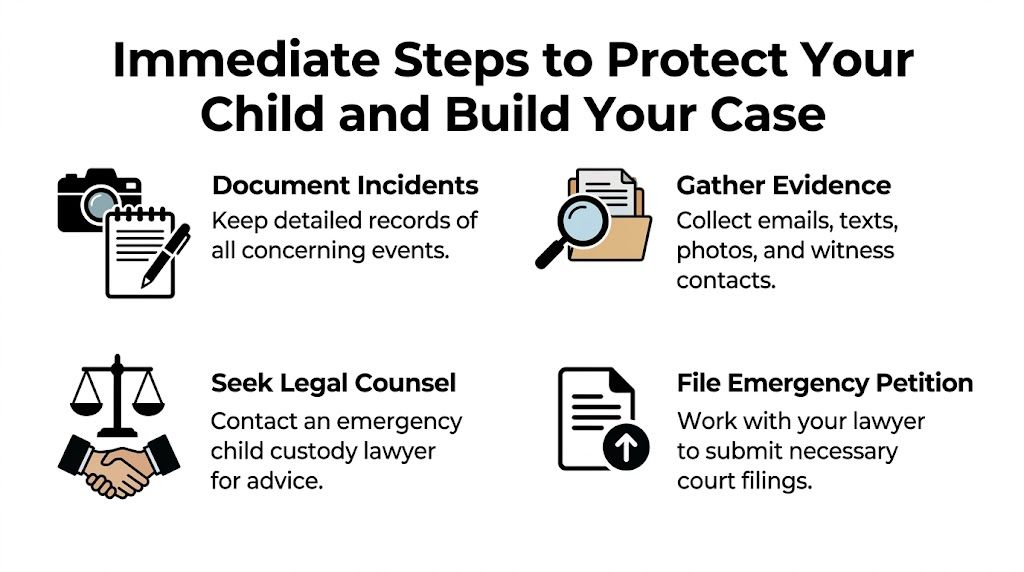
Immediate Steps to Protect Your Child and Build Your Case
If your child is in danger, your first job is safety. Your second job is proof.
The court can't act on fear alone. It acts on sworn facts and evidence that show why immediate intervention is necessary. In Texas emergency custody proceedings, the process begins with an affidavit describing the danger, supported by materials such as medical records, texts, emails, and witness statements. The filing must show imminent harm to support an ex parte emergency order, as discussed in this overview of Texas emergency custody filing requirements.
Secure immediate safety first
If there's active violence, a threat to take the child, or a dangerous confrontation, call law enforcement. If abuse or neglect is involved, a report to CPS may also become part of the record. Keep your focus narrow. Protect the child, avoid escalation, and avoid saying more than necessary in anger.
If domestic violence is part of what's happening, practical support matters as much as legal support. Families in crisis can use these crisis lines for immediate assistance when they need immediate safety planning and support outside business hours.
Some parents make the mistake of confronting the other parent in person to “get answers.” That often backfires. It can trigger a police call, create a hostile text trail, or give the other side a chance to claim you're the unstable one.
Start documenting like your hearing is tomorrow
In emergency custody cases, details matter more than general claims. Begin a clean record immediately.
- Write a timeline: Note dates, times, locations, who was present, and exactly what happened.
- Save digital communications: Preserve texts, emails, call logs, voicemail, and social media messages.
- Photograph conditions: If the child has injuries or the environment is unsafe, photograph what you lawfully can.
- Collect third-party records: Medical paperwork, school reports, police incident numbers, and discharge papers can anchor your claims.
- Identify witnesses: Write down full names, contact information, and what each person personally observed.
- Track exchanges and missed visits: Use a phone note, calendar, or parenting app to keep entries organized and time-stamped.
Texas courts place real weight on documentation. Parents who keep daily records of communications, visitations, exchanges, and major decisions are in a much stronger position than parents who rely on memory and verbal claims. If you're preparing for a hearing, this article on how to prepare for a custody hearing in Texas can help you organize what the judge is likely to focus on.
Don't edit screenshots. Don't crop out context. Save the full thread, the date, and the sender information.
What not to do while building your case
Some mistakes show up again and again in urgent cases:
- Don't coach your child: Judges and investigators notice when a child's language sounds rehearsed.
- Don't destroy context: Deleting your own angry replies can make you look selective or misleading.
- Don't rely on informal promises: If the other parent says, “I won't do it again,” that isn't a court order.
- Don't assume CPS will sort it out for you: CPS and family court overlap, but they aren't the same process.
- Don't wait for one more incident: When the danger is already clear, delay can weaken both safety and strategy.
One practical option among others is working directly with a local family law office that handles Humble custody matters, such as the Law Office of Bryan Fagan Humble child custody team, to turn raw facts into a filing the court can act on quickly.
Navigating the Harris County Legal Process for an Emergency Order
It is 3:45 p.m. on a weekday in Humble. A parent has just learned the other parent is intoxicated with the child, threatening to leave the area, or refusing to return the child after school. At that point, the question is not whether the situation feels urgent. The question is whether the facts support emergency relief a Harris County judge can sign today or by the next court setting.

The filing stage and the first order
In Harris County, an emergency request usually starts with four pieces: an original petition or modification, an application for temporary restraining order, a proposed order, and a sworn affidavit with specific facts. General accusations do not carry these hearings. Judges want dates, locations, what happened, who saw it, and why waiting for regular notice would put the child at immediate risk.
If the papers show a serious and immediate danger, the court can sign an ex parte emergency order without the other parent present first. That order is short-term. In Texas family cases, temporary restraining orders generally last up to 14 days unless the court extends them. The court then sets a prompt hearing so both sides can be heard.
Parents in Humble often file into the Harris County family district courts, and procedure matters more than people expect. Filing county, cause number history, and whether there is already an order from another court can change where and how the case gets heard. For a local overview tied to venue and custody procedure, see this guide on working with a Harris County custody lawyer serving Humble.
What the judge is looking for at the hearing
The next setting is usually the point where the court tests the emergency claim in real time. Judges listen for one central issue. Is there credible evidence of immediate risk to the child, and if so, what temporary arrangement protects the child with the least disruption necessary?
That second part matters. A judge may agree that the situation is dangerous and still choose a narrower remedy than the parent requested. I have seen courts order supervised possession, no overnight access, geographic restrictions, drug testing, or third-party exchange terms instead of fully cutting off contact. In Harris County, judges often look for a measured response that fits the risk.
The court also views the case through the child's best interest. That includes the child's physical safety, emotional needs, stability at home, each adult's judgment, and the practicality of the temporary plan. In blended families, informal caregivers, grandparents, and long-term partners may all be part of the factual picture, but the legal rights of each person are not the same. That is one reason these hearings can turn quickly on details that parents did not realize mattered.
A short explainer can help if you'd rather hear the process discussed out loud:
Compliance matters after the first order
Parents sometimes feel relief the moment an emergency order is signed. Relief is understandable. Precision is still required.
If the order says exchanges happen at a certain place, use that place. If it sets a return time, follow that time. If it bars school pickup, police contact outside emergencies, or direct communication except through a parenting app, treat those terms as binding from day one. A parent who ignores a temporary order because the other side "agreed" to something different can lose credibility fast.
Legal fees also tend to rise when emergency issues turn into contested temporary-orders litigation, multiple hearings, or disputes over enforcement. The cost usually depends on the amount of evidence, the number of witnesses, whether experts become necessary, and how hard the other side fights. No honest lawyer can promise a success rate in this kind of case, because emergency custody rulings depend on the facts, the proof available that day, and the judge's view of immediate risk.
If the judge signs a temporary order, follow it exactly. Don't “work something out” on the side and assume the court will approve later.
One more practical point. Harris County courts expect parents to focus on the child's safety, not to use emergency filings as punishment for a breakup, new relationship, or parenting style dispute. Judges see that difference quickly.
If the family stress has reached the point where children are struggling emotionally, some parents also benefit from outside support while the case is pending. This resource on helping children cope with divorce can be useful alongside the legal process.
After the Emergency Order Planning Your Next Steps
An emergency order is a shield. It isn't the final answer.
Once the immediate crisis is contained, the case shifts toward building a stable long-term plan. That may involve temporary orders with more detailed possession terms, a structured parenting plan, discovery, mediation, and eventually a final order. The work changes from proving immediate danger to proving what arrangement gives the child the safest and most stable future.
Building the case for longer-term stability
This stage is less dramatic, but it often decides the outcome. Parents need to show consistency in housing, school involvement, communication, and decision-making. The court watches for calm, not theatrics.
Useful case-building often includes:
- A workable parenting plan: Judges want specifics, not vague promises.
- Steady compliance: Following every temporary term builds credibility.
- Focused communication: Messages should stay child-centered and brief.
- Reliable records: Attendance, medical follow-up, and school information matter.
If divorce is part of the larger family situation, some parents also benefit from child-focused mental health guidance outside the courtroom. This resource on helping children cope with divorce can help parents think about emotional stability while the legal case moves forward.
Non-traditional families need a different strategy
Many online guides oversimplify emergency custody. They assume one biological parent is trying to take custody from the other and leave it there. That misses real situations in Humble, Atascocita, Kingwood, and Northeast Houston.
A significant gap in common legal guides is the failure to address non-traditional family structures, including grandparents seeking emergency custody or families trying to move from an existing joint custody arrangement to sole control because of a sudden mental health crisis or substance abuse concern, as noted in this discussion of Houston-area custody issues affecting diverse families.
Those cases often need a different presentation. A grandparent may need to explain standing. A parent in a joint conservatorship arrangement may need to show why the old order is no longer safe. A family dealing with sudden incapacity may need coordinated action across custody, medical, and practical caregiving issues.
Courts don't award long-term stability to the parent with the most anger. They usually favor the adult with the clearest plan, the best records, and the strongest proof of safe day-to-day parenting.
Mediation and final orders
Not every emergency case ends in a trial. Some move into negotiation or mediation once the child is safe and the facts are on the table. That's often productive when both sides understand the court is already watching closely.
But settlement only works if the terms are specific and enforceable. Parents get into trouble when they leave key points vague, especially around exchange logistics, school decisions, therapy, supervised visitation, and communication rules.
Frequently Asked Questions About Emergency Custody in Humble
How much does an emergency custody case cost in the Humble area
The honest answer is that cost depends on how fast the case must be filed, whether the other parent contests the request, and how much evidence has to be prepared on short notice. A same-day or next-day emergency filing in Harris County usually takes concentrated attorney time at the front end, and the cost rises if the case turns into multiple hearings, contested temporary orders, drug testing disputes, or witness testimony.
Ask direct questions before hiring counsel. Find out whether the lawyer charges a flat fee for the initial emergency filing, requires a retainer, bills separately for hearings, or expects added costs for service, records, and expert evaluations. Families often make better decisions when they understand the fee structure in writing from the start. For a general overview of how family-law fees are commonly billed in Texas, the State Bar of Texas lawyer referral and information service is a more reliable starting point than court administration pages.
Can parents just agree outside court after an emergency starts
Parents can work out short-term logistics, such as who picks the child up from school or where the child sleeps that night. That does not replace a signed court order.
If a judge has already entered emergency restrictions, follow them exactly until the court changes them. In Harris County, informal side agreements often create trouble later because each parent remembers the deal differently, and judges care about what is written, signed, and enforceable. A text message agreement may help explain what happened, but it usually does not protect a parent the way a filed order does.
What if I'm falsely accused of putting my child in danger
Do two things right away. Stay controlled, and get organized.
Save texts, emails, call logs, school records, medical records, and any photos that give context. Make a list of witnesses who have seen your parenting firsthand, including teachers, counselors, relatives, or neighbors who can speak to specific events instead of general opinions. Do not argue about the case on social media. Do not coach the child on what to say. In Humble cases, I often see parents hurt themselves more by reacting online or violating a temporary instruction than by the original accusation itself.
A false accusation can still lead to immediate court action if the judge believes there may be a present risk to the child. That is why the response has to be fast, factual, and disciplined.
If your child may be in immediate danger, don't try to sort it out alone. The Law Office of Bryan Fagan helps families in Humble, Atascocita, Kingwood, and Northeast Houston respond to urgent custody crises with clear legal action and steady guidance. Schedule a free consultation with our Humble office to talk through the facts, protect your child, and take the next step with confidence.