Skip to content

You built something in Humble, Atascocita, Kingwood, or Northeast Houston that feeds your family, carries your name, and probably keeps you awake at night. Now your marriage is under strain, and the business is suddenly part of the divorce conversation. That’s where panic usually starts.
I’ll be blunt. If you own a small business and you’re facing divorce, you cannot treat the company like just another asset on a spreadsheet. Your business is a living operation. It has payroll, clients, vendors, taxes, and a reputation that can be damaged fast if you handle this the wrong way.
The good news is that Texas law gives you tools. Harris County procedure gives you opportunities. But only if you move early, stay organized, and stop making emotional decisions with business records, bank accounts, and ownership documents.
For anyone searching for real answers about divorce involving small business humble texas, start with this: the first fight is usually not over who “deserves” the business. The first fight is over what the business legally is, what it’s worth, and how to keep it operating while the divorce moves through the system.
Is Your Business Separate or Community Property in Texas
This is the question that drives everything else.
Think of your business like a garden. If you planted it before marriage, that garden may be yours. If you planted it during the marriage, Texas usually treats it as something the marriage built. If you started with your own garden before marriage but both spouses later watered it with shared money, shared labor, or shared debt, the lines get blurry fast.
Texas law starts with a presumption. Under Texas Family Code § 3.002, a business started during marriage is generally treated as community property and can be divided in a “just and right” way, even if only one spouse’s name is on the paperwork. A business claimed as separate property has to be proven with clear and convincing evidence under Texas Family Code § 3.001. If marital funds were mixed into it, that can put the separate property claim at risk, as discussed in this overview of Texas community property rules.

What separate property really means
A lot of business owners say, “I started it, so it’s mine.” That’s not enough.
If you owned the business before marriage, you may have a strong separate property argument. But you still need proof. Courts care about documents, not feelings. They want formation records, old tax returns, bank statements, operating agreements, ownership ledgers, and records showing where investment money came from.
Here’s where owners get hurt. They start with a separate business, then:
- Use marital income to fund operations: That creates tracing problems.
- Pay personal bills from the business account: That muddies the books.
- Add the spouse informally: Maybe not on paper, but through labor, management, or unpaid help.
- Fail to document loans or capital contributions: Courts don’t guess. They classify based on evidence.
Practical rule: If you can’t trace the money cleanly, you’ve handed the other side an argument.
What community property means for a business owner
If the business was formed during marriage, the court will generally start from the position that it belongs to the marital estate. That doesn’t automatically mean a simple half-and-half split of the company itself. It means the business interest is in the pool of property the court will divide.
That matters in real life. A machine shop in Northeast Houston, a contractor based in Humble, or a boutique service company in Kingwood can all become part of the property fight even if one spouse handled every customer and every invoice.
The mistake I see most often is delay. Owners wait until divorce papers are filed to gather records they should’ve preserved for years.
What to do right now
Start with a paper trail review. Pull the basics first:
- Formation documents for the LLC, corporation, or partnership.
- Tax returns for the business and for you personally.
- Bank records showing where startup and operating funds came from.
- Ownership records that show whether interests changed during marriage.
- Loan documents if family money, spouse money, or personal money went into the company.
If you’re also trying to understand the financial side effects beyond ownership classification, this outside guide on tax and property considerations during separation or divorce is a useful practical companion.
The spouse who keeps better records usually starts in the stronger position.
For small business owners in Humble, Atascocita, and Kingwood, this first classification issue often determines whether you’re negotiating from strength or from fear. Get that answer early.
How Courts Determine Your Humble Business's Value
Classification is only the first fight. Valuation is where the arguments usually turn expensive.
Most owners either undervalue their business because they’re exhausted, or overvalue it because they built it with sweat and sacrifice. Courts don’t use either of those standards. They use valuation methods.
In a Texas divorce, the business usually gets examined through one or more standard approaches. That often means accountants, financial records, and competing opinions. If your divorce includes a company in Humble or the surrounding Harris County area, expect the value question to influence settlement negotiations. This is the point where many people need a deeper look at Texas divorce property division issues.
The three valuation methods you need to understand
Here’s the plain-English version.
| Method | What it looks at | Common fit |
|---|---|---|
| Asset-based | What the business owns, minus what it owes | Companies with equipment, inventory, or hard assets |
| Market-based | What similar businesses sell for | Retail, hospitality, and some local service businesses |
| Income-based | What the business is expected to earn | Professional practices, consulting firms, and steady service businesses |
A local machine shop may get heavy attention under the asset-based method because the equipment, tools, receivables, and liabilities matter. A café near Kingwood may invite market comparisons if there are meaningful sales of similar businesses to review. A consulting company in Atascocita may be judged more heavily by income because its future earning stream is the center of the dispute.
Why the method matters
Different methods can produce very different numbers.
That’s why owners get angry during divorce. One side says, “This thing barely survives month to month.” The other side says, “It’s worth a lot because it pays your lifestyle.” Both may be partially right. The method chosen affects the result.
Texas business valuation discussions often refer to income, market, and asset-based methods, and local disputes can involve forensic accounting and close review of business records, especially when the company was started before marriage but grew during it. The legal and valuation discussion in this area is tied to separate property and business protection in Texas divorce.
Goodwill is not one thing
This part confuses a lot of smart people.
There’s a difference between the value of the business itself and the value that exists mainly because of you. In practical terms, a company may have systems, staff, contracts, location value, and repeat customer habits that make it worth something apart from the owner. That is different from value tied mostly to one person’s personal reputation, skill, or relationships.
For a Humble dentist, consultant, or tradesperson, that distinction matters. If clients only come because of your personal name, hands, or license, that changes the valuation conversation. If the business has staff, processes, branding, and transferable operations, the argument shifts.
A business that can run without you for a while is usually valued differently from a job you created for yourself.
What owners should do before valuation begins
Don’t wait for the other side’s expert to define your company for you. Get organized before the valuation process starts.
Focus on these records:
- Profit and loss statements: Keep them current and consistent.
- Balance sheets: They show whether the business is asset-heavy or debt-heavy.
- Business tax returns: Courts and experts will compare them to your claims.
- Accounts receivable and payable records: These help show timing and cash flow reality.
- Payroll records and owner draws: Sloppy compensation records create suspicion.
Then ask the practical questions. Is revenue stable or uneven? Are there unusual one-time expenses? Did the company surge or drop because of temporary events? Were personal expenses run through the business? Those details shape the valuation story.
Expect disagreement and prepare for it
Valuation fights are emotional because they hit identity, money, and control all at once. But you need to treat the process like a business decision, not a marital referendum.
If your spouse says the business is worth far more than it really is, the answer isn’t outrage. The answer is records, analysis, and discipline. If you claim it’s worth little while using it to fund a comfortable lifestyle, expect that contradiction to be exposed.
That’s especially true for owners in Humble and Northeast Houston who operate closely held businesses with informal accounting habits. Clean books don’t just help at tax time. They help protect your position in divorce.
Protecting Your Business Operations During Divorce
The legal fight over ownership and value takes time. Your business still has to survive while that fight is happening.
That’s why I strongly favor immediate guardrails when a divorce involves a company. If there’s any risk your spouse could drain accounts, interfere with operations, contact vendors, run up debt, take records, or disrupt payroll, you need court orders fast. Waiting for people to “calm down” is not a strategy.

Temporary orders are the business owner's seat belt
In divorce, temporary restraining orders and temporary injunctions often work like a financial ceasefire. They can stop both spouses from making damaging moves while the case is pending.
That matters more than most owners realize. A spouse doesn’t need to “win” the divorce to hurt the company. One bad transfer, one missing records folder, one angry message to a customer, or one sudden account freeze can create weeks of damage.
If you own a business in Humble, Atascocita, or Kingwood, think through the weak points right now:
- Bank access
- Accounting software logins
- Vendor relationships
- Merchant processing access
- Payroll authority
- Customer data
- Social media and website control
A broader practical discussion of preserving financial stability appears in this guide on protecting assets in a Texas divorce.
What these orders can accomplish
Temporary orders can create structure when the parties no longer trust each other. They can address who manages the business, what spending is allowed, what records must be preserved, and what transactions require agreement or notice.
That structure protects both the business and the evidence. It also lowers the chance that one spouse later accuses the other of hiding money or manipulating operations during the case.
If the business is your livelihood, stabilizing it early is not aggressive. It’s responsible.
A common Northeast Houston scenario goes like this. The owner-spouse thinks, “I’ll just keep things running as usual until court.” The non-owner spouse gets worried, assumes money is disappearing, and starts pressing the bank, messaging staff, or demanding access to every account at once. Temporary orders can stop that spiral before it starts.
A short primer may help if you're trying to understand how these disputes unfold in practice.
Discovery is not optional
Once divorce is underway, financial transparency becomes part of the process. That means requests for tax returns, bank statements, credit records, bookkeeping files, entity documents, contracts, loan paperwork, and more.
Don’t hide records. Don’t “clean up” files after the fact. Don’t delete messages. That behavior damages credibility and can turn a manageable property case into a credibility case.
Use this checklist mindset instead:
- Preserve everything that shows ownership, revenue, debt, and transfers.
- Separate personal and business data as cleanly as possible.
- Track ordinary business expenses carefully while the divorce is pending.
- Avoid unusual transactions unless they are documented and necessary.
Passwords and access control matter
This part gets overlooked until there’s a crisis.
Review access to your email, QuickBooks or similar accounting software, payroll portal, cloud storage, merchant account, website backend, and customer database. Change passwords lawfully and carefully. Keep records of who has access. If both spouses have historically shared access, handle changes in a way that matches court orders and legal advice.
The point isn’t secrecy. The point is operational integrity. A business can’t function if no one knows who controls the books, the invoices, or the customer lists.
For many owners dealing with divorce involving small business humble texas, the fastest win is not a dramatic courtroom hearing. It’s getting temporary structure in place before the company takes a hit.
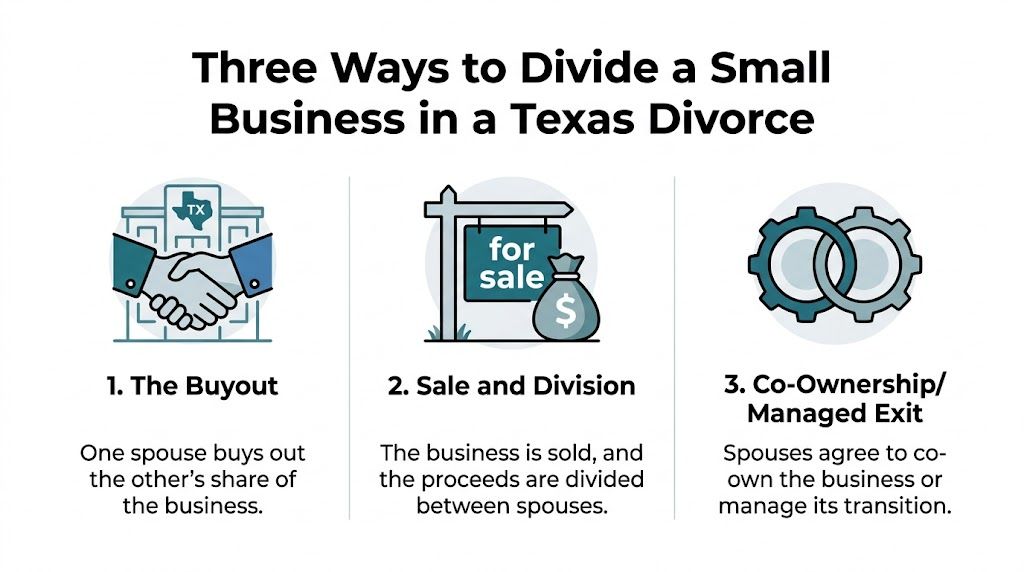
Three Ways to Divide a Small Business in a Texas Divorce
Once the business is classified and valued, you have to decide what happens to it. In real life, there are three common paths. None is painless. One is usually better than the others.
And yes, this matters because business owners are under real strain in divorce. Legal sources discussing entrepreneur divorce have reported rates between 43% and 48%, which is 5% to 10% higher than the general population. For local owners, that makes planning for division options more than a theoretical exercise, as noted in this discussion of divorce considerations for small business owners.
A side-by-side look
| Option | What happens | Best fit | Main risk |
|---|---|---|---|
| Buyout | One spouse keeps the business and compensates the other | The company is viable and one spouse actually runs it | Cash flow strain |
| Sale | The business is sold and proceeds are divided | Neither party can keep it fairly or safely | Forced timing can destroy value |
| Co-ownership or managed exit | Former spouses continue involvement for a period or under strict terms | Rare cases with unusual trust or transition needs | Ongoing conflict |
The buyout
This is usually the cleanest practical answer when one spouse built and operates the company.
The owner keeps the business. The other spouse receives value through cash, installment payments, or offset assets. Maybe the owner keeps the company while the other spouse keeps more retirement, equity in real estate, or another major asset. Sometimes the payout is structured over time to protect operations.
The buyout works best when the numbers are real. Not hopeful. Not inflated. Real. If the company can’t support a buyout and still pay taxes, payroll, vendors, and the owner’s living expenses, you’ve got a paper solution that will fail in practice.
A smart buyout preserves control without choking the business to death.
The sale
Sometimes sale is the only realistic path. If neither spouse can buy out the other, or if the conflict is so bad that every financial decision turns into a war, liquidation or sale may end the fight.
I don’t love this option for owner-operated local businesses. A forced sale often happens on a bad timetable, with emotional pressure and limited bargaining power. Buyers can smell distress. Distressed sellers rarely get their ideal outcome.
For a contractor in Humble or a family-run retail operation in Atascocita, a rushed sale can wipe out years of value. The company gets marketed while everyone is distracted, angry, and worried. That is not when owners negotiate from strength.
Co-ownership or managed exit
This is the option people suggest when they’re trying to sound reasonable. It can work. It often doesn’t.
If you and your soon-to-be ex can’t agree on basic personal issues, staying in business together is usually a bad bet. You’ll still have to make decisions on spending, hiring, distributions, debt, strategy, and customer issues. Divorce doesn’t improve communication.
That said, a managed exit can make sense where there’s a short-term transition need. One spouse stays involved for a limited time. Ownership shifts under a written schedule. Duties are defined. Payments are set. Access rights are limited. It has to be specific.
Which choice is usually best
For most owner-operated businesses in Humble and Northeast Houston, I favor a structured buyout over sale or co-ownership if the math works. It protects continuity, customers, and jobs.
Here’s a quick decision lens:
- Choose buyout if one spouse solely runs the company and financing the settlement is feasible.
- Choose sale if neither side can fund a workable resolution or the business cannot survive the dispute.
- Choose managed exit only if both people can follow a detailed written plan without turning every week into fresh litigation.
If your case has major business equity, layered assets, or complicated offset negotiations, it also overlaps with many of the same concerns that show up in high-asset divorce cases.
Negotiation Strategies and Harris County Court Realities
A lot of statewide divorce articles miss the practical local point. In Harris County, business cases are not won by chest-thumping. They’re won by preparation, disciplined mediation, and realistic settlement design.
If your case is filed here, over 95% of family law cases must go through mediation before trial, and in small business divorce matters that process can extend the timeline by 3 to 6 months. It can also create your best chance to preserve the business instead of watching a judge impose a rough solution, as outlined in this Harris County-focused discussion of what happens to your small business during a Texas divorce.

Mediation is where owners keep control
Some people hear “mandatory mediation” and think delay, cost, and hassle. I look at it differently. Mediation gives you room to build a business-minded result.
A judge has limited time and limited flexibility. In mediation, you can negotiate payment schedules, offset assets, decision deadlines, transition periods, non-disparagement terms, record-sharing rules, and operational protections that a courtroom solution may never address with that level of detail.
For a Humble business owner, that matters. You know your receivables cycle. You know whether a slow season is coming. You know when contracts renew and when inventory spikes. Mediation lets you build around those realities.
What strong mediation prep looks like
Good mediation is not showing up with a hopeful attitude and a box of receipts. Good mediation is structured.
Come prepared with:
- A defensible valuation position: Not guesswork.
- A clear division proposal: What you want, what you’ll offer, and what you won’t agree to.
- Payment options: Lump sum, installments, offsets, or a staged transfer.
- Operational boundaries: Who controls accounts, hiring, and distributions during transition.
- Tax awareness: Division choices can create downstream tax issues, so review practical guidance like how major life changes impact your taxes, including divorce as part of your planning.
The best mediation results usually come from the party who can explain both the legal position and the business reality without drama.
The local timeline matters
Business divorce cases in Harris County tend to move slower than people expect because records have to be gathered, reviewed, and often analyzed by financial professionals. Mediation requirements add time, and business disputes don’t fit neatly into quick settlement templates.
That delay is frustrating. It can also be useful if you use the time correctly. Owners who clean up financial reporting, document separate property claims properly, and build a workable buyout proposal usually negotiate from a much stronger position than owners who spend months arguing by text message.
A contrarian but practical point
Not every win looks like locking down the company and freezing out the other spouse. Sometimes the smarter move is a deferred division arrangement where one spouse keeps operating the business and the other receives structured offset payments over time. In the right case, that approach preserves operations and reduces the risk of a distressed sale.
That kind of outcome is much more likely in mediation than in a trial setting. It’s one reason local procedure matters so much in divorce involving small business humble texas cases. A lawyer who understands Harris County process should be shaping strategy from day one, not scrambling the week before mediation.
Your Next Steps A Checklist for Humble Business Owners
If your marriage is breaking down and your company is in the middle of it, keep this simple. Don’t make sudden moves. Don’t run on fear. Follow a checklist.
Freeze major business changes: Don’t sell assets, rewrite ownership documents, or move money around without legal guidance. In Texas community property cases, business divorces can end in court-ordered sales or forced buyouts, and legal sources report a sharp rise in these high-conflict outcomes after 2020 in Texas business divorce matters, which is why early planning matters so much in this discussion of business-owner divorce risks in Texas.
Gather the core records: Pull profit and loss statements, balance sheets, tax returns, payroll reports, loan documents, and bank records.
Find your formation paperwork: LLC operating agreement, bylaws, shareholder records, partnership agreement, and any buy-sell terms.
Stop casual business talk with your spouse: Don’t negotiate ownership, value, or payouts in the kitchen or by text.
Secure digital access: Review passwords for email, accounting systems, payroll, banking, cloud storage, website access, and customer platforms.
Make a timeline: Write down when the business started, how it was funded, when it grew, and what major financial events happened during the marriage.
Protect reputation and operations: Tell key staff only what they need to know. Keep customers out of your domestic conflict.
Schedule a local legal consultation early: This is the move that prevents expensive mistakes.
If you own a business in Humble, Atascocita, Kingwood, or Northeast Houston, your divorce strategy has to protect both your legal position and your daily operations. Those are not separate problems. They are the same problem.
If you’re dealing with a divorce that puts your business at risk, the Law Office of Bryan Fagan is here to help. Our Humble office works with local business owners, professionals, and families who need clear answers about property division, mediation, and protecting what they’ve built. Schedule a free consultation and get a practical plan for your next step.