Skip to content

A lot of people in Humble don’t start by asking, “How does Texas divide property?” They start with a knot in their stomach.
They look around the house, think about the mortgage, the retirement account, the truck payment, the credit cards, the kids’ routines, and wonder what life will look like six months from now. If you’re in Humble, Atascocita, Kingwood, or Northeast Houston and you’re facing divorce, that worry is normal. Property division isn’t just about paperwork. It’s about your home, your savings, your debt, and the life you’ve worked hard to build.
That’s why this topic matters so much locally. Humble’s population grew to over 16,400 residents by 2023, and the same local source says the area has a 12% annual divorce rate, with 65% of local divorces involving property disputes over homes and other assets, according to attorneys serving Humble listed by Super Lawyers. For many families, the hardest part of divorce isn’t deciding to separate. It’s not knowing what happens next.
Facing Divorce in Humble and Worrying About Your Future
A spouse in Kingwood may be wondering whether they can keep the house. A parent in Atascocita may be trying to figure out whether a retirement account gets split. A small business owner in Northeast Houston may be worried that years of work will get tangled up in a divorce case.
Those concerns are more common than people think. In and around Humble, property questions come up often because a divorce touches nearly every part of a household’s financial life. The family home, vehicles, savings, debt, retirement plans, and even reimbursements for money spent during the marriage can all become part of the discussion.

The first fear is usually uncertainty
People don’t need a lecture. They need a calm explanation.
Texas doesn’t handle divorce property the way many people assume. The court’s approach is not to draw a line down the middle and declare it settled. Instead, judges look at what counts as marital property, what belongs separately to one spouse, and what outcome would be fair under the facts of that family’s case.
Practical rule: Before you can divide property fairly, you have to identify what you have, what you owe, and how each item is legally classified.
That’s where a property division lawyer humble tx residents can turn to becomes helpful. The job isn’t only arguing in court. It’s helping people slow down, get organized, and understand what’s happening one step at a time.
Why local guidance matters
A divorce filed in Harris County affects real families in specific neighborhoods, with local homes, local jobs, and local court procedures. The questions sound practical because they are practical:
- About the house: Who stays, who refinances, and what happens to the equity?
- About retirement: Is a 401(k) partly separate, partly marital, or fully divisible?
- About debt: If one spouse used a card more, does that decide who pays it?
- About records: What if one spouse handled all the finances?
If that’s where you are right now, you don’t need to know everything today. You just need a clear place to start.
Texas Community Property Law Explained for Humble Families
Texas is a community property state. That means the law starts with the idea that property acquired during the marriage belongs to the marital community. Under Texas Family Code §7.001, that property is divided in a way the court finds “justly and righteously,” not automatically in a strict half-and-half split. A source discussing Texas property division notes that Texas had over 62,000 divorces filed in 2022, with property disputes arising in roughly 40% of them, in this overview of how property division is determined in Texas.
A simple way to think about it is this. Marriage creates a shared grocery cart for many financial items gathered during the relationship. But each spouse may also still carry a personal backpack with items that belonged only to them.
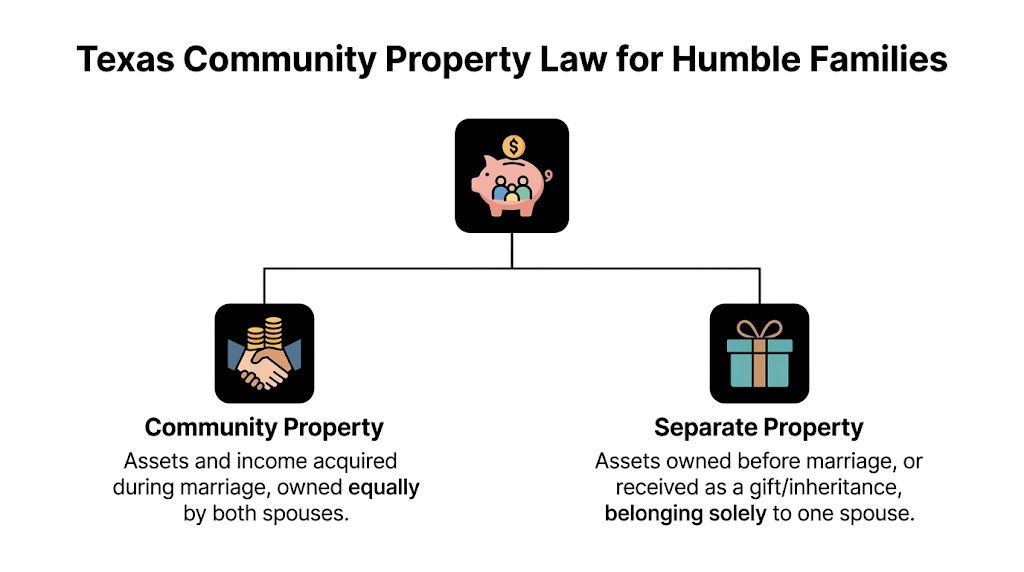
The two big categories
Community property usually means assets and income acquired during the marriage.
Separate property usually means property owned before marriage, or received individually as a gift or inheritance.
That sounds straightforward until real life gets involved. Paychecks are deposited into joint accounts. One spouse sells something they owned before marriage and uses the funds during marriage. A gift from a parent helps renovate the family home. That’s when classification becomes harder than the label on the asset.
For a more detailed discussion of the legal framework, see this guide on what is community property in Texas.
Community property vs separate property at a glance
| Asset Category | Community Property (Acquired During Marriage) | Separate Property (Owned Before or Gifted) |
|---|---|---|
| Paycheck earnings | Usually included if earned during the marriage | Not usually separate just because deposited in one name |
| House | May be community if bought during the marriage | May be separate if owned before marriage or received by gift/inheritance |
| Retirement growth | Often divisible to the extent built during the marriage | Pre-marriage portion may be separate |
| Gift from parent | Usually not community if given to one spouse individually | Often separate if properly documented |
| Inheritance | Usually not community if kept identifiable | Often separate if not mixed beyond tracing |
Fair doesn’t always mean equal
Many readers get tripped up by the phrase "community property", assuming every case ends in a clean 50/50 split. That’s not how Texas works.
A court can consider factors such as earning capacity, separate property, debts, and tax impact when deciding what division is fair. In plain language, a judge asks: what result is just for this family, under these facts?
The legal question isn’t only “What do you own?” It’s also “What would be a fair division after looking at the whole picture?”
For many Humble families, that difference matters. A spouse who has less income, more caregiving responsibility, or less access to future earning opportunities may not be standing in the same financial position after divorce.
Navigating Common Property Division Complications
Once you move past the basic labels, most property cases become detail-driven. The issue usually isn’t whether something exists. The issue is how to classify it, value it, and divide it without creating a bigger financial problem.

The house is emotional and financial
For many couples in Humble, Atascocita, and Kingwood, the home is the biggest source of stress. A house isn’t just an asset on paper. It’s where children sleep, where bills arrive, and where routines happen.
Questions often include:
- Can one spouse keep it? Sometimes yes, if that spouse can handle refinancing, taxes, insurance, and upkeep.
- Should it be sold? Sometimes selling creates the cleanest break, especially when cash flow is tight.
- What about separate contributions? If one spouse brought money into the purchase from a separate source, tracing may matter.
The answer depends on the title history, payment history, current value, and any claims for reimbursement.
Retirement accounts need careful handling
A retirement account often looks simple until you ask when the balance was built. Money earned before marriage may be treated differently from money added during marriage. Division can require a special court order, such as a QDRO, so the plan administrator knows how to divide the account correctly.
If you want a closer look at that part of the process, this page on dividing retirement accounts in divorce explains the basics in plain language.
A retirement account is like a layered cake. The hard part is figuring out which slices were baked before the marriage and which were added during it.
Businesses and commingled accounts are where mistakes happen
Business interests, side income, and mixed accounts can create some of the toughest fights in a divorce. When personal and business money move back and forth, the records may not tell a neat story. The same problem shows up when separate property and marital funds are mixed in one account.
A source discussing Texas asset division explains that for complex holdings like businesses or commingled accounts, expert valuation is critical, and that inadequate tracing of separate property can cause it to be recharacterized as community property, potentially increasing litigation costs by 15-25%, in this discussion of property division issues.
That’s one reason lawyers often work with financial professionals. If you’re curious about the practical side of the investigation, this overview of how forensic accountants help find hidden assets gives a useful, non-technical explanation of the methods involved.
Debts matter too
People often focus on what they own and forget what they owe. But debt allocation can shape your post-divorce life just as much as asset division.
Common examples include:
- Credit cards used for household expenses
- Vehicle loans
- Tax obligations
- Business debts
- Home equity lines
Courts and negotiating attorneys look at who incurred the debt, what it was used for, and whether it benefited the marital household. A debt in one spouse’s name isn’t automatically that spouse’s sole problem in every situation.
Here’s a short explainer that helps show how these issues connect in real divorce cases:
What commingling looks like in real life
A common example goes like this. One spouse had savings before marriage. During the marriage, that money was deposited into a joint account, mixed with payroll deposits, and later used for family expenses and renovations. The original separate property may still exist as a legal claim, but proving it gets harder when the paper trail fades.
That’s why timing, records, and account statements matter so much. In property division, memory rarely carries the day. Documents do.
The Divorce Property Process in Harris County Courts
Families in Humble and Northeast Houston usually feel better once they can see the road ahead. Property division doesn’t happen all at once. It moves through stages, and each stage has a purpose.
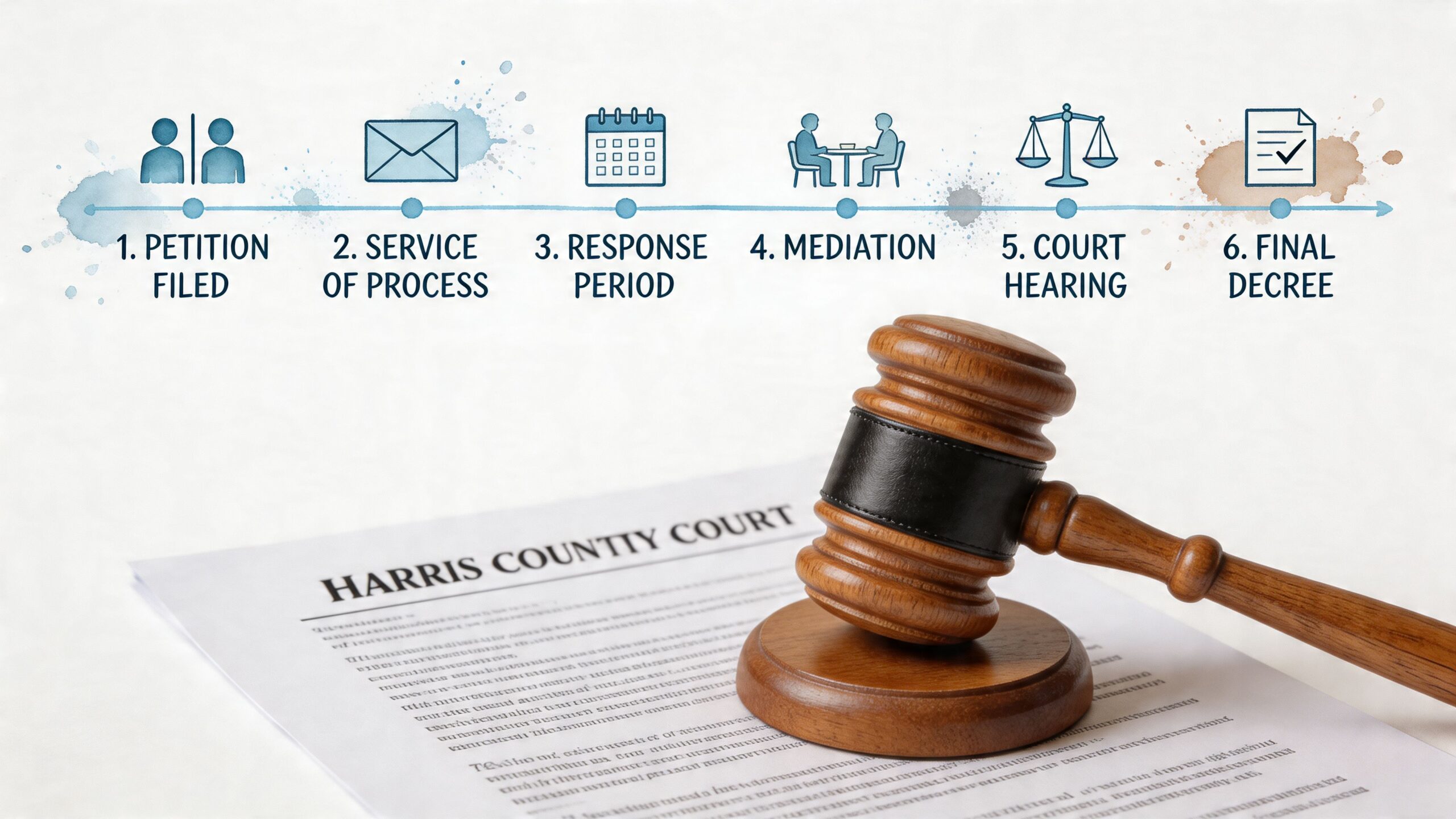
Filing and financial disclosure
The case starts with the divorce filing. Soon after, both sides usually need to gather and exchange financial information. Lawyers call this discovery. Most clients call it “finally getting all the paperwork together.”
That may include bank records, retirement statements, mortgage documents, tax returns, business records, and debt information. If one spouse controlled the finances during the marriage, discovery helps level the field.
For a local overview of the forum where these cases are handled, this page on Harris County family court in Humble helps explain the setting.
Mediation is often the turning point
Many people assume divorce property cases always end in a courtroom. In reality, many are resolved through negotiation or mediation. Mediation places both sides in a structured settlement setting with a neutral mediator helping them work toward an agreement.
That path can be worth serious consideration. A Harris County focused discussion notes that many firms don’t break down the economics clearly, but national data shows mediation can be 40-50% less expensive and significantly faster than going to trial, according to this discussion of mediation and litigation in asset division matters.
Mediation can protect more than peace. It can protect the assets you’re trying to divide.
Settlement, collaborative work, or trial
Once the financial picture is clearer, most property cases move in one of three directions:
Negotiated settlement
The spouses, often through their attorneys, reach terms and put them into a written agreement.Collaborative-style problem solving
Some families prefer a lower-conflict process focused on information sharing and practical solutions.Trial
If major issues remain unresolved, the judge decides the disputed questions.
Trial is sometimes necessary. But when families can reach a workable agreement with full information and solid legal advice, they usually keep more control over the result.
Why the process feels slow
Property division takes time because each item has to be identified, classified, valued, and assigned. If records are incomplete or one side disputes ownership, the case can slow down further. That delay can feel frustrating, but careful work early often prevents costly errors later.
For many local families, the best strategy is not the loudest one. It’s the one that protects the balance sheet, reduces unnecessary conflict, and gets to a durable final order.
How a Humble Property Division Lawyer Protects Your Interests
You may be sitting at your kitchen table in Humble with a folder full of bank statements, mortgage papers, and retirement account printouts, trying to answer one hard question. What is yours, what is shared, and what happens next?
That is where legal help matters in a very practical way. A good property division attorney acts as part investigator, part strategist, and part buffer between you and a very stressful situation.
Your lawyer builds a clear financial picture
Property division cases often feel confusing because the paperwork tells the story in pieces. One account was opened before marriage but grew during marriage. The house was refinanced. A credit card balance changed month to month. A retirement plan has years of contributions with different rules attached to it.
Your lawyer puts those pieces in order so the court, and you, can see the full picture. In Harris County divorce cases, that means more than collecting documents. It means asking the right questions early, before a small mistake turns into a costly argument later.
That often includes sorting out:
- whether property may be separate or community
- which records are missing or incomplete
- whether a home, business, or account needs a formal value
- which debts deserve closer review
- whether tracing or reimbursement claims may apply
A simple comparison helps here. Your lawyer is putting together the financial puzzle by finding edge pieces first, then filling in the middle with records, timelines, and supporting proof.
Your lawyer helps you make decisions from evidence
Divorce can put people under a lot of pressure. In that state, it is easy to agree to terms just to end the stress, especially if the language sounds fair on first reading.
A lawyer slows that process down. They review proposed terms, explain what they mean in plain English, and flag provisions that may create problems after the divorce is final. That might involve hidden tax concerns, unclear debt responsibility, or wording that leaves too much room for future disagreement.
The goal is not to fight over every lamp, truck, or account.
The goal is to protect the parts of your financial life that will still matter next year and five years from now.
Your lawyer works with the right outside professionals
Some property cases need more than legal arguments and document review. They need an appraiser for real estate, a business valuation expert, or a retirement plan administrator who prepares the right division orders.
In appropriate cases, firms including the Law Office of Bryan Fagan may coordinate with those professionals so valuations, retirement division documents, and tracing issues are handled correctly. That support can be especially helpful in Harris County cases involving family businesses, pensions, or homes with mixed separate and community interests.
When emotions are high, clear records often provide the strongest protection.
Your lawyer reduces conflict and protects your footing
Money disputes in divorce are rarely just about numbers. For many families in Humble, Kingwood, and Atascocita, strain comes from repeated arguments, pressure to respond quickly, or fear that the other spouse has more information.
An attorney helps level that out. Your lawyer can send formal requests for records, respond to claims through the proper channels, and keep conversations focused on facts instead of blame. That changes the tone of the case. It also gives you room to think clearly, care for your children, keep working, and make decisions with less panic.
That peace of mind has real value. In a property case, clear thinking protects people almost as much as clear paperwork.
Your Practical Checklist for Preparing for Property Division
You don’t need to walk into a consultation with every answer. But bringing the right information can save time and help your lawyer spot issues early.
Documents to start gathering
- Income records like pay stubs and recent tax returns
- Bank and credit union statements for individual and joint accounts
- Retirement account statements for 401(k)s, IRAs, pensions, and similar plans
- Real estate records such as deeds, mortgage statements, refinance papers, and property tax documents
- Debt records for credit cards, auto loans, personal loans, and business obligations
- Business paperwork if either spouse owns a company or partnership interest
- Gift or inheritance records including letters, transfer records, or account histories showing where the asset came from
- Insurance and title documents for vehicles, homes, and valuable personal property
Questions to ask in a consultation
Some questions should be direct.
- What property classification issues do you see right away?
- Do any accounts or assets need tracing or valuation?
- What documents should I gather first?
- Do you think mediation makes sense in my case?
- What risks do you see if my spouse handled most of the money?
- How will retirement accounts or the home likely be addressed procedurally?
A simple way to prepare yourself
Make a written list of everything you own, everything you owe, and anything you believe should be treated as separate property. Don’t worry about getting the legal labels perfect. Your job is to be complete and honest.
Then gather what you can without breaking rules or escalating conflict. Good preparation usually starts with organization, not confrontation.
Frequently Asked Questions About Property Division in Humble
Can I keep the house in the divorce
Sometimes, yes. Keeping the house usually depends on whether the numbers work. A spouse who wants the home may need a workable plan for mortgage responsibility, refinancing, equity allocation, and ongoing costs.
Is my inheritance or a gift from my parents divided
It may be treated as separate property if it was given to you individually and you can prove it clearly. Problems often arise when inherited or gifted funds were mixed with marital funds and the records are incomplete.
What if I think my spouse is hiding assets
Tell your lawyer early. Hidden or undervalued assets are easier to address when the concern is raised before settlement discussions are far along. Financial records, discovery tools, and expert review can all become important.
How long will the property division process take in Harris County
The answer depends on complexity. Cases involving a house, retirement accounts, business interests, missing records, or disputes about separate property usually take more work than cases with straightforward finances. Cooperation between spouses can shorten the process. Disputes over classification and value can lengthen it.
Do I need a lawyer if we want to stay amicable
Often, yes. Amicable doesn’t always mean simple. Even cooperative spouses need to make sure the final paperwork properly addresses title transfers, retirement orders, debt language, and the classification of assets.
Protect Your Future and Schedule Your Free Consultation Today
A lot of Humble families reach this point late at night, sitting at the kitchen table, wondering what life will look like six months from now. The questions feel heavy for a reason. Your house, your retirement, your debts, and the records tied to them can affect where you live and how stable the next chapter feels.
Property division works a lot like sorting two families' belongings after years of sharing the same garage. Some items clearly belong in one pile. Some are shared. Some are mixed together in ways that take patience and proof to sort out. In Harris County divorce cases, small details often shape the outcome, especially when there is a home, retirement savings, a business interest, or missing paperwork.
That is why local guidance matters.
If you want to speak with a property division lawyer humble tx families turn to for clear answers and steady support, it helps to talk with someone who understands how these cases affect people in Humble, Atascocita, and Kingwood, and how Harris County courts handle the process in real life. A careful legal plan can help protect your financial footing, reduce avoidable mistakes, and give you a clearer path ahead.
If you are ready to talk through your situation, schedule a free consultation with Law Office of Bryan Fagan. Our Humble office works with local families who need practical, compassionate guidance on divorce and property division, and we are here to help you take the next step with clarity.