Skip to content

A lot of military families around Humble reach the same point. One spouse is driving back from work in Atascocita, the other is checking orders, housing paperwork, or a deployment calendar, and both know the marriage isn’t working. What makes the decision harder is that a military divorce doesn’t move like a standard Texas divorce.
You may live in Kingwood now, have ties to another state, receive military pay that doesn’t look like civilian income, and worry about what happens to retirement, TRICARE, parenting time, or even where the case should be filed. Those aren’t small details. They shape strategy from the first conversation.
If you’re searching for a military divorce lawyer humble texas, you’re usually not looking for abstract legal theory. You want straight answers about Harris County procedure, filing options, federal protections, and what will matter in court or mediation. That’s what this guide is built to do for families in Humble, Atascacita, Kingwood, and Northeast Houston.
Navigating a New Mission The Reality of Military Divorce in Humble
A military divorce often starts with ordinary local life. The kids are in school near Humble. One spouse handles home routines. The other may be active-duty, recently returned, preparing to leave, or working through a schedule that changes with little notice. The marriage strain feels personal, but the legal issues become technical fast.

In a civilian divorce, individuals typically ask the usual questions first. Who keeps the house, what happens with the kids, and how will bills be paid? In a military divorce, those questions are still there, but they come with added layers. A spouse may live in Harris County while claiming legal domicile somewhere else. Retirement may be divisible under federal law but not in the same way as a civilian pension. Support may involve housing and subsistence allowances that don’t show up like standard wages.
That combination is why military families around Northeast Houston often feel stuck before they even file. They’re not just ending a marriage. They’re trying to make sense of two legal systems at once and protect their future while keeping life stable for their children.
A good military divorce plan doesn’t begin with paperwork. It begins with choosing the right court, confirming residency, and identifying every military-related benefit before positions harden.
For families in Humble, local context matters. Harris County judges, clerks, mediation practice, and scheduling realities all affect how a case moves. So do practical details like base access, deployment timing, and whether one spouse can realistically appear in person. The right approach is steady, informed, and local.
How Military Divorce Differs from Civilian Divorce in Texas
Think of a civilian divorce as one game with one rulebook. A military divorce is more like playing on the same field with two rulebooks at once. Texas family law still applies, but federal military law changes how major parts of the case work.
Texas treats ordinary divorces under state law. Military divorces are different. Military divorce cases in Texas are subject to both state and federal court jurisdiction, unlike civilian divorces which fall only under state jurisdiction, and that dual framework can affect property division, spousal support, and child support outcomes for military families in Humble, according to HHZ Family Law's discussion of Texas military divorce.
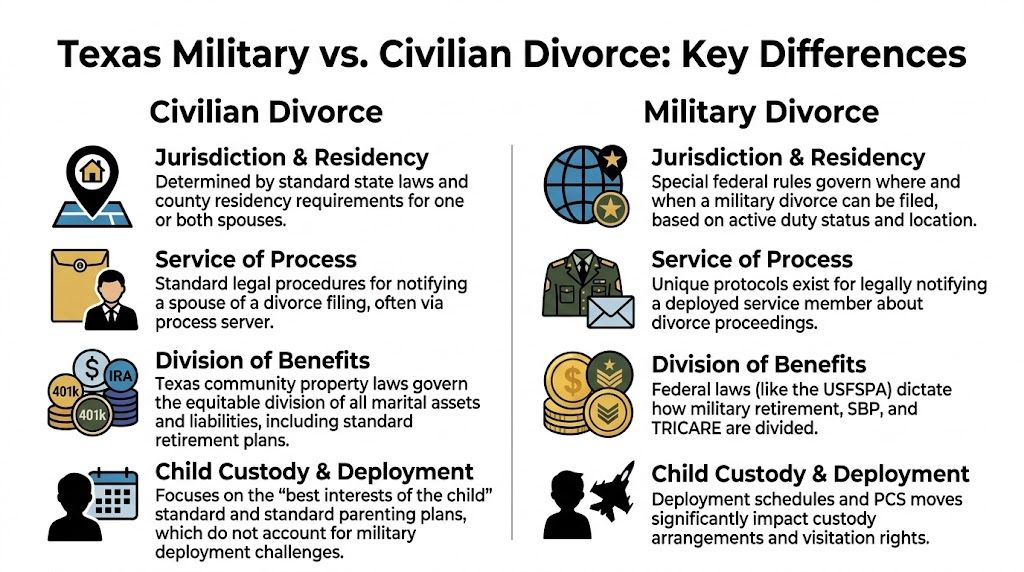
Where you file can change the case
In many civilian divorces, the filing question is simple. You file where residency requirements are met, and the court applies Texas law. Military families often have more than one possible connection. A service member may be stationed near Humble, maintain legal domicile elsewhere, and have a spouse living in another county or state.
That matters because filing location can affect:
- Property treatment: Texas is a community property state, so marital property division starts from a different baseline than in many other states.
- Support analysis: Child support guidelines are fixed under Texas law, but military compensation can complicate how income is identified.
- Spousal support expectations: Texas uses strict standards for maintenance, and parties can make costly mistakes if they assume another state’s rules apply.
Residency is simple on paper and tricky in practice
For civilian couples, residency usually follows where they live. Military families often need to prove something more nuanced. Living in one place, claiming domicile in another, and being stationed in a third can all exist at the same time.
That’s why paperwork and factual consistency matter. Court pleadings, military records, tax positions, and sworn statements should tell a coherent story. What doesn’t work is treating residency like an afterthought. If the filing basis is weak or inconsistent, the case can bog down early.
Military benefits are not ordinary assets
Civilian divorces may involve 401(k)s, IRAs, pensions, and health insurance. Military divorces may involve retired pay, survivor elections, TRICARE questions, housing-related compensation, and branch-specific administrative details. Those issues don’t fit neatly into a standard divorce template.
A few examples show the difference clearly:
| Issue | Civilian divorce | Military divorce |
|---|---|---|
| Retirement division | Often handled through ordinary retirement-division processes | Military retired pay follows federal rules and may not require the same tools used for civilian plans |
| Service of process | Standard state procedures usually apply | Federal protections can affect how an active-duty member is served |
| Parenting schedules | Built around jobs, school, and distance | Must account for deployment, training, temporary duty, and relocation realities |
Practical rule: In military cases, the first strategic question usually isn’t “What do you want?” It’s “Which court can act, and what rules control the asset or benefit you’re asking about?”
Families in Humble, Kingwood, and Atascocita benefit from treating military divorce as its own category of case, not as a regular divorce with a camouflage overlay. That shift in mindset avoids a lot of expensive missteps.
Key Protections The SCRA and USFSPA Explained
A Humble spouse may be ready to file in Harris County, only to learn that the other spouse is on active duty in another state or overseas. At that point, the case stops being a standard Texas divorce and starts turning on two federal statutes that local families often hear about only after a deadline is missed or a hearing is reset.
Those statutes are the Servicemembers Civil Relief Act (SCRA) and the Uniformed Services Former Spouses' Protection Act (USFSPA). One protects a service member’s ability to participate fairly in the case. The other gives Texas courts limited authority over military retired pay. They affect timing, strategy, and what a Harris County judge can order.
The SCRA protects participation, not avoidance
The SCRA exists to prevent a service member from losing rights in court because military duty keeps them from responding or appearing. In practice, that issue often comes up early, especially if one spouse files in Harris County while the service member is deployed, in training, or stationed outside Texas.
The law can support a stay of the case when military duties materially affect the service member’s ability to appear. A stay is a pause. It is not a dismissal, and it does not erase the divorce filing. The court still expects the case to move once participation becomes realistic.
That matters in local practice. Harris County courts generally want to see that both sides had a fair chance to be heard before temporary orders, default relief, or final terms are entered. If active-duty service affects that ability, the court has to account for it. The official SCRA materials from the U.S. Department of Justice explain those protections in plain terms: Servicemembers Civil Relief Act overview.
A few practical consequences show up again and again:
- Default is harder to get: Before a court enters a default judgment, military status has to be addressed carefully.
- Hearing dates may need adjustment: Orders, training schedules, or deployment can affect whether a setting is realistic.
- Waiver decisions matter: Some service members prefer to proceed and sign the right paperwork rather than delay the case.
I often tell clients to treat the SCRA as a fairness rule. If you ignore it, you risk defective orders and expensive do-overs.
Service of process can create avoidable problems
Service issues in military cases are often mishandled because people assume ordinary divorce procedures will work the same way. Sometimes they do. Sometimes they do not.
If a spouse is on active duty, the first question is usually practical, not theoretical. Where is that person, and can they be served properly under the facts of this case? If the member is deployed, on base, or in a restricted setting, shortcuts can create months of trouble. That is especially true in Harris County cases where one bad service attempt can delay temporary orders and weaken settlement position.
A careful plan usually includes confirming duty status, identifying a workable service method, and deciding whether a waiver is appropriate. If retirement issues may also be in play, it helps to review how Texas courts handle dividing retirement accounts in divorce before drafting final terms.
USFSPA gives the court authority over retired pay, within limits
The USFSPA is the federal law that allows state courts to treat certain military retired pay as divisible in divorce. That authority is narrower than many people expect.
USFSPA does not guarantee a former spouse a set percentage. It does not make every military-related benefit divisible. It creates the legal framework for a state court, including a Harris County family court, to address military retired pay under federal rules. The Defense Finance and Accounting Service explains the scope of those rules and the limits on direct payment: DFAS guidance on the Uniformed Services Former Spouses' Protection Act.
One common mistake is assuming military retirement works like a civilian 401(k) or pension. It does not. The language in the decree matters, the definition of disposable retired pay matters, and jurisdiction matters. In some military divorces around Humble and Atascocita, the court may have authority to dissolve the marriage and decide child-related issues, but not authority to divide retired pay unless the federal jurisdiction rules are satisfied.
That distinction is easy to miss, especially in cases where the family lives in Texas for military reasons but claims domicile elsewhere.
What to gather before your first serious case review
Good strategy starts with good documents. For military families filing or responding in Harris County, these records usually help:
- Current LES and pay records
- Orders, deployment information, or duty-station records
- Retirement point statements or other retirement paperwork
- Any prior support orders or written agreements
- Basic information showing where each spouse claims legal residence
Some spouses also want a broader picture of post-divorce income planning, especially if the marriage includes both military and civilian benefit questions. A plain-English explanation of how spousal Social Security benefits are calculated can help frame those discussions.
In military divorce, federal protections do not replace Texas family law. They set the boundaries Harris County courts have to respect. If those boundaries are identified early, the case usually moves with fewer surprises and fewer procedural fights.
Dividing Military Retirement SBP and Healthcare Benefits
For many military families, the hardest part of divorce isn’t deciding to separate. It’s understanding the long-term financial value of benefits that don’t look like ordinary assets. Retirement, survivor coverage, and healthcare can matter long after the decree is signed.

Retirement division is more technical than most people expect
Military retired pay isn’t just another account to split down the middle and move on. Federal law controls the framework, and the wording in the decree matters. A vague order can create enforcement problems later, even if both spouses thought they had a deal.
Another common mistake is focusing only on the monthly amount a retiree may someday receive. Proper analysis should include when the benefit vests, how the divisible portion is defined, and whether related protections are in place if the service member dies first.
For people trying to compare future income streams after divorce, it can also help to understand how other federal benefits work. A plain-English guide on how spousal Social Security benefits are calculated gives useful context when you’re mapping out post-divorce income sources alongside military-related benefits.
SBP is often negotiated too late
The Survivor Benefit Plan, or SBP, is one of the most overlooked issues in military divorce. Many people focus on retirement division and only later realize that retirement payments can stop upon the retiree’s death unless survivor protection was properly addressed.
That’s why SBP deserves direct negotiation, not a passing mention. A settlement should clearly state whether former-spouse coverage will be elected, who bears associated costs if the parties agree on them, and what deadlines apply. If the order is silent or sloppy, the intended protection can be lost.
Retirement division answers who receives a share while the retiree is alive. SBP addresses what happens after death. Those are separate questions.
Healthcare and related benefits need careful review
According to Texas Advocates' overview of military divorce issues, spousal and child support calculations must account for non-taxable income like Basic Allowance for Housing (BAH) and Basic Allowance for Subsistence (BAS). The same source notes that the division of TRICARE health insurance and the Survivor Benefit Plan represents complex property valuation requiring specialized financial and legal expertise.
That tells you two important things. First, healthcare-related issues aren’t side notes. Second, support analysis can be distorted if someone looks only at taxable wage income and ignores military allowances.
For a closer look at retirement-related property issues in Texas divorce, families often benefit from reviewing dividing retirement accounts in divorce. Military retirement is its own category, but the broader property-division principles still help frame negotiations.
Here’s a short breakdown of what deserves attention:
- TRICARE questions: Eligibility and continuation issues should be reviewed early, not after temporary orders.
- SBP election language: It needs to be specific enough to be enforced and implemented.
- Income analysis: BAH and BAS may affect support even though they’re not taxed like ordinary pay.
- Administrative follow-through: A good decree still requires the right post-divorce submissions and deadlines.
A quick overview can help before deeper negotiation:
What works in settlement, and what usually fails
The best results usually come from treating military benefits as a package rather than isolated line items. One spouse may focus on cash flow. The other may care more about survivor protection or healthcare continuity. Productive negotiation identifies those priorities early.
What tends to fail is informal drafting and wishful language. Courts can only enforce what the order states. If the decree is generic, the benefit administration won’t become easier later.
Protecting Your Children Custody and Support with Deployment
Children usually don’t care about legal jargon. They care about who picks them up, who calls at bedtime, whether school stays stable, and whether both parents still show up in dependable ways. Military service can complicate those routines, which is why a standard possession schedule often isn’t enough.
A deployment-ready parenting plan is not optional in a military case involving children. It protects the child first, and it protects both parents from preventable fights when schedules change. Without detailed language, ordinary events can become emergency disputes.
A plain custody order often breaks under military pressure
A basic order may work when both parents live nearby and keep predictable schedules. It usually struggles when one parent may deploy, train away from home, relocate, or face duty changes on short notice. That’s where parents in Humble, Kingwood, and Atascocita need a more customized plan.
A stronger order should address points like these:
- Communication during absence: Set expectations for video calls, phone contact, missed-call makeups, and school updates.
- Temporary caregiving: If a parent is unavailable because of service, identify how temporary time with relatives or trusted caregivers will be handled if the law allows it.
- Return and reintegration: Spell out how parenting time resumes after deployment so the child isn’t caught in a new argument every time duty status changes.
- Travel and notice rules: Include realistic notice procedures for leave periods, schedule changes, and transportation responsibility.
The best parenting plans aren’t written for good weeks. They’re written for stressful weeks when everyone is tired and decisions need to be clear.
For families dealing with custody in Harris County, local guidance matters. A useful starting point is Harris County child custody representation in Humble, especially when military obligations make standard templates inadequate.
Support calculations need a full income picture
Military child support issues often become contentious because one parent looks at take-home pay while the other looks at total compensation. In practice, support analysis has to account for military income components that affect actual resources.
As noted earlier, military compensation can include housing and subsistence allowances that matter in support calculations. If a parent ignores those items, the result may be unrealistic and invite later modification disputes. If a parent overstates variable compensation without documentation, that can also distort the case.
A productive support review usually includes:
- Current pay records.
- Allowance information.
- Housing circumstances.
- Existing child-related expenses.
- A realistic schedule showing how much parenting time each parent will exercise.
PCS moves should be planned, not improvised
A permanent change of station can destabilize even cooperative co-parents if no relocation terms exist. Families often find it helpful to review practical logistics before they become legal emergencies. A civilian-friendly Military PCS Moving Guide can help parents think through timing, household planning, and transition details that often spill into custody disputes.
The legal goal is stability. The human goal is trust. Children do better when both parents create a plan that survives military life instead of pretending military life won’t affect parenting.
Filing for Military Divorce A Step-by-Step Guide for Harris County
Once the decision to file is made, the process feels less overwhelming when it’s broken into steps. Military divorce in Harris County still follows Texas divorce procedure, but the military-specific details must be built into the case from the start.
Step one is confirming where you can file
Before preparing a petition, confirm that Harris County is the right venue. For military families, that means reviewing where each spouse lives, where the service member is stationed, and what facts support filing locally. Filing first and sorting out residency later is usually a mistake.
A practical local resource for the ordinary filing process is filing for divorce in Harris County from Humble. In military cases, that baseline process is only part of the picture. Residency and service issues need their own review.
Step two is gathering the right documents
A military divorce file should be built with more than the usual bank statements and tax records. The court may need a clear record of military status, compensation, and family circumstances.
Helpful documents often include:
- Marriage and family records: Basic identification documents, information about children, and prior orders.
- Financial records: Bank statements, debt records, and property information.
- Military-specific records: Orders, LES documents, retirement-related paperwork, and housing information.
- Insurance and benefit details: Information tied to healthcare, survivor coverage, and dependent status.
Step three is filing the petition and handling service correctly
The case usually begins with an Original Petition for Divorce filed in a Harris County family court. In a military case, service of process needs careful planning. If the responding spouse is on active duty, deployed, or difficult to reach, shortcut service methods can create serious problems later.
After filing, the court process often includes temporary-orders issues, required disclosures, negotiation, possible mediation, and final decree preparation. Texas also has a waiting period before a divorce can be finalized. In military cases, federal protections or service complications can lengthen that timeline.
Filing starts the lawsuit. It doesn’t solve service, residency, retirement language, or parenting logistics. Those pieces have to be built alongside the case.
Step four is using mediation well
Many Harris County divorces resolve through mediation. That can work well in military cases too, but only when the numbers and benefits have been identified beforehand. Mediation fails when one side arrives without retirement terms, support records, or a deployment-sensitive parenting proposal.
A useful pre-mediation checklist includes:
| Issue to prepare | Why it matters |
|---|---|
| Residency basis | Prevents early procedural fights |
| Military income documents | Supports accurate temporary and final support discussions |
| Proposed parenting plan | Gives the mediator something specific to work with |
| Benefit summary | Keeps retirement, SBP, and healthcare from being ignored |
Step five is finishing with enforceable language
The final decree is where many avoidable errors happen. General promises are not enough. Orders involving military retirement, support, healthcare-related issues, and parenting during deployment should be written with enough detail that they can be carried out.
This is one area where using counsel familiar with military cases matters a great deal. The Law Office of Bryan Fagan handles family law matters in the Humble area, including divorce and custody matters involving military-specific issues, and that kind of focused drafting is often what separates a workable order from future litigation.
Why You Need a Local Humble Military Divorce Lawyer
A military divorce doesn’t just require knowledge of military law. It requires someone who knows how that law meets real Harris County procedure. That local piece is where many families lose time and advantage.

A downtown Houston firm may understand general family law and still miss the practical issues facing a family in Humble, Atascocita, or Kingwood. Local practice means understanding how Harris County courts move, what judges expect in family cases, how to prepare for mediation, and how to present a clean residency basis when military facts are involved.
One issue stands out for service members living near Humble. According to Farias Law's discussion of Texas military divorce residency, service members can establish Texas residency for divorce after living in the state for 6 months and the county for 90 days, even if they maintain legal domicile elsewhere for tax purposes. That means a person stationed near Humble may be able to file in Harris County despite keeping another state as legal domicile for other purposes.
That sounds straightforward, but it rarely feels straightforward to the family living it. Proof issues matter. Pleadings matter. The facts used to support local filing should be organized and consistent. A local lawyer helps by translating that dual-residency reality into a court-ready case rather than a confusing explanation.
Local representation changes the strategy
A Humble-based approach usually helps in several ways:
- Court familiarity: Knowing Harris County filing practice and hearing expectations reduces procedural friction.
- Community context: A local lawyer understands the practical geography of Humble, Kingwood, Atascocita, and Northeast Houston when building parenting proposals.
- Better issue spotting: Residency, deployment timing, and military benefit questions are easier to address early than to fix later.
In military divorce, local knowledge isn’t cosmetic. It affects venue choice, scheduling, and how cleanly the case reaches a final order.
If you’re looking for a military divorce lawyer humble texas, the primary question is whether your attorney can handle both the federal military layer and the neighborhood-level court reality. For many families, that combination is what brings the case under control.
Frequently Asked Questions About Military Divorce in Texas
Can deployment stop a divorce completely
Usually, no. Military service can delay proceedings under federal protections, but it doesn’t erase the case forever. If active-duty obligations interfere with participation, the court may pause the matter. In some situations, the service member may choose to waive that protection and move forward.
Can I file in Harris County if I still claim another state as my legal domicile
Possibly, yes. Military families often have overlapping residency facts. A service member living in the Humble area may still be able to file locally if Texas and county residency requirements are met, even while keeping another domicile for tax or voting purposes. This is one of the most important reasons to get case-specific legal advice before filing.
Will military housing and subsistence allowances matter for support
Yes. In military divorce, support analysis should not stop at base pay. Allowances can affect the court’s review of available resources, which is why current military pay records matter so much.
Is military retirement the only long-term benefit we need to discuss
No. Retirement is important, but it’s not the whole picture. Survivor coverage and healthcare-related benefits can carry major long-term value and should be addressed directly during negotiation and drafting.
How much will a military divorce cost in the Humble area
There isn’t one fixed price because cost depends on conflict level, service issues, contested custody, benefit complexity, and whether the case settles in mediation or requires more court time. The most useful way to control cost is to get the filing court right early, gather complete records, and avoid defective service or vague decree language that creates repeat work.
If you live in Humble, Atascocita, Kingwood, or Northeast Houston and need guidance on a military divorce, schedule a free consultation with the Law Office of Bryan Fagan. Our Humble office helps families understand Harris County procedure, military-specific divorce issues, and practical next steps so you can protect your children, your finances, and your future with a clear plan.