Skip to content

If you're searching for a high conflict divorce attorney humble, you're probably not dealing with a routine split. You're dealing with a spouse who won't calm down, won't cooperate, or won't stop turning every decision into a fight. In Humble, Atascocita, Kingwood, and across Northeast Houston, that often means the divorce stops feeling like a legal process and starts feeling like damage control.
A high-conflict case needs a different mindset. You don't solve it by hoping the other side will become reasonable next week. You solve it by creating structure, preserving evidence, protecting children, and using the Harris County court process in a deliberate way. That's what matters when the other side is trying to provoke, delay, intimidate, or hide the ball.
Understanding What Makes a Divorce High-Conflict
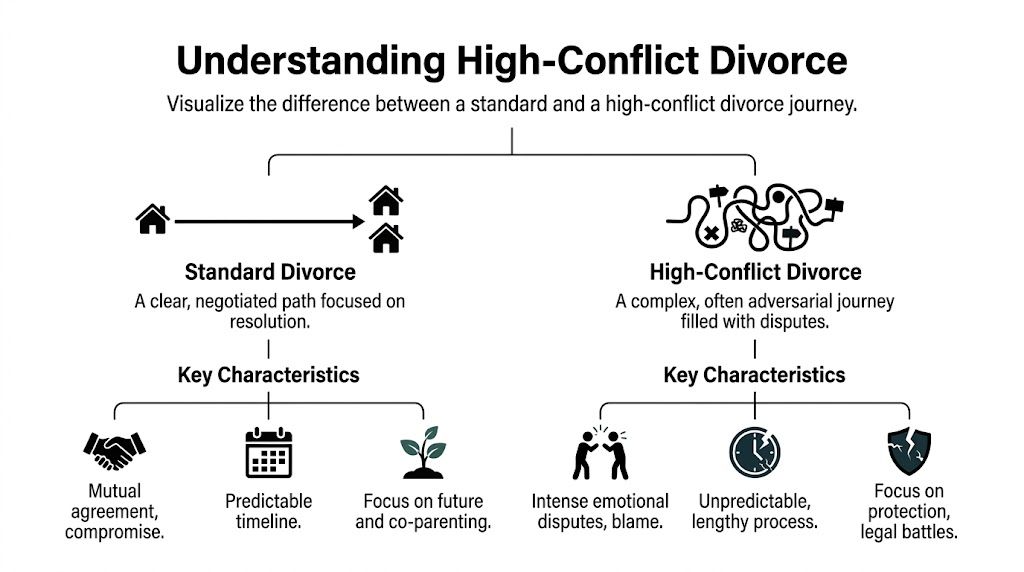
A standard divorce usually looks like a hard business negotiation. People may disagree, but both sides still understand that the case needs to end.
A high-conflict divorce is different. It behaves more like a running dispute with no natural stopping point. One person may treat every text, exchange, or court setting as another chance to control the situation.
The difference is behavior, not just emotion
Every divorce has emotion. Anger alone doesn't make a case high-conflict.
What changes the category is a repeated pattern of conduct such as refusing to exchange information, filing unnecessary motions, using the children to gain an advantage, or making every small issue into a courtroom issue. If you're facing a fully contested case, this overview of a contested divorce in Humble helps explain the broader framework.
Entrenched conflict means the disagreement doesn't fade with time. It hardens. Each new issue pulls in old grievances, and settlement becomes harder because trust is already gone.
Common features of a high-conflict case
Some signs show up early. Others appear after filing.
- Communication breaks down: Conversations stop being about solutions and start being about blame, intimidation, or baiting.
- Cooperation disappears: One spouse won't sign, won't disclose, won't answer, or agrees one day and reverses the next.
- Parenting becomes a battleground: School choices, pickups, medical issues, and routine decisions turn into loyalty tests.
- Financial disputes intensify: Hidden accounts, incomplete disclosures, unusual spending, or sudden claims of poverty often surface.
- Court involvement expands: Temporary hearings, emergency requests, and repeated disputes become part of the case.
Why these cases need a different legal approach
In Humble, the legal market is crowded. The Super Lawyers Humble directory lists 190 top-rated divorce attorneys serving the area, and the same source notes that approximately 20-30% of divorces are classified as high-conflict. That matters because not every divorce lawyer approaches conflict the same way.
A high-conflict case usually requires tighter document control, clearer communication boundaries, and faster action when safety or child stability is at risk. You can't treat it like a standard file and expect the stress to stay contained.
In a high-conflict divorce, the question isn't only "What outcome do you want?" It's also "What structure will stop the chaos from spreading?"
What people in Humble often miss at the start
Many spouses wait too long to call the situation what it is. They think, "This is just a rough patch in the divorce," or "Once papers are filed, things will settle down."
Sometimes they do. Often they don't.
When the conflict is driven by control, resentment, or manipulation, the legal process itself can become another tool. That's why a high conflict divorce attorney humble residents trust should be looking beyond the petition and asking practical questions right away:
- What needs to be documented now?
- Are the children being pulled into the dispute?
- Is financial information already incomplete?
- Do we need immediate court orders to stabilize the home?
Those are the questions that separate a difficult divorce from a high-conflict one.
The Warning Signs Your Divorce Is Becoming High-Conflict
Individuals don't wake up one morning and neatly label their case "high-conflict." They notice patterns.
A pickup turns into an argument in front of the kids. A simple request for bank records gets ignored. A spouse who used to negotiate now threatens, rewrites history, or tries to recruit family members into the fight.

The red flags people describe most often
Ask yourself whether these sound familiar.
Parenting fights never stay about parenting
One parent says the child needs tutoring. The other turns it into an accusation about control. A discussion about bedtime becomes a fight about who is the "better parent."
That pattern matters because the topic isn't really the topic. The conflict keeps getting repackaged.
Financial information is always "coming later"
You ask for statements, tax returns, or business records. You get excuses, partial records, or silence.
In high-conflict divorces, that often signals a bigger strategy. Delay can create pressure. Pressure can push an exhausted spouse into a bad settlement.
Every exchange leaves you confused
You receive texts that deny obvious facts, twist prior conversations, or accuse you of things you didn't do. That can leave you second-guessing your memory and reacting emotionally when a calm record would help you more.
Keep the record cleaner than the conflict. Save messages, confirm agreements in writing, and don't rely on memory when the other side is rewriting events.
When the children start carrying the conflict
Many Humble parents feel the deepest alarm here.
A child suddenly repeats adult phrases that sound borrowed. A parent starts asking the child to report back. One parent undermines the other in front of the kids or pressures them to choose sides.
The gap in local online guidance is real. A review of Humble listings on Justia's divorce lawyer page for Humble shows plenty of general divorce listings, but less practical discussion of how to document parental alienation, even though the verified data notes it affects 11-15% of divorce cases. In real life, that means many parents know something is wrong but don't know what proof helps.
Here are examples that should put you on alert:
- The child delivers adult messages: "Mom said you're lying about money."
- Routine transitions become tense: The child seems afraid to enjoy time with one parent.
- You get shut out of information: School, therapy, or activities become harder to access.
- A parent starts a loyalty contest: Gifts, pressure, or guilt replace healthy co-parenting.
What does not work
In Atascocita and Kingwood cases, I often see good people make the same mistake. They try to argue the other spouse into fairness.
That rarely works when conflict is being used as a tactic.
It also doesn't help to flood the other side with emotional texts, involve the children in explanations, or wait months before organizing records. High-conflict cases reward calm documentation, not bigger reactions.
A short video may help frame that mindset before you decide your next move.
A simple self-check
If several of these are happening at once, your divorce may already be in high-conflict territory:
- You dread every communication: Because it usually turns hostile or manipulative.
- The children are being exposed: They hear too much, carry messages, or feel pressure to align.
- Money feels murky: Records are missing, spending has changed, or disclosure keeps stalling.
- The rules keep shifting: Verbal agreements vanish when it's convenient for the other side.
When those signs are present, the answer isn't to become louder. The answer is to become more strategic.
Your Legal Options and Strategies in a Contentious Divorce
A Humble parent wakes up to find the joint account drained, the school calling about a pickup dispute, and a text thread that has already turned ugly before 8 a.m. That is the point where a high-conflict divorce stops being a private argument and becomes a case that needs structure, deadlines, and enforceable court orders.
In Harris County, the right strategy depends on the problem in front of you. Some cases need immediate protection. Others need temporary rules, formal financial discovery, or a tightly managed settlement process. The goal is not to react to every provocation. The goal is to put the case on rails so a judge has clear facts to work with.

Protective orders and emergency relief
If there has been family violence, threats, stalking, or coercive control, waiting for the standard pace of a divorce can be a mistake.
Texas Family Code § 85.001 governs protective orders in cases where the facts support that relief. In real terms, this can limit contact, create distance, and give law enforcement and the court something concrete to enforce while the divorce is pending.
This is a serious remedy. Judges in Harris County expect specific facts, dates, messages, witnesses, photos, or police reports when they are available.
Temporary orders often decide how the next several months feel
For many families in Humble, Kingwood, and Atascocita, the first legal fight is about control of daily life. Who stays in the home. Who covers the mortgage or rent. Where the children sleep on school nights. How exchanges happen without another scene in the driveway.
Temporary orders can set rules on:
- Parenting time and exchange terms
- Temporary child or spousal support
- Use of the house, vehicles, and bank accounts
- Payment of bills and debt during the case
- Restrictions on harassment, property transfers, or financial gamesmanship
A weak temporary-orders hearing can create months of avoidable damage. A well-prepared one can stabilize the case early and reduce the number of emergencies later.
Discovery is how you prove a money case
High-conflict divorces often involve half-truths about income, spending, bonuses, business revenue, or debt. If the paper trail is incomplete, formal discovery matters.
That may include requests for production, interrogatories, subpoenas, depositions, and, in the right case, a forensic accountant. In Harris County, judges generally respond better to organized records than broad accusations. Bank statements, payroll records, tax returns, credit card statements, and app-based payment histories usually carry more weight than a spouse's suspicion alone.
A practical rule applies here. If one spouse has controlled the finances, assume records need to be gathered quickly and preserved correctly.
Mediation still has a place, if it is handled with guardrails
Mediation is not reserved for easy divorces. It can work in contentious cases when the issues are framed clearly, the documents are exchanged in advance, and each side understands what will happen if no agreement is reached.
That is especially true in Harris County, where crowded dockets can make a productive mediation worth serious attention. For some families, a mediated temporary agreement is the fastest way to stop constant conflict over possession schedules, bills, or use of the house. For others, mediation should wait until enough discovery has been completed to negotiate from a position of knowledge. A fuller explanation of that process is available on this page about divorce mediation in Humble TX.
The trade-off is simple. Mediation can save time and reduce public courtroom fighting, but it is a poor setting for a spouse who is still hiding documents or using intimidation to force concessions.
Child-focused tools can narrow the dispute
When the conflict centers on the children, the court may need help beyond each parent's version of events.
Depending on the facts, a lawyer may request:
- A custody evaluation, if serious concerns exist about parenting, home stability, or safety
- An amicus attorney, if the court needs an independent voice focused on the child's interests
- A detailed parenting plan, with precise exchange times, decision-making rules, travel terms, and communication boundaries
These tools are not automatic. They add cost and time. In the right case, though, they can give the judge a clearer record and reduce the room for future arguments.
A broad family law practice like Law Office of Bryan Fagan is one option families consider when they need help with divorce, custody disputes, and related court orders in Humble.
What a Dedicated High-Conflict Attorney in Humble Does for You
A high-conflict lawyer doesn't just file paperwork and wait for hearing dates. The job is to reduce openings for chaos.
In a routine divorce, an attorney may spend most of the case moving papers, negotiating terms, and finalizing details. In a high-conflict case, the lawyer often has to function as strategist, shield, evidence manager, and courtroom advocate at the same time.
The lawyer becomes the buffer
One of the fastest ways to calm a dangerous pattern is to stop direct damage where possible.
That can mean routing communication through counsel, narrowing what must be discussed, and making sure agreements are written instead of debated later. For many clients in Kingwood and Atascocita, this alone lowers the temperature because every baiting text no longer requires a personal reply.
The lawyer builds a case, not just a file
A dedicated high-conflict attorney is always asking: what can be proved, what needs corroboration, and what will matter to a Harris County judge?
That changes how the case is prepared. Instead of relying on verbal summaries, your lawyer should be organizing timelines, preserving digital communication, identifying records to subpoena, and separating noise from evidence.
Judges respond to facts they can verify. In high-conflict cases, the side with the cleaner record often stands on firmer ground than the side with the louder story.
The lawyer spots tactics early
High-conflict spouses tend to repeat patterns. Delay. Deflection. Sudden emergencies. Last-minute accusations. Selective disclosure.
A lawyer who regularly handles these files is less likely to treat those moves as isolated events. The value isn't only legal knowledge. It's pattern recognition.
That matters in Humble because there are many lawyers available. As noted earlier, the local market includes 190 top-rated divorce attorneys and approximately 20-30% of divorces are classified as high-conflict according to the verified data from the Super Lawyers listing cited above. In a field that large, families need to ask a sharper question than "Do you handle divorce?" They need to ask whether the attorney knows how to manage a spouse who uses the process itself to gain an advantage.
The lawyer protects your bandwidth
People underestimate how exhausting these cases become.
A strong attorney helps you decide what deserves a response, what should be documented for the record, and when court action is warranted. That protects more than your legal position. It protects your energy, your parenting focus, and your ability to keep working and functioning while the case is pending.
If you're looking for a high conflict divorce attorney humble families can rely on, that's the standard. Not someone who promises drama. Someone who can contain it.
How High-Conflict Cases Move Through Harris County Courts
The Harris County process feels intimidating when you're new to it. It becomes more manageable when you know the sequence.
For families in Humble, Atascocita, Kingwood, and Northeast Houston, the case usually starts with filing, service, and an early push for temporary structure. After that, the court expects the case to move through ordered steps rather than emotional improvisation.
Filing and the first court decisions
Once the divorce is filed and the other side is served, the first important question is whether the home, children, money, or safety issues need immediate attention.
In a high-conflict case, that often means requesting temporary orders. These hearings can shape the tone of the entire file because they create the first enforceable rules.

The role of the Associate Judge
Many family law matters in Harris County are first heard by an Associate Judge. That surprises people.
You may not walk into a final trial setting right away. Instead, you may attend hearings on temporary issues, discovery disputes, or enforcement-type matters before the Associate Judge, with later review options depending on the issue and posture of the case.
If you're unfamiliar with the local setup, this page on Harris County family court for Humble residents gives a useful overview.
What mediation usually looks like
In many Harris County divorce cases, mediation is part of the path before trial. In practical terms, that means both sides and their attorneys work with a neutral mediator to see whether some or all disputes can be resolved.
A few realities help clients prepare:
- You usually aren't telling your whole story to a judge that day: You're negotiating through counsel and the mediator.
- Preparation matters: Organized records and clear goals produce better mediation decisions.
- Partial settlement still helps: Even resolving some issues can narrow what remains for court.
If the case doesn't settle
Some high-conflict cases continue into more intensive discovery, expert involvement, and pretrial preparation.
That can include contested custody issues, financial tracing, or hearings over compliance with prior court orders. By that stage, the court is less interested in general complaints and more interested in specifics. Dates, records, testimony, and consistency matter.
The Harris County system rewards preparation. Clients who keep records, follow temporary orders, and stay disciplined usually help their attorney far more than clients who try to "win" every exchange outside court.
What local families should expect emotionally
The process isn't quick, and it isn't always neat.
But it is structured. That structure matters. Once enforceable orders are in place and a judge is supervising the file, the other side has fewer opportunities to operate in total disorder. For many clients, that's the first real relief they feel.
Estimating the Timeline and Financial Cost
This is the part people ask about hesitantly, even when they're more worried about the children or the house. They want to know how long this will last and what it may cost.
The honest answer is that high-conflict divorce is more expensive because conflict creates work. More hearings. More document review. More discovery fights. More preparation for things that should have been simple.
What the verified cost data shows
According to The Houston Divorce Firm's high-conflict divorce page, high-conflict divorce costs average $25,000-$50,000 in Texas, and these cases often last 18+ months versus 6 for uncontested cases. The same verified data explains that costs rise because lawyers may need tools such as forensic accountants or temporary orders to protect a client's financial stability during prolonged litigation.
That doesn't mean every case lands in the same place. It means you should budget with open eyes if your spouse is delaying, hiding information, or turning routine issues into prolonged disputes.
Where the money usually goes
Below is a practical way to think about cost phases.
| Phase | Description | Potential Cost Range |
|---|---|---|
| Early case stabilization | Filing, service, initial strategy, and temporary orders work to set basic rules | Varies |
| Discovery and records review | Gathering financial records, written discovery, subpoenas, and analysis of missing information | Varies |
| Experts and evaluations | Forensic accounting, custody-related professionals, or other case-specific expert support | Varies |
| Mediation and trial preparation | Mediation prep, exhibit organization, witness work, and courtroom preparation if settlement fails | Varies |
What works better than guessing
Clients handle this part better when they stop asking for a single all-in number and start asking phase-based questions.
Try these instead:
- What is the immediate priority: Safety, support, custody structure, or financial disclosure?
- What facts might trigger expert costs: Business ownership, hidden assets, or severe parenting allegations?
- What can be organized now: Statements, tax records, calendars, school records, and communication logs.
- What spending can be delayed elsewhere: So legal decisions aren't made from panic.
Cost control is strategic, not passive
People sometimes think controlling cost means "do less." In high-conflict divorce, that can backfire.
Sometimes the cheaper path is early action. A temporary order can stop months of instability. A well-targeted discovery request can expose a problem before trial prep expands. Organized records can lower attorney time spent reconstructing events.
The goal isn't to fight over everything. The goal is to spend intentionally on the issues that affect your safety, children, and long-term financial position.
Answering Your Pressing Questions About High-Conflict Divorce
How do I divorce a narcissistic spouse and protect myself
Start by shifting your expectations. You're not trying to persuade a difficult spouse to become reasonable. You're building a record and controlling the channels of conflict.
The verified data from Hernandez Law Firm's discussion of divorcing a narcissist states that in these high-conflict cases, legal costs can increase by 50-100% when a narcissistic spouse uses frivolous motions and other tactics to exploit the process. The same source notes that a specialized attorney may respond with early forensic accounting to trace hidden assets and protective orders under Texas Family Code § 85.001, and that emotional abuse affects custody outcomes in 70% of such disputes.
Practical steps help:
- Keep communication in writing: Short, factual, and child-focused when children are involved.
- Save everything: Texts, emails, financial records, calendars, screenshots.
- Don't argue every lie: Your attorney can decide which falsehoods matter legally.
- Act early on safety: If there are threats or coercive conduct, ask about protective relief.
What are the best ways to shield my children from the conflict
Children do better when parents stop using them as go-betweens. That sounds obvious, but in high-conflict divorces it takes discipline.
Use direct adult-to-adult channels for schedules and decisions. Keep children out of legal updates. Don't ask them to report what happens at the other house. If a child is showing stress, document the behavior and raise concerns through appropriate legal or therapeutic channels rather than through accusations in front of the child.
Children need consistency more than commentary. They should know the schedule, the rules in each home, and that the adult case isn't their job to solve.
What if my spouse makes false allegations against me
Don't respond with panic. Respond with structure.
False allegations should be handled through documented facts, witness identification where available, and compliance with existing orders. If an accusation relates to parenting, your day-to-day record matters. School involvement, medical follow-through, calm communication, and reliable exchanges all become relevant.
The worst response is often a reactive one. Angry texts, social media posts, or efforts to recruit mutual friends can deepen the problem.
Can high-conflict divorce ever settle without trial
Yes. Some cases settle after temporary orders create boundaries. Others settle in mediation once records are exchanged and the cost of further fighting becomes clearer.
But settlement only helps when it is durable. A rushed deal that ignores safety concerns, unstable parenting terms, or hidden financial issues may create a new round of litigation later. In high-conflict divorce, a fair agreement is important, but an enforceable and workable agreement is just as important.
If your divorce in Humble, Atascocita, Kingwood, or Northeast Houston is starting to feel like a constant fight instead of a legal process, it's time to get a plan. The Law Office of Bryan Fagan offers free consultations through its Humble office and helps local families address divorce, custody, property division, and other family law issues with clear next steps. A focused conversation can help you identify what needs immediate protection, what should be documented, and how to move through Harris County court with more control.