Skip to content
When you're facing the end of a marriage, you hear a lot of legal terms thrown around. "Contested divorce" is one of them, and it’s a phrase that can sound intimidating. It might bring up images of dramatic courtroom battles, but for most families here in Humble, the reality is usually much different.
A contested divorce in Humble simply means you and your spouse haven't agreed on everything just yet. That’s it. It’s not a declaration of war; it's an acknowledgment that you need the legal process to help you sort through some key disagreements. As local attorneys who care about our community, our goal is to guide you through this process with clarity and support.
What a Contested Divorce Really Means for Humble Families
It really boils down to disagreement. If you and your spouse could sit down at your kitchen table, write out a plan for your kids, your finances, and your property, and both sign off on it, you’d have an uncontested divorce. It's faster and less expensive because you've done all the hard negotiation work yourselves.
But for most people, that's just not realistic. A contested divorce begins the moment it’s clear you can’t agree on one or more major issues. For families in our community—from Humble and Atascocita to Kingwood and across Northeast Houston—these sticking points are almost always the most personal and emotionally charged parts of the separation.
The most common areas where we see disagreements are:
- Child Custody and Visitation: Who will be the primary parent the kids live with? How will you and your ex split holidays, birthdays, and summer vacations in a way that feels fair for everyone involved?
- Child Support: Texas has specific guidelines, but disagreements often arise over a parent's true income, or how to pay for things like private school, medical needs, or extracurricular activities.
- Property Division: How do you fairly divide the house, the cars, the retirement accounts, and the credit card debt you’ve accumulated together? According to Texas law, this is rarely a simple 50/50 split.
- Spousal Support: This is a big one. One spouse may need financial support to get back on their feet after the divorce, while the other may not feel they should have to pay it.
To help you see the difference more clearly, here’s a quick breakdown.
Contested vs. Uncontested Divorce At a Glance
This table offers a simple comparison to help you identify which path your divorce might take. Keep in mind that many cases start contested but become uncontested as agreements are reached through negotiation or mediation.
| Feature | Contested Divorce | Uncontested Divorce |
|---|---|---|
| Agreement | Spouses disagree on one or more key issues (e.g., custody, property). | Spouses agree on all issues before filing with the court. |
| Process | Requires negotiation, mediation, and possibly court hearings or a trial. | A lawyer drafts agreed-upon paperwork for a judge to review and sign. No trial is needed. |
| Timeline | Typically 6-12 months in Harris County, but can be longer depending on complexity. | Can be finalized in as little as 61 days (the minimum waiting period in Texas). |
| Cost | Generally higher due to legal fees for negotiation, mediation, and court time. | Significantly lower, often a flat fee, as the legal work is more straightforward. |
| Court Involvement | A judge will make decisions on any issues the couple cannot resolve. | A judge simply reviews and approves the couple's pre-made agreement. |
Ultimately, the path your divorce takes depends entirely on your ability to find common ground with your spouse.
It's crucial to know that "contested" does not mean your divorce is destined for a full-blown trial. In fact, most contested divorces in Harris County never see the inside of a trial courtroom. The legal process is specifically designed to guide you toward a settlement through tools like mediation.
At The Law Office of Bryan Fagan, we approach a contested divorce as a problem that needs a strategic, practical solution—not a battle that needs to be won at all costs. Our focus is on protecting what matters most to you: your children, your financial security, and your future. It starts with understanding where you are right now and where you need to go.
Let's talk about your situation. Schedule a free consultation with our Humble office today, and we can help you find a clear path forward.
The Contested Divorce Process in Harris County Step by Step
When you and your spouse can’t agree on the terms of your divorce, the Texas court system provides a structured path to help you resolve those disputes. For our clients in Humble, Atascocita, and Kingwood, understanding this process from the start is the best way to reduce stress and feel in control.
It’s not as complicated as it might seem. Think of it as a series of well-defined stages, each with a specific goal. Let’s walk through the roadmap you can expect in a Harris County contested divorce.
The diagram below shows the fundamental difference between an uncontested divorce and a contested one. The contested path has more steps, but they are all designed to guide you toward a final resolution.
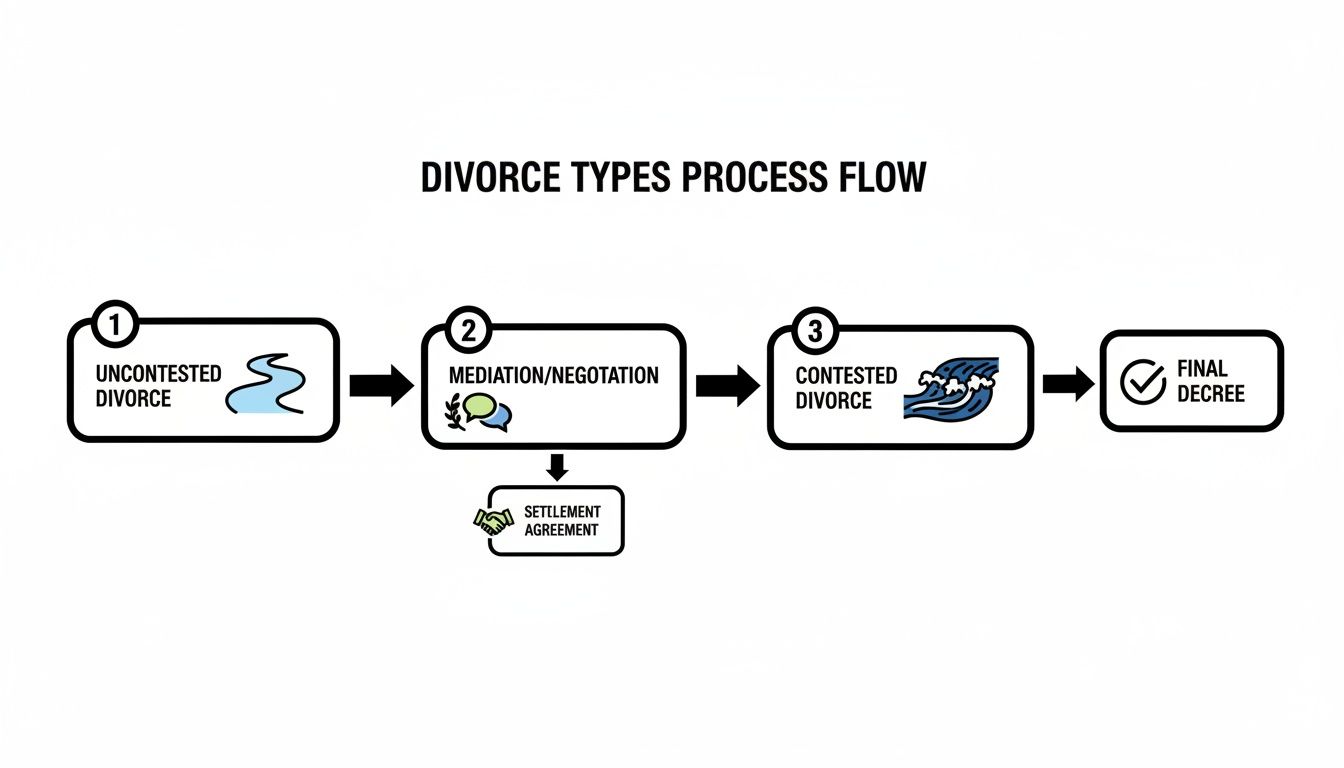
As you can see, these extra steps are necessary tools for when you and your spouse need the court's help to move forward.
Step 1: Filing the Original Petition for Divorce
Your divorce case officially begins the moment one spouse—known as the "Petitioner"—files an Original Petition for Divorce with the Harris County District Clerk. This is the legal document that initiates the lawsuit. It informs the court that the marriage is over and states what you are asking for on issues like property division and child custody.
To file in Harris County, either you or your spouse must have lived in Texas for at least six months and in the county for the last 90 days. Filing the Petition also triggers Texas’s mandatory 60-day waiting period, which is the minimum time that must pass before a judge can finalize your divorce.
Step 2: Serving Your Spouse
After filing the petition, your spouse (the "Respondent") must be given formal legal notice that a lawsuit has been filed. This crucial step is called "service of process," and it’s a constitutional right.
Typically, a sheriff, constable, or private process server will personally hand-deliver a copy of the lawsuit paperwork to your spouse. This delivery proves to the court that your spouse is officially aware of the divorce case and its deadlines.
Step 3: Receiving the Answer
Once served, your spouse has a specific amount of time to file a legal document called an "Answer." This is their official response to what you requested in your petition. In a contested divorce, it's almost guaranteed they will file an Answer, and they will likely file their own "Counter-Petition," which details what they want the court to award them.
Step 4: The Critical Temporary Orders Hearing
This is one of the most important hearings in your entire case. A contested divorce can take many months to resolve, so you need rules to live by in the meantime. At a Temporary Orders Hearing, a judge will make decisions on urgent matters to establish stability until the divorce is final.
Key issues decided here include:
- Who gets to live in the family home?
- Who will be the primary parent for the kids?
- What will the temporary visitation schedule look like?
- How will community bills be paid?
- Will one spouse receive temporary child support or spousal support?
These orders are legally binding and set the tone for the rest of the case. Because every word matters in these hearings, a clear record is vital, which is why parties often rely on professional legal court transcription services to document the proceedings.
A Crucial Takeaway: While these orders are called "temporary," they often set a powerful precedent. If an arrangement is working well, especially for the children, a judge might be reluctant to change it in the final decree. This is why strong preparation for this hearing is essential.
Step 5: The Discovery Process
Discovery is the formal, pre-trial investigation phase. This is where your attorney gathers all the necessary information, evidence, and documents from your spouse to build your case. It’s how we uncover the full picture of your community estate and get the facts needed to argue for custody.
This process involves sending legal requests for financial records, emails, text messages, and any other evidence relevant to your disputed issues. It ensures that both sides have access to the same information, promoting fairness.
Step 6: Mediation—A Required Step in Harris County
Harris County courts require you and your spouse to try and settle your case through mediation before you can go to trial. You, your spouse, and your respective attorneys will meet with a neutral third-party mediator whose job is to help you negotiate and find common ground.
Mediation is incredibly effective. In our experience, the vast majority of contested cases reach a full settlement in mediation, allowing families to avoid the financial and emotional cost of a public trial. It gives you control over the outcome.
Step 7: Final Trial
If you’ve exhausted all other options and still can't agree, your case will be scheduled for a final trial. At trial, both sides will present their evidence, call witnesses, and make legal arguments to a judge. The judge will then listen to everything and make the final, binding decisions on all your unresolved issues.
A trial is always the last resort. It takes the decision-making power out of your hands and puts it into the hands of the court, but it provides a definitive end when no agreement can be reached.
Key Disagreements in a Texas Contested Divorce

When a divorce turns from amicable to contested, it almost always boils down to a handful of core issues. Knowing what you're actually fighting over is the first real step toward finding a solution. These are the aspects of your life that are tangled together—your kids, your money, and your property—and untangling them is what a contested divorce is all about.
Let's walk through the major sticking points we see in Texas divorces, explaining them from the perspective of our neighbors here in Humble, Atascocita, and across Northeast Houston.
Child Custody and Visitation
For any parent, the kids come first. It’s no wonder, then, that disagreements over children are the number one reason a divorce becomes a legal battle. Texas family law has its own language for this, which can seem confusing, but the ideas behind the words are what really matter.
Conservatorship: This is what the court calls custody. It defines who has the right to make critical decisions for your child—things like where they go to school, what doctor they see, and their religious upbringing. The starting point for Texas courts is a Joint Managing Conservatorship, where both parents share these rights and duties.
Possession and Access: This is simply the visitation schedule. It’s the calendar that lays out exactly when the child will be with each parent, covering everything from regular weeks to holidays and summer break. Usually, one parent is named the "primary" conservator, giving them the right to decide where the child lives (within a certain area).
A Harris County judge’s decisions on these matters are driven by a single, powerful principle: the "best interest of the child." This isn't just a phrase; it's a legal standard that forces the court to look at everything—each parent's stability, the child's emotional and physical needs, and who can provide the safest home—before making a ruling.
Child and Medical Support
Right alongside custody, financial support for the children is a major point of conflict. While Texas uses a specific formula to calculate a baseline for child support, that doesn't stop arguments from happening. We often see disputes over one spouse's true income, especially if they're self-employed, work for tips, or get paid in cash.
But it's more than just the monthly check. Parents also have to figure out how to cover all the other costs of raising a child.
These often include:
- Who will provide health and dental insurance.
- How you'll split out-of-pocket medical bills, like co-pays or braces.
- Contributions for extracurricular activities, school supplies, or private school tuition.
Our role as your Humble divorce attorneys is to make sure any financial support ordered is fair, accurate, and truly reflects your family’s financial reality and your children’s needs.
Dividing Community Property
Texas is a community property state, a fact that completely shapes how your assets and debts are handled. Grasping the difference between community property and separate property is absolutely essential.
Key Legal Concept: In Texas, community property is basically anything you or your spouse earned or acquired while you were married. Separate property is what you owned before the marriage, or what you received during the marriage specifically as a gift or inheritance. The law assumes everything is community property unless you can prove otherwise with clear and convincing evidence.
Disagreements over property can get intense, particularly when there are significant assets on the line. For families in our area, this might involve fighting over:
- The family home in a Kingwood neighborhood.
- Retirement funds like a 401(k) or a pension.
- A small business operating out of Humble.
- Cars, boats, investment accounts, and even shared credit card debt.
A judge must divide your community estate in a "just and right" manner. This doesn't automatically mean a 50/50 split. The court can consider many factors, including who was at fault for the divorce, differences in earning potential between you and your spouse, and the children's needs. To get a better handle on this, you can learn more about what community property is in Texas in our detailed guide.
While these disagreements can feel overwhelming, they are all solvable. With the right strategy and a clear understanding of Texas law, you can navigate these hurdles and protect your future.
How to Prepare for Your Contested Divorce

Walking into a contested divorce in Humble often feels like you’ve lost control of your own life. We've seen it with countless clients from our community. But the single best thing you can do to get back in the driver's seat is to prepare. Getting organized from the very beginning doesn't just lower your stress; it gives your legal team the raw materials needed to build your strongest case.
For the families we work with in Humble, Atascocita, and Kingwood, we find that a solid, actionable plan is the best starting point. It's about gathering the right information to protect your future, piece by piece.
Your Essential Document Checklist
First things first, we need to get a handle on your finances. The court needs a complete and honest picture of your marital estate, and that picture is painted with documents. These records are the backbone of your case, providing the hard facts for arguing a fair division of property.
Start collecting these items as soon as you can:
- Income Records: Recent pay stubs for you and your spouse (if you can get them), along with W-2s and any 1099 forms.
- Tax Returns: At least the last two to five years of your joint federal income tax returns.
- Bank Statements: A year's worth of statements for every checking and savings account.
- Property Deeds: The official deeds to your house and any other real estate you own.
- Vehicle Titles: Titles for all cars, boats, RVs, or other vehicles.
- Retirement & Investment Accounts: The most recent statements you have for any 401(k)s, IRAs, pensions, or brokerage accounts.
- Debt Statements: Bills or statements for your mortgage, car loans, student loans, and credit cards.
Putting in this effort upfront is a game-changer. When you hand your attorney a well-organized file, you're not just making their job easier—you're saving yourself time and money in legal fees.
Documenting Key Events and Information
Financial papers tell one part of the story, but your own notes can be just as crucial, especially when kids are part of the equation. To make decisions about your family, the judge needs to understand the day-to-day reality of your lives, and a simple log can speak volumes.
We always advise our clients to start a private journal or a secure digital document to track important events. This isn't about slinging mud; it's about creating a factual record.
A Lawyer’s Advice: Keep your log objective. Write down dates, times, specific actions, and what was said. Avoid emotional language or interpretations. Stick to the facts, because this journal could very well end up as evidence in court.
For example, if your spouse is consistently late for pickups or skips their time with the kids, write it down every single time. If you notice large, unusual withdrawals from a joint account, record the date and amount. This detailed log creates a clear pattern that is far more compelling to a judge than a vague complaint.
This level of preparation is absolutely essential in Texas, where community property rules can make divorces complicated. We see how property and custody issues drive conflict every day. While statistics show the U.S. has 2.5 divorces per 1,000 people, what matters is your case, and preparing detailed evidence is how you make your case stand out. You can discover more insights about these global divorce rate trends to see how local issues fit into a larger picture.
At The Law Office of Bryan Fagan, we see ourselves as your partners in this process. We'll show you exactly what to gather and how to document information effectively. Feeling prepared is the first step toward feeling confident.
Let's start building your plan together. Contact our Humble office for a free, no-obligation consultation, and we can help you get your case organized for success.
Why a Local Humble Divorce Lawyer Matters
When you're facing a contested divorce, picking your attorney is arguably the most important decision you'll make. Sure, any licensed lawyer in Texas can technically handle your case. But there’s a world of difference between a lawyer who just works in the system and one who lives and breathes the local Humble-area legal community.
Think of it this way: a local attorney from Humble, Atascocita, or Kingwood has a home-field advantage. They have spent years in the Harris County family courts. They know the judges, their staff, and how they tend to approach hot-button issues like custody arrangements or splitting complex assets. That kind of on-the-ground intelligence isn't something you can look up in a book; it’s earned. This insider knowledge helps shape a smarter, more effective case strategy from day one.
The Advantage of a Community Connection
There's a different level of accountability when your lawyer is also your neighbor. At The Law Office of Bryan Fagan, we aren't just a downtown firm with a satellite office; we are part of the fabric of this community. Our kids go to local schools, and we shop at the same stores. We genuinely understand the challenges families face in Northeast Houston because we're facing them, too.
This deep-seated local knowledge is a powerful tool in a contested divorce in Humble. We’re familiar with local property values when it's time to divide a home, and we understand the dynamics of our school districts, which is crucial for building a solid custody plan. It allows us to build arguments that are grounded in the reality of your life here, not some generic template.
A local attorney sees you not just as a case file, but as a member of the community they are committed to serving. This personal investment translates into a more compassionate and dedicated approach to protecting your family and your future.
More Than Just Legal Advice
A contested divorce is draining—emotionally, mentally, and financially. You need more than just a legal technician; you need a steady, reassuring guide. National data shows that with 42-45% of first marriages ending in divorce, this is a path many people walk. But statistics don't capture the personal weight of a legal fight. That's where having an attorney who offers genuine, local support can change everything.
When you work with our Humble office, you get an ally who is truly invested in your well-being. This local focus also means we take our responsibilities to you seriously, including protecting your privacy. Any reputable firm will prioritize strong cybersecurity for law firms to keep your sensitive personal and financial data locked down. To learn more about what to look for, you can read our guide on how to choose the right divorce lawyer.
At the end of the day, a local lawyer offers a unique combination of professional skill and personal dedication that's tough to find elsewhere. We're here to help you get through the complexities of a contested divorce with the confidence that comes from having a knowledgeable team right in your own backyard.
Don't face this challenge alone. Schedule a free, no-obligation consultation at our Humble office today. Let's talk about how our local expertise can protect what matters most to you.
A Few Common Questions About Contested Divorce
When you're staring down the barrel of a contested divorce, your mind is probably racing with questions. The "what ifs" can feel endless, and the uncertainty is often the most stressful part. We get it. We've sat down with countless people from right here in Humble and Northeast Houston who were in the exact same spot you're in now.
To help bring some order to the chaos, here are some straight-talking answers to the questions we hear most often. Keep in mind, though, that every family's story is different. The best advice will always come from a real conversation about your specific situation.
How Long Will My Contested Divorce Take in Harris County?
This is usually the first thing anyone asks, and the only honest answer is: it depends. Texas law requires a 60-day minimum waiting period from the day the divorce is filed before it can be finalized. But in a contested case, you'll almost certainly go well beyond that.
A realistic timeline for a moderately contested divorce in Harris County is anywhere from six to twelve months. If you’re dealing with very complex assets, a high-conflict custody battle, or a spouse who seems determined to drag their feet, that can easily stretch to 18 months or even longer. The more issues you and your spouse disagree on, the more time is needed for legal work like discovery, mediation, and court hearings. The fastest path is always finding a way to agree.
What Is the Likely Cost of a Contested Divorce in the Humble Area?
Like the timeline, the cost of a contested divorce in Humble isn't a single, fixed number. The biggest factor is attorney's fees, and those are based on one thing: time. The more time your case requires, the more it will cost. It's that simple.
Here’s what really drives the expense:
- The Level of Conflict: If every single issue turns into a battle, that means more phone calls, emails, legal filings, and negotiation time. All of that adds up.
- The Complexity of Your Estate: Dividing a house, a couple of cars, and a 401(k) is one thing. Untangling a family business, rental properties, or complicated investment accounts requires much more legal work.
- Custody Fights: When you need to involve outside experts, like a child custody evaluator or an amicus attorney (an attorney appointed to represent the child), those professionals have their own fees that become part of your overall cost.
- The Other Side: Frankly, the attitude of your spouse and their lawyer plays a huge role. If they are unreasonable and refuse to cooperate, they will drive up the cost for everyone involved.
Ultimately, the most affordable contested divorces are the ones where both people, with the help of their lawyers, can set aside the emotion and work toward a practical, business-like solution.
What Happens if My Spouse Refuses to Sign the Divorce Papers?
This is a very common fear, but let's put it to rest: your spouse cannot legally force you to stay married. In Texas, you do not need their permission to get a divorce.
If your spouse is served with the divorce petition but then refuses to file a response or participate, you aren't stuck. We can move forward and ask the court for a "default judgment." This means you get to present your side of the case to the judge, and since your spouse chose not to show up and participate, the judge can grant the divorce based on the information you provide. Their refusal to sign doesn't stop the process; it just means they give up their right to have a say in the outcome.
Key Insight: A spouse's refusal to cooperate is a delay tactic, not a deal-breaker. The Texas legal system is designed to move forward, even if one person tries to put on the brakes.
Do I Need a Temporary Restraining Order (TRO)?
Think of a Temporary Restraining Order (TRO) as an emergency "pause" button. It's a court order we can get right at the beginning of a divorce to keep everything stable and prevent one person from causing immediate, irreversible damage.
You should seriously consider a TRO if you're worried your spouse might:
- Empty the bank accounts or max out the credit cards.
- Sell, give away, or hide community property.
- Harass you, your family, or your kids.
- Try to take the children out of the area without permission.
A standard TRO is often filed right along with the initial divorce petition. It puts immediate ground rules in place for both of you until a judge can hold a Temporary Orders Hearing to make more detailed decisions for the rest of the case. If you have even the slightest fear that your spouse might do something destructive, you need to bring it up with your attorney right away.
Facing a contested divorce is a heavy burden, but you don’t have to carry it by yourself. Here at The Law Office of Bryan Fagan, our roots are in the Humble community. We're dedicated to giving our neighbors clear, honest guidance when they need it most. We can answer your questions and help you map out a strategy to protect what matters most—your family and your future.
Take the first step. Call our Humble office and schedule a free, no-strings-attached consultation today. Let’s talk about how we can help. Schedule your free consultation here.