Skip to content

A parent passes away in Humble. The family gathers in the living room, someone finds the will, someone else is calling the bank, and another relative is asking what happens to the house. In a matter of days, grief gets mixed with paperwork, deadlines, and worry.
That’s where many Lake Houston families get stuck. They’re not just mourning. They’re trying to figure out what to do next without making a mistake.
If you’re looking for a probate attorney near Lake Houston, you’re probably dealing with exactly that kind of stress. Maybe you live in Humble, Atascocita, Kingwood, or another part of Northeast Houston. Maybe you’ve heard the word “probate” before, but no one has explained it in plain English. This guide is meant to do that.
Navigating Loss in the Lake Houston Community
Maria’s father lived near Atascocita and owned a modest home, a truck, and a checking account. After he passed, the family thought they could take the death certificate to the bank and transfer everything. Instead, they ran into questions they didn’t expect.
Was there a valid will? Who had legal authority to act? Could the house be sold yet? What about bills still arriving in the mail?
Those questions are common in Humble, Kingwood, and across Northeast Houston. Families often assume probate is only for very wealthy estates or bitter disputes. In reality, probate is often just the legal process that gives someone authority to wrap up a loved one’s affairs under Texas law.

There’s also a practical side that hits fast. You may need to secure the home, sort through personal belongings, and decide what to keep, donate, or remove. For families facing that part of the process, this resource on handling an estate cleanout can help you think through the logistics without adding more confusion.
Why local guidance matters
Harris County probate has its own procedures, forms, and expectations. A family in Kingwood or Humble doesn’t just need general internet advice. They need guidance that fits the local court system and the realities of property, family, and finances in this community.
If you want a local overview of the court system itself, this page on Harris County probate court in Humble is a helpful starting point.
Probate feels intimidating at first because families are trying to learn law while they’re grieving. The process gets easier once you break it into small steps.
Understanding Probate in Simple Terms
Think of probate as closing the books on a person’s financial life. It creates a legal path to collect assets, deal with debts, and transfer what’s left to the right people.
Without that legal process, banks, title companies, and other institutions often won’t know who has authority to act. Even in close families where everyone agrees, third parties still want court-backed proof.
The basic idea
Probate usually does three things:
- Validates the will if there is one
- Appoints the person in charge of the estate
- Clears the way for transfer of property after required obligations are handled
That’s the heart of it. Probate isn’t designed to punish families. It’s the court’s way of making sure property passes legally and in an orderly way.
Common probate terms in plain English
A few words tend to confuse people right away.
- Will means the written document stating who should receive property and who should handle the estate.
- Estate means everything a person owned that must be handled after death.
- Executor means the person named in a will to take charge of the process.
- Beneficiary means the person who receives property under a will.
If there’s no will, the court may appoint an administrator instead of an executor. The job is similar, but the path is usually more involved because the court has to rely on Texas law to determine who inherits.
Probate is different from estate planning
Families often mix up these two ideas.
Estate planning happens while someone is alive. That includes wills, trusts, beneficiary designations, and transfer choices. Probate happens after death if court involvement is needed.
Some assets pass outside probate. Others don’t. If you’re unsure which property may require court action, this page on what assets go through probate can help you sort that out.
For readers who want an additional plain-language overview from a general education source, Evermore Directory’s comprehensive probate guide may also be useful.
Practical rule: The question usually isn’t “Did my loved one have a will?” The better question is “What property still needs legal authority to transfer?”
Your Guide to Harris County Probate Options
Not every estate in the Lake Houston area goes through the same kind of probate. That’s where many national articles fall short. They explain probate as if there’s only one route, when Texas offers several.
The right path depends on whether there’s a will, what kind of property is involved, and how much court supervision the estate needs.
A side by side look at common options
| Option | Best fit | Main benefit | Main caution |
|---|---|---|---|
| Independent Administration | Estates that need probate but can be handled with limited court oversight | More efficient day-to-day administration | The executor still has duties and deadlines |
| Dependent Administration | Estates needing closer court supervision | Added oversight | More court involvement often means more expense and delay |
| Muniment of Title | Real property-focused estates with a valid will and no need for full administration | Streamlined transfer path | It only fits certain fact patterns |
| Small Estate Affidavit | Smaller qualifying estates under Texas law | May avoid full probate | Strict eligibility rules apply |
Independent Administration
This is often the practical choice when a valid will exists and the estate can be handled without constant court approval. The executor still has serious responsibilities, but the process is generally less burdensome than a dependent administration.
For many families in Humble and Atascocita, this option works well when there’s a home, bank account, and personal property, and the heirs are largely in agreement.
Dependent Administration
This is the more supervised version. The court stays more involved, and more actions may require approval.
That added supervision can be useful in difficult situations, but it can also create more paperwork and friction. If there’s conflict among heirs or concern about how assets are being handled, the court may require this route.
Muniment of Title
This option deserves more attention than it gets. For some estates with a valid will, especially those centered on real property, muniment of title can be a leaner way to clear title without full administration.
A key gap in online information is the failure to mention affordable probate alternatives like muniment of title under Texas Estates Code § 257, which can save families 50%+ in fees for real property-only estates but requires knowledgeable local counsel to execute correctly in Harris County (Justia probate listings discussion).
That matters in communities like Kingwood and Lake Houston, where a family home is often the main estate asset.
Small Estate Affidavit
Texas also offers a shortcut for certain smaller estates. Texas probate law distinguishes small estate affidavits for estates under $75,000, excluding homestead and lienable assets, per Estates Code §205, enabling heirs near Lake Houston to circumvent full probate in 30 days via affidavit filing, which succeeds in 85% of qualifying Humble-area cases without court intervention (McCulloch & Miller probate information).
That doesn’t mean every smaller estate qualifies. The details matter. Ownership structure, debts, and the type of property involved can all affect whether this option is available.
A simple way to think about the choice
Ask these questions first:
- Was there a will: That often determines whether muniment of title or independent administration is possible.
- What assets are involved: A house raises different issues than a small bank account.
- Is the estate modest enough for a shortcut: Some families may qualify for a small estate affidavit.
- Are family members in agreement: Disputes usually push the case toward more oversight.
Some local firms, including the Law Office of Bryan Fagan, handle probate and estate administration matters for families in Humble and surrounding areas. The value of any local attorney in this setting is that they can look at the actual asset mix and help you avoid using the wrong procedure for your situation.
A Step-by-Step Walkthrough of the Probate Process
Probate gets less overwhelming when you stop viewing it as one giant legal event and start seeing it as a series of manageable tasks.
Here’s a practical walkthrough of how probate often unfolds in Harris County.
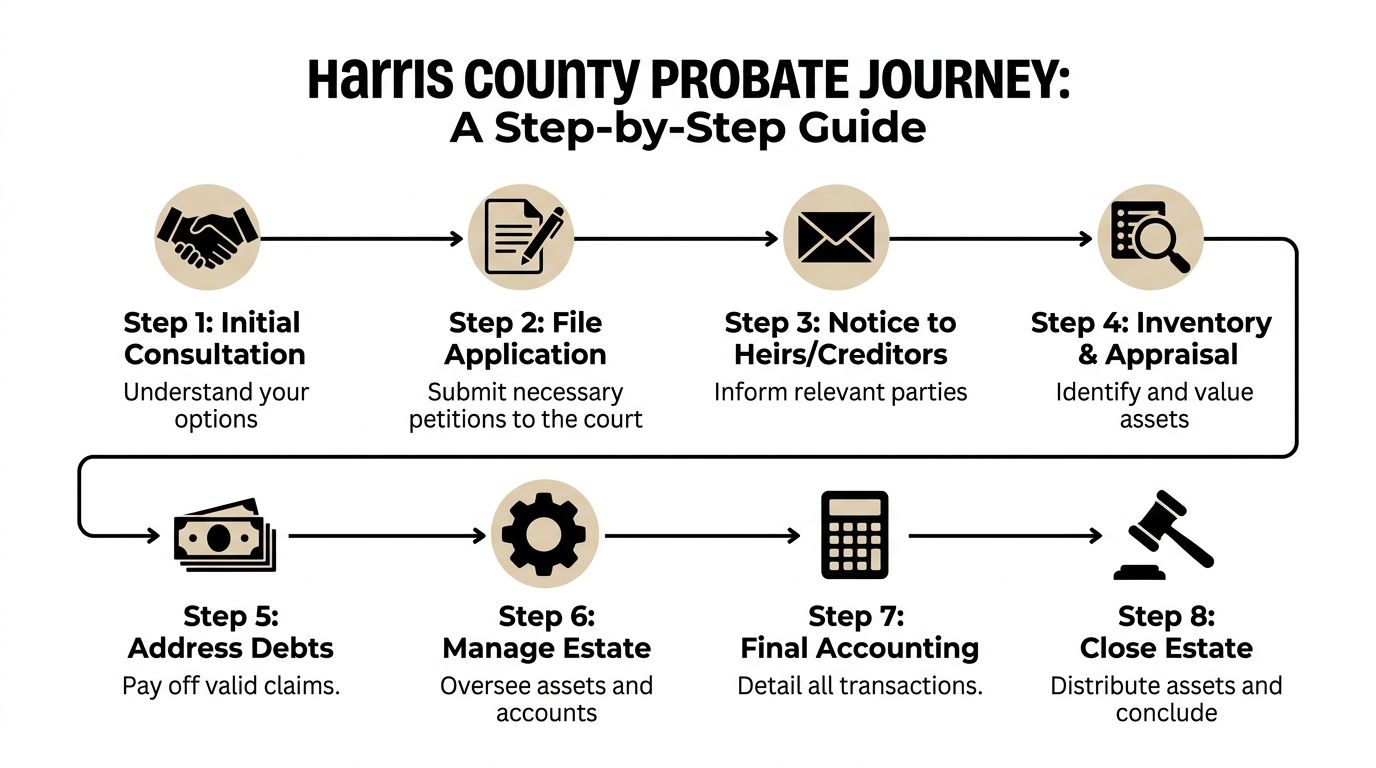
The probate roadmap
Gather the starting documents
Families usually begin with the death certificate, the original will if one exists, and a rough list of assets and debts.Meet with counsel and choose the right probate path
Before filing anything, it helps to confirm whether the estate needs full probate, muniment of title, or another procedure.File the application with the probate court
The formal probate case begins when the proper application is filed in Harris County.Attend the court hearing if required
The court reviews the filing, and if everything is in order, it may admit the will to probate and appoint the executor or administrator.Receive authority to act
This is the point where the personal representative can begin dealing with institutions, gathering information, and taking official steps on behalf of the estate.
Before going further, some readers like to see the process explained visually and verbally. This short video is a useful companion:
The middle stage where details matter
Notify interested parties and deal with estate administration tasks
That can include required notices, communicating with beneficiaries, and identifying valid claims against the estate.Prepare the inventory and appraisement
This part is easy to underestimate. In Harris County, an independent administration requires filing an inventory and appraisement within 90 days of the executor's qualification; failure to meet this deadline can result in court-ordered compliance and even potential removal of the executor under the Texas Estates Code (Troy M. Moore probate information).
That deadline is one reason families often want legal help early. Missing a requirement doesn’t just slow things down. It can create court problems for the person serving as executor.
- Pay valid debts and handle estate property
Some bills must be reviewed and addressed before distribution. The executor may also need to maintain a home, manage accounts, or gather sale proceeds if property is sold.
The final phase
- Distribute what remains and close out the estate
Once the required steps are complete, property can be transferred to the proper heirs or beneficiaries, and the estate can be wrapped up.
Here’s what that looks like in everyday terms:
- For the house: title issues may need to be cleared before a sale or transfer
- For bank accounts: institutions often want probate documents before releasing funds
- For personal property: the executor should track who receives what
- For family communication: regular updates help prevent misunderstandings
If you’re serving as executor, don’t guess your way through deadlines. A missed filing date can turn a straightforward estate into a stressful court issue.
For a more detailed local explanation of filings and court procedure, this guide on how to probate a will in Humble, Texas is a helpful next read.
Typical Probate Costs and Timelines for Local Families
One of the first questions families ask is the one they often feel awkward asking. What is this going to cost, and how long is it going to take?
That’s a fair question. It’s also one that many generic probate pages avoid.
What local families can expect
In the Houston area, typical probate costs include flat attorney fees of $3,500 to $6,500 for routine uncontested cases and court filing fees of $700 to $1,600. Standard probate timelines range from 6 to 12 months (West Loop probate cost overview).
That gives you a practical baseline, not a guaranteed quote for every case. Probate cost depends heavily on whether the estate is simple or contested and whether a simplified option applies.

What drives the price up or down
Some estates stay closer to the lower end because they have:
- A clear will
- Cooperative heirs
- A limited number of assets
- No major creditor problems
Other estates cost more because they involve:
- Family conflict
- Unclear property ownership
- Business interests
- Problems locating records or heirs
The same logic applies to timing. A routine estate can move steadily. A disorganized estate tends to slow down because every missing record creates another delay.
Cost transparency matters
If you’re comparing a probate attorney near Lake Houston, ask direct questions during the first conversation:
- Is this likely a flat-fee matter or hourly matter
- What filing fees should I expect
- Does this estate look eligible for a more affordable path
- What tasks will I handle myself, and what will the attorney handle
The right legal strategy isn’t always the most complicated one. Often, the goal is to use the simplest valid procedure that fits the estate.
For many families in Humble, Kingwood, and Atascocita, the best value comes from identifying the correct probate route early. That’s often where unnecessary expense begins or ends.
When to Partner with a Humble Probate Attorney
Some estates are simple enough that the main issue is choosing the right filing. Others become complicated fast.
The turning point usually isn’t emotion alone. It’s risk. If the wrong step could delay a transfer, trigger a dispute, or create personal liability for the executor, legal guidance starts to make real sense.

Situations where legal help is especially useful
A local probate lawyer is often worth involving when:
- There’s no will and family members disagree about who should handle the estate
- The estate includes real estate and title needs to be transferred correctly
- Creditors are involved and you’re unsure which claims are valid
- Someone is challenging the process or raising concerns about fairness
- The executor feels overwhelmed by court requirements and deadlines
Local knowledge saves more than time
A Humble-based attorney knows that Lake Houston area families are often dealing with a mix of home equity, retirement funds, personal property, and emotionally charged decisions about the family house.
A local lawyer also understands how to spot cost-saving procedures that broad national guides barely mention. One good example is the earlier discussion of muniment of title, which can reduce fees in the right kind of real-property estate.
That kind of guidance isn’t just about filing forms. It’s about protecting family relationships while keeping the estate moving.
Think of an attorney as a buffer
Probate can strain even healthy families. When one sibling is the executor and another sibling is suspicious, every decision can feel personal.
An attorney can act as the neutral process manager who explains the rules, prepares filings, and keeps the conversation focused on legal duties instead of family tension.
A good probate lawyer doesn’t just move paperwork. They reduce the chance that grief turns into conflict.
Your Probate Questions Answered
What happens if there is no will
Texas law still provides a path forward. The estate may still need probate, but the court will rely on intestate succession rules instead of a written will. That usually makes the process less flexible and sometimes more complicated for families.
Do all assets go through probate
No. Some assets pass outside probate, depending on how they were owned or whether a beneficiary was named. The key is identifying which assets require court authority and which transfer by contract or ownership structure.
Can the executor get paid
Possibly, but whether compensation applies and how it should be handled depends on the facts of the estate and the governing legal rules. This is one of those areas where families should be careful not to make assumptions.
Do I have to go to court myself
Often, much of the procedural work can be handled through your attorney, though some cases may still require appearances or participation depending on the filing and the court’s requirements.
What if the main asset is the house
That’s common in Humble, Kingwood, and Atascocita. The legal question becomes whether the home can transfer through a simplified procedure, a fuller administration, or another probate-related path. The answer depends on title, the existence of a will, and whether debts or other issues need to be addressed.
Is probate always a fight
No. Many probate matters are orderly and cooperative. Problems usually come from uncertainty, poor communication, or using the wrong legal process.
Your Next Steps for Peace of Mind
If you’re dealing with a recent loss near Lake Houston, you don’t need to solve everything this week. Start with the basics. Locate the will, gather key records, make a list of major assets, and get clear advice before taking action.
Probate in Harris County can feel heavy at first, but it becomes manageable when you understand the options. Families in Humble, Atascocita, Kingwood, and Northeast Houston often have more than one possible path. The important thing is choosing the one that fits your situation and avoids unnecessary cost or delay.
If you’re searching for a probate attorney near Lake Houston, local guidance can make the process clearer, calmer, and more efficient. A short conversation with a lawyer can help you understand whether you need full probate, a small estate approach, muniment of title, or another solution under Texas law.
If you need help with probate, wills, or estate administration in Humble, Atascocita, Kingwood, or Northeast Houston, contact the Law Office of Bryan Fagan to schedule a free consultation. Our Humble office can help you understand your options, explain the Harris County process in plain language, and take the next step with confidence.