Skip to content

Your phone is on the kitchen counter. There are unread texts from the other parent. School pickup is coming up. You’re trying to act normal for your child, but your mind keeps circling the same questions. Where will my child stay? What will a judge look at? Do I need a child custody attorney near Atascocita, or can I handle this myself?
If you live in Atascocita, Humble, Kingwood, or Northeast Houston, those questions are common. They’re also personal. A custody case doesn’t feel like paperwork. It feels like your child’s routine, your weekends, your holidays, and your peace of mind are all on the line.
I want to walk through this the way I’d explain it to a neighbor over coffee in Humble. Clear language. No scare tactics. No legal fog. Just a practical guide to how child custody works here in Harris County and what steps usually matter most.
Navigating Child Custody in Atascocita Your Family's Guide
A lot of parents first reach out when life has become unstable in small, exhausting ways. One parent moved out. A schedule that “sort of worked” suddenly stopped working. A child is asking where they’ll sleep next weekend. Nobody wants a courtroom fight, but nobody wants to give up their role in their child’s life either.
That’s where local guidance matters. An Atascocita custody case isn’t happening in the abstract. It’s happening in Harris County, with local judges, local filing rules, and real pressure on families trying to keep school, childcare, work, and co-parenting moving at the same time.

What most parents need first
Usually, it’s not a grand strategy. It’s clarity.
- What Texas calls custody
- How a case gets filed in Harris County
- What judges care about
- How to prepare before your first legal meeting
- Why local experience in Humble, Atascocita, and Kingwood can change how smoothly a case moves
You don’t need to know every law before you ask for help. You need to understand the next step and take it carefully.
If you’re feeling behind, you’re not. Most parents start this process while they’re still trying to manage work, school calendars, and emotional stress at home. The good news is that custody law gets much less intimidating when you break it into plain, practical pieces.
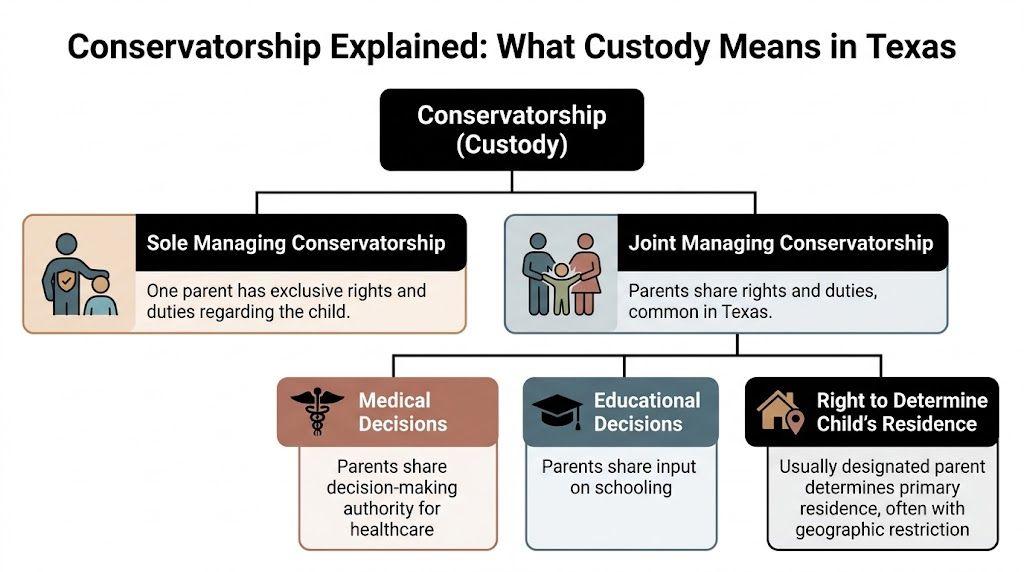
Conservatorship Explained What Custody Means in Texas
Texas uses a different word than commonly expected. Instead of “custody,” Texas law usually talks about conservatorship.
That sounds formal, but the idea is simple. Conservatorship means who has the rights and duties to make important choices for a child.
Think of it like co-captains and a single captain
A helpful way to remember this is to picture a team.
With Joint Managing Conservatorship, both parents are like co-captains. They share major decision-making responsibilities. Texas most commonly uses this arrangement. In Texas, child custody is legally termed conservatorship, and the most common arrangement is Joint Managing Conservatorship, where both parents share decision-making responsibilities, according to Modern Family Law’s Texas family law breakdown.
With Sole Managing Conservatorship, one parent is more like the single captain. That arrangement is less common and is typically used when one parent is considered unfit.
Decision-making and time are not the same thing
Many parents get confused at this point.
You can share decision-making rights and still have an uneven schedule for actual time with your child. A parent might have input on medical or school issues but not have equal overnights.
Common schedules in Texas can include:
- Alternating weekends
- 4-3 arrangements
- 2-2-5-5 schedules
- 50/50 plans
Some families do well with a customized arrangement, especially when school location, work shifts, or transportation make a standard schedule hard to manage.
Practical rule: Don’t assume “joint” automatically means “equal time.”
That matters because the split can still feel uneven in practice. The same Modern Family Law resource reports that while national statistics show mothers receive about 65% of custody time and fathers 35%, Texas fathers are awarded about 33% of custody time, which is about 120.5 days per year with their children. That gap is one reason parents often look for a child custody attorney near Atascocita before agreeing to a schedule they may later regret.
A note for unmarried parents
If you’re a father who hasn’t legally established parentage yet, custody rights can get more complicated before they get better. In that situation, understanding how to establish paternity in Texas can be an important first move before pushing for conservatorship or possession orders.
The main point is this. In Texas, “custody” is really a package of legal rights, parenting time, and responsibilities. Once you see those as separate pieces, the whole process starts making more sense.
Filing for Custody in Harris County Step by Step
When parents in Atascocita need a formal custody order, the case usually starts in Harris County. The process can begin online or in person, and parents generally file a petition with the appropriate family court, usually at the Harris County Civil Courthouse, as explained by Experts in Family Law’s Atascocita family law page.

Harris County courts are also known for being strict. That doesn’t mean every case becomes a fight. It means details matter. Missing information, improper service, or unclear requests can slow a case down or create avoidable problems.
Step one starts with the petition
In many cases involving children, a parent files the opening paperwork that asks the court to make orders about conservatorship, possession, and support.
The court can’t help until the case is formally opened. That sounds obvious, but many parents spend weeks arguing by text when what they really need is an enforceable structure.
Step two is making sure the other parent is properly notified
Filing the paperwork is only the start. The other parent usually has to be properly served or legally notified.
This is one place self-filed cases often run into trouble. Parents sometimes think sending screenshots or a text message is enough. Usually, it isn’t. Court rules on service have to be followed carefully.
If you’re trying to understand the mechanics of submission, signatures, and delivery options, this guide on how to file court documents gives a useful general overview of filing logistics.
Step three is asking for early stability
Many families can’t wait months for structure. They need rules now.
That’s where early requests may matter, such as:
- Temporary Orders that set a short-term schedule, support, and basic rules while the case is pending
- Emergency requests when there’s an urgent concern about safety, removal, or serious disruption
- Use and possession arrangements that reduce chaos while the adults sort out a long-term plan
The first orders in a case often shape the daily routine your child lives under while everything else is being decided.
What parents in Humble and Atascocita often overlook
Local procedure matters just as much as legal theory. A technically correct idea can still get bogged down if it’s poorly documented or badly timed.
That’s why many parents choose a local lawyer who already works in the Harris County system and understands how courts in Northeast Houston expect cases to be presented.
Here’s a quick way to understand it:
| Filing stage | What happens | Why it matters |
|---|---|---|
| Opening the case | A petition is filed with the court | It creates the legal framework for court orders |
| Notice to the other parent | Service or formal notice happens | Without proper notice, the case can stall |
| Early court requests | Temporary relief may be requested | It helps create stability for the child |
| Preparation for hearings | Evidence and parenting details are organized | Judges need clear, credible information |
A lot of anxiety eases once you can see the path. This short video gives helpful context on what parents should expect early in a custody matter.
The Best Interest of the Child Standard in Atascocita
The phrase you’ll hear again and again in a Texas custody case is best interest of the child. That isn’t a slogan. It’s the standard the court uses to make decisions.
For Atascocita families in Harris County, Texas Family Code Section 153.002 says conservatorship decisions hinge on the child’s best interest. Courts look closely at stability, each parent’s ability to provide a safe environment, historical caregiving roles, and the child’s emotional ties. The same Bryan Fagan Atascocita resource also notes that Harris County court data from 2022 to 2025 showed documented instability can significantly reduce a parent’s possession time, according to Bryan Fagan’s Atascocita family law page.

What that looks like in real life
Judges don’t award parenting rights based on who sounds the most upset or who has the longest text thread. They look for facts that connect to the child’s daily life.
A judge may care about questions like these:
- Safety at home. Is the child physically safe? Is the environment calm and appropriate?
- Routine and stability. Can this parent get the child to school, appointments, and activities consistently?
- Caregiving history. Who has been handling homework, meals, doctor visits, and bedtime?
- Emotional connection. Does the child have a strong, healthy bond with each parent?
- Co-parenting conduct. Is a parent encouraging the child’s relationship with the other parent, or constantly sabotaging it?
Three simple examples
Consider three common situations in Humble, Kingwood, and Atascocita.
Example one. One parent has a flexible story but no stable housing plan. The other parent can show where the child sleeps, how school drop-off works, and who watches the child after school. The second parent often looks more reliable because the court can see the structure.
Example two. A parent says the other one is “never around,” but has no calendar, no attendance records, no messages, and no witnesses. The claim may not carry much weight if it isn’t supported.
Example three. One parent has done most of the day-to-day parenting for years, but the other parent is involved and wants more time. That doesn’t automatically block expanded possession. It does mean the court will look hard at how to increase time without disrupting the child’s routine.
Good evidence isn’t dramatic. It’s usually ordinary records that tell a steady story.
What helps and what hurts
A strong custody presentation often includes organized, practical proof.
| Helps your case | Can hurt your case |
|---|---|
| School records | Frequent unexplained disruptions |
| Medical records | Missed exchanges or missed appointments |
| A parenting calendar | Angry messages sent in the child’s presence or about the child |
| Proof of stable housing | Unclear living arrangements |
| Evidence of cooperation | Refusal to communicate about important issues |
If you want a deeper look at the kind of proof courts respond to, this guide on how to prove best interest of child is a useful companion.
The core idea most parents miss
The court is not grading who’s the better person. The court is asking which arrangement best supports the child’s life.
That’s why “I love my child” is never the whole argument. The stronger argument is, “Here is the stable, healthy routine I can provide, and here is the evidence.”
How to Prepare for Your Consultation with a Custody Lawyer
The first meeting with a lawyer feels easier when you treat it like preparation, not confession. You don’t need a perfect memory. You need a clean set of facts, key documents, and a few questions that help you understand your options.
Some parents show up with only emotion. That’s understandable, but it makes strategy harder. Others bring a folder, a timeline, and screenshots that matter. Those meetings usually move faster because the attorney can spot issues early.
Bring the basics first
Start with the records that explain your family’s current situation.
| Item Type | What to Bring or Ask | Why It's Important |
|---|---|---|
| Court papers | Any existing orders, petitions, or notices | Shows what’s already been filed or ordered |
| Child information | School details, medical providers, activity schedules | Helps build a realistic parenting plan |
| Communication records | Relevant texts, emails, or co-parenting app messages | Gives context about disputes and cooperation |
| Financial records | Recent pay information and major child-related expenses | Helps evaluate support and practical planning |
| Timeline | A short written history of separation and caregiving | Lets the lawyer understand the case quickly |
| Questions | Ask about communication, likely next steps, and local court experience | Helps you decide whether the lawyer is a fit |
Ask practical questions, not just big emotional ones
A consultation is your chance to understand process and fit.
Good questions include:
- How do Harris County judges usually want these cases presented?
- What facts in my case seem strongest?
- What facts worry you?
- Do I need temporary orders soon?
- How should I communicate with the other parent while the case is pending?
- What should I stop doing today?
One useful planning resource is this guide on how to prepare for custody hearing. Even before a hearing is scheduled, it helps parents understand what kind of organization and mindset custody cases require.
Bring fewer documents that matter and more facts that can be verified. A stack of unrelated screenshots won’t help as much as a short, clear timeline with key records attached.
Don’t edit yourself into silence
Some parents hide bad facts because they’re embarrassed. That usually backfires.
If there was a heated exchange, a past move, a job change, or a rough period in co-parenting, tell your lawyer early. A good strategy accounts for weak spots. It doesn’t pretend they don’t exist.
Why Choose a Local Atascocita Area Attorney for Your Case
Not every custody issue is only about parenting time. Sometimes it’s tied to divorce, the house, retirement accounts, debt, or the question of how to keep a child’s life steady while the adults divide everything else.
That’s one reason local representation matters. A lawyer working in Humble, Atascocita, Kingwood, and Northeast Houston isn’t just closer to your home. That lawyer is dealing with the same court system your case will move through.
Local knowledge changes the experience
A local attorney can often help with things that don’t show up in a generic online article:
- Court expectations in Harris County
- Practical scheduling issues tied to schools, commutes, and exchanges in this area
- Coordination between divorce and custody issues
- More realistic advice about what needs immediate action and what can wait
This is especially important when property division and custody overlap. Under Texas Family Code §7.001, marital property division in Atascocita divorce cases must be “just and right.” Benchmarks cited in the Atascocita Super Lawyers material state that board-certified specialists achieve 15% to 30% more equitable distributions by using advanced financial models, and that Bryan Fagan’s Humble office reports success in complex property-custody matters, including securing trusts for children’s future education funds, according to Super Lawyers’ Atascocita family law page.
Why that matters to parents
If your custody case is part of a divorce, decisions about property can affect daily parenting reality. Who keeps the home? How will expenses be handled? What arrangement best protects the child from another major disruption?
Those aren’t side issues. They’re often part of the stability analysis.
Among local options, the Law Office of Bryan Fagan handles family law matters for parents in this area, including custody and conservatorship issues connected to divorce and property division. For many families, that kind of combined representation is relevant because the legal questions don’t arrive one at a time.
A local lawyer shouldn’t just know the law. That lawyer should understand the roads you drive, the courthouse your case enters, and the daily routines your child actually lives in.
Local fit also matters personally
You’re not hiring a voice on a national website. You’re choosing someone who can help you make decisions under stress.
That means you want clear communication, grounded advice, and a strategy that fits life in this part of Harris County. For families in Atascocita, Humble, Kingwood, and Northeast Houston, that local fit can make the process feel less abstract and much more manageable.
Take the First Step to Protect Your Family's Future
Custody cases feel heavy because they touch every part of family life. But the path gets clearer once you understand the terms, the filing steps, and the way Harris County courts think about a child’s best interests.
If you’ve been putting this off because you’re overwhelmed, start smaller. Gather your documents. Write down your timeline. Ask questions. Then talk with someone local who handles these cases in and around Humble and Atascocita.
If you’re comparing local legal options online, you may also find it helpful to see how local attorneys optimize their Google Business Profile for local success. It can give you a better sense of how law firms present location-specific information and how to evaluate whether a local office is active in your area.
A free consultation can turn a vague fear into a concrete plan. That first conversation is often the moment parents stop feeling stuck.
Frequently Asked Questions About Child Custody in Texas
Can parents agree on custody without a big court fight
Yes, sometimes they can. Parents may reach an agreement on conservatorship and possession. But the agreement still needs to be put into proper legal form and approved by the court to become enforceable.
How long does a custody case take in Harris County
It depends on the level of conflict, the court’s schedule, and whether emergency or temporary issues need immediate attention. Some cases move more smoothly when parents can agree on early rules. Others take longer because facts are disputed or documents are missing.
Can I change a custody order later
Yes, if circumstances change, a parent may be able to seek a modification. Common triggers include a major change in the child’s needs, a parent’s relocation, repeated problems following the current order, or a serious shift in stability.
Do I need a lawyer if my case seems simple
Some parents file on their own. But even a case that looks simple can become difficult if the paperwork is incomplete, the other parent disagrees, or temporary issues arise. Local legal advice often helps parents avoid mistakes early.
What if I’m worried about cost
That’s a fair question, and you should ask it directly during a consultation. Many parents benefit from discussing payment options, expected phases of the case, and what work is most urgent so they can plan realistically.
If you need help with a custody issue in Atascocita, Humble, Kingwood, or Northeast Houston, consider scheduling a free consultation with the Law Office of Bryan Fagan. A confidential meeting can help you understand your options, protect your parenting rights, and make a steady plan for your child.