Skip to content

Harris County handles a high volume of divorce cases each year. For families in Kingwood and Humble, that matters from the start because a busy court system can affect how quickly temporary orders are heard, how long paperwork takes to move, and how much planning a case requires.
A divorce case often feels less like one decision and more like four separate tracks running at the same time: children, property, monthly bills, and timing. A Humble parent may be focused on keeping school-week routines stable. A Kingwood homeowner may be asking a different question entirely, such as whether the house is community property even if only one spouse signed the deed. Those are different problems, but they sit inside the same case file.
Local details shape the experience. Families in northeast Harris County are often surprised to learn that even though they live in Kingwood, Humble, or Atascocita, much of the divorce process still turns on Harris County court procedure and downtown Houston logistics. That can affect work schedules, childcare planning, travel time, and the speed of hearings.
People searching for a divorce lawyer near Kingwood and Humble usually are not looking for legal jargon. They want clear answers about what happens first, what Texas community property rules really mean, how local court timing may affect strategy, and what the process is likely to cost in this part of Harris County.
The process becomes easier to handle when it is broken into stages and tied to real local concerns, including parenting schedules, property division, support, deadlines, and courthouse procedure.
Introduction to Harris County Divorce
A Kingwood couple may agree their marriage is over but disagree on what happens to the house. A parent in Humble may be less worried about the divorce itself than about where the children will sleep next month. An Atascocita spouse may already know the marriage is ending, but still have no idea how retirement accounts, debts, or temporary bills will be handled.
Those are normal concerns.
In Harris County, divorce isn’t rare or unusual. It’s part of a very active court system, and that matters because local procedure affects timing, negotiation pressure, and strategy. The law may be statewide, but the lived experience of divorce is local. For families in Humble, Kingwood, and Northeast Houston, that means balancing Texas Family Code rules with the practical realities of a downtown Houston courthouse and a busy docket.
What makes local divorces feel harder
Three things usually create the most confusion early on:
- Court location: Many residents are surprised that their case is usually handled through the Harris County Civil Courthouse in downtown Houston.
- Property questions: People often assume “my name is on it” decides ownership. In Texas, that’s not always true.
- Parenting uncertainty: Parents want stability fast, but temporary arrangements can take planning and legal care.
Practical rule: Divorce feels overwhelming when everything seems urgent at once. It gets easier when you separate the issues into categories: children, property, support, and timeline.
The good news is that divorce becomes more manageable once you understand the sequence. First comes filing. Then notice to the other spouse. Then temporary arrangements if needed. Then information gathering, negotiation, mediation, and either settlement or a court decision.
That’s the lens I want you to use throughout this guide. Not “How do I solve my whole divorce today?” but “What happens next, and what should I prepare for now?”
Understanding Divorce Process in Harris County
Texas divorce law gives you the framework. Harris County practice gives you the pace.
A divorce usually starts when one spouse files an Original Petition for Divorce. For most Humble and Kingwood residents, that filing goes through Harris County, and the case proceeds under Texas family law rules in a court system handling very high volume. As noted earlier, more than 15,000 divorces are filed annually in Harris County according to this Kingwood-area family law overview. That volume helps explain why local procedure and timing matter so much.
Where the process begins
The first legal step is filing. After that, the other spouse must be formally served or sign a waiver if the case is cooperative. From there, the court can address immediate needs like use of the home, temporary support, bill payment, and parenting schedules.
If you want a practical walkthrough of the filing stage, this guide on how to start a divorce in Humble, Texas is a useful next read.
The waiting period and what it means
Texas requires a 60-day waiting period for no-fault divorce cases. Many people hear that and assume the divorce will be over in two months. That’s only true in a narrow set of very simple, fully agreed cases.
If your case involves disagreement about custody, property, or support, the timeline often stretches because the court expects the parties to exchange information, attend hearings when needed, and often try settlement efforts before trial.
A divorce is a legal process, not a single court date. Most delay comes from unresolved issues, not just paperwork.
Community property causes the biggest confusion
Texas is a community property state. In plain language, property acquired during the marriage is generally presumed to belong to the marital estate unless someone proves otherwise.
That’s where people get tripped up. They may say, “I bought the car,” or “that account is in my name,” but the court asks a different question. Was it acquired during the marriage, and can separate ownership be proven?
Consider the following comparison:
| Issue | Common assumption | Texas approach |
|---|---|---|
| House | Name on deed controls | Court looks at when and how it was acquired |
| Bank account | Single name means separate | Funds may still be community |
| Inheritance | Automatically divided | Often separate if properly traced |
| Retirement | Belongs to the earner | Marital portion may be divisible |
Local procedure matters
Harris County judges also expect organized paperwork and realistic settlement efforts. Many cases involve mediation before trial. That means the lawyer who knows the local flow, not just the statute book, can often help clients avoid procedural headaches.
For families in Kingwood, Humble, and Northeast Houston, that local knowledge helps turn a stressful process into one that’s at least understandable.
Types of Divorce Cases Handled by Local Attorneys
Divorce cases around Kingwood, Humble, and the larger Harris County area tend to fall into a few clear categories. Knowing which category fits your situation helps you understand what the lawyer is doing, how much court involvement may be needed, and where time and cost usually rise.
A good way to view it is by asking one question first. Are you mainly documenting an agreement, or resolving a dispute?
Uncontested and contested divorce
An uncontested divorce is the paperwork version of a signed blueprint. Both spouses have already agreed on the major terms, and the attorney’s job is to put that agreement into language the court can approve. That usually covers property division, debt, child-related terms if children are involved, and any support obligations.
A contested divorce is different because one or more points are still in dispute. The disagreement may be limited, such as who keeps a retirement account or how a weekday possession schedule should work. In other cases, the dispute affects nearly everything, including finances, parenting, and temporary living arrangements.
That difference matters in real life. Uncontested cases usually center on drafting, filing, and preventing mistakes. Contested cases usually require records, strategy, negotiation, and sometimes hearings.
Cases involving children
Cases with children often feel less like dividing a household and more like building a workable operating plan for two homes. Local attorneys commonly help parents address:
- Conservatorship: Who makes major decisions about school, medical care, and other important issues.
- Possession and access: When the child is with each parent, including holidays and transportation details.
- Child support: How routine expenses are shared under Texas guidelines.
- Future changes: Whether later modification may be needed if a parent changes jobs, moves, or has a new schedule.
Texas courts apply the child’s best interest standard, but that phrase can sound abstract until you break it down. Judges are usually looking for stability, safety, follow-through, and a parenting plan that can work on a school-week calendar in places like Humble, Atascocita, and Kingwood.
Property-heavy divorces
Some local divorces are mostly about financial sorting. That often happens when the marital estate includes a house, retirement accounts, a family business, stock awards, separate-property claims, or inherited money mixed into joint accounts.
These cases often turn on tracing. In plain terms, tracing means showing the court where an asset came from and whether it stayed separate or became mixed with community property. A retirement account is a good example. Part may belong to the marital estate, while another part may be tied to contributions made before marriage. The account looks like one bucket, but the law may treat it as several layers.
That is especially important in higher-asset neighborhoods where families may own a home with significant equity, multiple vehicles, or investment accounts accumulated over many years.
If infidelity is part of the background, some people want facts before they decide how to proceed. In that setting, a resource like how to catch a cheater may help someone sort suspicion from documentation. Whether that information matters legally depends on the claim being made and the evidence available.
Cases that start with mediation
Many local attorneys also handle divorces that are headed to mediation, even when the case began with real disagreement. Mediation is a structured settlement process. The spouses and their lawyers work with a neutral mediator to try to resolve property, parenting, and support issues without asking a judge to decide every point.
The Texas Judicial Branch's mediation resources explain how mediation is used to help parties reach agreement outside of trial. In practice, that often matters in Harris County because mediation gives families more control over scheduling, privacy, and the wording of final terms.
Mediation does not erase conflict. It gives the conflict a format that is usually more productive than a courtroom hearing.
Choosing a Divorce Lawyer near Kingwood and Humble
In Harris County, the lawyer you choose can shape how clearly your case is organized, how well your finances are explained, and how much stress you carry through the process. For families in Kingwood and Humble, local fit matters for practical reasons. Travel time, familiarity with nearby courts, and experience with the kinds of property issues common in these neighborhoods can all affect how a case is handled.

A good divorce lawyer near Kingwood and Humble should understand two levels of the case at once. One is the law itself: Texas community property rules, custody standards, and court procedure. The other is the local reality: a family home in Kingwood with substantial equity, a small business in Humble, a long commute that affects possession schedules, or retirement accounts built over decades. A lawyer who can explain both levels usually gives clients a clearer map.
What to look for first
Experience matters, but the better question is experience with your type of problem. A lawyer who regularly handles divorces involving tracing separate property, contested parenting disputes, or mediation in Harris County will often spot issues earlier than someone who handles family law only occasionally.
Start with concrete screening points:
- Family law focus: Ask what portion of the attorney's practice is divorce and custody work.
- Harris County experience: Ask how often the lawyer appears in local courts and handles cases for Kingwood or Humble residents.
- Property analysis: If you have a house, retirement account, business interest, or inherited funds, ask how the lawyer sorts community and separate property.
- Communication: You need direct answers in plain language. Divorce is hard enough without legal jargon adding fog.
- Case planning: Ask how the lawyer decides whether to push for settlement, prepare for mediation, or build for trial.
Board certification can also be a useful signal because it shows tested, focused work in a specialty area. So can a lawyer's ability to explain a complicated issue clearly. If an attorney cannot explain your case clearly in a consultation, that usually does not improve once the case becomes more stressful.
Clients often compare lawyers the same way they compare contractors before a major home repair. You are not just hiring for a title. You are hiring for judgment, responsiveness, and the ability to see hidden problems before they become expensive. For a broader consumer perspective, the top factors that influence how clients choose a law firm outlines what many clients weigh before hiring counsel.
Questions worth asking in consultation
A first meeting should leave you better informed than when you walked in. It should feel less like a pitch and more like a careful review of what is simple, what is disputed, and what needs documents.
Useful questions include:
- What parts of my case look straightforward, and what parts may become contested?
- Do I need short-term court orders about the house, children, or bills?
- Which financial records should I gather first?
- Are there signs that property tracing will matter?
- Is mediation realistic in my situation?
- How do you usually update clients about deadlines and court settings?
If you want a stronger list before that first meeting, review questions to ask a divorce lawyer before you hire one.
One more point causes confusion for many families. A lawyer does not need to promise a specific outcome to be a strong fit. Divorce lawyers cannot ethically guarantee results. What they can do is explain the likely pressure points, the documents that matter, and the range of outcomes a Harris County court may consider under Texas law.
The Law Office of Bryan Fagan offers family law representation and free consultations for people in Humble, Kingwood, and nearby communities. A consultation is more useful when you bring a short timeline, recent financial records, and a list of the issues keeping you up at night.
A short video can also help you get grounded before that first meeting.
Divorce Timelines and Cost Expectations in Houston Area
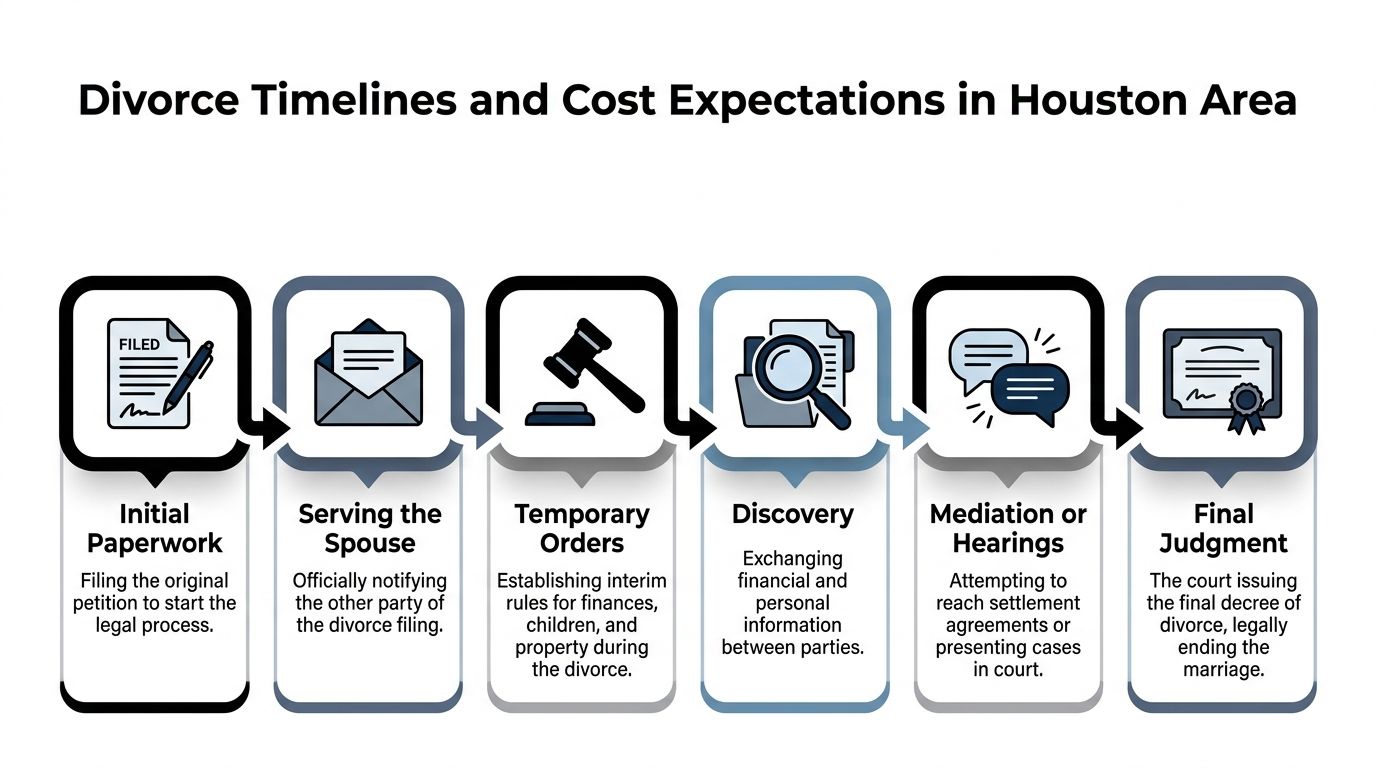
Most divorces follow the same broad path, but the pace depends on disagreement, preparation, and court scheduling. If you treat the process like a series of checkpoints instead of one long mystery, it becomes easier to manage.
The usual path from filing to decree
Think of divorce like moving a case through six gates. You can’t skip ahead cleanly if the earlier gate is still jammed.
Initial paperwork
One spouse files the petition and opens the case.Serving the spouse
The other spouse gets formal notice or signs a waiver if the case is cooperative.Temporary orders
If needed, the court can set short-term rules about children, bills, use of property, or support.Discovery
Each side exchanges financial and other relevant information.Mediation or hearings
Settlement efforts happen here. If major disputes remain, the court may hear contested issues.Final judgment
The judge signs the final decree once the case is ready for completion.
What slows cases down
The biggest slowdowns usually come from missing records, delayed responses, and unresolved financial questions. In local practice, travel into Houston for court settings can also make the process feel heavier for families based in Humble or Kingwood.
A few practical habits can help:
- Gather records early: Tax returns, bank statements, retirement records, loan documents, and property papers make everything easier.
- Respond quickly: Delays in review and signature often create avoidable drag.
- Stay focused on priorities: Don’t spend weeks fighting over items that don’t affect long-term stability.
- Prepare for mediation: Good preparation can turn a long dispute into a workable agreement.
Reality check: The faster spouse isn’t always the one who “wins.” The better-prepared spouse usually has the stronger position.
Costs and budgeting
Costs vary with conflict level. A straightforward agreed case costs very differently from a property-heavy contested case involving appraisals or detailed financial review.
Earlier in this article, the mediation section discussed published cost ranges for litigated versus mediated cases. Beyond attorney fees, local families should also budget for practical items such as filing fees, service fees, document copying, appraisals if needed, and time away from work.
If you’re trying to set realistic expectations around timing, how long does divorce take in Humble is a useful companion resource.
Real-Life Examples of Local Divorce Cases
Real cases usually fall somewhere between “easy” and “war.” Two common patterns show how different the path can look.
Atascocita agreed divorce
A couple in Atascocita decided early that they didn’t want a courtroom fight. They agreed the marriage should end, agreed on the parenting routine, and were willing to split most household items without argument.
Their main challenge wasn’t hostility. It was organization.
One spouse had the mortgage records. The other had the retirement information. Once those records were gathered and the proposed terms were put into clear written form, the case moved through mediation-style negotiation and into final drafting.
The lesson from that kind of case is simple. Cooperation only helps if the paperwork matches the agreement. A handshake understanding about a refinance or holiday schedule can still create post-divorce conflict if the decree is vague.
Kingwood property dispute
A different case from Kingwood involved more friction. The spouses disagreed about whether certain assets were marital or separate, and each person had a different memory of how accounts were funded over time.
That kind of case often turns on paper trails. Not emotion. Not who sounds more confident. Records.
The strategy in a dispute like this usually includes a tighter inventory, careful review of account history, and a realistic decision about whether settlement is possible before a final hearing. When children are also involved, temporary structure becomes even more important because daily life has to keep moving while the legal dispute continues.
A high-conflict divorce often becomes manageable when the issues are sorted into proof problems. Which claims can be documented, and which ones can’t?
Most local families see themselves in one of these two examples. Either they’re close to agreement and need clean legal drafting, or they’re dealing with disputed facts and need a lawyer who can organize the case around evidence instead of noise.
Frequently Asked Questions about Divorce in Humble and Kingwood
How does relocation affect custody
A parent usually can’t assume a move will be allowed just because it improves work or housing. If the move affects the child’s schedule, school, or access to the other parent, the court may review whether the relocation serves the child’s best interest. The smart first step is to review your current orders and speak with counsel before moving.
What happens if one spouse can’t be located
Texas law provides ways to move a case forward when a spouse cannot be found, but the court expects real effort and proper procedure. That may involve alternative service methods depending on the facts. These cases require caution because notice problems can create delays or later challenges.
How do temporary orders work
Temporary orders are short-term rules that apply while the divorce is pending. They can address who stays in the house, who pays which bills, temporary possession schedules for children, and temporary support. Think of them as the operating manual for the months before the final decree.
Can grandparents seek visitation
In some situations, grandparents may ask for visitation or seek court involvement, but they don’t automatically receive those rights. Texas courts look closely at the facts and at the child’s welfare. These cases are very specific, so families in Humble, Kingwood, and Northeast Houston should get legal guidance before making assumptions.
Conclusion and Call to Action
Divorce in Harris County can feel intimidating, especially when you’re balancing children, finances, work, and the uncertainty of a downtown Houston court process. Still, the path becomes clearer when you understand how local filing works, what community property means, when mediation may help, and what to look for in a lawyer.
Families in Humble, Kingwood, Atascocita, and Northeast Houston don’t need abstract advice. They need practical guidance, careful planning, and straightforward answers. Whether your case looks cooperative or highly contested, the right legal strategy starts with understanding your facts early and making good decisions before conflict grows.
If you’re weighing your options, a free consultation can help you sort out the next step with confidence.
If you need guidance from a local team that serves Humble, Kingwood, Atascocita, and Northeast Houston, schedule a free consultation with the Law Office of Bryan Fagan. You can discuss your goals, get a clearer view of your divorce process, and build a plan that protects your rights, your family, and your future.