Skip to content

If you're reading this, there's a good chance your current custody order no longer fits your real life. Maybe your work hours changed in Humble or downtown Houston. Maybe your child is struggling with the current schedule. Maybe the other parent moved, stopped following the order, or your concerns about safety have grown too serious to ignore.
That situation is more common than many parents realize in Humble, Atascocita, Kingwood, and across Northeast Houston. A custody order is meant to create stability, but families don't stay frozen in time. Children grow. Jobs change. Living situations shift. When that happens, a court may allow a change to the existing order, but only if you present the right legal reasons and the right proof.
A good custody modification attorney humble texas families can trust doesn't just file paperwork. That lawyer helps translate your day-to-day reality into a clear legal case that a Harris County judge can act on.
When Can You Modify a Custody Order in Texas
A lot of parents assume they can ask for a new custody order anytime the current one feels frustrating. Texas law is narrower than that. The court usually wants to see a real change, not just ongoing tension between co-parents.
Texas requires two things. First, you must show a material and substantial change in circumstances since the last order. Second, you must show that the requested change is in the best interest of the child. Courts in Harris County often deny weak cases, and denial rates exceed 60% when parents don't present sufficient evidence of a true change, as explained in this discussion of Texas custody modification standards.

What material and substantial change really means
That phrase sounds technical, but the idea is simple. Think of a custody order like a recipe that worked for your family at one point. If one small detail changes, the meal is still basically the same. But if a key ingredient changes, the whole result changes too.
A court is looking for that key ingredient shift.
Examples might include a major work schedule change, a significant relocation, a serious decline in one parent's reliability, or a change in the child's needs that makes the old schedule unworkable. What usually won't be enough is annoyance, conflict, or a belief that your preferred arrangement is more convenient.
Best interest is the court's North Star
The second part matters just as much. Even if life has changed, the judge still asks one central question. Will this modification help the child?
That focus can confuse parents because the case may feel personal. You may be exhausted, angry, or scared. But the court isn't trying to reward one parent and punish the other. The judge is looking for stability, safety, and a schedule that supports the child's emotional and physical needs.
Practical rule: If your reason for modifying custody centers on adult fairness, the court may not be persuaded. If your reason centers on how the child is affected every day, you're speaking the court's language.
Changes the court may care about
Not every change qualifies, but these often deserve a closer legal review:
- Work schedule disruption that now interferes with exchanges, school routines, or parenting time
- Relocation that makes the current possession schedule unrealistic
- Child-centered concerns such as school struggles, counseling needs, or medical issues
- Safety issues involving instability, family violence, or substance abuse
- Repeated noncompliance with the current order that harms consistency for the child
If you're worried about immediate danger rather than a standard modification, this guide on how to file for emergency custody may help you understand the faster protections available in Texas.
What parents often get wrong
Many parents walk into this process thinking, "The judge will understand once I explain what I've been dealing with." Sometimes that's true. Often, it isn't enough.
Judges need evidence that the change is real, meaningful, and tied to your child's well-being. A story matters, but documents, records, and credible witnesses give that story weight.
Here's the reassuring part. If your life has changed and your child is being affected, the law does provide a path forward. The key is presenting the situation the way Harris County courts expect to see it.
Common Reasons Humble Families Seek Custody Modifications
In Humble, family life often changes fast. A parent takes a new position near the Houston energy corridor. A child starts doing poorly with a midweek exchange routine. A move from Atascocita to Kingwood suddenly turns a workable plan into a daily scramble.
Those aren't abstract legal issues. They're the kinds of changes that push real families to ask whether the current order still fits.
Work and schedule changes
One common example is a parent whose job shifts from regular daytime hours to nights, weekends, or rotating schedules. The old possession plan may have made sense when school drop-offs and pick-ups were easy. It may stop making sense when a parent now leaves home before sunrise or gets back long after bedtime.
Texas trends also show that the idea of a "material change" is expanding to include modern life shifts such as remote work changes affecting possession schedules and housing cost surges in areas like Northeast Houston, which can affect a parent's stability and support a modification request, as noted in this overview of custody issues affecting Humble families.
A parent working from home might now be more available for weekday care. Another parent who moved farther out for affordable housing may have trouble getting the child to school on time under the old plan. The legal issue isn't that life got inconvenient. It's that the child's routine, supervision, and stability may now be different.
Moves across Humble and Northeast Houston
Relocation is another frequent trigger. Sometimes the move is small on a map but big in practice. A transfer from Humble to another part of Northeast Houston can mean longer school commutes, more traffic at exchange times, and less time for homework, sleep, and activities.
In other cases, one parent wants to move for family support, remarriage, or a better job. The court will usually look beyond the parent's reason for moving and focus on the effect on the child. Will the move improve daily stability, or will it disrupt a healthy routine and weaken a valuable parent-child relationship?
A move matters most when it changes the child's day-to-day life, not just the adults' preferences.
Changes inside the home
Some modification requests grow out of what the child experiences at home. A remarriage can be positive, but it can also change household dynamics, discipline, transportation, and supervision. A child who once did well under one arrangement may begin showing stress, behavioral problems, or school issues after a major family transition.
Parents also come in with concerns about instability. Maybe the other parent keeps changing residences. Maybe new roommates come and go. Maybe the child reports chaotic conditions that weren't part of the original case.
These cases are rarely about judging someone's lifestyle. They're about whether the environment still supports the child's needs.
Safety concerns and serious behavior shifts
The hardest cases usually involve safety. A parent may notice signs of substance abuse, repeated missed visits, unsafe driving, family violence, or emotional manipulation of the child. When that happens, the question becomes more urgent.
Here are a few examples of situations that often justify a closer legal review:
- Substance-related concerns when a parent's behavior, arrests, or impairment affects supervision
- Repeated breakdowns in visitation that leave the child confused and disappointed
- Parental alienation concerns when one parent interferes with the child's relationship with the other
- School and emotional decline when the current order appears tied to attendance issues, anxiety, or falling performance
In each example, the legal focus stays the same. How is this change affecting the child in Humble, Kingwood, Atascocita, or the surrounding area? That is the question that drives a strong modification case.
Navigating the Custody Modification Process in Harris County
Most parents feel less stressed once they know the path ahead. Harris County custody cases have their own rhythm, and understanding that rhythm helps you plan instead of react.
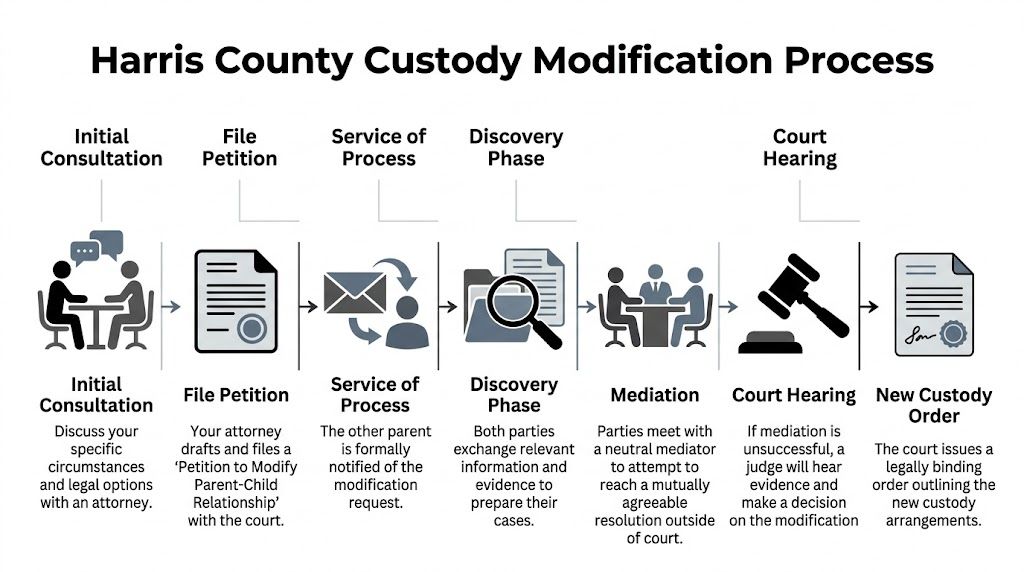
A contested custody modification in Harris County can take 6 to 12 months because of court backlogs, and mediation before trial is a key part of the process that often resolves cases sooner, according to this explanation of Texas child custody modification timelines.
Step one starts before filing
The first stage isn't really about forms. It's about clarity. You need to know what has changed, what relief you're asking for, and what evidence supports it.
A helpful starting point is writing out a short timeline. List the date of the current order, the major changes since then, and specific ways your child has been affected. That simple exercise often reveals whether you have a modification case, an enforcement issue, or an emergency concern.
For a local overview of where many of these cases move through the system, this page on Harris County family court for Humble residents gives useful context.
Filing and service
Once the legal strategy is clear, the formal case begins with a petition to modify the parent-child relationship. That filing tells the court what you want changed and why.
After filing, the other parent must be formally served unless an allowed alternative applies. This step matters more than many people expect. If service isn't handled properly, the case can stall before it really starts.
Discovery and temporary issues
After both sides are in the case, the parties may exchange records and information. This stage is often called discovery. It can include school records, medical records, work schedules, communication logs, and other documents tied to the requested change.
Sometimes parents also need temporary orders while the case is pending. For example, if school transportation, exchange logistics, or immediate parenting time needs can't wait for a final hearing, the court may address those issues earlier.
Waiting for the final order doesn't mean you have to live with every problem unchanged during the case.
Mediation matters in real life
Many Humble parents hear "mediation" and assume it means giving in. It doesn't. Mediation is a structured negotiation with a neutral third party, and in family cases it often gives parents more control than a courtroom fight.
This is also where strong preparation pays off. A parent who arrives with organized records, a workable schedule proposal, and a child-focused explanation usually stands on firmer ground than a parent who comes in angry but unprepared.
Some practical ways to prepare for mediation include:
- Bring a realistic schedule that works with school, work, and exchange logistics.
- Organize your documents so you can quickly support key points.
- Separate emotion from outcome by focusing on what the child needs next month, not what happened last year.
- Know your key priorities before the session begins.
If mediation doesn't resolve it
When no agreement is reached, the court may set the matter for a hearing or trial. That's where witnesses, records, and credibility carry real weight.
The judge will look at whether the change is legally sufficient and whether your proposal serves the child. Parents are often surprised by how much detail matters here. School attendance, transportation reliability, communication patterns, and the child's daily routine may all become important.
A simplified view of the process helps:
| Stage | What usually happens |
|---|---|
| Case review | You identify the change and define the relief requested |
| Petition filed | The court is formally asked to modify the order |
| Service completed | The other parent receives legal notice |
| Information exchange | Records and evidence are gathered and shared |
| Mediation | The parties try to resolve the dispute outside trial |
| Hearing or trial | The judge decides unresolved issues |
| New order | The final written custody terms become binding |
The process takes patience. But it becomes much more manageable once you understand each stage and prepare for it one step at a time.
Gathering Strong Evidence for Your Custody Case
A custody case often turns on something simple. Can you prove what you're saying?
Parents usually know what has been happening. The harder part is showing it in a way the court can trust. Strong evidence makes your concerns concrete. It also helps separate a serious modification request from a complaint that sounds vague or unsupported.

Start with what you already have
Most parents already have useful evidence without realizing it. Text messages about missed exchanges, school notices, calendars, photos, and co-parenting app records can all matter if they are relevant and organized.
Think in categories instead of one giant pile of paper.
- Communication records such as texts, emails, and app messages that show scheduling problems, refusals, threats, or admissions
- Child records such as report cards, attendance notices, counseling notes, and medical information when those records relate to the requested change
- Work and financial records that show schedule changes, income shifts, or relocation-related circumstances
- Third-party observations from teachers, counselors, relatives, coaches, or others with firsthand knowledge
If your case involves income changes, household expense issues, or support-related facts tied to the parenting arrangement, this resource on gathering financial evidence for family law matters can help you think through what records to pull together.
Evidence that often carries weight
The court's decision turns heavily on proof tied to the child's needs and each parent's fitness. In Northeast Houston dockets, documented proof of substance abuse or family violence leads to a transfer of primary conservatorship in 90% of those cases, and documented proof of parental alienation can lead to expanded possession for the targeted parent in 70% of evaluated cases, according to this discussion of Texas child custody modification evidence.
That doesn't mean every case needs a dramatic event. It does mean the court responds to documented facts, especially when those facts show direct impact on the child.
Keep this in mind: Judges usually trust patterns more than isolated accusations. A careful log over time can be more persuasive than one emotional statement.
How to organize your proof
Don't hand your lawyer or the court a random stack of screenshots. Build a clean file.
A useful approach is to create a folder system like this:
| Evidence type | What to include |
|---|---|
| Calendar log | Missed visits, late pickups, school disruptions, canceled exchanges |
| Messages | Relevant texts or emails, saved in date order |
| School file | Attendance notices, grade reports, teacher communications |
| Medical and counseling | Records that directly relate to the child's well-being |
| Home and safety concerns | Photos, police-related documents if applicable, witness names |
| Employment and finances | Pay records, work schedules, relocation documents |
You should also avoid two common mistakes. First, don't edit messages in a way that changes context. Second, don't gather records you aren't legally entitled to access. A lawyer can help you obtain some materials correctly through the court process if needed.
For parents trying to understand what kind of facts courts connect to the legal standard, this guide on how to prove the best interest of a child in Texas is a useful next read.
When outside professionals may be involved
Some cases need more than personal records. A social study, custody evaluation, therapist testimony, or school witness may become important if the facts are disputed or the child's needs are complex.
Those tools aren't necessary in every case. But when the concerns involve safety, emotional harm, or competing versions of what happens in each home, outside professionals can help the court see the bigger picture.
The strongest evidence is usually plain, consistent, and child-focused. That kind of proof doesn't just tell the court something is wrong. It shows exactly why a new order is needed.
How a Humble Custody Modification Attorney Can Help
You may already know something needs to change. The harder part is turning a stressful home situation into a court request that fits Texas law and makes sense to a Harris County judge.
A lawyer helps make that translation.
A custody modification attorney humble texas parents hire should do more than fill out forms. The job is to take the facts of your family life, separate the points that matter legally from the points that only add heat, and build a clear request around the child's needs. In custody cases, that shift matters. Courts do not rewrite orders because co-parenting feels tense. They change orders when the proof shows a material change and a new arrangement serves the child.

Local counsel helps in practical ways
In Humble-area cases, local experience matters because the process is not just about the Family Code on paper. It is also about how cases are filed, scheduled, presented, and resolved in Harris County courts. A lawyer who regularly handles these cases can often spot early whether your matter is likely to settle through agreement and mediation or whether it needs hearing preparation from the start.
That kind of guidance shows up in practical work, such as:
- Defining the legal issue clearly so your request is tied to a real basis for modification
- Organizing the story of the case so timelines, records, and witness information are easy for the court to follow
- Preparing filings and responses so avoidable procedural errors do not slow the case down
- Advising you for mediation with proposals that are specific, realistic, and centered on the child
- Acting as a buffer so every disagreement does not turn into another damaging text exchange
For many parents, this feels a lot like having a contractor before a major home repair. You may know the roof is leaking, but you still need someone who can identify the source, explain the options, and fix the right problem in the right order.
One local option is the Law Office of Bryan Fagan, which serves Humble, Atascocita, Kingwood, and Northeast Houston in family law matters including custody disputes and modifications.
Your lawyer should help you choose the next right step
Good representation also means judgment.
Sometimes filing immediately makes sense, especially if the current order no longer fits the child's safety, school, or daily care needs. Sometimes the better course is to spend a short period gathering records, clarifying dates, and tightening up the request before going to court. In other situations, temporary orders may need to be considered while the larger case is pending.
That decision-making can affect cost, timing, and credibility. It can also lower the emotional temperature of the case. Instead of reacting to every new conflict, you are working from a plan.
This short video gives a helpful overview of the issues many parents face in custody matters.
A lawyer familiar with Harris County practice can also prepare you for the questions that tend to matter in mediation and in court. What changed. How does it affect the child. Why is the order you want more workable than the one you have now. When you can answer those questions calmly and specifically, your case usually becomes easier for the court to understand.
Your Humble Custody Modification Questions Answered
How much does it cost to modify a custody order
The honest answer is that cost depends on the level of conflict, the amount of evidence involved, and whether your case settles or goes all the way to a final hearing. Cases with agreement are usually simpler than cases involving contested facts, witness testimony, or outside evaluations.
The better question to ask early is this: what work will likely be required in my case? If you understand that upfront, you can make informed decisions about strategy, negotiation, and where to focus your resources.
How long will the process take
Some families resolve issues fairly quickly through agreement and mediation. Others need a longer court process because the facts are disputed or the potential impact is substantial.
In Harris County, parents should expect that a contested case may take time. That means it's smart to start gathering records early, stay organized, and avoid waiting until the situation becomes unbearable before seeking advice.
The legal process feels less overwhelming when you stop treating it like one giant problem and start treating it like a series of manageable steps.
What if the other parent and I agree on the changes
Agreement is helpful, but it doesn't replace a court order. Parents sometimes make handshake deals or text-message arrangements because they want peace. The problem is that informal agreements can fall apart, and if the written court order never changed, the old terms may still control.
If you both agree, that's often a good opportunity to formalize the new arrangement properly. A lawyer can prepare the documents so the revised terms are enforceable and clear.
What if the other parent refuses to cooperate
That happens often. Refusal doesn't automatically block a modification.
If the legal grounds are present and the evidence is strong, the court can still move forward. The key is staying focused on proof rather than getting pulled into personal conflict. Angry exchanges rarely help. Organized facts do.
Here are practical ways to protect your position if the other parent won't cooperate:
- Follow the current order unless the court changes it or there's a true emergency
- Keep communication brief and civil because hostile messages often become evidence
- Document missed exchanges and problems in a calm, dated log
- Avoid self-help fixes such as withholding possession on your own without legal advice
- Bring concerns to your attorney early if safety or serious instability is involved
Can my child choose where to live
Parents ask this all the time, especially when a child gets older. A child's preferences can matter, but they are not the only factor and they do not automatically decide the case.
The court still looks at the broader picture. Stability, safety, school performance, parental judgment, and the child's overall needs remain central.
Do I need proof if the problem seems obvious
Usually, yes. Courts work from evidence, not assumptions.
Something may feel obvious inside your home because you've lived it for months. A judge wasn't there. That judge needs records, testimony, and specifics. Dates, school impacts, attendance issues, work records, and reliable witnesses often matter more than broad claims.
Should I wait and see if things improve
Sometimes patience helps. Sometimes waiting makes the problem harder to fix.
If the issue is minor and both parents are communicating well, a wait-and-watch approach may make sense. If the child is struggling, exchanges are breaking down, or safety concerns are emerging, getting legal guidance early is usually the safer move.
What should I bring to a consultation
Bring what helps tell the story clearly. That often includes your current order, any proposed schedule change, relevant messages, school records, work schedules, and a timeline of what changed and when.
You don't need a perfect binder to ask for help. But the more clearly you can show the history of the problem, the easier it is for a lawyer to assess your options.
If you're in Humble, Kingwood, Atascocita, or elsewhere in Northeast Houston and your current custody order no longer fits your child's life, getting answers early can make a real difference. You don't have to guess whether your situation qualifies. You can sit down, talk it through, and get a practical plan built around your family's facts.
If your custody order no longer works for your child or your family, Law Office of Bryan Fagan can help you understand your options and the next steps. Our Humble office offers free consultations for families in Humble, Atascocita, Kingwood, and across Northeast Houston, so you can get clear, local guidance without added pressure.