Skip to content

Many people in Humble, Kingwood, Atascocita, and Northeast Houston reach a point they never expected. The kids are grown. Retirement is getting closer. The house may be nearly paid off. Then a marriage of decades starts to come apart, and the questions feel heavier than they would have years earlier.
If you're facing divorce after a long marriage in Texas, you're probably not just worrying about the divorce itself. You're wondering how you'll afford life on one income, what happens to retirement accounts, whether you'll need to sell the home, and how to make careful decisions when emotions are already running high. Those concerns are normal.
A long-term divorce often feels different because it is different. Nationally, the divorce rate for adults age 50 and older has doubled in the past 20 years and tripled since 1990, according to divorce trend data summarized here. People often call this gray divorce. That term means divorce later in life, usually after many years together.
An Introduction for Our Humble Neighbors
A couple in their late 50s from the Humble area might have built almost everything together. One spouse may have handled most of the income. The other may have handled the home, the children, and the thousand small details that kept family life moving. After so many years, it can feel impossible to separate finances, routines, and future plans neatly.
That's why gray divorce can feel so unsettling. In a shorter marriage, people often focus on who keeps what furniture, whether a lease will end, or how to divide newer debt. In a long marriage, the bigger worries are usually retirement, the family home, health coverage, savings, and whether one spouse can support themselves after years away from the workforce.
For many neighbors in Kingwood and Atascocita, there's also a quiet fear nobody says out loud right away. They worry they're too old to start over. They worry they should already know what to do. They worry that asking questions somehow means they've failed.
You are not the only person in Texas trying to rebuild after a long marriage. And you don't need to have every answer before you speak with a lawyer.
What gray divorce usually means in real life
Gray divorce isn't a legal category in Texas. Courts don't have a special filing type for it. But in practice, these cases often come with a specific mix of issues:
- Retirement-centered planning: Pensions, 401(k)s, IRAs, and future income become central.
- Home equity questions: The house may hold both emotional value and a large share of the couple's wealth.
- Income imbalance: One spouse may have much stronger earning power.
- Long records to sort through: Decades of bank accounts, tax returns, title documents, and beneficiary designations may matter.
Why local guidance matters
If you live in Northeast Houston, your divorce will still follow Texas law, but local procedure matters too. Where you file, how your court handles scheduling, what documents are needed early, and how settlement talks unfold can shape the pace and stress of the case. A local lawyer can help turn a confusing process into a manageable one.
Why a Long-Term Divorce is Financially Different
Most divorces don't involve a marriage that lasted decades. One Texas analysis reports that the average marriage ending in divorce lasts about 8 to 10 years, and it also reports 111,202 divorce filings in 2024 in Texas, with a 43.8% increase in the per-capita divorce rate to 3.55 divorces per 1,000 residents in 2024. That same picture matters because long-term cases usually involve more built-up assets and more financial risk than shorter marriages, as noted in this Texas divorce filings analysis.
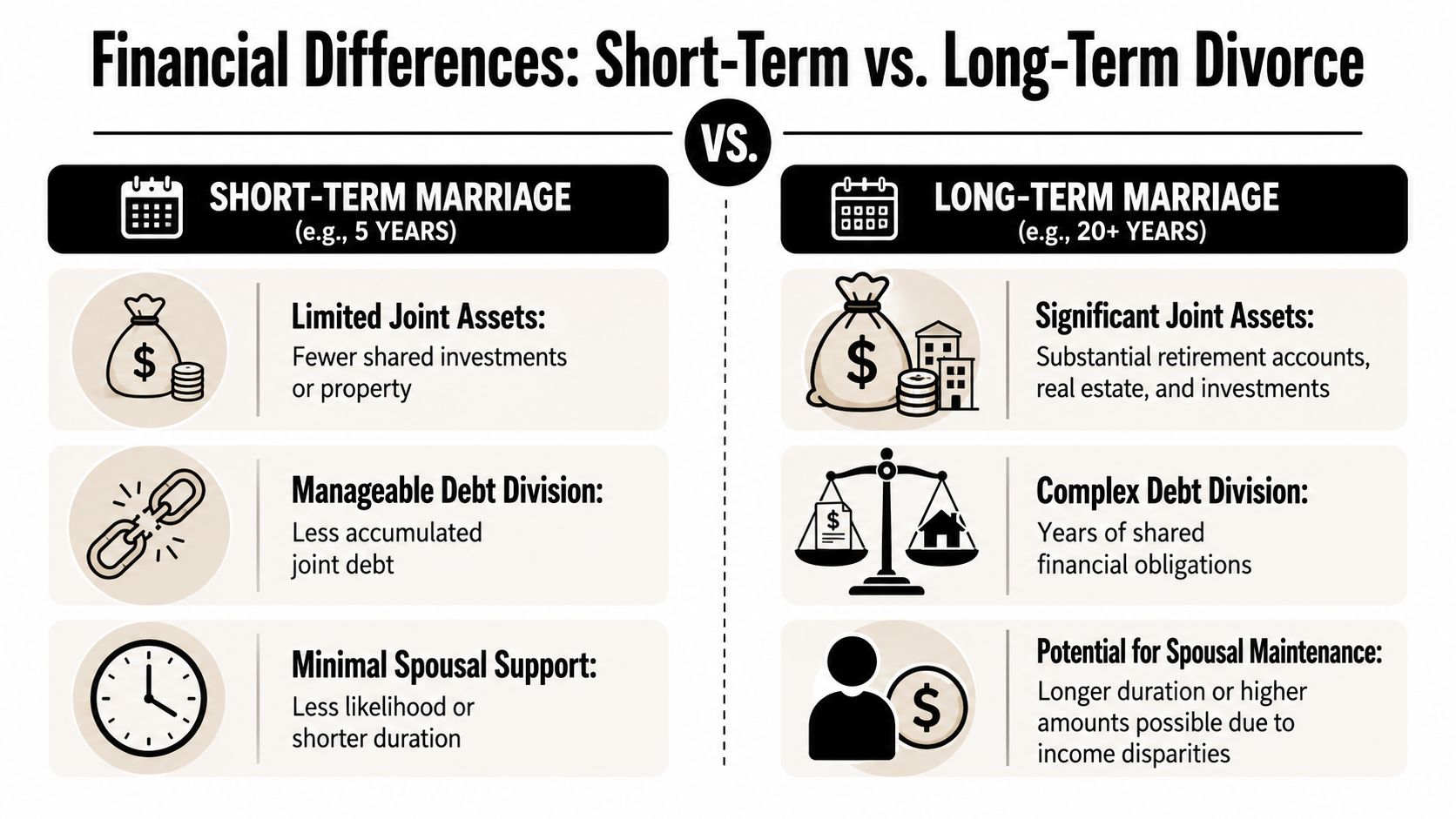
Short marriage issues versus long marriage issues
In a shorter marriage, the focus is often immediate and practical. Who moves out. Who pays which card. Whether there are young children and parenting schedules to set.
In a long marriage, the focus usually shifts to financial untangling over time. The court and the parties often need to look at what was accumulated over many years, what income each spouse can expect going forward, and whether one spouse can realistically maintain basic needs after the divorce.
| Marriage pattern | Common pressure points |
|---|---|
| Shorter marriage | Newer debts, fewer shared assets, child schedules, restarting household basics |
| Long-term marriage | Retirement accounts, pensions, home equity, support needs, tax consequences, long-term cash flow |
Why the stakes feel higher
A long-term divorce can affect the rest of your retirement years. If one spouse has been the main earner and the other hasn't worked outside the home for a long time, the settlement isn't just about dividing property. It's about whether both people can live with stability afterward.
That's often where readers in Atascocita get confused. They assume more property automatically means more security. Sometimes it doesn't. A person can receive assets on paper but still struggle with monthly cash flow if those assets are tied up in a house, retirement plan, or illiquid investment.
Practical rule: In a long marriage, don't ask only, “What am I getting?” Ask, “How will I pay my bills six months after the decree?”
The financial checklist changes later in life
When people divorce after a long marriage in Texas, these questions move to the front:
- Can I keep the house and still afford it: Mortgage, taxes, insurance, repairs, and utilities all matter.
- What income will I have each month: Salary, maintenance, retirement distributions, and other sources need to be reviewed together.
- How are debts divided: Credit lines, tax obligations, and loans can create future pressure if they aren't addressed clearly.
- What happens to insurance and beneficiaries: These details are easy to miss and can create serious problems later.
Understanding Community Property in Texas
Texas uses a community property system. The basic rule is that property acquired during the marriage is presumed to belong to both spouses, and a court divides that property in a just and right way, which does not always mean an even split, according to the Texas law library's divorce guide.
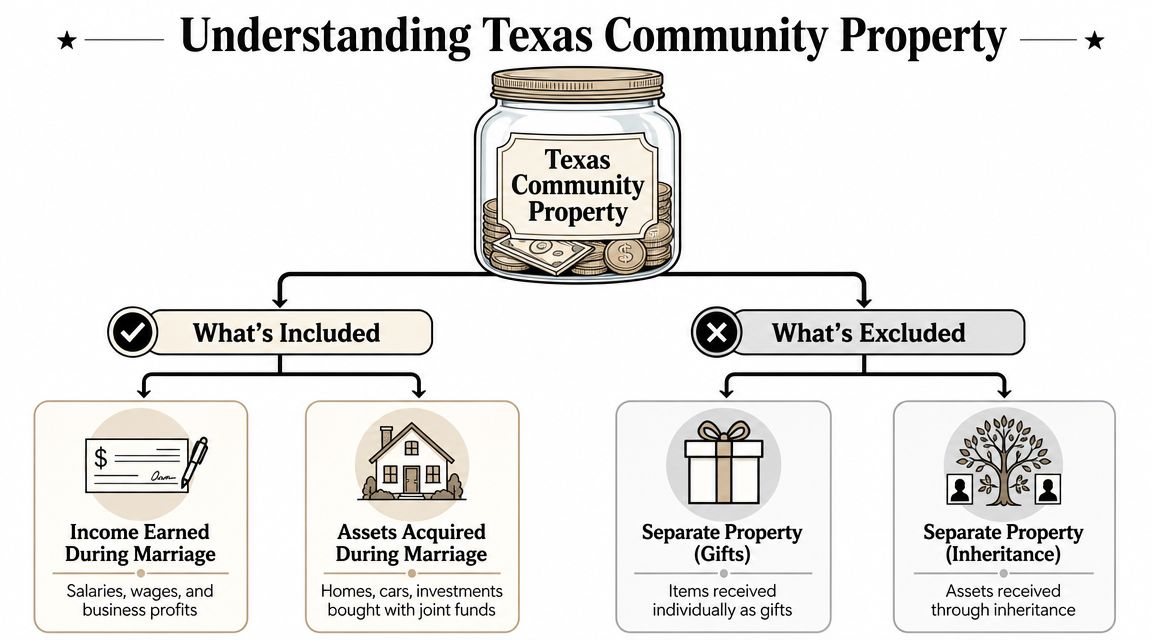
A simple way to think about it is a shared jar on the kitchen counter. During the marriage, most earnings and many things purchased with those earnings go into that jar. At divorce, the court has to decide how to divide what's in it fairly.
What usually counts as community property
Community property often includes income earned during the marriage and many assets bought during the marriage with marital funds. That can include a house purchased after the wedding, vehicles, savings, investment growth tied to marital earnings, and debt taken on during the marriage.
Names on title don't always settle the issue. A retirement account in one spouse's name may still include a community portion. A home deeded to one spouse may still have community equity if marital funds paid the mortgage.
What may be separate property
Some property may stay with one spouse alone, including:
- Property owned before marriage: A home, land, account, or business interest already owned before the wedding may begin as separate property.
- Gifts made to one spouse: If someone gave property specifically to one spouse, that may remain separate.
- Inheritance received by one spouse: Inheritances can remain separate if they weren't mixed beyond recognition with marital funds.
The hard part isn't the definition. The hard part is proof.
Why tracing matters
If you say something is separate property, you may need records that trace it clearly. That might mean old closing papers, bank statements, probate records, account histories, or documents showing how funds moved over time.
For example, suppose one spouse inherited money years ago and put it into a joint account that also received paychecks and paid household bills. That doesn't automatically destroy the separate claim in every situation, but it can make the issue much harder to prove.
A home can create similar confusion. If one spouse bought it before marriage, the home itself may start as separate property. But if the marriage later paid down the mortgage or funded major improvements, there may still be community reimbursement issues to sort out.
Long marriages often create blended financial histories. The paperwork matters as much as the story.
Just and right does not always mean equal
Texas judges aim for a division they consider just and right. That gives the court room to consider the full picture. In a long-term case, that picture may include earning power, who will keep certain debt, the nature of the assets, and whether one spouse needs more flexibility to rebuild.
This is also why some cases need deeper financial review. If business records are unclear, accounts moved repeatedly, or one spouse handled all money decisions, outside help may be useful. In more complicated financial disputes in divorce, a forensic accountant can help identify records, trace funds, and explain patterns that aren't obvious from a stack of statements alone.
If you want a more detailed look at the legal framework, this page on community property in Texas divorce is a good local starting point.
Can You Receive Spousal Maintenance in Texas
One of the most common worries in a long marriage divorce is simple. “I haven't earned enough on my own in years. What happens now?”
Texas calls post-divorce support spousal maintenance. It isn't automatic. A court doesn't award it just because one spouse earns more or because the marriage was long. The person asking for maintenance generally has to show that they can't meet their minimum reasonable needs with the property available to them after divorce.
When maintenance may be available
A long marriage can matter here. Texas law may allow maintenance when the marriage lasted long enough and the requesting spouse still can't meet basic needs despite making reasonable efforts. Other situations can matter too, such as disability or family violence.
A practical way to think about it is this checklist:
- Length of marriage matters: In many cases, a marriage lasting at least ten years opens the door to a maintenance request.
- Need still has to be shown: The court still looks at whether the requesting spouse can cover basic living needs.
- Effort matters: Judges often want to see that the spouse seeking support is trying to become self-supporting when possible.
- Special circumstances can change the analysis: Disability, caregiving responsibilities, or family violence can affect eligibility.
Common misunderstandings
People often assume maintenance will last forever after a long marriage. That's not how Texas usually treats it. Texas law generally views maintenance as support that helps a spouse transition, not lifelong income in every case.
Other people assume a spouse who receives property can't also ask for maintenance. That isn't always true. A person may receive property but still have trouble meeting monthly living expenses if the assets don't produce immediate income.
Questions to ask early
If maintenance may be part of your case, gather information before negotiations begin:
- What are your realistic monthly living expenses after separation?
- What income do you currently have, if any?
- How long have you been out of the workforce?
- Do you need training, education, or time to re-enter your field?
- Are there health conditions that affect your ability to work?
For many people in Humble and Kingwood, maintenance isn't the whole answer. It's one piece of a larger plan that may also involve property division, retirement funds, housing decisions, and careful budgeting.
Dividing Retirement Pensions and Social Security
For many couples divorcing later in life, retirement accounts are the biggest issue on the table. Texas family law sources focused on gray divorce note that these cases often revolve around retirement accounts, pensions, the family home, health insurance, and tax implications, making divorce later in life as much a planning problem as a legal one, as discussed in this Texas gray divorce overview.
What a QDRO actually does
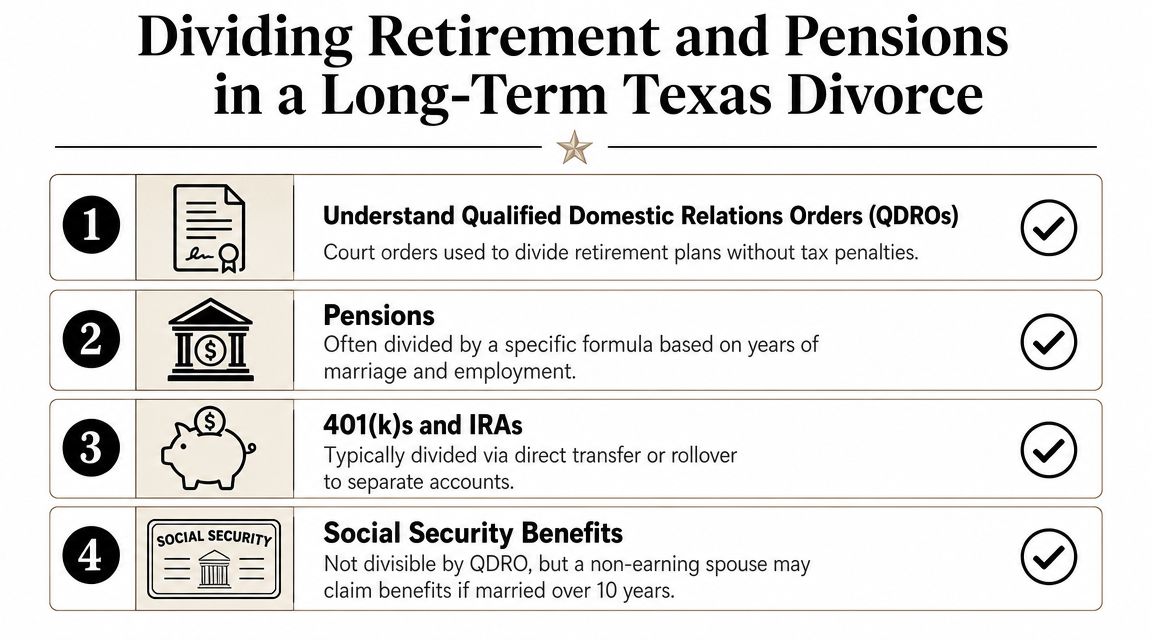
A Qualified Domestic Relations Order, usually called a QDRO, is a special court order often used to divide certain retirement plans. Many people think the divorce decree alone is enough. It usually isn't for employer-sponsored plans that require a separate order.
Without the right order, a couple can have a settlement on paper but still face delays or mistakes when trying to transfer retirement funds. That's why careful drafting matters.
Different accounts, different rules
Not all retirement assets are divided the same way.
- Pensions: These often require a formula that accounts for the marriage period and plan terms.
- 401(k) plans and similar accounts: These are commonly divided through plan-specific procedures and court orders.
- IRAs: They usually follow different transfer rules than employer plans.
- Military retirement: These cases can involve additional federal rules, which is important for many families in the greater Houston area.
If your case includes these assets, local counsel and financial professionals may both have a role. Some people work with a lawyer, a CPA, and a financial planner at the same time. Some also use a family-law firm such as The Law Office of Bryan Fagan's Humble divorce team to coordinate the legal side of retirement division and decree language.
Social Security is different
Social Security generally isn't divided by a Texas divorce court the way a pension or 401(k) may be. But long-marriage couples should still review it carefully. A person who was married for at least ten years may, depending on the federal rules that apply to their situation, be able to claim benefits on a former spouse's record without reducing the former spouse's own benefit.
That possibility often gets overlooked because it doesn't appear in the same place as property division talks. Yet it can shape post-divorce planning in a major way.
Review retirement division and Social Security at the same time. They affect the same monthly budget, even though they follow different rules.
For readers who want a plain-English resource on how to secure your retirement benefits, that guide can help you prepare better questions for your lawyer and financial adviser.
A Practical Guide to Filing Divorce in Harris County
A long-term divorce can feel less intimidating when you know the basic path. For local families, that usually means following Harris County procedure step by step rather than trying to solve everything at once.
Early divorce trends matter less here than process. Still, one Texas source notes that while many divorces happen earlier in marriage, long-term cases today often shift away from child issues and toward pension valuation and retirement security, which is why careful filing and document gathering matter so much in later-life divorce. That discussion appears in these Texas divorce statistics and trends.
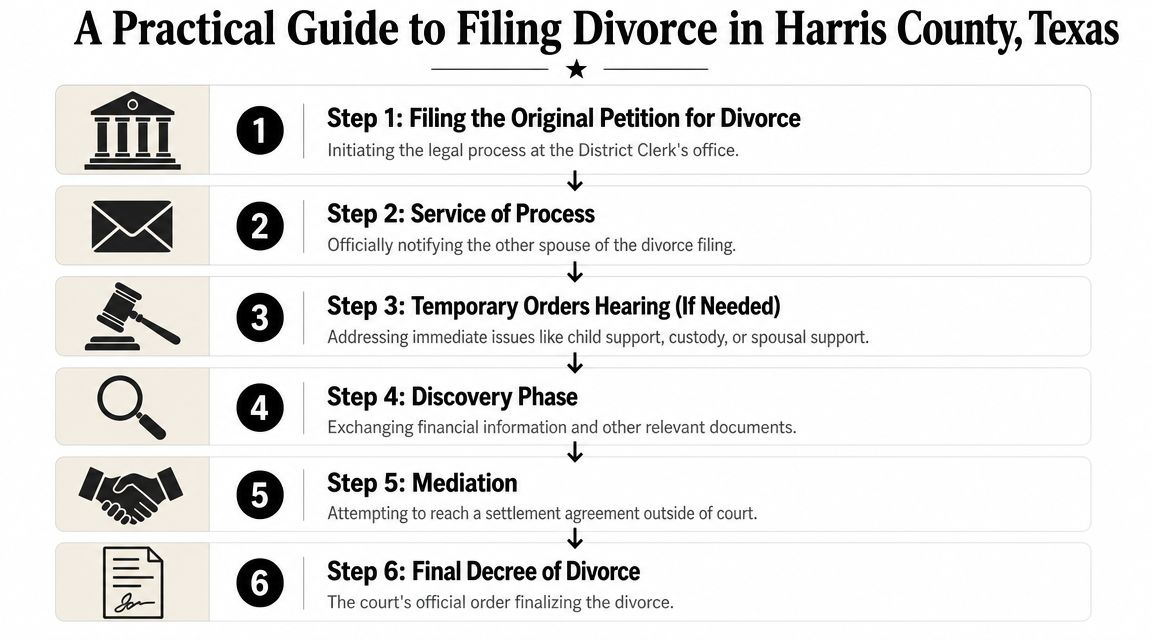
A visual overview can help before the paperwork starts.
The basic timeline
Most divorces in Harris County begin when one spouse files an Original Petition for Divorce. For many Humble residents, that means working through the district clerk process tied to Harris County courts. After filing, the other spouse must usually be formally served unless service is waived properly.
Then the case starts taking shape. Temporary issues may need attention. Financial records are exchanged. Settlement talks may happen early or later, depending on how much information is available and how cooperative both sides are.
What to gather before and after filing
Long marriages create long paper trails. Start collecting records as soon as divorce becomes likely.
- Income records: Pay stubs, retirement income statements, and tax returns help show the financial picture.
- Asset records: Bank statements, brokerage statements, deeds, mortgage papers, and retirement plan documents matter.
- Debt records: Credit cards, loans, tax debt, and any business obligations should be identified clearly.
- Insurance and beneficiary information: This often becomes important faster than people expect.
This local guide to filing for divorce in Harris County from Humble can help you understand where your case fits procedurally.
Later in the case, many couples go to mediation before a trial setting. If settlement is reached, the final paperwork is drafted into a decree. If not, the judge decides the unresolved issues.
This video gives added context on the divorce process many Texas families face:
Local reality in Harris County
For residents of Humble, Atascocita, and Northeast Houston, a divorce case can involve practical issues beyond the statute book. Travel time to court, document deadlines, mediation scheduling, and the pace of crowded dockets all affect how the experience feels.
That's why preparation matters. When your records are organized and your goals are clear, you're in a better position whether the case settles quickly or moves toward a hearing.
Choosing Your Path Mediation Versus Court
Not every long-term divorce needs a courtroom fight. Many don't. But not every case should settle quickly either. The right path depends on the personalities involved, the complexity of the finances, and whether both spouses are willing to negotiate in good faith.
When mediation makes sense
Mediation puts both sides in a structured settlement process, usually with lawyers and a neutral mediator helping move discussions forward. For long marriages, this can be especially useful because the couple often needs flexible solutions. One spouse may want to keep the house for a period of time. The other may want to trade equity for retirement assets. A mediated agreement can build those details in ways a rushed argument in court often can't.
Mediation can also reduce wear and tear. That matters when both parties need to preserve assets for the next stage of life rather than spending more of them on prolonged conflict.
When court may be necessary
Sometimes a judge needs to decide. That may happen when one spouse is hiding information, refusing to negotiate, controlling the finances, or taking positions that make settlement unrealistic.
Court can also be necessary when legal questions are unusually technical. If the parties disagree sharply about whether property is separate or community, whether reimbursement claims exist, or how a retirement asset should be addressed, a judge may have to resolve the dispute.
| Option | Often works best when |
|---|---|
| Mediation | Both spouses will exchange information and negotiate in good faith |
| Court | One side won't cooperate, facts are disputed, or judicial rulings are needed |
Settlement gives you more control. Court gives you a decision when control isn't possible.
For many families in Kingwood and Humble, the best approach is not choosing one forever. It's preparing thoroughly for court while still looking for smart opportunities to settle.
Begin Your New Chapter with Our Support
Divorce after a long marriage in Texas isn't just a legal filing. It's a major financial and personal transition. The questions are larger, the records are deeper, and the decisions can affect your housing, retirement, and day-to-day stability for years to come.
Still, this process becomes more manageable when you break it into parts. First understand the property rules. Then identify income needs. Then review retirement assets, support options, and the local Harris County process. From there, you can decide whether mediation or court fits your situation better.
If you live in Humble, Atascocita, Kingwood, or Northeast Houston, you don't have to sort through this alone. Clear advice, organized records, and a practical plan can help you move from fear to direction.
If you're dealing with a long-term divorce and need steady, local guidance, schedule a free consultation with Law Office of Bryan Fagan. Our Humble office works with families across Humble, Kingwood, Atascocita, and Northeast Houston to help them understand their rights, protect what they've built, and plan for the next chapter with confidence.